CPT code 93503: Swan-Ganz catheter billing and modifiers
CPT code 93503: Official descriptor and procedure overview In the AMA CPT code s...

Last Updated: Oct 23, 2026
C0630 is the CCSD code for decompression of orbit. The surgeon enlarges the eye socket by removing bony walls, retrobulbar fat, or both, to relieve pressure on the eye and optic nerve.
It is a Major procedure in chapter 4 of the schedule, and thyroid eye disease is the most common reason for it. Most UK private insurers want prior authorization before an elective case. The operative note should state the approach, the tissue removed and the side treated.
Let Pabau's smart automation suggest the right codes, reduce claim denials, and keep your practice compliant—effortlessly.
Automate repetitive tasks and focus on what matters most—your patients.
Reduce coding errors and ensure compliance with the latest regulations.
Clean claims, fewer denials, and faster reimbursements.
Powerful insights and reporting to help your practice thrive.
HIPAA compliant SOC 2 certified GDPR-compliant Trusted by 4,000+ clinics worldwide

CCSD code C0630 covers decompression of orbit in UK private practice, separate from eyelid and eye muscle procedures.
Thyroid eye disease (Graves ophthalmopathy) and compressive optic neuropathy are the main clinical indications that justify C0630.
Most major UK insurers require prior authorization before elective orbital decompression. A missing authorization is the leading cause of claim denial.
Pabau’s claims management software supports CCSD code library access, pre-authorization tracking and structured operative note capture.
CCSD Code C0630 is the procedure code for decompression of orbit under the Clinical Coding and Schedule Development (CCSD) schedule. CCSD is the standard coding framework for UK private medical billing. The surgery enlarges the orbital cavity to give the eye and its surrounding structures more room. The surgeon removes one or more bony walls, excises retrobulbar fat, or combines both techniques.
C0630 sits in Chapter 4 of the schedule, which covers the eye and orbital contents, and carries a Major complexity rating. The CCSD codes hub covers the wider schedule it belongs to.
Oculoplastic surgeons perform C0630 procedures in both NHS and private settings, but the code applies only to private billing. Billing staff use C0630 to identify the procedure on the invoice and the claim. That applies whenever the patient is covered by Bupa, AXA Health, Vitality, Aviva or another UK private medical insurer. Getting the code right decides whether the insurer pays at the agreed fee schedule rate or returns the claim for rework.
Always quote the CCSD edition date on your invoice submission. Insurers audit code validity against the schedule version current at the date of procedure, not at the date of invoicing. Using an outdated code descriptor can trigger a technical rejection even when the procedure itself was correct.
Orbital decompression has a defined clinical evidence base, and insurers require documented medical necessity before approving a C0630 claim. Its primary indication is functional rather than cosmetic, though some presentations sit in a disputed zone that needs careful documentation.
The four recognized clinical indications are:
Corneal exposure can also be treated by suturing part of the lid margins together, which reduces the exposed surface. UK private practices bill that tarsorrhaphy under C1640.
Billing staff need to understand the surgical technique, because the operative report must reflect the specific technique performed. Coders need to know what to look for in the note before assigning C0630.
Orbital decompression falls into two broad categories by tissue removed, plus a combination of both:
The procedure may use an open approach (coronal, transcaruncular or swinging eyelid incision). Medial wall decompression can also be done endoscopically through the nasal cavity. The approach should be explicit in the operative note. A report that says only “orbital decompression performed under general anesthesia” gives the insurer grounds to query the claim. It omits the approach, walls removed and laterality.
The table below sets out the key billing attributes of C0630. They follow the CCSD schedule business rules and how UK insurers generally apply the code. Always verify against the current CCSD schedule edition and the insurer’s provider manual, as fee values and bundling rules can change at annual updates.
C0630 sits within the eye and orbital contents chapter of the CCSD schedule. Practice managers and coders often meet adjacent codes when reviewing operative notes for orbital and periorbital surgery. The table below maps the codes most often confused with C0630.
Verify exact descriptors against the current published CCSD schedule before coding any claim. When the surgeon explores the orbit without removing tissue, the note supports C0650 instead. When the globe itself is removed with an implant, the claim moves to C0122.
When the surgeon drains a collection of pus or fluid from the orbit, the claim takes C0620 rather than C0630. Drainage releases the collection without enlarging the bony cavity.
A complete claim for CCSD code C0630 needs both strong operative documentation and correctly paired diagnosis codes. Missing either gives the insurer grounds to withhold payment or request a medical review that delays reimbursement by weeks.
The operative note must include:
A structured operative note template in your practice software stops a mandatory field from going missing before billing. When the referral, assessments and operative note sit in one patient record, billing staff have the full clinical picture at claim submission.
The ICD-10 diagnosis code submitted alongside C0630 should reflect the underlying condition. The table below lists accepted pairings and flags which combinations may trigger insurer review.
ICD-10 pairing guidance here is for reference and does not guarantee reimbursement. Verify accepted code combinations with each insurer’s current provider manual. An internal code-pairing list, updated at each CCSD schedule revision, keeps every coder working from the same combinations.
Most major UK private medical insurers require prior authorization for elective orbital decompression. The clinical evidence pack sent to the insurer before booking typically includes:
For compressive optic neuropathy, the insurer may have an expedited authorization pathway. This varies by provider, so confirm it before assuming it applies.
Authorization requirements and turnaround times can change. Always verify current rules with the insurer’s provider services team before scheduling an elective C0630 procedure. For Bupa’s fee schedule and submission rules, see our Bupa CCSD codes guide.
Claim denials for orbital decompression fall into a predictable set of categories. Knowing them lets billing staff address each one at submission rather than during appeals. The four checkpoints below show where in the claim’s path each one gets caught.
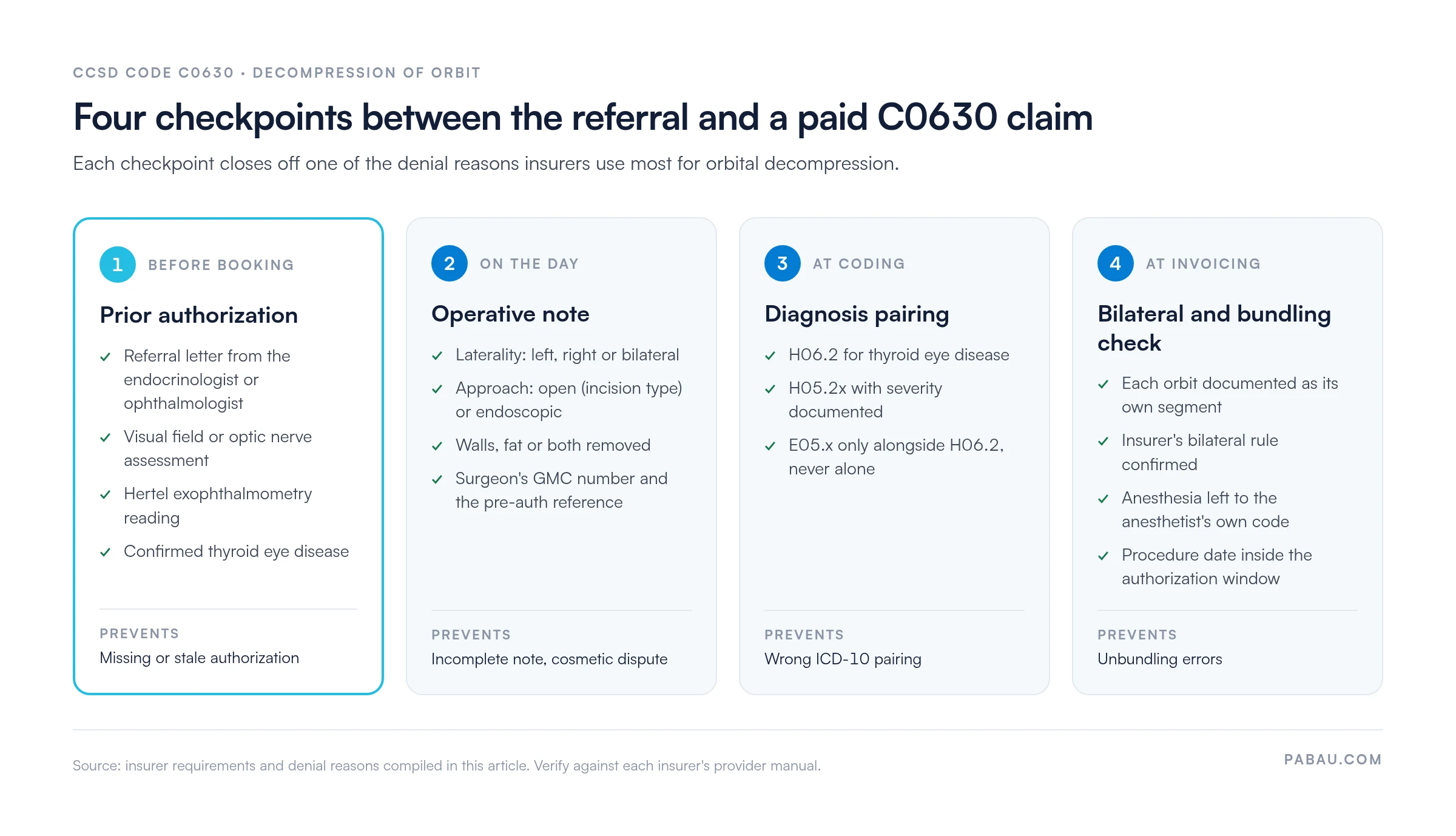
A documented medical billing compliance process catches these failure points at submission, before a denial forces a case-by-case appeal.
Bilateral orbital decompression is not uncommon in thyroid eye disease, where both orbits are affected. That raises the billing question coders ask most often about C0630: can it be billed once for each side?
The CCSD schedule includes bilateral rules that decide whether a second code line is allowed, or whether the fee already accounts for both sides. These rules have changed across schedule editions, so check the current CCSD technical guide for C0630.
As a general principle, each orbit decompressed at a separate sitting is coded as a separate episode. When both orbits are decompressed in the same session, the current CCSD guidance on simultaneous bilateral procedures applies. The resulting fee is not simply twice the unilateral rate.
Three points apply to every C0630 submission where bilateral work is performed:
Oculoplastic practices billing C0630 regularly handle the same three admin pressure points:
Handled by hand, each one means a spreadsheet of authorization dates and a coder re-reading every note before the invoice goes out.
Pabau’s claims management software lets UK private practices log authorization reference numbers against scheduled procedure dates and validate claims before they leave the practice. Operative notes are captured in structured fields, so laterality and approach don’t get left out.
For oculoplastic teams, a missed authorization or an incomplete note can mean a four-figure write-off. Ophthalmology and oculoplastic teams can set Pabau up around the documentation checklist their insurer panel requires for C0630.
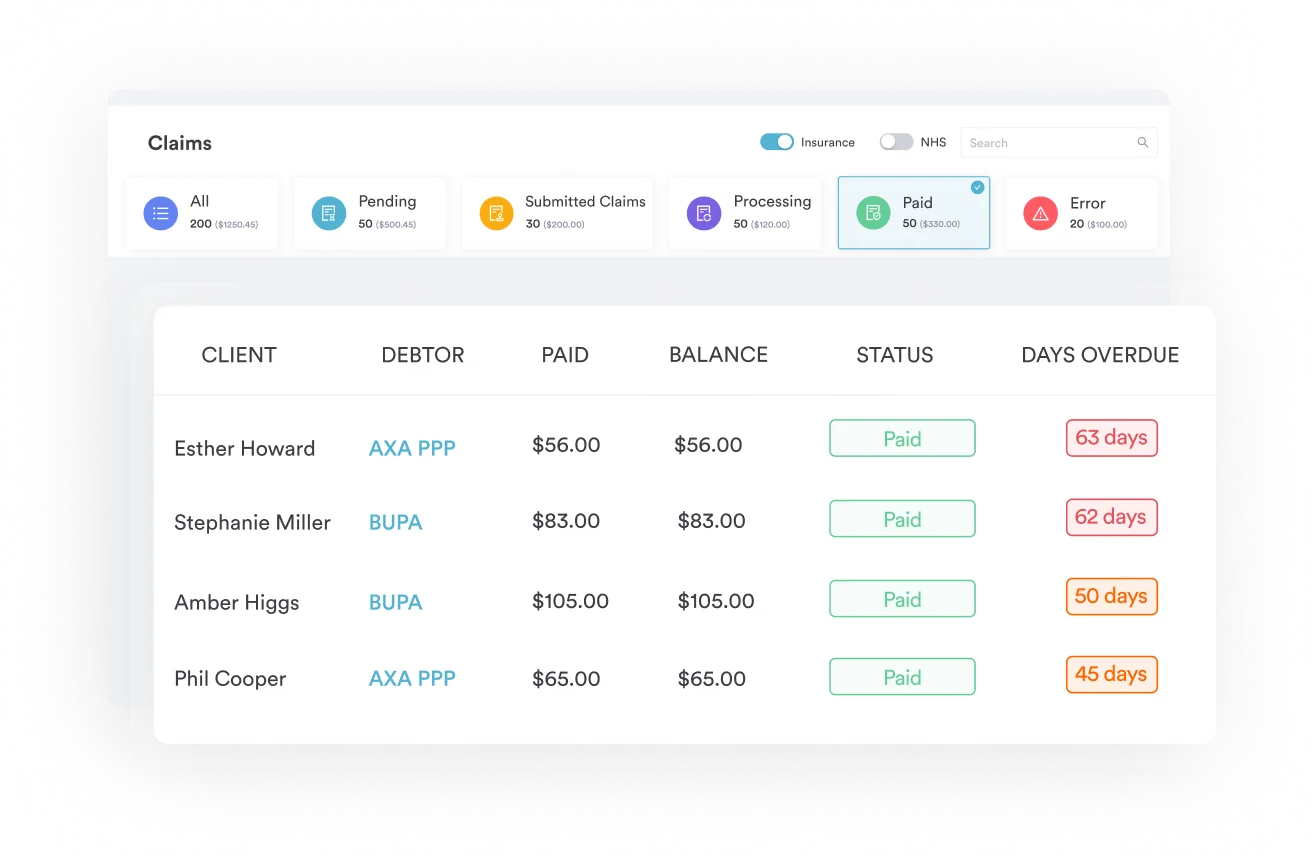

Pabau gives oculoplastic and ophthalmology practices a built-in CCSD code library, pre-authorization tracking and structured operative note capture. Billing staff spend less time chasing paperwork and more time submitting accurate claims.

A C0630 claim is mostly decided before the patient reaches the operating room. Build the authorization pack and the operative note template into the booking step, so billing staff inherit a complete file instead of chasing one.
The trade-off is a few extra minutes of admin at referral. That cost is small next to an appeal on a high-value orbital case, where a medical review can hold payment for weeks.
If your oculoplastic team bills C0630 regularly, book a demo to see how Pabau tracks authorizations and operative notes against each claim.

Billing a lateral orbitotomy instead? CCSD code C0213 covers excision of a lesion of the orbit by lateral orbitotomy.
Coding the most extensive orbital surgery? CCSD code C0110 walks through billing for exenteration of orbit.
Planning squint surgery after decompression? CCSD code C3180 covers billing for revision of squint surgery.
CCSD Code C0630 covers decompression of orbit in UK private practice. The surgery reduces intraorbital pressure by removing orbital bone, retrobulbar fat, or both. It includes the surgeon’s operative and immediate postoperative care but excludes anesthesia and any separately performed procedures such as squint correction.
Orbital decompression is indicated for thyroid eye disease causing significant proptosis, compressive optic neuropathy threatening vision, and corneal exposure from exophthalmos. Functional cases following resolved thyroid eye disease may also qualify, though insurers are more likely to request a medical review for these presentations.
Yes. Bupa, AXA Health, Vitality, Aviva, and WPA all require prior authorization for elective orbital decompression. The practice must submit a clinical justification pack (referral letter, proptosis measurements, optic nerve assessment) and receive an authorization reference number before the procedure date. Compressive optic neuropathy may qualify for expedited review; verify this directly with the insurer.
The most accepted pairing is H06.2 (dysthyroid exophthalmos) for thyroid eye disease. H05.2x covers exophthalmos from other causes, and E05.x (thyrotoxicosis) should accompany H06.2 when active thyroid disease is present. Submitting a thyroid metabolic code without an ophthalmic diagnosis code is a common pairing error that triggers insurer review.
The leading denial reasons are missing prior authorization and cosmetic classification disputes where proptosis severity is not documented. Incomplete operative notes and incorrect ICD-10 code pairing follow close behind. Stale authorizations and unbundling errors when blepharoplasty codes are submitted at the same episode also contribute to denials.
Bilateral billing for C0630 follows the current CCSD bilateral modifier rules. Verify them against the schedule edition in force at the date of procedure. The bilateral fee is typically not double the unilateral rate. Each insurer may also apply its own bilateral billing position. Confirm with Bupa, AXA Health, Vitality, and Aviva separately before submitting a bilateral C0630 claim.