CPT code 93503: Swan-Ganz catheter billing and modifiers
CPT code 93503: Official descriptor and procedure overview In the AMA CPT code s...

Last Updated: Oct 23, 2026
C3180 is the CCSD code for revision of squint surgery. It is used when a surgeon operates again on the eye muscles of a patient who has already had strabismus surgery.
The code sits in the Muscles section of the CCSD eye chapter, next to the primary squint codes C3112 (unilateral) and C3113 (bilateral). Documented prior squint surgery is what separates C3180 from those codes.
Let Pabau's smart automation suggest the right codes, reduce claim denials, and keep your practice compliant—effortlessly.
Automate repetitive tasks and focus on what matters most—your patients.
Reduce coding errors and ensure compliance with the latest regulations.
Clean claims, fewer denials, and faster reimbursements.
Powerful insights and reporting to help your practice thrive.
HIPAA compliant SOC 2 certified GDPR-compliant Trusted by 4,000+ clinics worldwide

CCSD Code C3180 covers revision of squint surgery, which is any return to theatre on extraocular muscles after previous strabismus surgery.
Pre-authorisation from the PMI payer is required before the procedure. An authorisation issued for primary squint surgery under C3112 or C3113 does not cover a revision.
The operative note must specify which muscles were operated, whether an adjustable suture technique was used, and the clinical indication for revision.
Practice management software like Pabau submits CCSD claims through Healthcode, pulling the procedure and diagnosis codes already on the patient record into the claim.
CCSD Code C3180 is the Clinical Coding and Schedule Development (CCSD) procedure code for revision of squint surgery, used in UK private medical insurance billing. The CCSD schedule is the standard coding system for UK PMI payers including Bupa, AXA Health, Aviva, Cigna, Vitality, and WPA.
It is entirely separate from NHS tariff billing: C3180 never appears on an NHS invoice, and NHS payment systems do not accept it.
The code sits in the Muscles section of the CCSD eye chapter. Code first-time squint surgery by laterality: C3112 for one eye and C3113 for both eyes. CCSD Code C3180 describes a return to theatre to operate on muscles that were previously surgically treated.
That surgical history is the defining criterion. A procedure qualifies as C3180 even if a different muscle is recessed or resected, provided the patient has undergone prior strabismus surgery.
Revision of squint surgery addresses residual, recurrent, or surgically induced ocular misalignment following a previous strabismus operation. The primary procedure may have under- or overcorrected the deviation, or the deviation may have drifted over time. Common revision techniques include re-recession (moving a previously recessed muscle further back), re-resection, and adjustable suture adjustment performed post-operatively under topical anaesthesia.
Revision surgery is technically more demanding than primary surgery. Scar tissue from the first operation surrounds the muscle insertion, increasing the risk of muscle perforation or inadvertent disinsertion. Payers expect that added risk to show in the record. Make the clinical justification explicit and record the operative approach in detail.
Typical patients requiring revision include adults with residual esotropia or exotropia after childhood surgery, and patients with thyroid eye disease whose deviation has evolved post-decompression. Children also need revision where primary surgery produced an overcorrection, creating a secondary deviation and amblyopia risk.
CCSD Code C3180 is appropriate when the clinical record demonstrates a clear surgical indication related to the outcome of prior strabismus surgery. Document each indication in the clinic letter or pre-operative assessment to support the claim.
Where the mechanical restriction follows a scleral buckle, the earlier detachment repair is a separate episode coded C5432. That record does not stand in for the prior extraocular muscle surgery C3180 requires.
Payers look closely at purely cosmetic indications in adults. Where the presenting complaint is cosmetic misalignment without functional impact, some PMI policies may decline authorisation. The pre-operative orthoptic report is critical in these cases to establish functional impairment.
Choosing between CCSD Code C3180 and the primary squint codes depends on surgical history first and laterality second. Code C3180 for a patient with documented prior strabismus surgery. Code a first-time operation C3112 when the surgeon operates on one eye and C3113 when they operate on both.
A first-time case is not always settled by laterality alone. Surgery on the superior oblique, superior rectus or inferior rectus can be coded C3115, which the schedule splits by muscle group rather than eye.
Billing a revision under a primary code is the main audit risk on this code family. Bupa places C3180 in a higher fee category than either primary code. Payers therefore check the surgical history closely before authorising a revision.
The same rule runs across the CCSD eye chapter. Revision of a previous glaucoma operation is coded C6150, rather than the primary trabeculectomy or tube shunt codes. Complex glaucoma surgery takes a separate entry, C6160, which covers anti-metabolites and the insertion of seton devices.
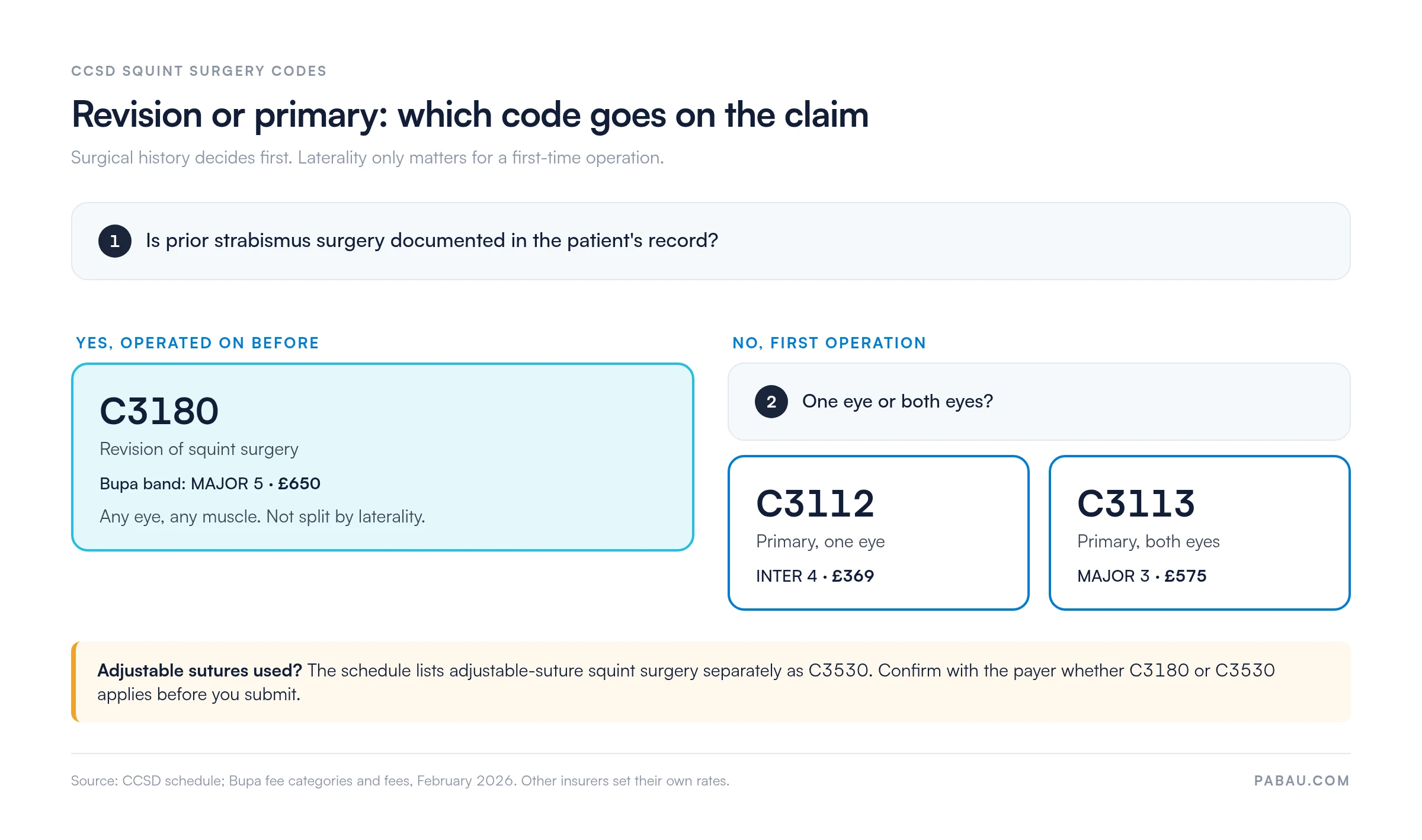
If the patient has documented prior strabismus surgery, the code is C3180. Only a first-time operation goes to C3112 or C3113, chosen by whether one eye or both are operated. Never rely on the technique alone to determine primary vs revision status.
The flow below shows the two steps. Fee categories vary by payer, so confirm the current rate in each insurer’s own schedule.
Several CCSD codes may appear on the same episode as CCSD Code C3180. Understanding which can and cannot be billed concurrently protects against bundling challenges from payers. Pabau’s CCSD guides for private practices cover individual codes across the schedule.
The respective provider always bills theatre fees and anaesthesia codes, not the surgeon. The schedule lists adjustable-suture squint surgery separately as C3530. If a revision uses adjustable sutures, confirm with the payer whether C3180 or C3530 applies before submitting.
All UK PMI payers require pre-authorisation before C3180 is performed. Proceeding without authorisation almost always results in a declined claim, regardless of the clinical merit of the procedure.
A standard pre-authorisation request for C3180 should include:
Bupa and AXA Health typically respond to authorisation requests for elective surgery within five to ten working days. Payers may escalate urgent clinical cases. Authorisation references are policy-year specific: if the surgery straddles a policy renewal, a new reference may be required. Confirm the reference number applies to the procedure date before booking the patient.
Request authorisation specifically under CCSD Code C3180, not C3112 or C3113. Some billing teams default to a primary squint code out of habit. If the insurer authorises a primary code and the surgeon bills C3180, the claim will be rejected on code mismatch. Check the authorisation letter confirms the exact CCSD code before proceeding.
Incomplete documentation is the leading cause of delayed payment and outright denial for C3180 claims. PMI payers can and do request supporting records on revision procedures before releasing payment. Building the same documentation pack for every revision case stops items going missing at submission. The required documents are:
Digital clinical documentation that captures operative note fields at the point of care reduces the risk of incomplete records at claim time. Paper notes that are later transcribed introduce transcription delays and increase the risk of key details being omitted.
The NHS Records Management Code of Practice sets retention at a minimum of eight years for adult clinical records, and until age 25 for children. Private practices often use the same periods as their benchmark. Store the documentation supporting a C3180 claim securely, as UK GDPR requires for any health data you hold.
Healthcode is the primary electronic billing platform for UK PMI claims. Most major payers (Bupa, AXA Health, Aviva, Cigna, Vitality, WPA) accept electronic invoices submitted through Healthcode’s provider portal. Your private practice claims management software should integrate with Healthcode to reduce manual data entry and submission errors. The submission steps for a C3180 claim are:
Each PMI payer sets its own fee schedule for CCSD Code C3180 and reviews it periodically, typically annually. The lookup tools below link to each payer’s published schedule. Rates change, so confirm them directly with the insurer before invoicing. Negotiated consultant fees agreed through individual recognition contracts may differ from standard schedule rates.
If a payer’s schedule does not list C3180 separately from the primary squint codes, contact the payer’s provider services team before invoicing. In most cases the payer will confirm which code applies and at what rate, or will direct you to the correct section of their schedule.
Do not default to the C3112 or C3113 fee for a revision procedure without explicit payer confirmation. For the wider Bupa schedule, see Pabau’s guide to Bupa CCSD codes.
Revision claims face more payer checks than primary operations, because payers have to verify the surgical history. Knowing the common triggers and their remedies helps billing teams recover claims quickly. A denial log that records each rejection reason returned through Healthcode shows repeat errors early.
CCSD Code C3180 applies to both paediatric and adult patients, but the documentation requirements and payer scrutiny differ between the two groups.
For paediatric patients, the clinical record must show a visual development risk to justify revision surgery under a child’s PMI policy. Amblyopia and impaired development of binocular single vision are the usual examples.
Some child policies require a GP referral letter confirming the child is registered with the insurer. Consent documentation for minors must also include parental or guardian consent recorded in the clinical notes.
For adult patients, functional impact is the primary justification. Payers increasingly apply a cosmetic exclusion to adult strabismus surgery where the presenting complaint is purely aesthetic. The exclusion applies when no functional impairment, such as diplopia, BSV disruption or occupational impact, is documented.
The pre-operative orthoptic report and clinic letter must establish functional impact explicitly. Tell patients considering private treatment about this distinction early in the consultation, before they commit to a date.
Adjustable suture strabismus surgery places a slip knot at the muscle insertion point during the operation. The surgeon then adjusts the muscle position afterwards under topical anaesthesia, once the patient is cooperative. Surgeons use it in selected revision cases where precise alignment is key or where previous scarring makes prediction of the surgical effect difficult.
Whether the post-operative suture adjustment is bundled within CCSD Code C3180 or separately codeable depends on the individual payer’s schedule and bundling rules. Some payers treat the adjustment as integral to the surgical episode and will not reimburse a separate code. Others list a distinct adjustment code.
The operative note must state clearly whether an adjustable suture technique was used and whether adjustment was performed on the day following surgery.
A separate adjustment code submitted without this documentation or the payer’s bundling position risks a bundling challenge. Those challenges can take months to resolve through appeal. Check the payer’s schedule and the CCSD schedule before billing any additional code alongside C3180.
Revision squint claims usually stall on paperwork rather than clinical merit. The prior operative note, the orthoptic report and the authorisation letter often sit in separate systems. The billing team then chases each one before a claim can go out.
Pabau keeps those records in the patient file alongside the invoice. Clinicians complete assessment and operative notes on digital forms, and the billing team raises the CCSD invoice from the same record. The claim then goes to the insurer through the Healthcode integration, with its status tracked in one place.
The result is fewer code-mismatch rejections. Staff can compare the code on the authorisation letter with the code on the invoice before submission. That makes it far less likely a C3180 revision goes out under a primary squint code.

Pabau keeps the operative note, orthoptic report and authorisation reference in one patient record, then submits the CCSD claim through Healthcode. Your billing team can check the authorised code against the invoice before the claim goes out.

Code the surgical history first. If the record shows any previous strabismus operation, the claim is C3180. The authorisation, the invoice and the operative note should all carry that code before the patient reaches theatre.
The trade-off is time spent up front. Checking the surgical history and the authorisation code before theatre takes minutes, while recovering a denied revision claim can take months. Book a demo to see how Pabau keeps the operative note, authorisation and invoice for each revision case in one record.

Billing cataract surgery as well? CCSD Code C7123 covers phacoemulsification of cataract, another high-volume code in the same eye chapter.
Coding an older cataract technique? CCSD Code C7110 explains extracapsular cataract extraction without an implant.
Unsure which strabismus diagnosis to pair? ICD-10 Code H50.9 covers unspecified strabismus, the fallback when the record does not name the type.
Want to streamline how your practice handles claims? Pabau claims management supports CCSD code submission, Healthcode integration, and denial tracking for UK private practices.
CCSD Code C3180 covers revision of squint surgery, meaning any surgical procedure on extraocular muscles where the patient has previously undergone strabismus surgery. The prior squint correction must be documented in the clinical record.
C3112 and C3113 are the CCSD codes for first-time squint surgery, on one eye and on both eyes respectively. C3180 is the code for revision surgery on muscles that have previously been operated on. The choice between primary and revision codes depends on surgical history, not the technique used.
Yes, all major UK PMI payers require pre-authorisation before revision squint surgery is performed. The authorisation must specifically reference CCSD Code C3180, not C3112 or C3113.
The correct ICD-10 code depends on the type of strabismus. Common pairings include H50.0 (convergent concomitant strabismus), H50.1 (divergent concomitant strabismus), H50.2 (vertical strabismus), and H50.6 (mechanical strabismus). The diagnosis code must match the clinical presentation documented in the operative note and orthoptic assessment.
Yes, anaesthesia codes and theatre facility fees are billed separately from C3180 and are typically submitted by the anaesthetist and hospital respectively. The surgeon bills C3180 only. Whether an adjustable suture code is separately billable depends on the individual payer’s schedule.
Yes, C3180 applies to paediatric patients. Claims for children require documentation of a visual development indication, such as amblyopia risk or impaired binocular single vision. The clinical notes must also include parental or guardian consent. Some child PMI policies also require a GP referral letter confirming active policy cover.