CPT Code 69610: Tympanic membrane patch repair (myringoplasty)
CPT code 69610: official descriptor and procedure overview CPT code 69610 descri...

Last Updated: Oct 19, 2026
20130 is the CCSD code for an exercise ECG, including the baseline 12-lead ECG and the consultant's report. UK private medical insurers use it to reimburse a supervised treadmill or cycle stress test with continuous ECG monitoring.
The code sits in Section 1 of the CCSD schedule, which covers investigations, simple procedures and consultations. Most insurers require pre-authorization before the test, and two published insurer schedules list it at £130 to £132.
Let Pabau's smart automation suggest the right codes, reduce claim denials, and keep your practice compliant—effortlessly.
Automate repetitive tasks and focus on what matters most—your patients.
Reduce coding errors and ensure compliance with the latest regulations.
Clean claims, fewer denials, and faster reimbursements.
Powerful insights and reporting to help your practice thrive.
HIPAA compliant SOC 2 certified GDPR-compliant Trusted by 4,000+ clinics worldwide

CCSD code 20130 covers a supervised exercise ECG, including the baseline 12-lead ECG, continuous monitoring and the consultant’s report.
The Bruce or modified Bruce treadmill protocol is standard, and the record must show heart rate, blood pressure, ECG findings and test duration.
Most major UK insurers require pre-authorization before the test, and a missing pre-auth reference is the most frequent cause of claim rejection.
Same-day echocardiograms and cardiopulmonary exercise tests (CPET) are billed under their own CCSD codes, never bundled into 20130.
Claims management software like Pabau lets cardiology practices attach CCSD codes, link fee schedules and submit claims from one system.
CCSD code 20130 is the procedure code for an exercise ECG, also known as a stress ECG or exercise tolerance test (ETT). The CCSD (Clinical Coding and Schedule Development Group) describes it as “Exercise ECG (including base line 12 lead ECG and reporting)”. One claim under 20130 covers the baseline ECG, supervised exercise with continuous 12-lead monitoring, and the consultant’s written report.
The code sits in Section 1 of the CCSD schedule, “Investigations, simple procedures and consultation codes,” under 1.1 Investigations. UK private medical insurers use the schedule to link each procedure to an approved remuneration rate. Our CCSD codes hub lists the other codes in the schedule.
The CCSD schedule gives each discrete procedure a numeric code. Insurers use it to validate what was performed and release payment against an agreed tariff. Invoices submitted without a valid CCSD code are rejected before they reach a payment reviewer.
For an exercise ECG, 20130 is the only applicable code. Billing a resting ECG code instead is a substitution error (see the neighboring codes below). It triggers denial and can flag the account for audit.
An exercise ECG records continuous cardiac electrical activity while the patient exercises, typically on a motorized treadmill using the Bruce or modified Bruce protocol. Blood pressure is measured at each protocol stage, and the patient’s symptoms are monitored and documented throughout.
The test detects ST-segment changes that indicate myocardial ischemia, exercise-induced arrhythmias, abnormal hemodynamic responses and exercise capacity. From first electrode attachment to final report, the test takes 45 to 90 minutes, including the cool-down phase and post-exercise observation.
The Duke Treadmill Score (DTS) is calculated from exercise duration, ST deviation and angina index. It must appear in the consultant’s report to support a complete billing record.
Establishing and documenting the clinical indication is the first step in justifying the claim to an insurer. NICE guidance on chest pain and stable angina is the main reference for medical necessity in UK private practice. Accepted indications include:
Suspected angina is missing from that list for a reason. Since 2010, NICE guideline CG95 has advised against using exercise ECG to diagnose or exclude stable angina in patients without known coronary artery disease.
The referral letter must state the indication explicitly. Where a GP refers the patient rather than a consultant, the letter still needs a clear clinical question to support the CCSD 20130 claim.
Insurers treat a documented contraindication review as part of the billing record, and they may audit procedure records for evidence of appropriate patient selection. Absolute contraindications that must be excluded before the test include:
Relative contraindications include left main coronary stenosis, moderate valvular stenosis and resting systolic BP above 200 mmHg. Weigh each against clinical need and document the decision in the procedure record. Written patient consent and a risk disclosure note must be obtained before testing. Keep both in the patient record as part of the billing evidence file.
Knowing the bundling rules prevents both under-coding (losing revenue) and unbundling errors (triggering rejection). The table below separates what 20130 covers from what must be billed under a separate code.
Check current bundling rules against the CCSD Technical Guide (October 2025) before submitting, as unbundling rules are updated annually.
Choosing between adjacent cardiac investigation codes is where substitution errors usually happen. The table below maps the investigations coders most often confuse with CCSD code 20130.
Use the Bupa code search portal to confirm the exact codes for adjacent procedures before billing. Code numbers for resting ECG and Holter monitoring are not consistent across every insurer schedule. If a transthoracic echo runs on the same day, bill it under CCSD code 64300 as a separate line.
A complete procedure record is the single most effective defense against claim rejection and audit. Each element below maps to a field that insurers audit when reviewing a CCSD 20130 claim.
UK GDPR applies to billing records that contain clinical detail. Storing procedure reports alongside invoice data in a compliant system is both a regulatory obligation and a practical audit defense. The Information Commissioner’s Office (ICO) sets the standard for how that documentation is stored.
Before the test begins, confirm that the pre-authorization reference number is recorded in the patient file. Make it a mandatory field when the appointment is booked, so it’s never left for the day the invoice is raised. Missing pre-auth discovered at the billing stage is the hardest rejection to appeal.
Pre-authorization (pre-auth) is a formal insurer approval granted before the procedure is performed. Most major UK private medical insurers require it for CCSD 20130, and retrospective applications are rarely approved. The table below summarizes the pre-auth approach for the four major insurers.
Pre-auth requirements can change between policy years. Always check current requirements on each insurer’s provider portal rather than relying on prior-year guidance.
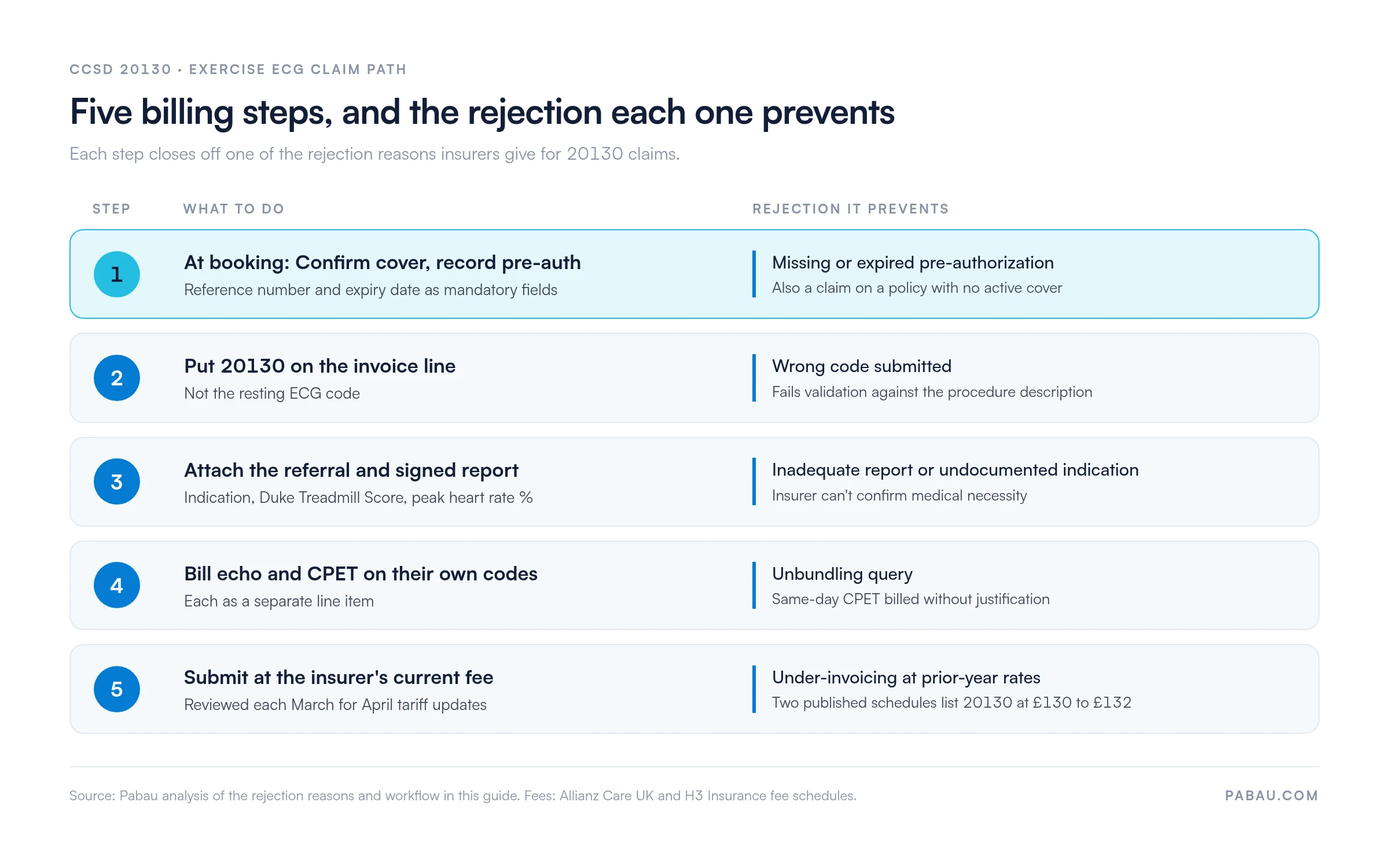
Rejection reasons for CCSD 20130 fall into six consistent categories. Each is preventable with the right workflow in place before the invoice is raised.
Appealing a rejection for missing pre-auth is rarely successful, because insurers treat pre-auth as a contractual condition. A pre-auth confirmation step in the booking workflow removes this category of rejection. The chart below maps each rejection reason to the billing step that prevents it.
The CCSD schedule does not publish a single national fee for code 20130. Each insurer sets its own recognized fee schedule, and the rate a consultant receives depends on their recognition agreement with that insurer.
Two published insurer schedules, the Allianz Care UK Recognition Fee Schedule and the H3 Insurance Fee Schedule, both list 20130 at £130 to £132. Rates at other insurers vary with the tariff, the consultant’s recognition grade, and whether the hospital bills a facility fee separately.
For practices billing several insurers, an up-to-date reference of each insurer’s rate for 20130 prevents under-invoicing. Practices with several cardiology consultants benefit from keeping that fee data in one system rather than in per-consultant spreadsheets.
Check each insurer’s fee schedule every year, typically from April 1, when most UK private medical insurance (PMI) tariff updates take effect. Schedule a review in your billing calendar each March so that invoices issued in the new tariff year don’t go out at prior-year rates. Even a small per-procedure difference adds up across a busy cardiology list.
Submitting CCSD 20130 through practice management software removes the manual steps behind the most common rejection reasons. A structured submission workflow for a cardiology practice looks like this:
Many cardiology practices still track pre-auth numbers in one place, reports in another, and insurer fees in a spreadsheet. Each handoff is a chance for a 20130 claim to go out incomplete.
Practice management software like Pabau keeps those pieces on the patient record. You add the patient’s insurer and policy once, and every invoice routes to the right insurer automatically. Pabau’s claims management software then runs validation checks before each claim is sent, so a missing membership number or authorization code is caught first.
Claims go to Healthcode without re-keying, and each one sits in a Claims dashboard with a live status: Pending, Submitted, Processing, Paid or Error. Your team sees which 20130 claims need attention without chasing insurers by phone.
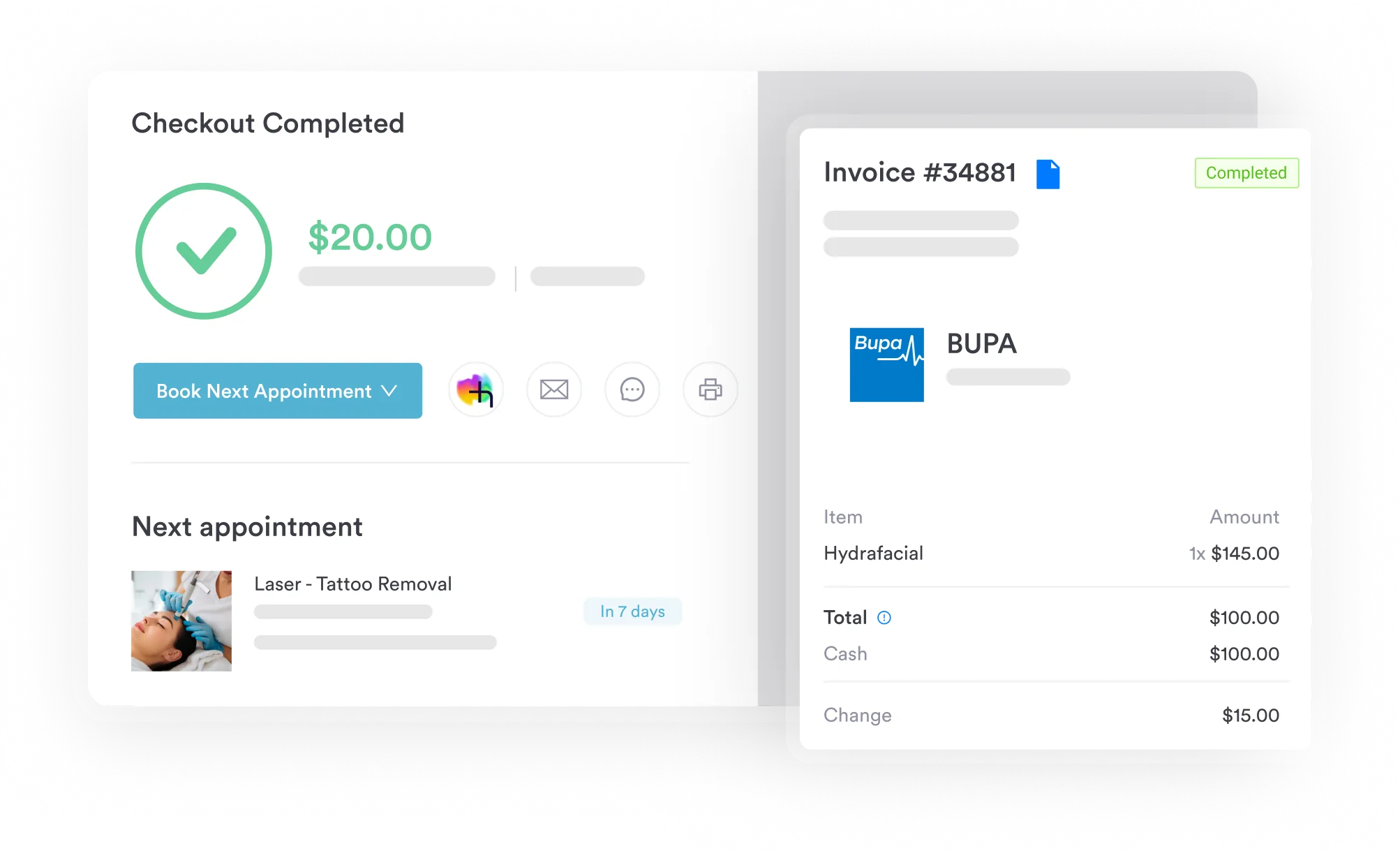

Pabau lets you attach CCSD codes to invoices, link insurer fee schedules, record pre-auth reference numbers and submit claims without switching systems. Fewer manual steps means fewer rejection reasons.

Billing 20130 well is mostly decided before the patient steps on the treadmill. Settle the pre-auth, the indication and the code at booking, and the claim itself becomes routine.
The trade-off is a few extra minutes at the front desk. That costs far less than appealing a rejection insurers rarely overturn.
To see how Pabau handles pre-auth tracking and CCSD claims for a private cardiology list, book a demo.

Billing across multiple UK private insurers? Bupa CCSD procedure codes covers how Bupa applies the CCSD schedule and what cardiologists need to know about code submission.
Checking what Bupa pays? Bupa procedure codes and fee schedule sets out how Bupa structures its tariffs code by code.
Running an echo on the same day? CCSD code 64300 covers billing for transthoracic echocardiography.
CCSD code 20130 is the UK private medical insurance billing code for an exercise ECG. It covers the baseline 12-lead ECG, consultant supervision, continuous 12-lead monitoring during exercise and the written report. Echocardiography and cardiopulmonary exercise testing are billed under their own CCSD codes.
CCSD 20130 covers a supervised exercise tolerance test, with ECG monitoring during exertion and blood pressure recorded at each protocol stage. The consultant’s report includes a Duke Treadmill Score. A resting ECG code covers only a standard 12-lead ECG recorded at rest, typically in under 10 minutes. Submitting a resting ECG code for an exercise test is a substitution error that triggers rejection.
All major UK private medical insurers that use the CCSD schedule accept code 20130 for exercise ECG. That includes Bupa, AXA Health, Aviva, Vitality Health, WPA, Healix, Allianz Care and Cigna. Each insurer sets its own recognized fee for the code. Acceptance depends on the patient’s policy terms, active cover for cardiology diagnostics and, in most cases, prior pre-authorization.
Yes, an exercise tolerance test (ETT) is the same procedure as an exercise ECG. CCSD 20130 is the billing code for this investigation, whether it’s described as an ETT, stress ECG or treadmill test. The Bruce protocol is the most common method in UK private cardiology. Modified Bruce and cycle ergometer protocols are also coded under 20130.
Yes, provided both procedures were clinically indicated and performed. The echocardiogram is billed under its own CCSD code on the same invoice date. Document the clinical reason for both investigations in the procedure records, because insurers may query same-day multi-procedure invoices that the clinical letter doesn’t explain.
The six most frequent reasons are missing or expired pre-authorization, a resting ECG code submitted instead of 20130, and an inadequate clinical report. The other three are an undocumented indication, duplicate billing alongside a CPET code, and a policy that doesn’t cover cardiology diagnostics. Missing pre-auth is the most frequent of the six.