

CCSD code G5100: Bypass of duodenum billing guide
CCSD code G5100 bills a bypass that leaves the duodenum in place CCSD code G5100...

Last Updated: Oct 16, 2026
A4280 is the CCSD code for burr hole drainage of an intracranial infection. The surgeon drills a small opening in the skull to drain a brain abscess, subdural empyema, or epidural abscess. UK private medical insurers such as Bupa, AXA Health, and Vitality use it to identify the surgeon's fee.
A4280 sits in CCSD chapter 2.0.0 Brain, Cranium and Other Intracranial Organs, sub-chapter 2.2.0 Cranium, with CCSD reference Fb.016. Burr holes for hematoma, biopsy, or pressure monitoring take other codes, and a craniotomy replaces A4280 entirely.
Let Pabau's smart automation suggest the right codes, reduce claim denials, and keep your practice compliant—effortlessly.
Automate repetitive tasks and focus on what matters most—your patients.
Reduce coding errors and ensure compliance with the latest regulations.
Clean claims, fewer denials, and faster reimbursements.
Powerful insights and reporting to help your practice thrive.
HIPAA compliant SOC 2 certified GDPR-compliant Trusted by 4,000+ clinics worldwide

CCSD code A4280 is the UK private billing code for burr hole drainage of an intracranial infection, not for hematoma, biopsy, or ICP monitoring.
Every A4280 claim needs a confirmed infection, such as a brain abscess or subdural empyema, paired with a matching ICD-10 code.
When the procedure escalates to a full craniotomy, A4280 no longer applies and the craniotomy code is billed instead.
Pabau, the practice management platform we build, keeps pre-authorization references, co-billing, and insurer deadlines for UK neurosurgery practices on one patient record.
CCSD code A4280 is the UK private procedure code for a burr hole performed to drain an intracranial infection. The Clinical Coding and Schedule Development (CCSD) Group publishes the schedule it belongs to.
UK private medical insurers such as Bupa, AXA Health, Vitality, Aviva, and WPA use CCSD codes to identify the surgeon’s fee. Our guide to Bupa CCSD codes shows how one of those insurers works with the schedule. A4280 sits in chapter 2.0.0 Brain, Cranium and Other Intracranial Organs, under sub-chapter 2.2.0 Cranium.
The code covers drilling through the skull, opening the dura, draining or aspirating infected material, irrigating the cavity, and closing the site.
The code is indication-specific. A burr hole for hematoma evacuation, for intracranial pressure monitoring, or for diagnostic biopsy each attracts a different CCSD code. A4280 is reserved for cases where infection is the primary operative indication.
A burr hole is a small circular opening drilled through the skull to reach the intracranial space. For an infection, the surgeon uses a cranial drill or perforator to make the opening. The surgeon then incises the dura mater to reach the infected collection underneath.
The procedure follows a consistent sequence, though specific steps vary by infection type and location.
The procedure is usually performed under general anesthesia in a neurosurgical operating room. Stereotactic guidance sometimes helps locate a deep-seated abscess. Whether that changes the billing is covered below.
Brain abscess, subdural empyema, and epidural abscess are the three main intracranial infections drained through a burr hole. An infection after earlier cranial surgery may also qualify when the surgeon re-explores through a burr hole rather than a craniotomy.
UK private claims use the WHO edition of ICD-10 for diagnoses. In that edition, G06.0 covers intracranial abscesses in the brain and in the epidural and subdural spaces.
A4280 does not apply when the primary indication is hematoma, tumor biopsy, ICP monitor insertion, or hydrocephalus. Each of those indications has its own CCSD code. Evacuation of an extradural hematoma, for example, is billed under A4010.
The most common coding error on A4280 claims is billing the wrong burr hole code for the indication. Two burr holes can read the same in the operative note and still take different codes, because the indication decides which one applies. Browse our CCSD code guides to compare A4280 with neighboring neurosurgery codes.
A surgeon may plan a burr hole but raise a bone flap during the same operation. At that point the procedure has become a craniotomy, so bill the craniotomy code. Excision of a brain abscess also has its own CCSD code, A0180.
Billing A4280 in that scenario is downcoding. The operative note will contradict the claim if the insurer reviews it. The decision runs in two steps, as the diagram below shows.
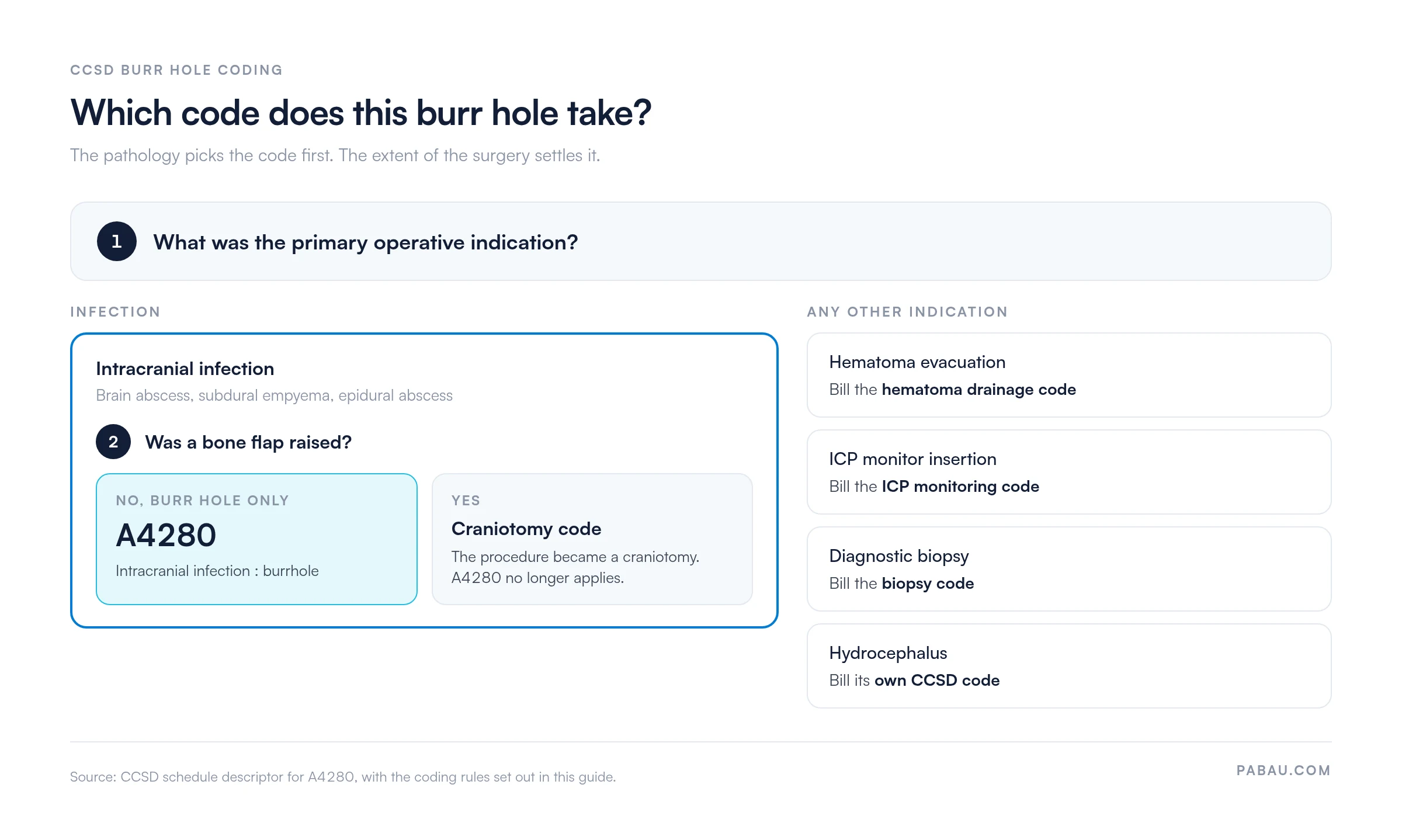
Before you finalize any A4280 claim, confirm the operative report states intracranial infection as the primary indication. A report that describes a hematoma, an unspecified collection, or a lesion of unknown cause will fail the insurer’s review. Get the indication right in the notes first, and the code follows.
UK private medical insurers look closely at high-value neurosurgical claims. Back every A4280 claim with complete medical billing documentation. The insurer’s clinical reviewer should be able to confirm the indication, the approach, and the outcome without contacting your practice.
Bupa, AXA Health, Vitality, Aviva, and WPA each set their own pre-authorization rules. Check each insurer’s published requirement before treatment, rather than assuming one insurer’s process applies to another.
Intracranial infections often present as emergencies, and many UK private policies exclude emergency admissions. Confirm with the insurer that the patient’s policy covers private treatment before you proceed.
A4280 claims fail more often than they should because the indication boundary is narrow and the documentation bar is high. These are the most frequent triggers. A denial management workflow helps you spot which ones keep recurring in your practice.
A4280 covers the neurosurgeon’s fee for the burr hole procedure. It does not include the anesthetist’s fee, the hospital’s charges, or an assistant surgeon’s fee. Each is billed separately under the insurer’s own rules.
The Healix fee schedule shows how one UK insurer lists fees against CCSD codes.
No, image guidance does not change the primary code. A surgeon may use frameless neuronavigation or CT or MRI targeting to find a deep brain abscess. The procedure is still a burr hole drainage of an intracranial infection, so A4280 remains the primary code.
Whether guidance can be billed as an add-on alongside A4280 depends on the current CCSD schedule and each insurer’s rules. Check the live schedule before you bill any add-on code, because CCSD updates it regularly.
Practical rule: Document the guidance technology in the operative note whether or not you bill a separate code. The note shows clinical complexity and supports the claim if the insurer queries it.
A consistent claim routine reduces rejections and shortens the time to payment. The checklist below covers the full sequence.
CCSD code A4280 applies to adults and children alike when a burr hole drains an intracranial infection. The procedure code does not change with the patient’s age.
Some insurers apply their own rules to pediatric surgery, so check each insurer’s published requirement before you invoice. Record the child’s age, weight, and any age-related complexity in the operative note.
In many neurosurgery practices, the parts of an A4280 claim live in different places. The authorization number sits in an email, the culture result in a lab portal, and the invoice in a billing tool.
In Pabau’s billing software, those parts sit on one patient record. With its claims management software, your team attaches A4280 at invoicing and records the insurer’s authorization reference alongside it.
Digital forms let the surgical team record the indication, the number of burr holes, and the culture specimens. Your billing team can then confirm the infection indication before the invoice leaves the practice.

Pabau helps UK neurosurgery practices track authorization references, attach CCSD codes, and invoice private insurers on time. See how it works for your practice.

A4280 is a narrow code, and the operative note decides whether it pays. Name the infection, confirm a burr hole rather than a bone flap, and pair the claim with the right ICD-10 code.
Build those three checks into the step before invoicing, not after a query arrives. A few minutes at that point cost far less than reworking a rejected neurosurgical claim.
Still chasing authorization numbers across inboxes? Book a demo to see how Pabau links each A4280 claim to its authorization and operative record.

Billing a craniotomy for bleeding after surgery? CCSD code A4080 explains how to bill a craniotomy for postoperative hemorrhage.
Need a broader overview of how CCSD codes work? Pabau’s Bupa CCSD guide covers the structure of the schedule and how to navigate its chapters.
Struggling with claim denials across your neurosurgery practice? Denial management in healthcare explains root-cause analysis, appeals, and how to track denial patterns by code.
Did the surgeon excise the abscess instead of draining it? CCSD code A0180 covers excision of a brain abscess and the documentation it needs.
Was the collection blood rather than pus? CCSD code A4180 explains how to bill a subdural hemorrhage tap.
CCSD code A4280 covers a burr hole performed to drain an intracranial infection, such as a brain abscess, subdural empyema, or epidural abscess. Burr holes for hematoma evacuation, ICP monitoring, or diagnostic biopsy each have their own CCSD code.
UK private medical insurers that use the CCSD schedule, including Bupa, AXA Health, Vitality, Aviva, and WPA, recognize A4280. Each insurer sets its own fees and authorization rules, so check its published requirements before treatment.
A4280 applies when the surgeon makes only a burr hole, a small circular opening in the skull. A craniotomy code applies when a bone flap is raised for wider access. If a burr hole escalates to a craniotomy, bill the craniotomy code, not A4280.
Brain abscess, subdural empyema, and epidural abscess are the three main intracranial infections drained through a burr hole. An infection after earlier cranial surgery may also qualify when the surgeon re-explores through a burr hole.
Send an operative report naming intracranial infection as the primary indication, plus a confirmed ICD-10 code. Add the pre-operative imaging, the microbiology specimen record, and the insurer’s authorization reference.
Yes. A4280 covers the neurosurgeon’s fee only, so the anesthetist and the hospital invoice separately. The dural opening and wound irrigation are part of the burr hole procedure and must not be billed separately.
A4280 is used only for infection drainage. Inserting an ICP monitor through a burr hole takes a separate CCSD code. Billing A4280 for monitoring is a coding error that the ICD-10 code will expose.



