

CCSD code G5100: Bypass of duodenum billing guide
CCSD code G5100 bills a bypass that leaves the duodenum in place CCSD code G5100...

Last Updated: Oct 16, 2026
C0840 is the CCSD code for orbital injection, the delivery of a therapeutic agent into or around the orbit. Consultant ophthalmologists and oculoplastic surgeons use it to bill UK private medical insurers such as Bupa, AXA Health, Aviva and Vitality for the injection itself.
The code sits in CCSD chapter 4, Eye and orbital contents, and insurer fee schedules band it as a minor procedure. The drug and any same-day consultation are billed on separate lines. Retrobulbar, sub-Tenon and peri-orbital approaches are typically billed under C0840, but confirm with the insurer's code search.
Let Pabau's smart automation suggest the right codes, reduce claim denials, and keep your practice compliant—effortlessly.
Automate repetitive tasks and focus on what matters most—your patients.
Reduce coding errors and ensure compliance with the latest regulations.
Clean claims, fewer denials, and faster reimbursements.
Powerful insights and reporting to help your practice thrive.
HIPAA compliant SOC 2 certified GDPR-compliant Trusted by 4,000+ clinics worldwide

CCSD Code C0840 bills the orbital injection itself in UK private practice. The drug and any same-day consultation go on separate lines.
Thyroid eye disease and orbital pseudotumour (idiopathic orbital inflammation) are typical indications, and each claim needs a linked ICD-10 diagnosis code.
Code the drug on its own line with the insurer’s drug or consumable code, or the claim risks rejection or under-payment.
Retrobulbar, sub-Tenon and peri-orbital approaches are typically billed under C0840, but confirm with the insurer’s code search first.
Pabau’s claims management software pulls the patient, treatment and insurer details from the record into a pre-filled Healthcode claim.
CCSD Code C0840 is the procedure code for an orbital injection in the CCSD schedule, the standard billing language for UK private medical practice. The schedule is maintained by the Clinical Coding and Schedule Development (CCSD) Group (Aviva, AXA Health, Bupa, Vitality).
Consultant ophthalmologists and oculoplastic surgeons use C0840 to bill for the injection itself: introducing a therapeutic agent into or around the orbital space. The drug and any preceding consultation are billed separately. Insurer fee schedules band C0840 as a minor procedure.
The CCSD code set is distinct from CPT, which is used in the United States, and from the OPCS-4 codes used for NHS procedures. C0840 applies to UK private practice claims, which go to insurers, typically through Healthcode. The CCSD Group publishes the codes but does not receive claims.
C0840 sits in chapter 4 of the schedule, Eye and orbital contents. Open orbital surgery carries its own codes. Drainage of the orbit is billed as C0620, and exploration of the orbit as C0650.
An orbital injection is the delivery of a therapeutic agent into the orbital space: the bony cavity surrounding the eye and its supporting structures. The procedure targets tissue within or immediately next to the orbit rather than the eye itself. That separates it from intravitreal injections into the vitreous cavity and subconjunctival injections beneath the conjunctiva.
Three anatomical approaches are used in clinical practice. Each is typically billed under C0840, but confirm with the insurer’s code search:
A retrobulbar anaesthetic block given as part of another procedure is normally not billed separately under C0840.
Corticosteroids are the most commonly injected agents: triamcinolone acetonide, methylprednisolone, and dexamethasone are all used depending on indication, payer policy, and consultant preference. The route, drug, and dose must be documented in the procedure note to support both the C0840 claim and any separately coded drug/consumable claim.
CCSD Code C0840 needs a linked ICD-10 diagnosis code for the claim to pass a private medical insurer’s (PMI’s) medical necessity review. Typical diagnoses fall into four groups.
PMI policies on medical necessity vary by insurer and by the individual patient’s plan. A diagnosis code alone does not guarantee approval. Clinical justification in the procedure note, cross-referenced with a preauthorisation reference number, is what the claims team uses to confirm coverage.
Coding errors on C0840 claims fall into two patterns: under-billing (not coding the drug separately) and over-billing (including items already bundled into the procedure code). The table below sets out the boundary.
Verify the drug or consumable code against the insurer’s current schedule before submitting. Codes can change between schedule editions, so last year’s code for triamcinolone acetonide may no longer apply.
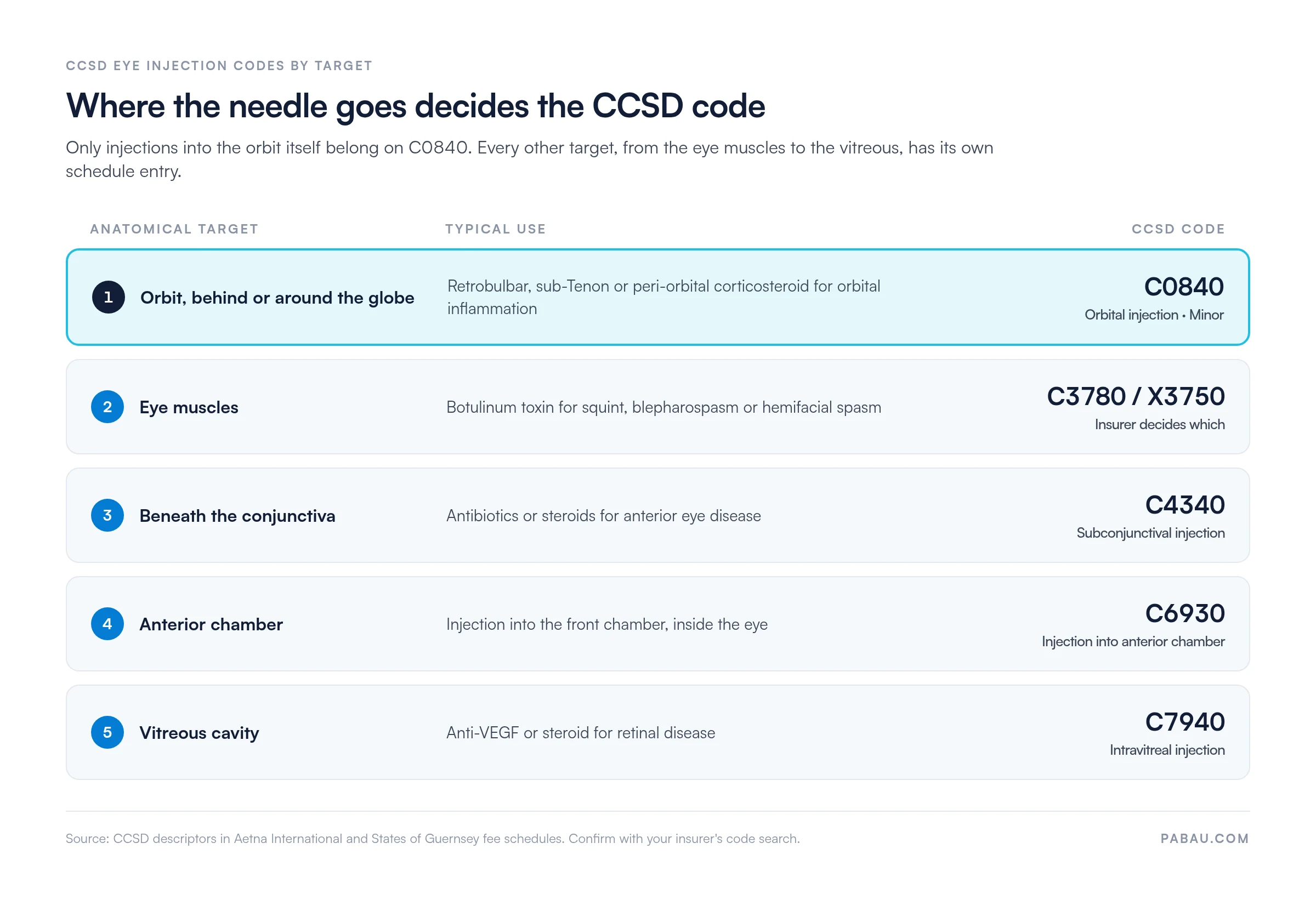
A common miscoding error on C0840 claims is confusing the orbital injection with nearby eye procedures that carry their own CCSD codes. They differ by anatomical target, clinical purpose and code. An injection into the front chamber of the eye, for example, is billed as C6930.
Sub-Tenon and retrobulbar injections are typically billed under C0840, because both deliver the agent into or behind the orbital space. The schedule entry reads only “Orbital injection”, so confirm with the insurer’s code search. The full CCSD code lookup lists every other entry by chapter.
The map below shows which code each injection target takes, from the orbit inwards.
Check the CCSD edition year on your practice’s fee schedule agreement with each PMI. A payer’s schedule set under an older CCSD edition may carry a different descriptor or bundling rule from the current published version. Disputes about what C0840 includes are often edition-year mismatches rather than genuine disagreements.
Incomplete documentation is a common cause of C0840 claim failure. PMIs expect a procedure record that lets their clinical reviewers confirm medical necessity, the procedure performed and the materials used. The General Medical Council’s guidance on clinical records sets the professional standard, and PMIs use a similar framework for claim adjudication.
A compliant procedure note for a C0840 claim should include all of the following:
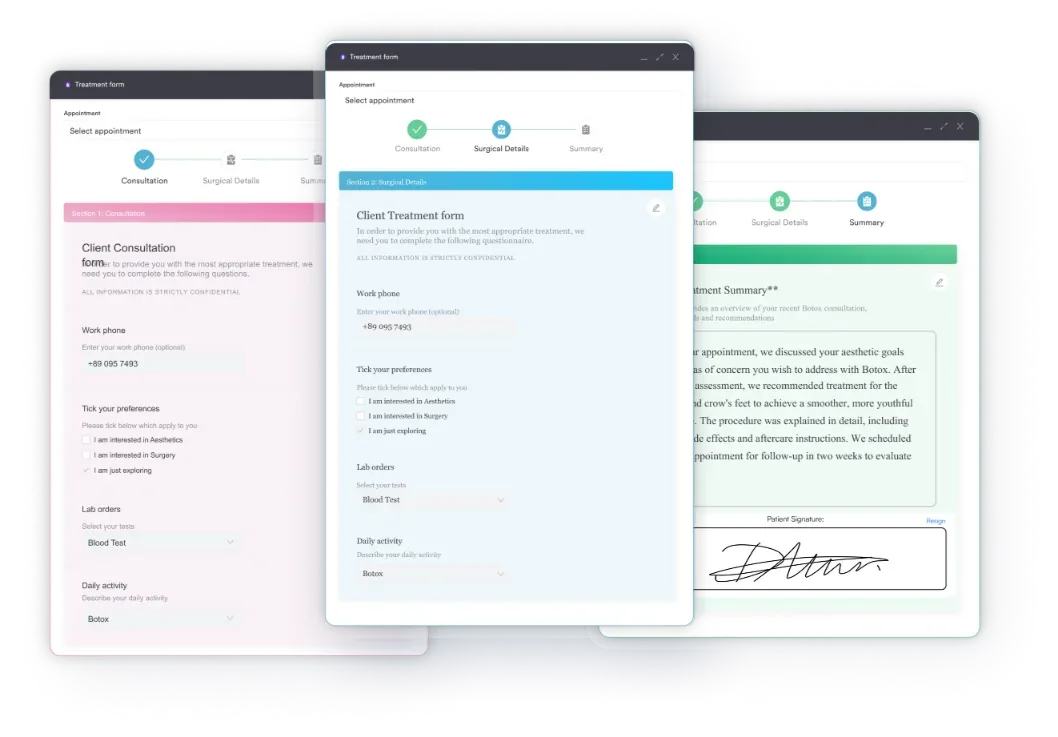
Digital procedure and consent forms capture this data at the point of care, so nobody has to rebuild the documentation afterwards. Make every field listed above mandatory in the practice’s ophthalmology procedure template.
Most UK PMIs require preauthorisation (also called prior authorisation or pre-auth) before an orbital injection proceeds under C0840. Submitting a claim without a valid authorisation reference is a quick route to rejection.
Payer preauthorisation rules for C0840 can change between policy years. Check each payer’s provider portal before every procedure, not just at the start of the year. The Bupa CCSD code reference on Pabau covers Bupa-specific CCSD billing requirements in more detail.
Healthcode is the standard electronic data interchange (EDI) clearinghouse for UK private medical billing. Most major PMIs, including Bupa and AXA Health, require claims to be submitted through Healthcode rather than by paper invoice. Practices using a practice management system with Healthcode integration can submit C0840 claims directly from the patient record.
A compliant C0840 claim submission via Healthcode follows these steps:
C0840 claim denials tend to follow five patterns. Most can be prevented while the claim is prepared, long before an appeal.
When a claim is denied for medical necessity, start with the diagnosis. Check that the ICD-10 code on the claim exactly matches the condition described in the procedure note. An H05.1 (orbital pseudotumour) claim that uses a nonspecific H05.9 code will fail medical necessity review at most payers. A pre-submission check that compares the diagnosis code with the procedure note catches this before the claim goes out.
Give your billing team a five-point C0840 checklist. Confirm the preauthorisation reference, link the ICD-10 code and add the drug as a separate line. Then check that the note states laterality and the invoice carries the consultant’s GMC number. A five-point check before every submission eliminates the most common denial patterns.
Many ophthalmology practices still build C0840 claims by hand. Someone copies the procedure, drug and authorisation details from the note into the insurer’s form, and each copy is a chance for an error.
Pabau, the practice management platform we build, pulls the patient, treatment and insurer details straight from the patient record into a pre-filled claim. Our claims management software then sends it to Healthcode, so the C0840 line, drug line and consultation line leave together.
Before each claim goes, Pabau checks that insurer details such as membership numbers and authorisation codes are in place. That catches a missing pre-auth reference, the first denial pattern above, before the insurer sees the claim.
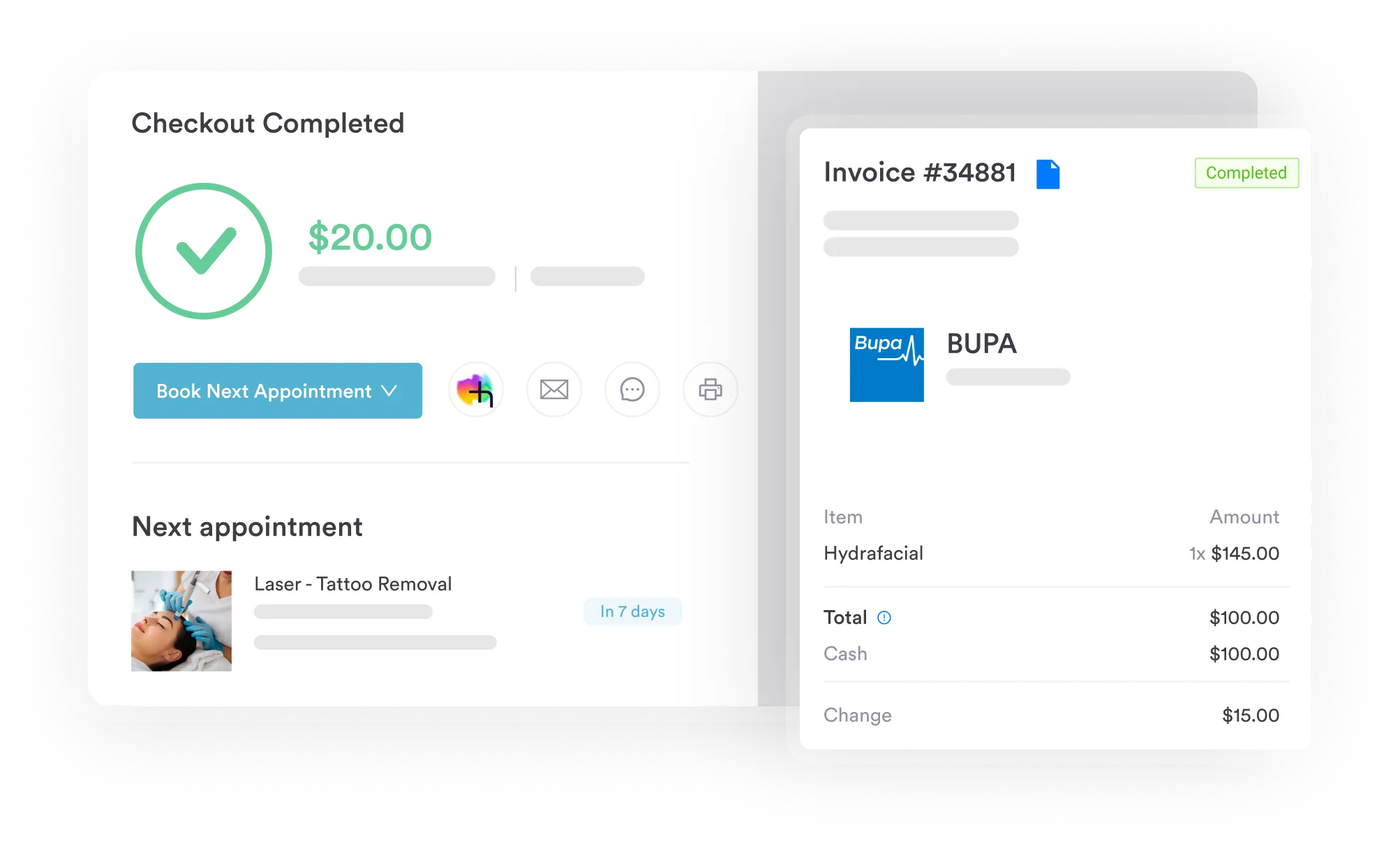

Pabau pulls the patient, treatment and insurer details from the record into a pre-filled Healthcode claim. It checks membership and authorisation numbers before the claim goes.

C0840 is a minor code, but the claim around it has several moving parts. Bill the injection, the drug and any consultation as separate lines, and keep the authorisation reference on the claim.
Where the answer turns on the insurer, ask the insurer. The approach, a second side and botulinum toxin to the eye muscles all depend on the insurer’s code search or bilateral rule. Check those before the procedure date rather than after a rejection.
To see how Pabau carries a C0840 claim from the procedure note to Healthcode, book a demo.

Need a full Bupa CCSD code reference? Bupa CCSD codes covers the full schedule of CCSD codes recognised by Bupa for UK private practice billing.
Billing an orbital drainage instead? CCSD code C0620 covers drainage of the orbit, with fees and insurer billing steps.
Billing open orbital surgery? CCSD code C0650 explains exploration of the orbit as a sole procedure.
Injecting the front of the eye? CCSD code C6930 walks through anterior chamber injection billing.
Choosing a system for Healthcode claims? Best medical billing software in the UK compares billing systems for UK private practices.
CCSD Code C0840 covers an orbital injection: a consultant delivering a therapeutic agent into or around the orbit in UK private practice. It covers the injection technique only. The drug, any consumables and a same-day consultation are billed separately.
C0840 covers the injection procedure only, not the drug. Corticosteroids such as triamcinolone acetonide or methylprednisolone are billed separately, using the insurer’s drug or consumable code.
C0840 targets the orbital space outside the eye, while the intravitreal code C7940 targets the vitreous cavity inside it. They are separate procedures with separate CCSD codes. Billing C7940 for a retrobulbar or sub-Tenon injection is a miscoding error and a common denial trigger.
Bupa is likely to require preauthorisation for interventional outpatient procedures, including orbital injections. Confirm via the Bupa Provider portal for the patient’s policy. AXA Health’s requirement for C0840 varies by policy, so check the AXA Health provider portal before the procedure date.
A therapeutic retrobulbar injection is typically billed under C0840, because the agent goes into the retrobulbar space. The schedule entry reads only orbital injection, so confirm with the insurer’s code search. A retrobulbar anaesthetic block given as part of another procedure is normally not billed separately.
Yes, a same-date outpatient consultation is not bundled into C0840. Bill it separately using the relevant CCSD outpatient consultation code. Record the consultation and the injection as distinct entries, and confirm the payer accepts same-date billing for both.



