

HCPCS code E0198: Water pressure pad billing guide
HCPCS code E0198 is a water pad for a standard mattress HCPCS code E0198 is the ...

Last Updated: Oct 13, 2026
A5420 is the CCSD code for injection of a therapeutic substance into the cerebrospinal fluid (CSF) as the sole procedure. It covers a one-off intrathecal dose, such as a baclofen trial, given once the needle crosses the dura and CSF return is confirmed.
The drug is billed separately. Intrathecal chemotherapy has its own code, A5480, and a diagnostic lumbar puncture is A5530. Bupa's February 2026 schedule grades A5420 as Minor 2.
Let Pabau's smart automation suggest the right codes, reduce claim denials, and keep your practice compliant—effortlessly.
Automate repetitive tasks and focus on what matters most—your patients.
Reduce coding errors and ensure compliance with the latest regulations.
Clean claims, fewer denials, and faster reimbursements.
Powerful insights and reporting to help your practice thrive.
HIPAA compliant SOC 2 certified GDPR-compliant Trusted by 4,000+ clinics worldwide

CCSD Code A5420 covers a therapeutic injection into the CSF as the sole procedure. The drug cost and any diagnostic lumbar puncture are billed elsewhere.
Intrathecal chemotherapy has its own code, A5480, so methotrexate or cytarabine doses never go under A5420.
Confirmation of CSF return before injection is a key documentation point for A5420 claims.
Epidural injections take A5200, A5210 or A5220 by spinal region, even when the therapeutic intent matches an intrathecal dose.
In Pabau’s claims management software, each claim pre-fills from the patient record and gets checked for missing authorization codes before submission.
CCSD Code A5420 is the procedure code for injecting a therapeutic substance into the cerebrospinal fluid (CSF) as the sole procedure. Its official descriptor is “Injection of therapeutic substance into CSF – as sole procedure.” The CCSD added the “as sole procedure” qualifier in its November 2024 bulletin.
The code applies when a clinician gains intrathecal access, confirms CSF return, and delivers a drug directly into the subarachnoid space. A trial dose of intrathecal baclofen is the textbook case.
A5420 belongs to the CCSD (Clinical Coding and Schedule Development) schedule, maintained by the CCSD group. The major UK private medical insurers use it, such as Bupa, AXA Health, Aviva, Vitality, WPA and Healix. Bupa’s February 2026 schedule grades A5420 as Minor 2, with a £123 benefit.
The schedule is procedure-based, so each code describes one clinical act. Our CCSD codes hub lists the other procedures in the schedule. Four points define the scope of A5420:
An intrathecal injection reaches the subarachnoid space by passing a spinal needle through the dura mater. An epidural injection differs because the needle stops short of the dura. That distinction decides the code.
The standard procedural sequence is:
Step 4 (CSF confirmation) is the clinical and documentation gateway. Without it, the procedure is not verifiably intrathecal and the A5420 claim is open to challenge.
A5420 applies when an MHRA-licensed or clinically approved therapeutic agent is delivered into the intrathecal space as the sole procedure. The most common clinical scenarios are:
Two common intrathecal uses fall outside A5420. Intrathecal chemotherapy, such as methotrexate or cytarabine, is billed under A5480. Contrast medium for myelography is diagnostic rather than therapeutic, so it does not qualify.
The substance must be clinically indicated for the intrathecal route. An agent given intrathecally purely for convenience, when an effective intravenous alternative exists, may not meet an insurer’s medical necessity criteria.
Knowing the code’s exclusions prevents overbilling and reduces denials. Five boundaries apply:
The codes most often confused with A5420 share a needle at the spine but differ in anatomical target, purpose, or technique. Choosing the wrong one is a common source of A5420 denials. Three questions, asked in order, settle most cases.
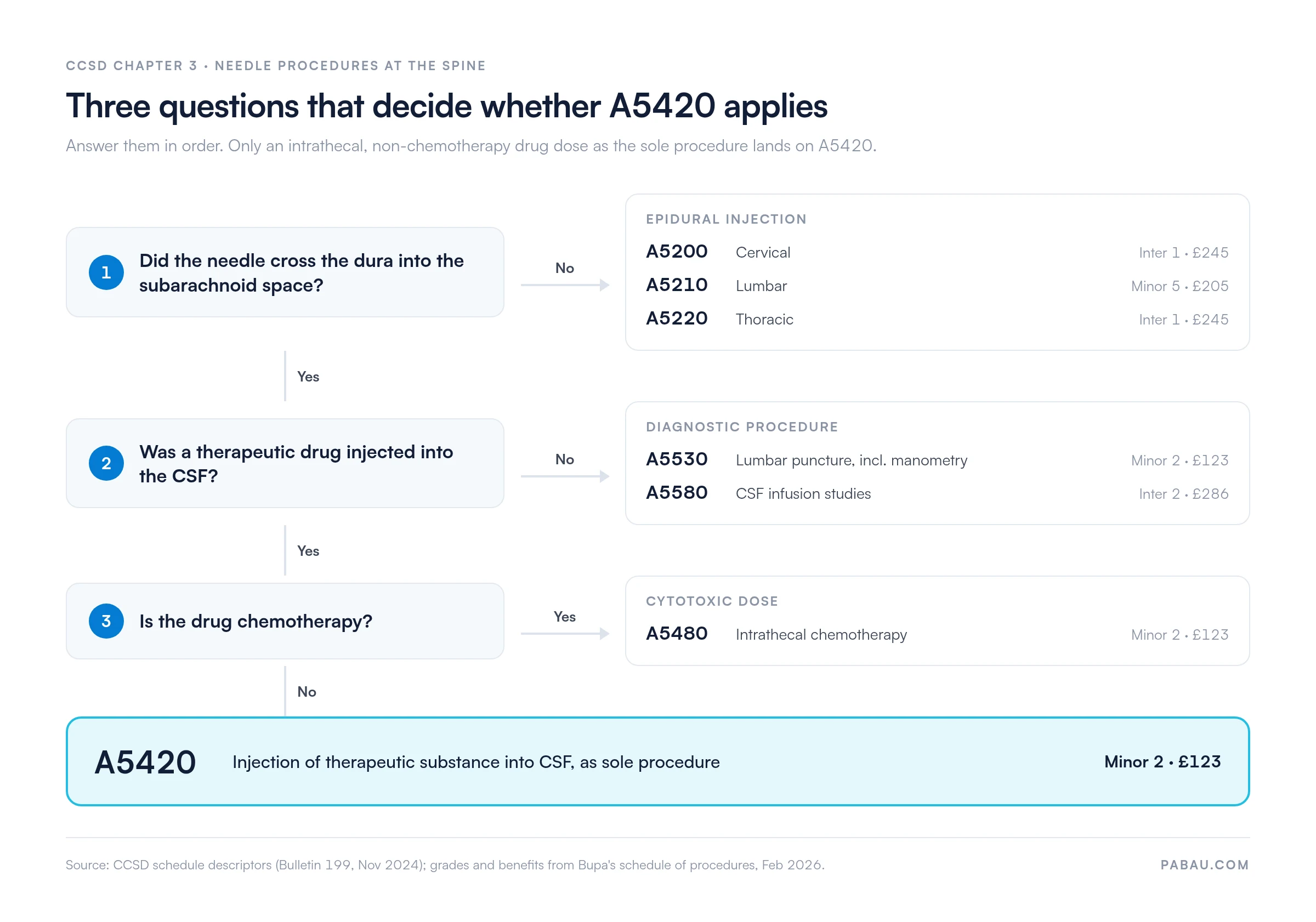
Two of these codes have their own reference pages. A5530 covers a lumbar puncture with manometry, and its guidance sends an intrathecal injection to A5420 or A5480 instead. A5580 covers CSF infusion studies, a diagnostic test of CSF dynamics.
Confirm current descriptors against the CCSD technical guide before finalizing a code. Descriptors are reviewed periodically, and an older edition of the schedule may miss recent changes.
A5420 claims are audited against the procedure note. Insurers check whether the record substantiates the intrathecal route. A note that is vague about needle depth or omits CSF confirmation counts as incomplete, and the claim can be denied on that basis alone.
Keeping structured patient records from consent through post-procedure monitoring reduces audit exposure and speeds up claim processing.
A complete procedure note for A5420 should include:
Document CSF confirmation as a positive, active statement in the procedure note: ‘Clear CSF observed flowing freely from needle hub prior to injection.’ A passive or indirect reference such as ‘position confirmed’ or ‘standard intrathecal technique used’ is too vague for most insurer audits.
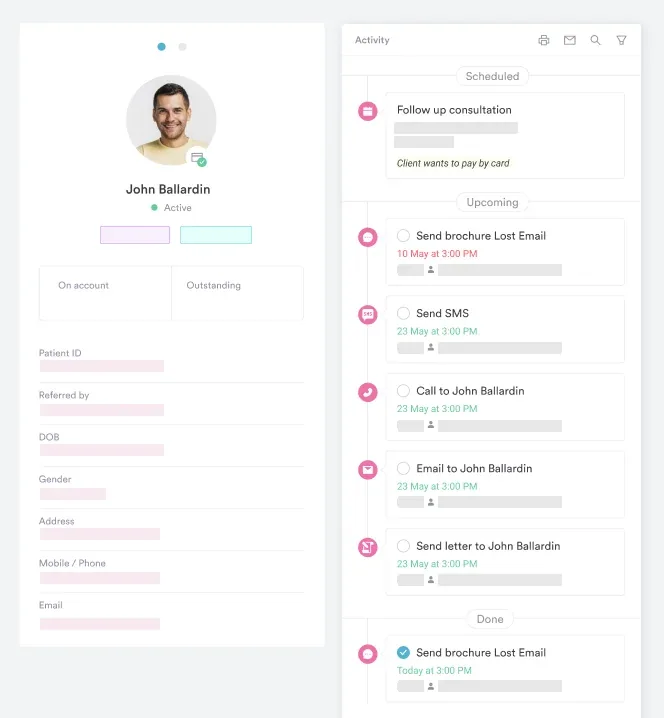
Digital forms with procedure-specific templates prompt for each mandatory field at the point of care. That way a missing field is caught at the bedside rather than at claims submission.
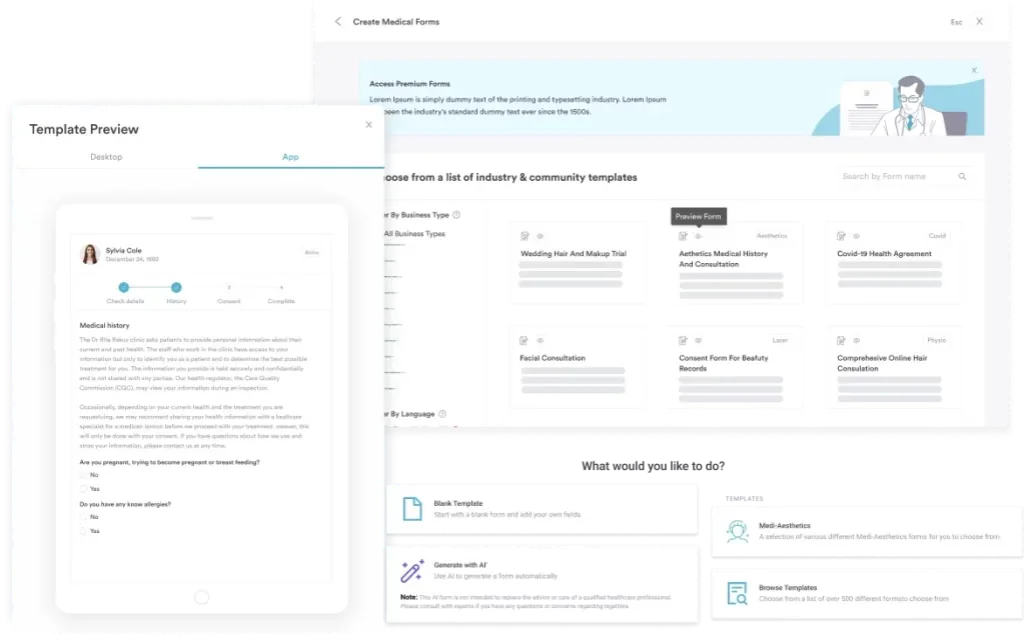
CCSD Code A5420 is billed to the patient’s private medical insurer as part of the procedure invoice. Each insurer publishes its own fee schedule and benefit table based on the CCSD schedule. Benefit levels, shortfalls, and excess structures vary between insurers and between policy tiers.
For insurer-specific fee lookups, use the insurer’s own tool. The Healix fee schedule and the Vitality fee finder both support CCSD code searches. For Bupa, the Bupa code search tool gives current benefit values and billing rules.
For a fuller overview, see the Bupa CCSD code reference and the broader Bupa fee schedule guide.
Key billing considerations for A5420:
Most A5420 denials fall into one of five categories, and each has a direct documentation or coding fix. Claims management software that tracks every claim’s status helps practices spot repeat denial reasons and fix the notes behind them.
Most denied A5420 claims can be overturned if the appeal answers the stated denial reason with targeted documentation. Resubmitting the original note without correction rarely succeeds.
Without a connected system, an A5420 claim gets assembled from scattered parts. The CSF confirmation sits in a free-text note, the authorization code in an email, and someone retypes both into the claim.
Pabau, the practice management platform we build, keeps those parts in one patient record. A digital form can make CSF confirmation a standard field in the procedure note. When you raise the claim, patient, treatment and insurer details pre-fill from that record.
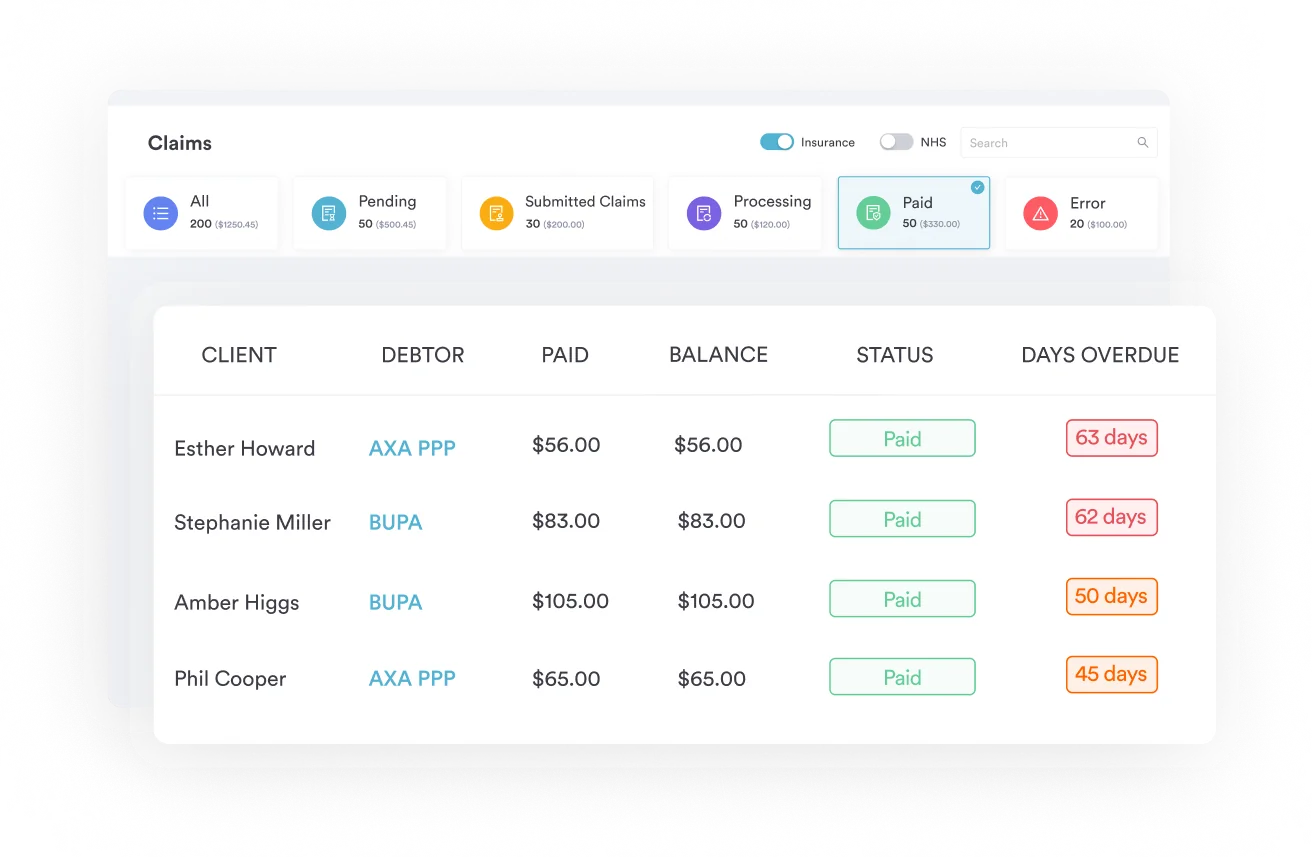
Validation checks flag missing details, such as membership numbers and authorization codes, before the claim goes out. UK practices can submit through Healthcode or by email, then follow each claim through to payment in one view.

Pabau pre-fills CCSD claims from the patient record and flags missing authorization codes before submission. Track every claim from submitted to paid in one view.

Code A5420 only when a therapeutic drug goes into the CSF as the whole procedure. Chemotherapy belongs to A5480, a diagnostic tap to A5530, and an epidural to its regional code.
Once the code is right, the procedure note decides whether the claim pays. Make CSF confirmation a required line in your intrathecal template, and one of the most preventable denials never reaches the insurer.
Book a demo to see how Pabau turns a complete procedure note into a pre-filled A5420 claim.

Managing CCSD codes across Bupa claims? Bupa CCSD codes reference covers the full Bupa schedule and how CCSD codes map to its fee structure.
Coding the diagnostic tap instead? CCSD Code A5530 explains lumbar puncture billing, including when an injection moves the claim to A5420.
Measuring CSF dynamics rather than injecting? CCSD Code A5580 covers CSF infusion studies and the pressure recording insurers expect.
Need a broader view of insurer fee schedules? Bupa procedure codes fee schedule explains how UK private medical insurers structure CCSD-based benefits.
Seeing the same denial reasons repeat? Denial management in healthcare sets out a process for tracking and preventing repeat denials.
CCSD Code A5420 covers injecting a therapeutic substance into the cerebrospinal fluid (CSF) via the intrathecal route, as the sole procedure. It excludes the drug cost, a diagnostic lumbar puncture, intrathecal chemotherapy, and epidural-only procedures.
An intrathecal injection penetrates the dura mater and delivers the substance into the subarachnoid space. An epidural injection stops short of the dura. Only intrathecal access qualifies under A5420, while epidurals take A5200, A5210 or A5220. Billing an epidural as A5420 is a coding error and a common cause of denials.
Clinically indicated drugs given intrathecally as the sole procedure qualify. Examples include baclofen for spasticity, opioids and local anesthetics for pain, and antibiotics for CNS infection. Intrathecal chemotherapy, such as methotrexate or cytarabine, is coded A5480 instead. The drug should be MHRA-licensed for the indication, because unlicensed use may fail an insurer’s medical necessity review.
The most common reasons are the wrong code (an epidural billed as intrathecal) and missing or vague CSF confirmation. No prior authorization for an elective procedure is another. Others are adding a lumbar puncture code for the same needle insertion, and a drug the insurer does not cover.
Not as a rule. A5420 applies when the injection is the sole procedure. Guidance for A5530 codes an injection given during a tap as A5420 or A5480 instead of A5530. Billing both for one needle insertion is likely to be denied as an unbundling error.
Prior authorization requirements vary by insurer and policy type. Some insurers require pre-approval for elective intrathecal procedures, particularly planned treatment courses. Check with the specific insurer before scheduling, since one insurer’s rules do not carry over to another.



