

CCSD code G5100: Bypass of duodenum billing guide
CCSD code G5100 bills a bypass that leaves the duodenum in place CCSD code G5100...

Last Updated: Oct 16, 2026
20310 is the CCSD code for follow-up outpatient consultation. It covers a subsequent face-to-face review by a consultant in an outpatient setting. That review has to fall inside the episode of care opened by an initial consultation under code 20300.
The fee pays for the consultant's time, the assessment and the letter back to the referring clinician. Procedures and investigations performed at the same attendance carry their own CCSD codes. A remote follow-up is coded 20365 instead.
Let Pabau's smart automation suggest the right codes, reduce claim denials, and keep your practice compliant—effortlessly.
Automate repetitive tasks and focus on what matters most—your patients.
Reduce coding errors and ensure compliance with the latest regulations.
Clean claims, fewer denials, and faster reimbursements.
Powerful insights and reporting to help your practice thrive.
HIPAA compliant SOC 2 certified GDPR-compliant Trusted by 4,000+ clinics worldwide

CCSD code 20310 covers a follow-up outpatient consultation by a consultant-grade clinician within an active episode of care.
It is distinct from 20300, the initial consultation code, and confusing the two is the leading cause of denial.
A remote follow-up has its own CCSD code, 20365, so 20310 is not the code for a telephone or video review.
Pre-authorization, episode linkage and a dated clinical note are expected by Bupa, AXA Health, Aviva and Vitality Health.
Pabau submits CCSD claims through Healthcode with the patient, treatment and insurer details already filled in.
CCSD code 20310 is the Clinical Coding and Schedule Development code for a follow-up outpatient consultation. It covers a subsequent face-to-face review by a consultant in an outpatient setting. That review has to fall inside the same authorized episode of care in which the initial consultation, code 20300, was billed.
The CCSD Group maintains the schedule this descriptor is drawn from, and your insurer’s portal carries the current wording. The code sits in the CCSD consultation family alongside 20300, 20320 and 20330. Like every CCSD code, it applies only to UK private healthcare billing, with no equivalent in the NHS tariff or in CPT coding.
The 20310 fee pays for the consultation itself. That means the clinician’s time, the assessment, the management advice and the letter back to the referrer. It does not cover procedures, investigations or imaging performed at the same attendance. Those carry their own CCSD procedure codes, submitted alongside 20310 on the same claim.
Take an impedance audiogram performed at the same review. It is billed on its own line under 20230, and the attendance stays coded 20310.
Cardiology follows the same pattern. An exercise ECG performed at that attendance is an investigation in its own right, billed under 20130 on a separate claim line.
Key scope boundaries to know before billing:
The most common coding error on follow-up claims is billing 20300 instead of 20310, or the reverse. Both codes cover a consultant-led outpatient consultation, but they are not interchangeable. 20300 is for the first assessment in a new episode of care, and 20310 is for every subsequent review inside that same episode.
Billing 20300 for a patient already inside an active episode is an over-claim. Any payer that cross-references episode history will reject it.
20310 sits in a family of six consultation codes, split by setting and by whether the review happens in person. The grid below shows which attendance takes which code. The wider schedule these sit in is indexed under CCSD codes.
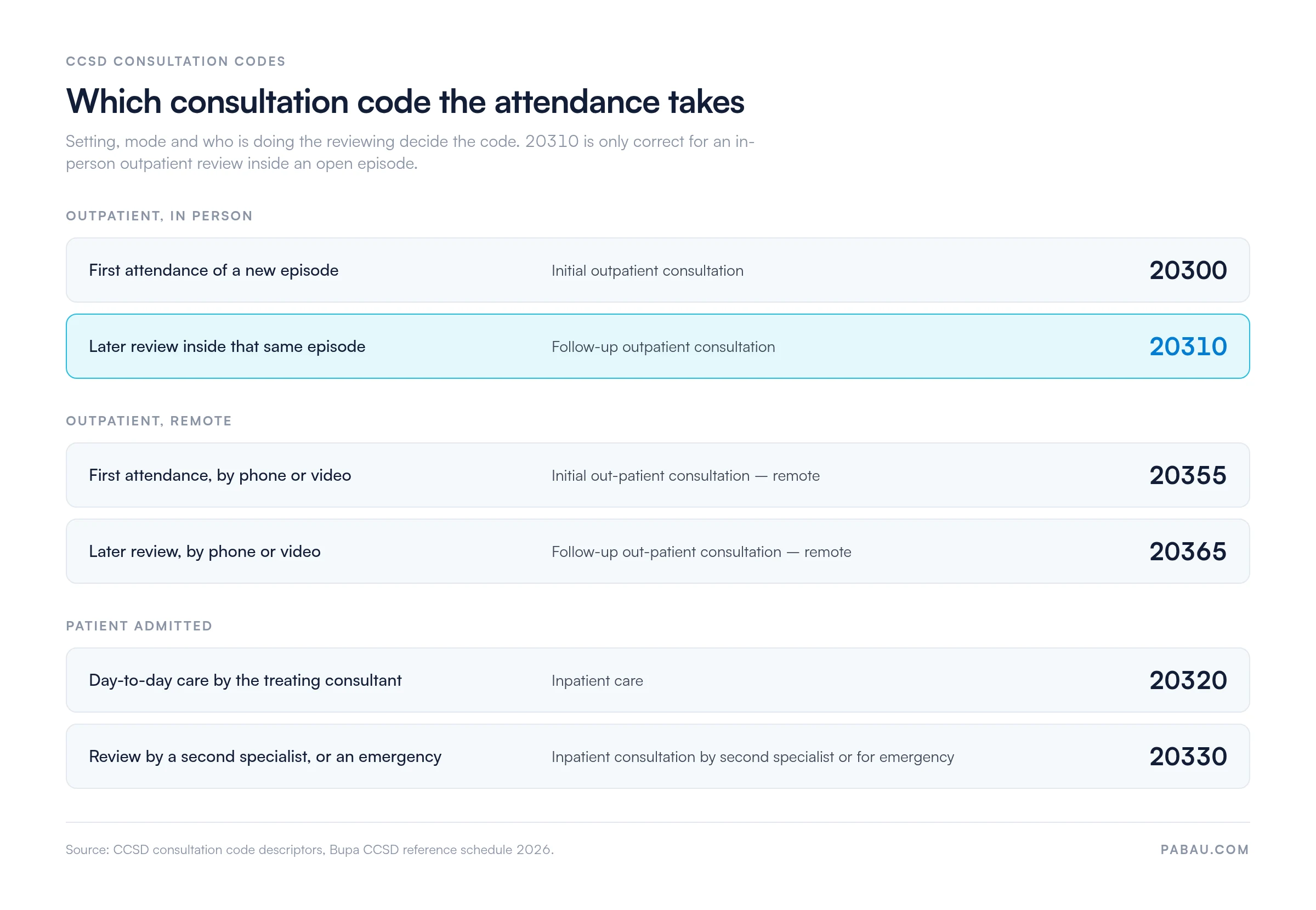
The official descriptors, with the attendance each one is written for:
If a patient who completed treatment under one episode returns months later with a recurrence, that visit needs a new 20300. The episode has to be open at the date of service for 20310 to be valid.
A 20310 claim is paid only where the documentation shows a consultant-led follow-up inside a live episode. Most rejections at the documentation stage are preventable, and the fix is usually a field nobody filled in.
Every 20310 claim should be supported by:
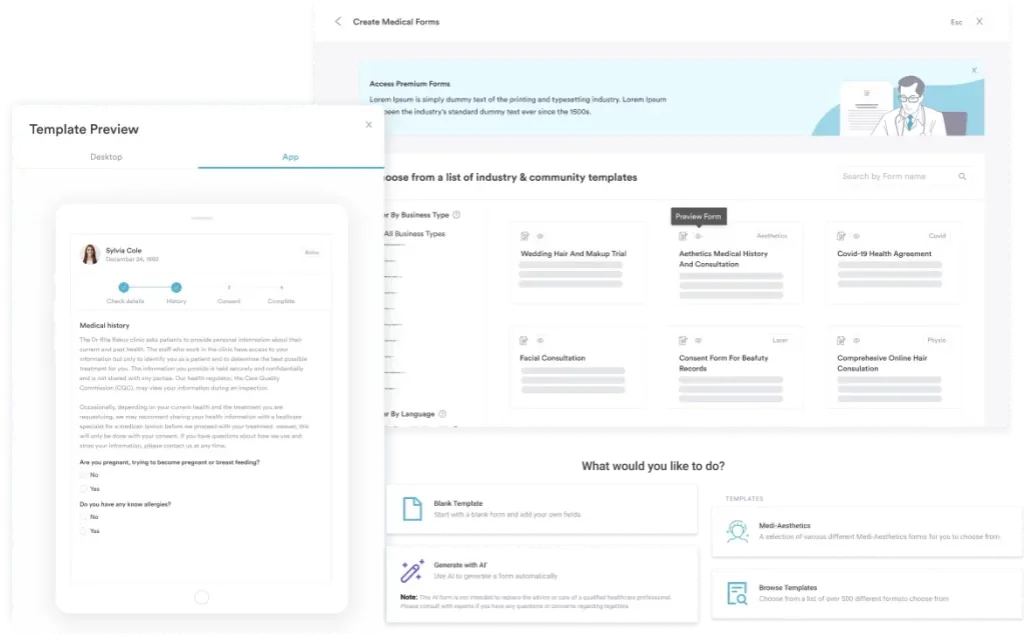
Digital consultation forms write the date, the clinician’s name and the episode reference straight into the patient record. That removes the commonest cause of a missing field at claim time. Practice management software like Pabau attaches the completed form to the encounter it belongs to, so the note and the claim never drift apart.
Record the episode reference number in the clinical note itself, not only on the claim form. A query raised weeks later is then answered straight from your own records, with no need to cross-reference two systems.
Every major UK private medical insurer accepts CCSD code 20310 as the standard follow-up outpatient consultation code. Pre-authorization requirements and episode limits differ between them, so confirm the specifics with each payer before billing. The table below covers the four largest UK private medical insurers, and their policies are revised periodically.
Vitality accepts digital invoices only and asks providers to submit through Healthcode, which is the same route the other three payers use.
Most UK private consultants submit CCSD claims electronically through Healthcode, the EDI billing network the major UK insurers share. The steps below describe a Healthcode submission, and a paper claim follows the same sequence.
An impedance audiogram carried out as part of another procedure is billed under CCSD code 20240, not under the standalone investigation code. That code needs the host procedure code on the same claim, or the insurer rejects the line.
Denial rates on follow-up consultation claims run higher than on initial consultations. 20310 depends on three things 20300 does not: a prior 20300 claim, an open episode and a valid pre-authorization number. Any one of the three can be wrong. The most frequent denial reasons are:
The appeals route for a denied 20310 claim is broadly consistent across payers. It is also the first question a billing team faces after a rejection, and the sequence below is what usually resolves one.
Fee levels for CCSD code 20310 vary by insurer and are revised on each payer’s own schedule, usually once a year. No single published fee applies across all insurers, so check current rates against each fee schedule.
The structure is consistent, though: the 20310 rate sits below the 20300 rate, because a review is shorter than a first assessment.
Self-pay patients are billed at the consultant’s own published rate, which need not follow the insurer schedule. Many consultants set that rate slightly above it, since self-pay work carries none of the insurer-driven volume.
For verified figures, go to each payer directly:
Practice management software that connects to Healthcode removes most of the manual steps in a 20310 workflow. Instead of retyping the code, the episode reference and the consultant’s details into a portal, a connected system reads them from the patient record.
Pabau supports CCSD billing through its claims management software. Insurer details sit on the patient record, so a claim routes to the right payer and the patient, treatment and insurer fields arrive pre-filled.
Validation checks run in the background and hold the submission until required details such as the membership number and authorization code are present.
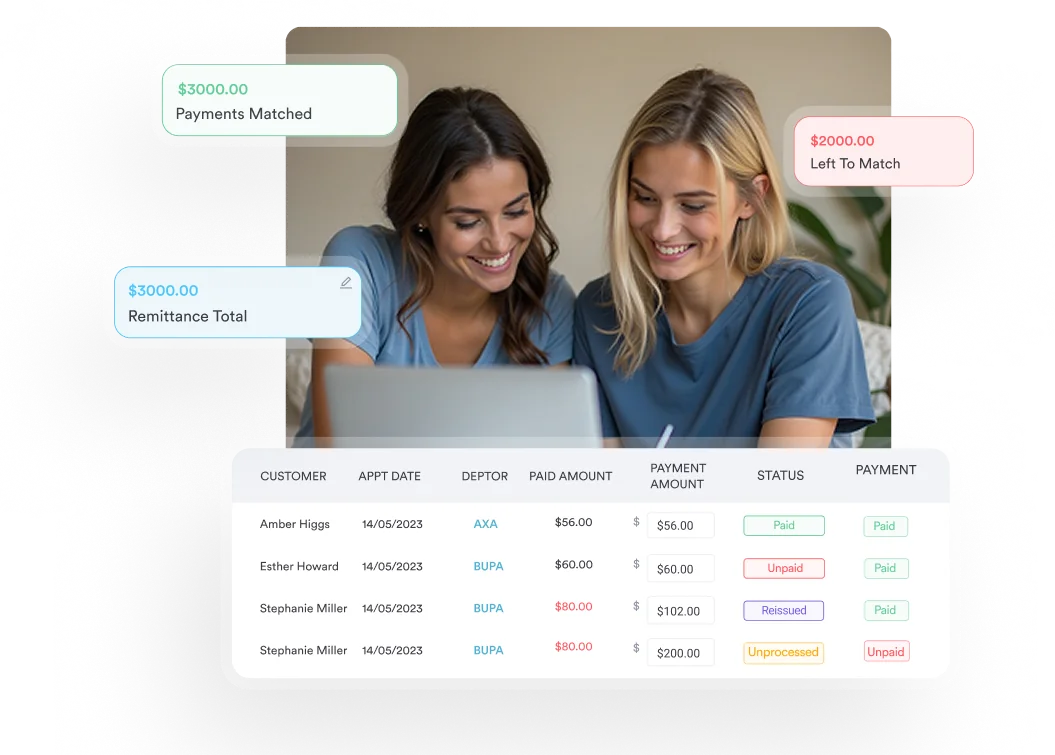
Every claim then sits on one dashboard, moving through pending, submitted, processing, paid or error, filterable by date, insurer or invoice ID. For a practice running a high volume of follow-up consultations, that replaces the spreadsheet usually kept alongside the portal.
Set a reminder four weeks before an episode reaches its authorized end date. Requesting an extension in advance is far simpler than appealing a denied claim once the episode has lapsed.

Pabau connects your consultation workflow to Healthcode and pre-fills each CCSD claim from the patient record. Book a demo to see it running in a UK private practice.

CCSD code 20310 is simple in principle. Bill it for a consultant-led follow-up outpatient consultation inside an active, pre-authorized episode of care.
The errors cluster in three places: confusing 20310 with 20300, submitting without a valid authorization reference, and letting the episode lapse before the visit.
Getting those three right prevents most rejections before they happen, and it costs far less time than any appeal. Pabau links the consultation record to the Healthcode submission, so the claim carries what the payer asked for. Book a demo to see how it handles CCSD billing for a UK private practice.

Want a reference for the full Bupa CCSD schedule? Bupa CCSD codes runs through the schedule code by code, with descriptors and billing notes.
Checking what a code pays before you invoice? Bupa procedure codes and fee schedule explains how to find a code, get it pre-authorized and avoid a billing surprise.
Working through a rejection reason code? Denial codes in medical billing decodes the reasons payers return and what each one asks you to fix.
CCSD code 20310 is the Clinical Coding and Schedule Development code for a follow-up outpatient consultation in UK private healthcare. It covers a subsequent face-to-face review by a consultant, inside the same pre-authorized episode of care in which the initial consultation, code 20300, was billed.
Code 20300 is for the initial outpatient consultation at the start of a new episode of care. Code 20310 is for every subsequent follow-up review inside that same episode. Using 20300 for a patient already in an active episode is an over-claim, and the insurer will reject it.
Obtain a pre-authorization number from Bupa before the appointment, then complete a dated clinical note on the day. Submit the claim through Healthcode with code 20310, the authorization number and the consultant’s recognized name. Confirm the episode is still open before you bill.
There are four usual causes. No prior 20300 claim on file for the same episode, an expired episode of care, or a missing or invalid pre-authorization number. The fourth is a billing clinician the insurer does not recognize at consultant grade. Check the denial reason code on the Healthcode portal first.
No. CCSD publishes a separate code for a remote follow-up outpatient consultation, 20365, and a telephone or video review is coded there instead. Code 20310 is written for an in-person attendance. Confirm each insurer’s remote consultation policy before billing either code.
Yes, but not at the same appointment. An episode begins with one 20300 for the initial consultation, then uses 20310 for each subsequent review. Billing both codes on the same date of service for the same patient and episode is rejected as a duplicate or an over-claim.



