

CCSD code G5100: Bypass of duodenum billing guide
CCSD code G5100 bills a bypass that leaves the duodenum in place CCSD code G5100...

Last Updated: Oct 16, 2026
20150 is the CCSD code for patch testing, inclusive of application, reading and reporting. Standardized allergens are applied to the skin under occlusion, then graded at set intervals to detect delayed-type hypersensitivity.
The code is episodic. One claim covers the whole series of appointments, from application through the final reading, so a separate procedure code is never billed per reading.
Let Pabau's smart automation suggest the right codes, reduce claim denials, and keep your practice compliant—effortlessly.
Automate repetitive tasks and focus on what matters most—your patients.
Reduce coding errors and ensure compliance with the latest regulations.
Clean claims, fewer denials, and faster reimbursements.
Powerful insights and reporting to help your practice thrive.
HIPAA compliant SOC 2 certified GDPR-compliant Trusted by 4,000+ clinics worldwide

CCSD code 20150 covers the full patch testing episode, not individual consultation visits.
Every reading, at 48 hours and again at 72 to 96 hours, belongs in the clinical notes.
Most major UK private insurers require pre-authorization before patch testing begins.
Photopatch testing and skin prick testing use separate CCSD codes and must not be billed under 20150.
Practice management software like Pabau keeps the allergen list, the readings and the authorization number in one patient record.
CCSD code 20150 describes patch testing, inclusive of application, reading and reporting. Standardized allergen preparations are applied to the patient’s skin under occlusion.
They are then read at set intervals to detect delayed-type (Type IV) hypersensitivity reactions. The code covers the whole episode of care rather than each appointment, which sets it apart from per-consultation codes elsewhere in the CCSD schedule.
The code sits in Chapter 1 of the CCSD schedule, “Simple investigations and procedures”, under the Investigation Codes category. Bupa lists it with no complexity band and no benefit maximum. Other Chapter 1 investigation codes sit on the same footing, including 20240.
It is used almost exclusively by consultant dermatologists, clinical immunologists and specialist allergy nurses in private practice. It maps to the investigation of allergic contact dermatitis (ACD), occupational skin disease, and chronic eczematous conditions where a contact allergen is suspected.
Because the code is episodic, a single CCSD 20150 claim covers several appointments. Practices that bill a separate procedure code for each reading appointment are miscoding the episode, and they risk rejection or audit. The sequence below shows where each visit falls and when the claim can go out.
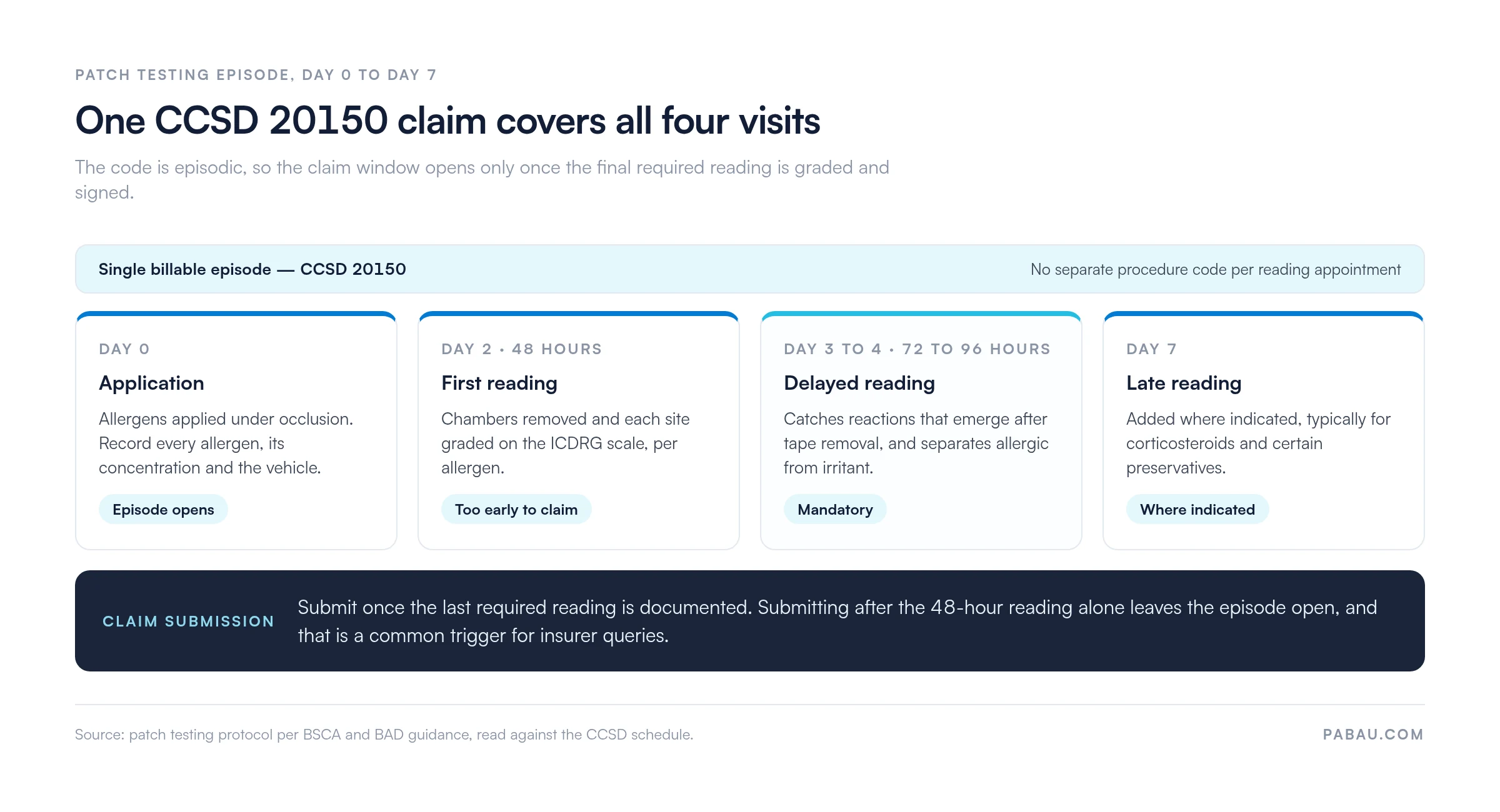
Patch testing is a multi-stage procedure conducted over four to seven days. Each stage generates documentation that has to appear in the clinical record. Billing teams need to know the steps, because that record is what supports the CCSD 20150 claim.
The standard protocol recommended by the British Society for Cutaneous Allergy (BSCA) and the British Association of Dermatologists (BAD) follows these stages:
Each reading must be dated, signed, and linked to the original allergen list in the clinical record. Billing teams should confirm with the treating clinician that every reading is documented before the claim goes out.
The code applies regardless of which allergen panel the clinician selects, provided the procedure follows the standard patch testing protocol. The panels most commonly used in UK private practice are:
Photopatch testing is not covered by CCSD 20150. The procedure adds a UV irradiation step to identify photoallergens, making it clinically and procedurally distinct. Billing it under 20150 counts as miscoding.
Check the current CCSD Technical Guide for the applicable photopatch code, and confirm it with the insurer before you submit.
The multi-visit reading schedule causes more billing errors than any other part of the procedure. CCSD 20150 covers an episode rather than a single visit, so every reading must be completed and documented before the claim is submitted. Submitting after the day-2 reading alone, with the day-4 reading still to come, is a common trigger for insurer queries.
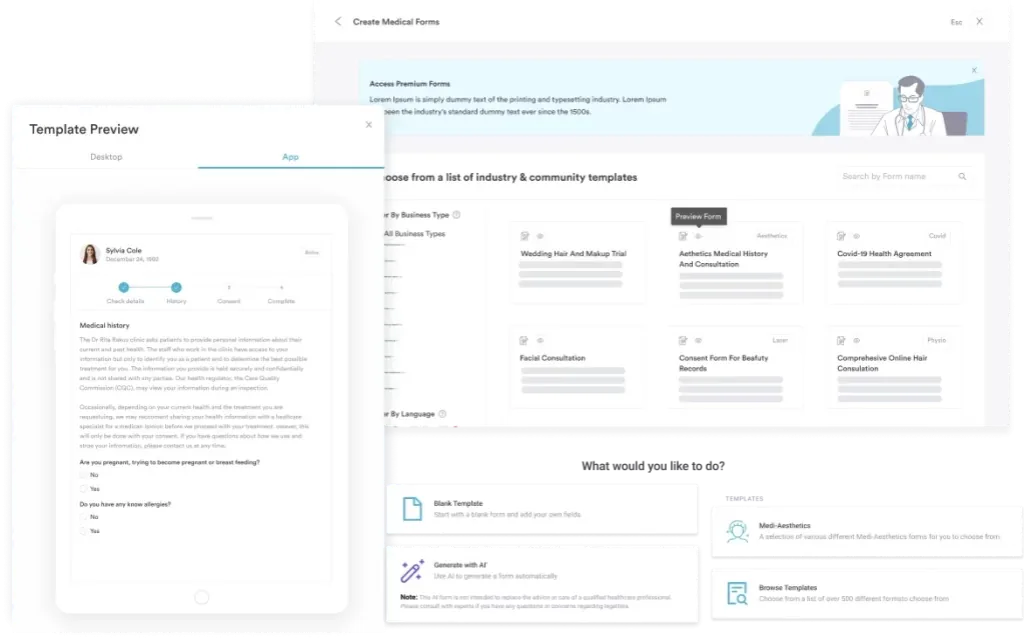
Structured digital forms for each reading appointment keep the grades, dates and signatures in one place. A practice that captures the ICDRG grade for every allergen at every time point will rarely face a documentation-based denial.
A valid CCSD 20150 claim needs a clinical record that reconstructs the full episode. Insurers can request notes at any time, and an incomplete record is the most common reason a paid claim is clawed back at audit.
The clinical note must contain:
Practices on a paper-based system should scan and upload the record before the claim is submitted. Electronic patient records give you timestamped entries and searchable allergen data instead.
Some insurers also want the referral letter from the GP or specialist who requested the investigation, so confirm what they need before the episode starts.
Submit your CCSD 20150 claim only after the final reading is complete and all notes are signed and dated. Submitting mid-episode is a common cause of insurer queries and delayed payment. Build a claim checklist into your billing workflow that includes a sign-off step for the treating clinician.
Most UK private medical insurers require pre-authorization before patch testing proceeds. Performing the procedure without approval is the leading cause of CCSD 20150 claim denial, however well the episode is documented. Missing approval heads the rejection list on other CCSD investigation codes as well, including CCSD code 20230.
Insurer policies change regularly, so check the insurer’s current guidelines directly rather than relying on prior experience with a plan. Recording the pre-authorization reference in the patient record and on the invoice is mandatory for most insurers. It also heads off the single most common cause of denial.
For a practice juggling several insurer relationships, recording pre-authorization status per patient stops approval being missed before the procedure starts. Our guide to Bupa CCSD codes covers the insurer-specific workflow in more detail.
Billing CCSD code 20150 correctly means finishing each step before the next begins. Skipping pre-authorization and submitting before the episode closes are the two costliest errors in practice.
Billing teams handling several insurers benefit from a workflow that prompts each step and records authorization references against the patient record. That cuts the manual tracking burden, which matters most for practices running patch testing in volume.
Patch testing sits within a family of allergen and skin investigation procedures in the CCSD schedule. Using the wrong one, particularly confusing patch testing with skin prick testing, is a frequent billing error.
The billing distinction between patch testing and skin prick testing is the immunological mechanism. Patch testing detects delayed hypersensitivity to contact allergens and needs several appointments. Skin prick testing detects immediate IgE-mediated reactions and produces results within 15 to 20 minutes.
Billing one under the other’s code is miscoding, and it will be challenged at audit. Confirm the current numbers in the live schedule before you submit. Our reference library of CCSD codes shows how the rest of the schedule is organized.
Most CCSD 20150 denials are preventable. The same six issues appear again and again across UK private practices.
Tracking denial reasons by insurer and by code turns a scatter of rejections into a short list you can work through. Claims management software that flags a missing authorization reference before submission stops the most common failure before the invoice leaves the practice.
Keep a running log of denial reasons by insurer for your CCSD 20150 claims. If one insurer repeatedly queries allergen documentation, ask their provider relations team what format they prefer, then build a matching template into your clinical notes. Three months of denial data is usually enough to show a pattern.
Patch testing under CCSD 20150 is supported by established UK clinical guidelines, which matters when an insurer challenges medical necessity.
The British Society for Cutaneous Allergy (BSCA) and the British Association of Dermatologists (BAD) publish joint guidance on patch testing. It covers the indications and how the procedure should be conducted.
CCSD 20150 billing is built around the standard of care they define. That includes the European baseline series as the starting panel, and the multi-reading schedule. Citing BSCA and BAD guidance in the clinical record, alongside the clinical rationale, strengthens the claim against challenge.
The International Contact Dermatitis Research Group (ICDRG) grading scale is the recognized system for recording reaction results. Using it consistently shows that the documentation meets the standard UK and European specialist bodies expect.
Practices taking occupational skin disease referrals should also know the NHS occupational dermatology pathway guidance. In some cases it supports onward referral to private allergy services where NHS waiting times are prohibitive. Documenting the referral pathway and the clinical rationale in full supports both the clinical record and the billing position.
Private dermatology and allergy practices billing CCSD 20150 face one specific administrative problem. The procedure generates several clinical contacts across several days, each needing dated and signed documentation, before a single claim can go out. Tracked by hand in a busy practice, one of those entries eventually goes missing, and the claim stalls.
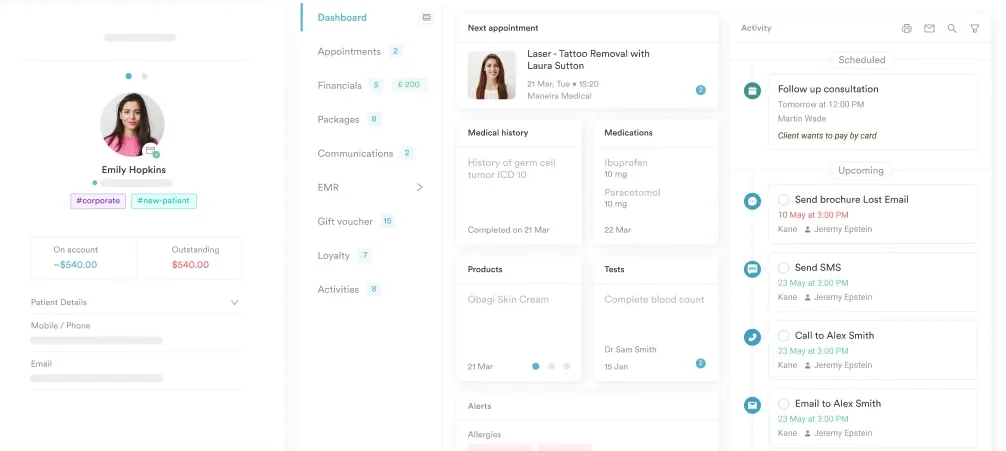
Practice management software like Pabau is built for that shape of work. Clinical notes for each reading appointment are structured, timestamped, and attached to the patient’s record. The allergen list from the application visit travels through the episode, so the day-4 reading is graded against the same list it started with. Pre-authorization reference numbers are recorded against the patient before the first appointment takes place.
For practices working with several insurers, procedure codes such as CCSD 20150 can be mapped to each insurer’s invoicing template. That removes the reformatting step every payer otherwise adds to the billing run, so your team spends its afternoon on patients rather than on paperwork.

Pabau gives UK dermatology and allergy practices structured clinical notes, pre-authorization tracking, and insurer billing in one place. See how it handles a multi-visit CCSD episode.

CCSD code 20150 is a straightforward episodic code, as long as the documentation keeps pace with the procedure and pre-authorization is treated as non-negotiable. The practices that avoid denials build both into the patch testing episode from day 0. They are not assembling a claim from memory a week after the last reading.
So the decision worth making now is procedural, not clinical. Pin down when your team records the authorization number, and when the claim is released. Get those two moments right and most of this article stops applying to you. Book a demo to see how Pabau keeps a multi-visit patch testing episode claim-ready from the first appointment.

Looking up a different procedure? CCSD codes is the reference library for the schedule, organized by chapter and category.
Want to understand the full CCSD fee schedule? Bupa procedure codes fee schedule explains how fee schedules are structured and how practices use them for accurate invoicing.
Chasing rejected claims more often than you would like? Denial codes in medical billing decodes the rejection reasons payers send back and what each one asks you to fix.
CCSD code 20150 covers the complete patch testing episode, from allergen application on day 0 through every required reading. Readings typically fall at 48 hours and again at 72 to 96 hours. It is an episodic code, so a single claim covers all attendances within the episode rather than billing per visit. It applies to standard epicutaneous patch testing using panels such as the British baseline series, an extended series, or a bespoke occupational panel.
Obtain insurer pre-authorization before patch testing begins and record the authorization reference in the patient record. Complete all clinical readings and document them in full. Then submit CCSD 20150 with the authorization reference, the treating clinician’s GMC number, and the episode dates. Submit only once the final reading is completed and documented.
Most major UK private medical insurers require pre-authorization before patch testing is performed. Bupa and Aviva typically require it, while AXA Health and Vitality requirements vary by policy. Check directly with each insurer before the procedure, because policies change and plan tiers carry different rules. Missing pre-authorization is the most common cause of CCSD 20150 claim denial.
Photopatch testing applies allergens under occlusion, then irradiates the site with UV light before reading. It identifies photoallergens such as certain sunscreen ingredients. It is clinically distinct from standard patch testing and carries its own CCSD code. Billing photopatch testing under CCSD 20150 is miscoding, so verify the correct photopatch code in the current CCSD schedule before submitting.
The clinical record must include every allergen applied with its concentration and vehicle, plus the date of application. It also needs dated and signed entries for each reading, with the ICDRG grade recorded per allergen. Add the clinician’s name and GMC number, plus a clinical interpretation of the results. Incomplete allergen documentation and missing reaction grades are the most frequent documentation-related reasons for claim queries.
The usual causes are a missing pre-authorization reference, a claim submitted before all readings are complete, and incomplete allergen documentation. The wrong code and a missing GMC number account for most of the rest. Photopatch or skin prick testing billed under 20150 is the classic wrong-code error. Policy exclusions for pre-existing skin conditions also cause denials when coverage is not verified before the episode begins.



