ICD-10 Code S42.444P: Medial epicondyle fracture, right humerus
ICD-10 Code S42.444P: full descriptor and code validity ICD-10 Code S42.444P car...

Last Updated: Oct 13, 2026
Billable Code Specific Code
Z63.4 is the billable ICD-10-CM code for disappearance and death of family member.
It records bereavement as a psychosocial factor rather than a clinical disorder. That makes it the right code when grief drives the encounter but no diagnosis threshold is met.
Two judgment calls account for most Z63.4 rework. One is sequencing it against a comorbid F code. The other is deciding when grief crosses into F43.81.
Let Pabau's smart automation suggest the right codes, reduce claim denials, and keep your practice compliant—effortlessly.
Automate repetitive tasks and focus on what matters most—your patients.
Reduce coding errors and ensure compliance with the latest regulations.
Clean claims, fewer denials, and faster reimbursements.
Powerful insights and reporting to help your practice thrive.
HIPAA compliant SOC 2 certified GDPR-compliant Trusted by 4,000+ clinics worldwide

ICD-10 Code Z63.4 (Disappearance and death of family member) is a billable ICD-10-CM code effective October 1, 2025, under parent category Z63.
Z63.4 captures uncomplicated bereavement as a psychosocial factor. When grief becomes clinically prolonged, F43.81 (prolonged grief disorder) applies instead.
Z63.4 can function as a primary diagnosis when bereavement is the chief reason for the encounter. Some payers restrict Z code primary use, so verify payer policy before submitting.
Practice management software like Pabau pairs claims management with Pabau Scribe, our AI scribe, so Z63.4 documentation and clean claims come from one workflow.
ICD-10 Code Z63.4 is the billable ICD-10-CM diagnosis code for disappearance and death of a family member. It sits in the Z63 category, which covers other problems related to the primary support group and family circumstances.
Z63 belongs to the wider Z55-Z65 block for socioeconomic and psychosocial circumstances affecting health. The CDC/NCHS ICD-10-CM web tool confirms Z63.4 is valid and billable under the 2026 edition, effective October 1, 2025.
Z codes record factors influencing health status, not diseases. Z63.4 tells payers and reviewers that the encounter relates to a family member’s death or unexplained disappearance. That context can justify a visit on its own, or explain a symptom the patient reports.
You’ll see Z63.4 applied most often in outpatient mental health, primary care, hospice, and palliative care.
The table below summarizes the key technical attributes of Z63.4 as a billable code for quick reference.
An Excludes2 note means the listed conditions are not part of Z63.4. Both can sit on the same claim when the record documents both.
Z63.4 captures two related circumstances under one code. The first is the confirmed death of a family member. The second is a disappearance where death is presumed or unknown. Both can be legitimate reasons for a clinical encounter, particularly in mental health and primary care.
“Family member” under ICD-10-CM is broadly interpreted. The Official Guidelines give no exhaustive definition. Clinicians typically apply the term to spouses, partners, children, parents, siblings, and other close household members.
Some practices extend it to significant non-biological relationships, and the clinical narrative has to support that choice. Naming the relationship in the note costs a few words and settles the question for any reviewer.
Z63.4 does not require a concurrent psychiatric disorder. It covers the cases where grief is present, significant, and driving the encounter, but has not escalated to a diagnosable condition. That distinction shapes how you sequence the code against other diagnoses.
The ICD-10 Alphabetic Index routes several related terms to Z63.4. Knowing these synonyms helps coders find the right code when the note uses lay or clinical language rather than the official descriptor.
“Complicated grief” or “prolonged grief” in the clinical notes should prompt a review of whether F43.81 fits better. The index term alone does not decide code selection. The clinical record has to support the choice, and the AAPC ICD-10-CM code lookup helps with synonym cross-referencing and index navigation.
Correct application of Z63.4 turns on clinical judgment about the nature and severity of the grief. The code fits when bereavement is present, documented, and relevant to the encounter, without meeting the criteria for a recognized mental health disorder.
Z63.4 can serve as either a primary or a secondary diagnosis. As a primary diagnosis, it applies when bereavement is the sole or predominant reason for the encounter. That is most common in dedicated grief counseling, bereavement support groups, and hospice follow-up.
As a secondary code, Z63.4 records the psychosocial context alongside a primary disorder code such as F32.x or F43.20. The ICD-10-CM Official Guidelines, Section I.C.21, permit Z codes as additional codes for factors affecting a patient’s care or outcomes.
Some payers will not accept a Z code as the sole primary code, so verify the policy before you submit.
The most consequential coding decision around bereavement is whether the presentation warrants Z63.4 or F43.81. Both errors cost something. Under-coding to Z63.4 when F43.81 is indicated understates severity and can affect treatment authorization. Over-coding to F43.81 when grief sits within the normal range attracts audit scrutiny.
Three checks settle it, and they run in a fixed order.
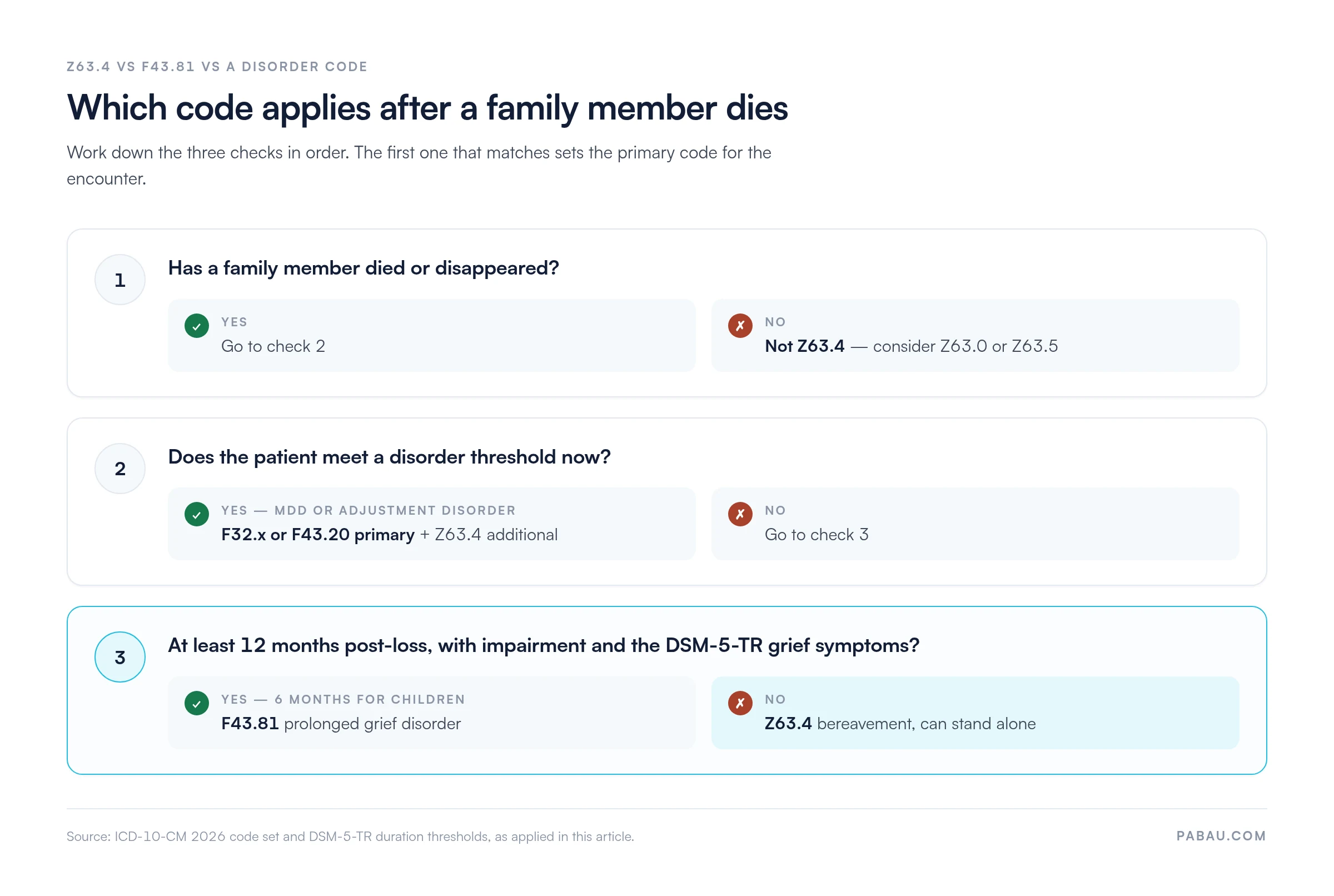
The table below sets out the features that separate the two codes once you reach that third check.
Bereavement-related presentations often overlap with adjacent diagnoses. The following codes come up frequently alongside Z63.4 in coding decisions.
Z63.0 and Z63.5 are alternatives to Z63.4, not companions to it. F43.20, F32.x, and Z71.89 can all sit on the same claim alongside it.
A weak support network is a different problem from a death in the family. When the note describes inadequate social support rather than a specific loss, Z60.8 is the code that fits.
Z63.4 is billable, and it is also auditable. Three things have to be clear in the record. A family member has died or disappeared. The loss is relevant to this encounter. And the clinician, not the coder, has linked the two.
A structured psychosocial history section in your evaluation template makes that reproducible from one bereavement encounter to the next.
Structured notes matter here because some payer systems route Z codes to manual review more often than primary F codes. A dedicated assessment section for psychosocial context is the simplest way to meet the standard on every bereavement encounter.
Flag Z63.4 encounters in your EHR for a brief documentation audit each quarter. Look for notes that name the loss but never connect it to the reason for the visit. That missing sentence is a common reason Z code claims get queried. One added line prevents the denial: “Bereavement following mother’s death is the primary reason for today’s session.”
Z63.4 is billable, but payer acceptance varies more than it does for F-code disorders. Knowing each payer’s rule before you submit is what keeps the claim moving.
Medicare and Medicaid: CMS generally permits Z codes as additional diagnosis codes. Using Z63.4 as a standalone primary code for a billable therapy session is a grayer area.
Local Coverage Determinations (LCDs) and National Coverage Determinations (NCDs) govern the specifics. Check the behavioral health LCD from your Medicare Administrative Contractor before submitting Z63.4 as the sole diagnosis. The CMS ICD-10 coding resources page links to the current coverage files.
Commercial payers: Most accept Z63.4 as an additional code without issue. Some apply benefit exclusions to claims that carry no disease code as primary. That restriction shows up most often in outpatient mental health.
Verify whether the payer’s behavioral health policy permits Z code primary billing before the claim goes out. The WHO’s ICD-10 browser is the authoritative international reference for how Z codes are meant to work.
CPT code pairing: Z63.4 on its own does not drive reimbursement. The CPT procedure code does. Common pairings are 90837 (individual psychotherapy, 60 minutes) and 90832 (30 minutes). Primary care encounters that address bereavement usually pair it with 99213 or 99214.
Accurate pairing is what makes the claim clean, so check the CPT procedure code descriptors against the session you delivered. A 60-minute code on a 30-minute note is a denial waiting to happen, whatever the diagnosis code says.
Practices with high Z-code volume get more from medical claims management that tracks acceptance rates by payer. Over a few months, that record tells you which payers want a comorbid F code and which take Z63.4 as a standalone primary.
Z63.4 errors cluster around three failure modes. One is a premature upgrade to F43.81. Another is incorrect sequencing. The third is a note too thin to defend on review.
Sound denial management in healthcare starts before the claim is submitted. Practices that build a Z code review into the pre-billing workflow catch sequencing errors themselves, rather than getting them back as denials.
Review your Z63.4 coding decisions at least quarterly. Watch the Z63.4-to-F43.81 boundary in particular, since that is where judgment varies most between clinicians in the same practice.
Z code documentation is where practice management software earns its keep. Finding Z63.4 is easy. The work is making sure the note carries the three or four sentences that defend it. That is a workflow problem more than a knowledge problem.
Pabau Scribe, our AI scribe, records the consultation and structures it into the note, pulling psychosocial context into the assessment section. On a bereavement encounter, the sentence explaining why the Z code applies gets captured while the clinician is still talking. Nobody has to reconstruct it a week later.
Pair that with a structured psychosocial history section in your note template. Z63.4 documentation then comes out of the standard clinical flow, instead of a coder chasing missing elements after the visit.
On the billing side, Pabau’s clearinghouse integration runs claim-level edits before submission. It checks CPT and ICD-10 pairing against payer rules. A Z63.4-primary claim sent with a therapy CPT code the payer won’t accept gets flagged at that stage, not after a denial.
Pabau’s reporting then shows how those claims landed across your payer mix. Over a quarter or two, the pattern of which payers want a comorbid F code becomes visible without anyone building a spreadsheet.

Pabau gives mental health and primary care teams one place to document, code, and submit. Its Claim.MD clearinghouse connection checks ICD-10 and CPT pairings before the claim leaves.

Z63.4 comes down to one discipline. Document the link between the loss and the encounter, every time. The code is billable, the scenarios are common, and the F43.81 boundary is workable once you know the thresholds.
The clinical judgment is rarely the hard part. Writing down the link between the loss and the encounter is the step that slips. Build that line into the note template, and Z63.4 claims stop coming back.
Pabau Scribe captures the clinical narrative while the session happens, and the claims workflow checks the code pairing before it goes out. If your practice codes Z63.4 every week, book a demo to see how the note and the claim connect.

Want fewer Z code claims coming back? Denial management in healthcare covers the pre-billing workflows that catch sequencing errors before the payer does.
Not sure what makes a claim pay on the first pass? What is a clean claim in medical billing walks through the fields and code pairings payers check before they pay.
Building documentation standards that survive an audit? Medical billing compliance explains the laws and violations behind defensible coding decisions, with a downloadable checklist.
ICD-10 Code Z63.4 documents a patient encounter related to the disappearance or death of a family member. It is a Z code, so it captures bereavement as a psychosocial factor affecting health rather than a clinical disorder. Mental health clinicians, primary care physicians, and hospice providers use it to establish the grief context for an encounter. It can stand alone as the primary code, or sit alongside a disorder code such as F32.x or F43.20.
Yes, Z63.4 is a billable and valid ICD-10-CM code for the 2026 edition, effective October 1, 2025. It can be submitted for reimbursement, though some payers restrict Z codes used as the sole primary diagnosis on mental health claims. Always verify the payer’s behavioral health policy before submitting Z63.4 as the principal diagnosis without a comorbid F code.
Z63.4 applies to uncomplicated bereavement, where grief is present but no clinical disorder threshold is met. F43.81 (prolonged grief disorder) applies once grief persists for at least 12 months after the loss, or 6 months for children. It also requires clinically significant functional impairment and the DSM-5-TR symptom cluster, including intense yearning, disbelief, and emotional pain most days. Duration, impairment, and that symptom cluster are the three differentiators.
Yes, when bereavement is the chief reason for the encounter and no other condition takes precedence. That is typical in dedicated grief counseling and hospice bereavement support visits. Some payers, including certain Medicare Administrative Contractors, restrict Z code primary billing for mental health services. Verify the applicable Local Coverage Determinations before submitting Z63.4 as the sole primary code.
The clinical record must identify the specific loss, naming the relationship and the approximate timeframe. It must document the connection between the bereavement and the reason for the encounter. It should also indicate, implicitly or explicitly, that no higher-threshold clinical disorder is present. A line such as “patient’s sleep disruption and low mood are directly related to grief following spouse’s death six weeks ago” is the standard. That is the language that makes Z63.4 defensible on audit review.
The parent code for Z63.4 is Z63, other problems related to primary support group, including family circumstances. Z63 sits within the Z55-Z65 block, which covers potential health hazards related to socioeconomic and psychosocial circumstances. Sibling codes include Z63.0 for problems with a spouse or partner, and Z63.5 for disruption of family by separation and divorce.