ICD-10 Code S42.444P: Medial epicondyle fracture, right humerus
ICD-10 Code S42.444P: full descriptor and code validity ICD-10 Code S42.444P car...

Last Updated: Oct 13, 2026
Billable Code Specific Code
Z12.6 is the billable ICD-10-CM code for encounter for screening for malignant neoplasm of bladder. It applies when an asymptomatic patient presents for bladder cancer screening and no malignancy has been confirmed.
Most Z12.6 denials come from the documentation around the code. Coders reach for it after hematuria is already recorded, or submit it with no risk-based rationale a payer will accept.
Let Pabau's smart automation suggest the right codes, reduce claim denials, and keep your practice compliant—effortlessly.
Automate repetitive tasks and focus on what matters most—your patients.
Reduce coding errors and ensure compliance with the latest regulations.
Clean claims, fewer denials, and faster reimbursements.
Powerful insights and reporting to help your practice thrive.
HIPAA compliant SOC 2 certified GDPR-compliant Trusted by 4,000+ clinics worldwide

Z12.6 is the billable ICD-10-CM code for an asymptomatic bladder cancer screening encounter in FY2026.
Switch from Z12.6 to a C67.x code the moment a bladder malignancy is confirmed during or after the screening visit.
Medicare has no national coverage determination for routine bladder cancer screening, so every claim needs a documented medical-necessity or risk-based rationale.
Practice management software like Pabau flags missing companion codes before a Z12.6 claim goes out, which lowers denial rates.
ICD-10 code Z12.6 is a valid, billable ICD-10-CM diagnosis code for fiscal year 2026, confirmed in the CDC/NCHS ICD-10-CM web tool. Its full official descriptor is “Encounter for screening for malignant neoplasm of bladder.” The code belongs to the Z12 category, which covers encounters for screening for malignant neoplasms. Z12 itself sits inside the Z00-Z13 range of factors influencing health status and contact with health services.
The CMS ICD-10-CM code files and the NCHS tabular list both list Z12.6 as a leaf-node code with no further specificity subdivisions. No additional characters are required or permitted.
An “encounter for screening” under ICD-10-CM means the patient has no current signs or symptoms of bladder cancer. They are presenting because a clinician or an established protocol has decided that screening is warranted. At the time of the encounter, the patient is asymptomatic with respect to bladder malignancy.
This distinction matters because it controls which code family governs the visit. Per ICD-10-CM Official Guidelines Section I.C.21.c.5, screening codes apply when the test looks for disease in an otherwise asymptomatic patient. If a symptom drives the visit, the symptom code takes the lead. If a confirmed malignancy is found or already known, a C67.x code applies instead of Z12.6.
Those three rules collapse into one question at the keyboard, and the answer decides both the code and its position on the claim.
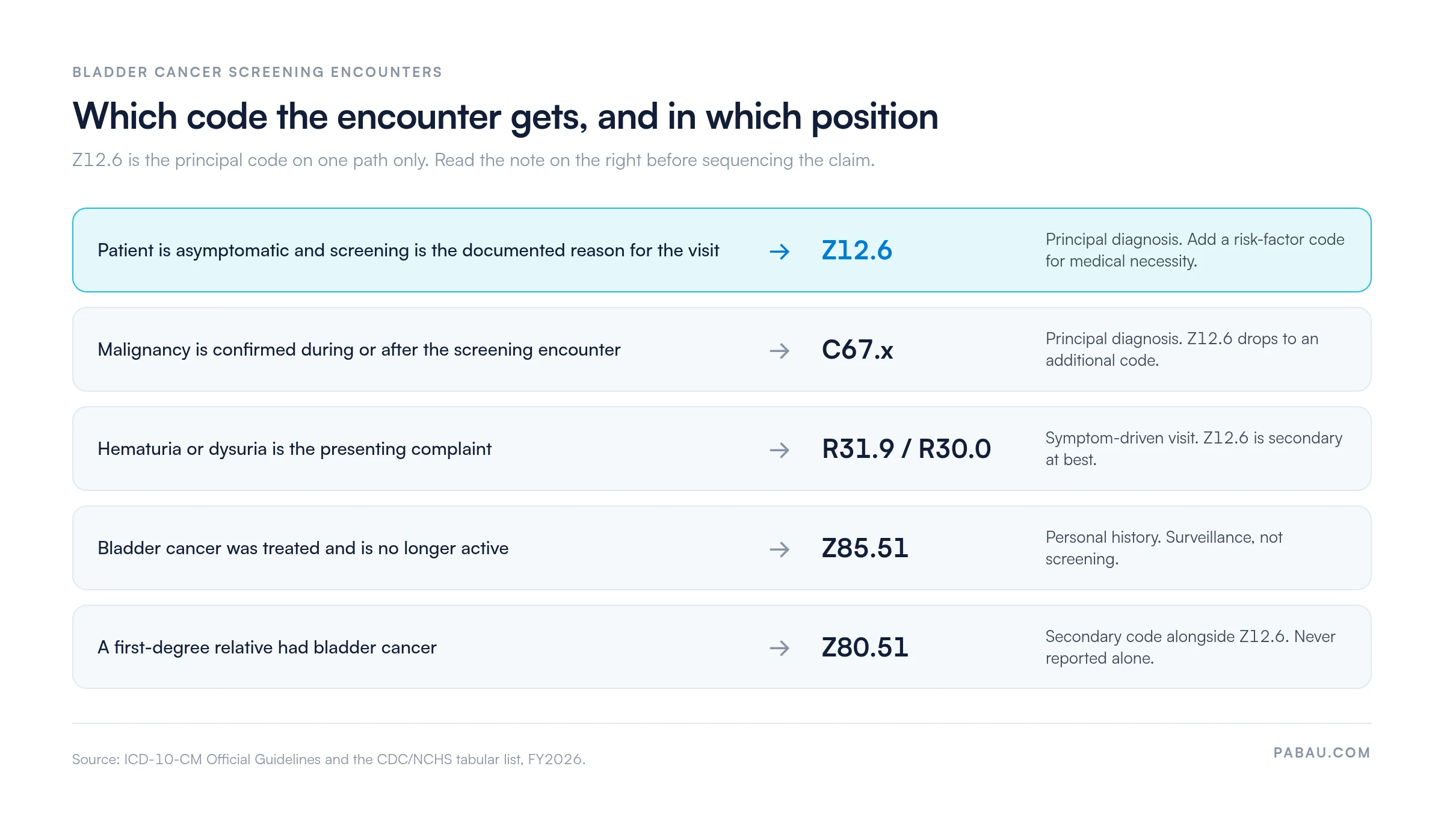
Z12.6 sits inside a defined ICD-10-CM hierarchy, and the parent levels carry instructional notes that apply to the code. The table below maps the parent and sibling structure.
The ICD-10-CM tabular list attaches instructional notes at both the Z12 category level and at the Z12.6 code level. Coders must read notes at every level of the hierarchy, not only at the code itself. Reading only the code-level note is how a category-level instruction gets missed at audit.
The most frequent miscoding errors involve substituting Z12.6 for a confirmed malignancy code, or conflating the screening code with personal history and symptom codes. Use the AAPC ICD-10-CM lookup to verify descriptors side by side before claim submission. The comparison below covers the codes coders most often mix up with ICD-10 code Z12.6.
The Z85.51 versus Z12.6 distinction trips up practices treating patients who had bladder cancer years ago. Z85.51 goes on the record when the cancer is no longer active. It says the personal history is relevant to today’s visit without claiming a current malignancy.
Meeting the documentation threshold for Z12.6 requires more than selecting the correct code. Payers and auditors want to see that the note supports the screening intent before reimbursing. A solid superbill for screening visits captures the elements below at the point of care. Use this checklist for every Z12.6 encounter.
Flag asymptomatic status explicitly in the assessment section using language like: ‘Patient presents for bladder cancer screening. No hematuria, dysuria, or other urinary symptoms reported or observed.’ A single clear sentence removes ambiguity during payer review and supports Z12.6 without additional documentation requests.
Z12.6 rarely appears on a claim in isolation. A bladder cancer screening encounter usually bundles it with one or more procedure codes. Each of those procedures carries its own coverage rules, and a mismatch between the diagnosis and the procedure is what a payer edit catches first.
Practice management software like Pabau checks the diagnosis-to-procedure pairing before the claim goes out. Its claims management software flags a mismatch while the coder can still fix it, which is where most Z12.6 denials start.
CPT coverage for cystoscopy (52000) and urine biomarker assays varies by indication and payer. Do not assume Medicare covers these procedures simply because Z12.6 establishes a screening context. Each procedure’s reimbursability depends on its own local coverage determination (LCD).
Medicare does not currently have a national coverage determination (NCD) for routine bladder cancer screening. Without an NCD there is no automatic entitlement to coverage. Every claim has to demonstrate medical necessity or a recognized risk-based rationale, and MAC auditors review Z12.6 claim patterns with that in mind.
A clearinghouse that runs eligibility and payer-specific edit checks catches most of this before the claim leaves the practice. A Z12.6 claim missing its risk-factor codes lands in manual review, and manual review is where medical-necessity denials come from.
Z12.6 denials cluster around a predictable set of documentation and sequencing errors. The denial codes in medical billing attached to Z12.6 fall into a short list. The usual ones are CO-50 (not medically necessary), CO-4 (procedure inconsistent with modifier), and CO-97 (benefit included in another service).
Reporting secondary codes that explain why the patient qualifies for screening turns a bare Z12.6 into a medically justified claim. Those codes give the payer a medical-necessity hook that Z12.6 on its own does not. Smoking is the leading modifiable risk factor for bladder cancer, which makes nicotine-dependence coding the one most worth getting right.
Sequencing rule: Z12.6 is the principal code for an asymptomatic screening encounter. Risk-factor and history codes (F17.210, Z87.891, Z57.5, Z80.51, Z85.51) are always secondary. When a symptom code like R31.9 is genuinely concurrent, the principal diagnosis is whatever chiefly prompted the encounter. Follow the ICD-10-CM sequencing guidelines to decide.
Review the WHO ICD-10 browser and the CDC NCHS tabular list together when verifying Z-code sequencing rules. They cross-reference instructional notes at different hierarchy levels. Checking both catches a note that applies at category level (Z12) rather than at the code itself.
Most urology and primary care practices catch a Z12.6 problem after the remittance arrives. The coder rebuilds the note from memory, finds the missing risk-factor code, and reworks a claim that is already weeks old.
Pabau moves that check to the front of the process. Claims are validated against payer edits before submission. A Z12.6 claim with no supporting risk-factor code gets flagged while the encounter is still open. The clinician who wrote the note is still the person who fixes it.
The outcome is fewer reworked claims and a shorter path to payment. Denial patterns also stay visible across the billing team, so a recurring Z12.6 error gets fixed once rather than claim by claim.

Pabau’s built-in claims management validates diagnosis-to-procedure pairings before submission, flags missing documentation, and tracks denial patterns across your urology billing team.

Z12.6 is a narrow code, and the trouble starts when coders apply it outside that boundary. The test never changes: Is this patient asymptomatic, and is screening the documented reason for the encounter? When the answer is yes and the note reflects it, Z12.6 supports a clean claim. When it is no, a C67.x, R31.x, or R30.x code describes the visit more accurately.
The habit worth building is pairing every Z12.6 with the risk factor that justifies it. That one step removes most medical-necessity denials before they happen. Book a demo to see how Pabau validates Z12.6 claims against payer edits before they leave your practice.

Need guidance on submitting clean claims through a US clearinghouse? Medical claims clearinghouse overview explains how EDI submission works and what validation checks prevent denial before claims leave the practice.
Want to know which claim line a denial actually landed on? Electronic remittance advice guide covers how to read ERA 835 files and trace the denial reason code back to a specific claim line.
Looking to build cleaner superbills for preventive screening visits? Clean claim best practices outlines the documentation and coding standards that reduce the need for appeals across preventive encounter types.
ICD-10 code Z12.6 is a billable ICD-10-CM diagnosis code for an encounter for screening for malignant neoplasm of bladder. It applies when an asymptomatic patient presents specifically for bladder cancer screening, with no confirmed bladder malignancy already on record.
Yes. Z12.6 is a valid, billable ICD-10-CM code for FY2026, confirmed in the CDC/NCHS tabular list and the CMS ICD-10-CM code files. No additional characters are required because Z12.6 is a leaf-node code with no further specificity subdivisions.
Z12.6 covers screening specifically for bladder malignancy. Z12.79 covers screening for other genitourinary neoplasms that have no more specific Z12 code of their own. Use Z12.6 whenever the screening explicitly targets the bladder. Use Z12.79 for other genitourinary sites without a dedicated code.
Medicare does not have a national coverage determination (NCD) for routine bladder cancer screening. Coverage depends on the MAC jurisdiction and requires documented medical necessity or a recognized risk-based rationale. Without that documentation, claims are denied as not medically necessary regardless of the Z12.6 code assignment.
Use Z12.6 only when the patient is asymptomatic and no bladder malignancy has been confirmed. The moment a malignancy is established during or after the encounter, switch to the appropriate C67.x code. Z12.6 may be retained as an additional code to reflect the screening context, but C67.x becomes the principal diagnosis.
The note must confirm the patient is asymptomatic and record the physician’s rationale for ordering screening. It also needs at least one risk factor, such as smoking, occupational exposure, or family history. A statement that no bladder malignancy is confirmed belongs in the note too. Missing any of these elements increases the risk of a medical-necessity denial.