ICD-10 code S62.635G: Left ring distal phalanx, delayed healing
ICD-10 code S62.635G at a glance ICD-10 code S62.635G covers a displaced fractur...

Last Updated: Oct 16, 2026
Billable Code Specific Code
W36.1XXA is the billable ICD-10-CM code for explosion and rupture of aerosol can, initial encounter. It records the cause of an injury from a bursting aerosol container, such as hairspray or spray paint, while the patient receives active treatment.
As an external cause code, W36.1XXA is never the principal diagnosis. It follows the injury code on the claim, and its 7th character matches that code's suffix.
Let Pabau's smart automation suggest the right codes, reduce claim denials, and keep your practice compliant—effortlessly.
Automate repetitive tasks and focus on what matters most—your patients.
Reduce coding errors and ensure compliance with the latest regulations.
Clean claims, fewer denials, and faster reimbursements.
Powerful insights and reporting to help your practice thrive.
HIPAA compliant SOC 2 certified GDPR-compliant Trusted by 4,000+ clinics worldwide

W36.1XXA is a billable ICD-10-CM external cause code for an aerosol can explosion at the initial encounter, and it is never the principal diagnosis.
The 7th character A, D, or S sets the phase of care. A suffix that doesn’t match the injury code is the top denial trigger for W36 codes.
W36.1XXA is always sequenced after the nature-of-injury code, such as a burn, laceration, or fracture, and never listed first on the claim.
Within W36, aerosol cans are W36.1, while air tanks, pressurized-gas tanks, and other gas cylinders each take their own subcategory.
Practice management software like Pabau submits claims through Claim.MD and tracks their status, so a rejected W36 claim is spotted and fixed quickly.
ICD-10 code W36.1XXA is the external cause code for explosion and rupture of aerosol can, initial encounter. It is a billable ICD-10-CM code, valid for FY2026 claims. Per the CMS ICD-10-CM coding page, it covers encounters from October 1, 2025 through September 30, 2026.
Two details matter most to coders looking up this code for the first time. First, W36.1XXA is an external cause of morbidity code, not a nature-of-injury code. It tells the payer how the injury happened, while the injury code describes the damage itself. Second, each character after W36.1 holds a fixed position, and swapping one character changes the code entirely.
W36.1XXA sits in the ICD-10-CM Tabular List under Chapter 20 (External causes of morbidity, V00-Y99). The hierarchy from chapter to code matters when choosing between sibling codes. According to the CDC/NCHS ICD-10-CM web tool, the path is:
The two placeholder “X” characters between W36.1 and the 7th character (A/D/S) are structural padding required by ICD-10-CM formatting rules. They carry no clinical meaning.
The 7th character in W36.1XXA is the letter “A,” and choosing it correctly is the most consequential coding decision for this code family. ICD-10-CM assigns three valid 7th characters to W36 codes.
A common misconception is that “initial encounter” means the patient’s first visit to any provider. It covers every visit where the patient receives active treatment. A patient transferred from an urgent care to a burn center is still in the initial encounter phase at the burn center.
The choice between W36.1XXA, W36.1XXD, and W36.1XXS depends on the phase of care at the visit being coded, whatever the order of visits. Use these decision rules to avoid misassignment.
The misassignment that triggers the most denials is using W36.1XXA at a follow-up visit when the injury code carries a “D” suffix. Payers flag a mismatch between the 7th character on the injury code and the one on the external cause code. If the burn is coded T25.319D (subsequent encounter), the external cause is W36.1XXD.
W36.1XXA captures any injury where the causative mechanism is the explosion or rupture of a pressurized aerosol container. The code applies regardless of the type of aerosol product involved: Hairspray, spray paint, compressed-gas aerosols, or similar consumer products.
W36 splits gas cylinders into five subcategories: Three named device types, a catch-all for other gas cylinders, and an unspecified code. Choosing the wrong subcategory is a frequent error when the documentation is vague about the product.
Bicycle tire blowouts sit outside W36 entirely. They are coded W37.0XXA, in the category for exploding pressurized tires, pipes, and hoses.
W36.9XXA (unspecified) should be a last resort. If the record describes the device only as a “can,” query the provider before defaulting to unspecified. The difference between “aerosol can” and “pressurized-gas tank” changes the code.
W36.1XXA is an external cause code. Under ICD-10-CM Official Guidelines Section I.C.20, external cause codes are supplemental and are never assigned as the principal diagnosis on a claim. The nature-of-injury code always leads.
Correct sequencing follows three steps.
The claim line order below shows how the four codes stack up, and how the 7th character on W36.1XXA follows the injury code.
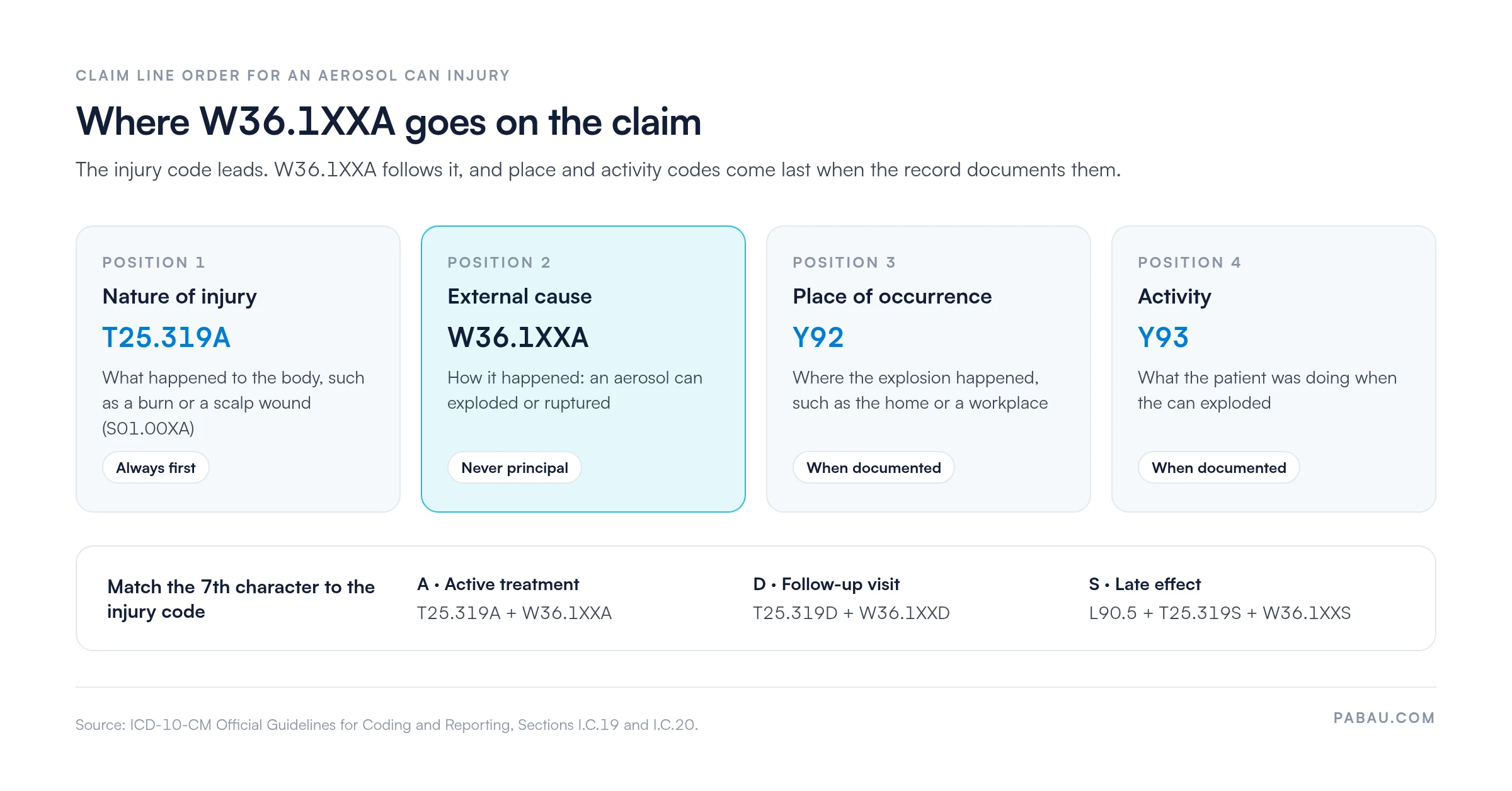
A claim that lists W36.1XXA as the first-listed diagnosis will be denied by most payers. Chapter 20 conventions treat external cause codes as supplemental, so payer edits flag one automatically in the principal position.
Payer auditors reviewing a claim with W36.1XXA need the clinical record to substantiate both the mechanism and the encounter type. Missing documentation is the second most common denial trigger after a wrong 7th character.
The record must contain all four of these elements to support the code. A clean claim starts with thorough clinical documentation before the coder ever opens the chart.
Medicare does not require external cause codes for claim payment. Per the CMS Medicare Claims Processing Manual, Chapter 23, external cause codes are supplemental. They support data collection and quality reporting, but they are not a condition of payment on most Part B claims.
Other payer types often require external cause codes as a condition of payment or prior authorization. Confirm each payer’s rules before you submit.
The safest approach for practices billing injury claims across mixed payers: Include W36.1XXA on every applicable claim. The code is valid, billable, and adds data value. Leaving it off saves no time where it’s optional, and it causes a denial where it’s required.
W36.1XXA denials cluster around five root causes. Each one has a straightforward fix when caught before submission.
Tracking denials by reason makes these patterns visible early. When a payer rejects a W36 claim, the remittance carries a reason code, and our reference to payer denial codes explains what each one means.
Audit your W36 claims quarterly by pulling all claims with a W36 external cause code and grouping them by 7th character. Look for W36.1XXA on encounters where the primary injury code carries a D suffix. A cluster of those means your team is defaulting to initial encounter instead of W36.1XXD. A one-time coder education session on encounter-phase matching eliminates this pattern.
ICD-9-CM had no precise structural equivalent to W36.1XXA. The approximate crosswalk maps to ICD-9-CM code E921.8 (Accident caused by explosion of other specified pressure vessels). The mapping is non-unique, because E921.8 covers a broader range of pressure vessel explosions than W36.1XXA alone.
This crosswalk is approximate. Per ResDAC guidance on ICD codes in Medicare files, GEMs (General Equivalency Mappings) for external cause codes are frequently non-unique. One ICD-9 code often maps to several ICD-10 codes. Retrospective data analysis or comparative studies using E921.8 as a proxy for W36.1XXA should account for this imprecision.
W36.1XXA claims tend to fail on small slips: A missing injury code, a suffix copied from the wrong visit, or an unworked rejection. Those slips multiply when the clinical note and the billing tool live in separate systems.
In practice management software like Pabau, the claims workflow for billers builds the invoice from the appointment and the patient record. In the US, claims go to payers through Claim.MD, with eligibility checks, claim status tracking, and ERA posting in one dashboard.
The outcome is fewer resubmissions. When a payer rejects a W36 claim, your billing team sees it in Pabau. They fix the code order or suffix and resend it without switching systems.

Pabau links patients to their insurers, submits claims through Claim.MD, and tracks every claim’s status, so rejected injury claims get fixed fast. See how it works for your practice.

W36.1XXA is simple to assign and easy to get wrong. Build your pre-submission check around three questions: Is the injury code listed first? Does the 7th character match it? Does the note name the aerosol can?
Get those three right and most W36 denials never happen. The trade-off is a few seconds of review per claim, which costs far less than reworking a denial weeks later.
Book a demo to see how Pabau tracks injury claims from appointment to payment, so your team spends less time chasing rejections.

Need to understand denial patterns across your ICD-10 claims? Denial management in healthcare breaks down how to build a systematic denial tracking and appeal workflow for injury and external cause claims.
How does Pabau connect with clearinghouses for claim validation? Pabau’s Claim.MD clearinghouse integration explains how real-time eligibility checks and ICD-10 edits reduce denials before submission.
Looking for a complete reference on denial reason codes? Denial codes in medical billing provides a searchable reference for CARC codes returned by payers on rejected claims.
Need to meet billing rules across every payer? Medical billing compliance covers the coding and documentation standards payers audit injury claims against.
Where does external cause coding fit in the revenue cycle? What is revenue cycle management walks through each stage from patient registration to final payment.
ICD-10 code W36.1XXA is the billable external cause code for explosion and rupture of an aerosol can, initial encounter. It sits in Chapter 20 of ICD-10-CM (External causes of morbidity) and records how the injury happened. It must be paired with a nature-of-injury code and is never used as the principal diagnosis.
Yes, W36.1XXA is a billable ICD-10-CM code, valid for FY2026 claims with dates of service from October 1, 2025 through September 30, 2026. As a supplemental external cause code, it must appear after the primary injury diagnosis code on the claim.
The difference is the phase of care. W36.1XXA applies to the initial encounter when active treatment is being rendered. W36.1XXD applies to subsequent encounters such as follow-up visits, wound checks, or physical therapy once active treatment is complete. W36.1XXS applies to sequela, meaning a late effect or complication that persists after the original injury has healed. The 7th character on the external cause code must match the 7th character on the primary injury code.
Yes. W36.1XXA must always be paired with a nature-of-injury code that describes the injury itself, such as a burn, laceration, or blast injury. It cannot stand alone as the only diagnosis on a claim. A claim with only W36.1XXA and no companion injury code will be denied by most payers.
Denials on W36.1XXA usually trace to one of five causes. The most common is the wrong 7th character, such as A instead of D at a follow-up visit. The others are listing W36.1XXA as principal diagnosis, omitting the injury code, documentation that doesn’t name the aerosol can, and an outdated code edition.
Use W36.1XXA when the visit involves active treatment of the injury, such as the emergency department visit, initial surgery, or first wound care. Switch to W36.1XXD once the treatment phase is complete and subsequent visits are for monitoring, suture removal, or rehabilitation. The 7th character must align with the suffix on the primary injury code submitted on the same claim.