

ICD-10 Code S42.444P: Medial epicondyle fracture, right humerus
ICD-10 Code S42.444P: full descriptor and code validity ICD-10 Code S42.444P car...

Last Updated: Oct 13, 2026
Billable Code Specific Code
W31.2XXD is the billable ICD-10-CM code for contact with powered woodworking and forming machines, subsequent encounter. It sits in the W31 category of the V00-Y99 external cause chapter, and it is never the principal diagnosis.
Coders often confuse it with its sibling W31.2XXA, applying the initial encounter code to a follow-up visit. That single character is one of the most preventable causes of external cause code denials. Pair W31.2XXD with the injury code that reports what the patient sustained.
Let Pabau's smart automation suggest the right codes, reduce claim denials, and keep your practice compliant—effortlessly.
Automate repetitive tasks and focus on what matters most—your patients.
Reduce coding errors and ensure compliance with the latest regulations.
Clean claims, fewer denials, and faster reimbursements.
Powerful insights and reporting to help your practice thrive.
HIPAA compliant SOC 2 certified GDPR-compliant Trusted by 4,000+ clinics worldwide

W31.2XXD is the billable ICD-10-CM external cause code for powered woodworking machine contact at a subsequent encounter.
The 7th character D signals routine care during the healing phase. W31.2XXA covers the active treatment visit where the injury first presented.
W31.2 covers band saws, chain saws, circular saws, planers, and routers. Agricultural and mining machinery falls under separate W codes.
W31.2XXD is never the principal diagnosis. Sequence it after the injury code, per ICD-10-CM Official Guidelines Section I.C.20.
ICD-10 code W31.2XXD is a billable and specific ICD-10-CM diagnosis code, valid for reimbursement under the 2026 edition of the CDC/NCHS ICD-10-CM classification. Its full official descriptor is: Contact with powered woodworking and forming machines, subsequent encounter.
Because the code is billable and specific, no additional digits are required. It can go on a claim as a standalone external cause code. The claim still needs the principal diagnosis code that reports the injury itself.
Coders checking billable status can verify W31.2XXD against the CMS ICD-10 codes page, which publishes the annual tabular list update files. Payer coverage policies can still add requirements on top of that general reimbursement validity.
The 7th character D means the patient is receiving routine care during the healing or recovery phase. That definition comes from the ICD-10-CM Official Guidelines for Coding and Reporting, Section I.C.20. The injury has already been actively assessed and treated on a prior encounter.
Three 7th character options apply to every W31.2 code. Selecting the wrong one is the most common coding error on external cause claims involving machinery injuries. Use this table to distinguish them:
The distinction between A and D turns on the phase of care rather than the visit number. A patient who needed two active debridements before moving to wound checks may carry W31.2XXA on both treatment visits. Once the provider’s note shifts to monitoring how the wound heals, W31.2XXD applies. The documentation has to show that transition.
W31.2XXA, W31.2XXD, and W31.2XXS are the three sibling codes within the W31.2 subcategory, differentiated only by the 7th character. All three share the same parent descriptor and the same list of included machinery. Look up all three when a patient’s care is moving between phases.
Use the AAPC Codify ICD-10-CM lookup to cross-reference the siblings and confirm the encounter note matches the character you selected. The table below is a fast reference for each one.
W31.2 is the parent subcategory that covers all encounters involving powered woodworking and forming machines, regardless of encounter type. The ICD-10-CM tabular list names the machinery that falls under this subcategory through its includes notes. Check the parent code first to confirm the machine involved belongs under W31.2 rather than another W31 subcategory.
The ICD-10-CM tabular list includes the following machine types within the W31.2 subcategory. If the injury-causing machine is not on this list, check whether a more specific W31 subcategory or a different external cause code applies.
A lathe is a metalworking machine, so contact with one is coded under W31.1 rather than W31.2. Agricultural machinery such as farm tractors and harvesters falls outside the W31 category, as does mining and earth-moving equipment. Contact with non-powered hand tools is excluded too. The qualifier for W31.2 is that the machine must be motor-driven and classified as woodworking or forming equipment.
ICD-10-CM approximate synonyms are alternate clinical descriptions that map to the same code. For ICD-10 code W31.2XXD, the following synonyms appear in the tabular index and are common in clinical documentation. A coder who meets one of these terms in a provider’s note should consider W31.2XXD, provided the encounter type is subsequent.
These synonyms help you confirm that the language in the encounter note maps to the code. A note reading “subsequent follow-up for circular saw laceration” supports W31.2XXD as the external cause code, provided the injury diagnosis code is also present.
Check the encounter note for the specific machine type before assigning W31.2XXD. If the note says ‘table saw,’ confirm whether your facility treats that as a circular saw under W31.2. Record the machine type in the chart so an auditor can follow the assignment.
ICD-10 code W31.2XXD sits within a nested hierarchy in the external causes chapter. Reading that hierarchy helps you find related codes and sequence the claim correctly at chapter level.
The XX placeholders in positions 5 and 6 are required because W31.2 is a five-character code. Without them the mandatory 7th character cannot reach position seven, and the claim carries an invalid code that payers reject. The CDC/NCHS tabular list is the definitive reference for the external cause chapter, and our ICD-10-CM codes library covers the neighboring categories. The breakdown below shows what each position carries.
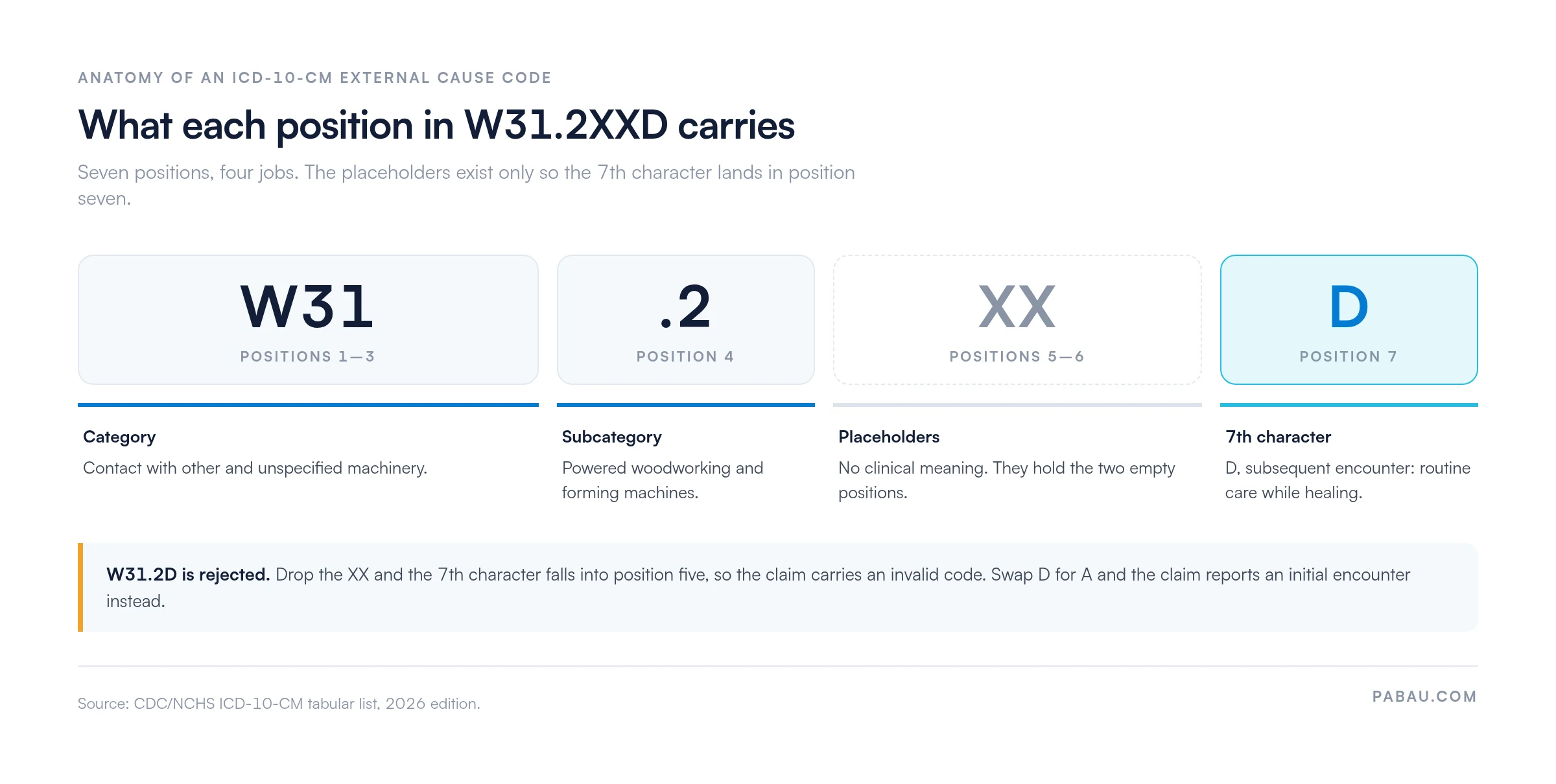
The W31 category carries excludes notes that restrict which codes can be combined, and W31.2 adds one of its own. Breaking those notes is a common cause of claim edits. These exclusions apply:
An Excludes1 note is a hard prohibition, so the two codes cannot appear together for the same condition. An Excludes2 note works differently. It means the excluded condition is not part of the coded one, so both may be reported where the documentation supports it. Check which note type applies before you combine codes on a claim.
Using ICD-10 code W31.2XXD correctly means pairing it with a principal injury diagnosis code and sequencing the two in the right order. An external cause code is always secondary to the injury or condition diagnosis code.
Five steps cover the documentation workflow for this code:
The most frequent error is assigning W31.2XXA to a follow-up visit. It happens when a coder copies the external cause code off the original claim without updating the 7th character. Payers catch this in claims history. If W31.2XXA keeps appearing for the same patient and the same injury, an edit or a denial follows.
Dropping the XX placeholders is the next most common error, and it produces the invalid code W31.2D. Coders also sequence W31.2XXD as the principal diagnosis. Another error is reaching for W31.2XXS while the patient is still healing, with no documented late effect. Strong denial management workflows flag these patterns and route them for coder review before submission.
Run a monthly audit of external cause codes on occupational injury claims. Filter for W31.2XXA claims where the date of service is more than 14 days after the initial injury date of service. Claims matching this pattern likely need the 7th character updated to D before resubmission.
External cause codes including W31.2XXD travel on the CMS-1500 claim form, or on its 837P electronic equivalent. They sit in the diagnosis pointer fields as secondary diagnosis codes. The path is the same as for a primary diagnosis code, under stricter sequencing rules.
Track denial rates on external cause codes separately from primary diagnosis denials. A wrong 7th character comes back as a coding edit rather than a coverage denial. That tells you the fix belongs with the coding team rather than with payer relations. Routing it correctly is the difference between a two-day turnaround and a two-week one.
In most practices a wrong 7th character only surfaces when the remittance arrives. The claim was coded off the original encounter, nobody re-read the note, and the denial lands three weeks later. By then the coder is reconstructing a visit from weeks earlier.
Practice management software like Pabau keeps the encounter note, the assigned codes, and the claim in one patient record. When a coder opens a follow-up appointment, the previous encounter for the same injury is already on screen. The choice between W31.2XXA and W31.2XXD is then made against what the provider wrote.
Pabau’s claims management software validates ICD-10-CM codes before transmission. A missing XX placeholder or an invalid code is flagged while the claim can still be corrected. Denials are grouped by reason in the dashboard, so a run of repeat 7th character edits is visible across your external cause volume.
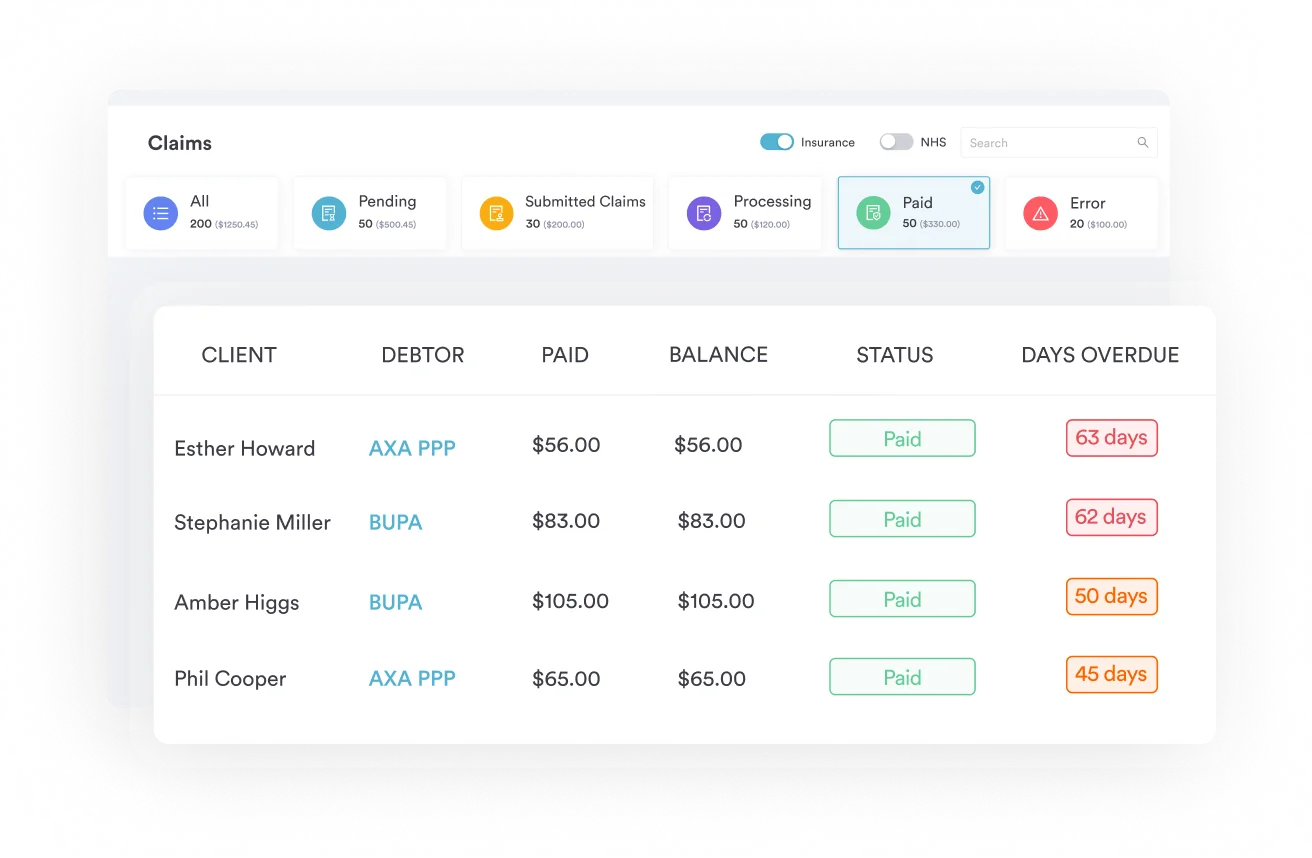

Pabau validates ICD-10-CM codes against the current tabular list and flags invalid or incomplete codes before submission. Your billing team sees every repeat 7th character edit in one dashboard.

The 7th character is the only part of W31.2XXD that changes as a patient moves through care. It is also the part most likely to be wrong. Assign it at the point of coding and the claim clears on first pass. Assign it from last month’s claim and the work moves to a denial queue, where it costs far more to resolve.
One small habit prevents most of it. Read the encounter note before you copy forward the code, because a wound check is not an initial encounter however similar the two claims look. Book a demo to see how Pabau flags a mismatched 7th character before your claim reaches the payer.

List Item #1
List Item #2
ICD-10 code W31.2XXD is the billable ICD-10-CM diagnosis code for contact with powered woodworking and forming machines at a subsequent encounter. The patient is receiving routine follow-up care during the healing phase of a machinery injury. The 7th character D distinguishes it from the initial encounter code W31.2XXA.
Yes, W31.2XXD is a billable and specific ICD-10-CM code valid for reimbursement under the 2026 edition, effective October 1, 2025. It requires no additional digits and can be submitted on claims as an external cause code alongside the principal injury diagnosis.
W31.2XXA is for the initial encounter, when the provider is actively assessing and treating the injury for the first time. W31.2XXD is for subsequent encounters, when the patient returns for routine monitoring, wound checks, or follow-up care during healing. The machinery type and injury mechanism are identical. Only the phase of care changes.
The 7th character D in ICD-10-CM denotes a subsequent encounter. The patient is in the routine care phase, after the injury has already been actively treated. Per ICD-10-CM Official Guidelines Section I.C.20, subsequent encounters cover visits for follow-up, monitoring healing progress, or managing the injury’s recovery.
Use W31.2XXD when the patient is still healing from the original injury and the visit is routine follow-up care. Use W31.2XXS when the original injury has resolved but the patient has a documented late effect or residual condition caused by that injury. Sequela coding requires a separate diagnosis code for the late effect condition itself.
W31.2XXD is always sequenced as a secondary code after the primary injury diagnosis from chapters S00-T88. Coders should also consider a place of occurrence code (Y92), an activity code (Y93), or an external cause status code (Y99). Add them where the payer requires them. W31.2XXD cannot serve as the principal diagnosis on any claim.




