

ICD-10 code S61.201A: Open wound of left index finger without nail damage
ICD-10 code S61.201A covers a left index finger wound of unstated type ICD-10 co...

Last Updated: Oct 16, 2026
Billable Code Specific Code
W28.XXXD is the billable ICD-10-CM code for contact with powered lawn mower, subsequent encounter. It reports the cause of a mower injury on follow-up visits after active treatment ends, such as wound checks and suture removal.
The code sits in Chapter 20 (V00-Y99), External causes of morbidity, under block W20-W49, Exposure to inanimate mechanical forces. As an external cause code, it is always listed after the nature-of-injury diagnosis and never as the principal diagnosis. Sequencing errors are a common cause of avoidable claim denials.
Let Pabau's smart automation suggest the right codes, reduce claim denials, and keep your practice compliant—effortlessly.
Automate repetitive tasks and focus on what matters most—your patients.
Reduce coding errors and ensure compliance with the latest regulations.
Clean claims, fewer denials, and faster reimbursements.
Powerful insights and reporting to help your practice thrive.
HIPAA compliant SOC 2 certified GDPR-compliant Trusted by 4,000+ clinics worldwide

W28.XXXD is a billable ICD-10-CM code for visits after active treatment of a powered lawn mower injury has ended. It is valid, unchanged, for FY2025, FY2026 and FY2027 (October 2026 to September 2027).
Seventh character D means the patient is in the routine care or healing phase. Reporting A on a follow-up visit is a coding error.
W28.XXXD is always listed after the nature-of-injury code, such as a laceration, amputation or crush injury, and can never be the principal or first-listed diagnosis.
Pabau’s claims management software turns invoices into electronic CMS-1500 claims, so the diagnosis codes you document, including external cause codes, travel with the claim.
ICD-10 code W28.XXXD reports contact with a powered lawn mower at a subsequent encounter, meaning a visit after active treatment has ended. Its official descriptor is “Contact with powered lawn mower, subsequent encounter.” The code is billable, but only as a secondary diagnosis listed after the injury code.
The table below summarizes the reference data to confirm before you submit a claim with this code. Validity reflects the CMS ICD-10-CM annual release for FY2025, FY2026 and FY2027.
Coders can verify annual validity through the CDC/NCHS ICD-10-CM web tool, which publishes each fiscal year’s tabular list. It is the authoritative reference for confirming billability in medical billing workflows.
W28.XXXD applies specifically to accidental contact with a powered (motorized) lawn mower, including ride-on and powered push mowers, at a subsequent encounter after active treatment. The code does not extend to every garden equipment injury or every mower-related visit.
Included scenarios:
Excluded scenarios:
The seventh character on W28 codes determines the encounter type. Under ICD-10-CM Official Guidelines Section I.C.20.a, three options apply. The choice follows the patient’s treatment status, not whether the provider is seeing the patient for the first time.
Physician documentation decides when the seventh character moves from A to D at a later visit. If the notes describe a follow-up, wound check, or routine aftercare visit with no active intervention, D is the right character. Coders must not override the documented encounter type.
A frequent billing error on lawn mower injury claims is reporting W28.XXXA on every visit, whatever the encounter type. Once the physician has transitioned from active wound management to routine monitoring or rehabilitation, W28.XXXD is the correct external cause code.
D and S are also easy to confuse. Sequela (S) applies when the patient is treated for a late effect of the mower injury, such as a contracture or scar. Code the sequela condition first, then the injury code with seventh character S. W28.XXXS follows as the external cause code.
W28.XXXD applies while the original injury is still healing and the visit is routine care rather than active treatment.
Set out as a decision path, the choice comes down to two questions about the visit.
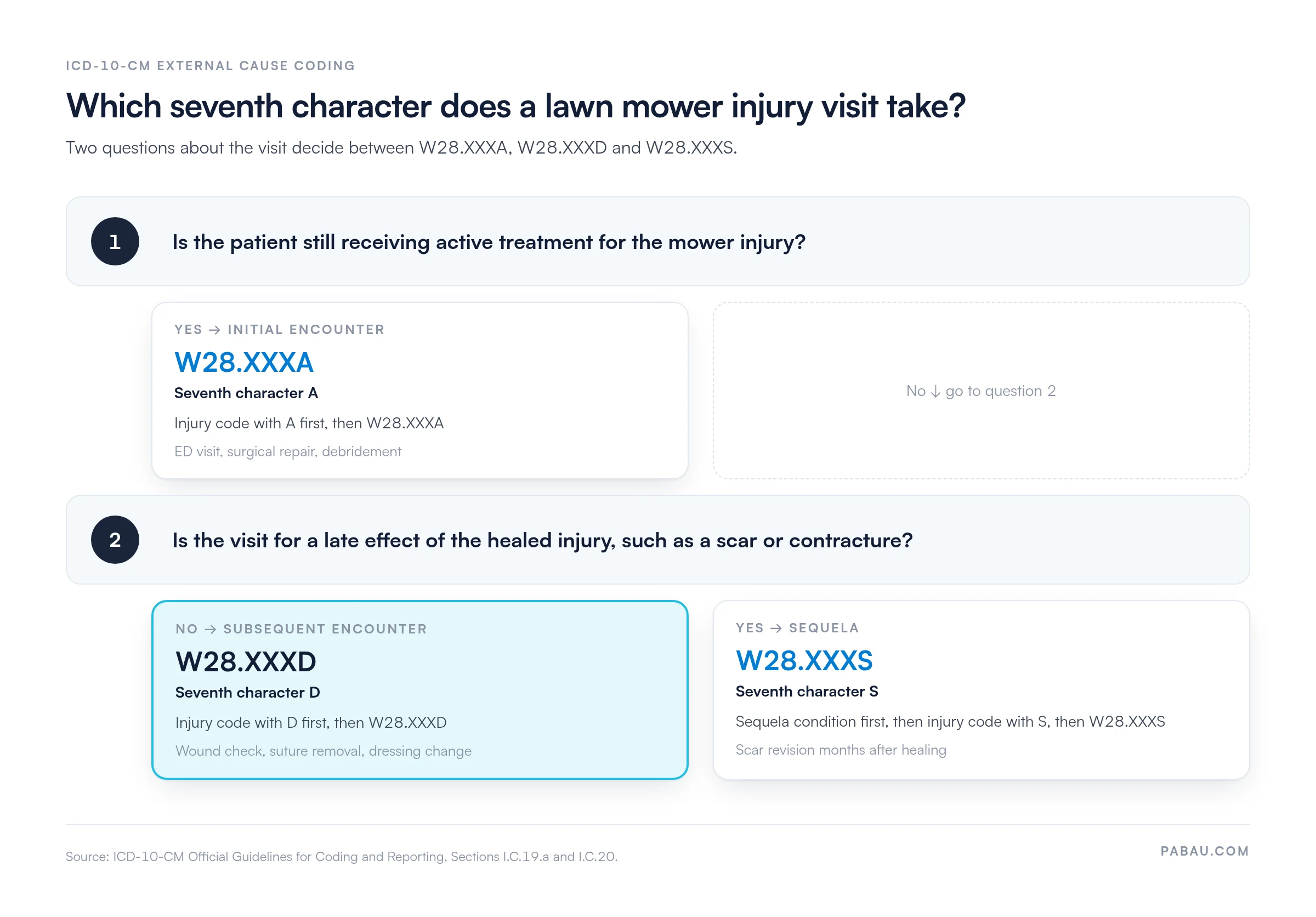
Document the transition point. When the treating provider ends active treatment and moves the patient to follow-up care, that visit note should say so explicitly. That note is what supports seventh character D on both the injury code and W28.XXXD.
External cause code sequencing rules under ICD-10-CM Official Guidelines Section I.C.20 are unambiguous: external cause codes are never the principal or first-listed diagnosis. W28.XXXD is always secondary.
The correct claim sequence works as follows:
Both the nature-of-injury code and W28.XXXD should carry the seventh character D when the visit is a subsequent encounter. Pairing an S-series injury code that ends in A with W28.XXXD is a mismatch. Payer claim edits can catch it and deny the claim.
Because W28.XXXD cannot stand alone as a principal diagnosis, coders always need a nature-of-injury code in the first position. Mower injuries tend to involve the feet, lower legs and hands. The table below shows example subsequent-encounter codes for each.
Check each code against the current CDC ICD-10-CM tabular list for laterality, specificity, and seventh-character requirements before submission. The codes above are examples, and the medical record determines the precise code.
Selecting W28 over W27 or W29 depends on the type of equipment involved. The distinctions are clear in the tabular list, but coders who skim incident descriptions can misapply the parent category before applying the seventh character.
If the operative report or clinic note describes a hedge trimmer or chain saw, W29 applies regardless of where the incident occurred. The equipment type, not the setting, drives the code selection.
The medical record must support three things to justify W28.XXXD: the type of equipment, the encounter type, and the ongoing nature of the care. If any one is missing, a payer can cite the record as grounds for denial. Meeting clean claim requirements starts with the visit note, well before the billing stage.
Not all payers require external cause codes. Under current Centers for Medicare and Medicaid Services (CMS) guidance, Medicare does not mandate external cause codes on physician claims. Many commercial payers and state Medicaid programs do. Coders should verify each payer’s requirements before treating W28.XXXD as optional.
For payers that require or accept external cause codes, submission tips that reduce denial risk include:
Four denial patterns are common on W28.XXXD claims. Each one is preventable with the right documentation and sequencing habits. Effective denial management workflow starts with knowing which errors produce which denial reasons.
For practices handling frequent injury follow-ups, tracking these patterns through denial codes reports shows whether the cause is documentation, coder training, or a payer-specific policy.
Before each claim batch goes out, filter for claims that pair W28.XXXD with an injury code whose seventh character is A in the same claim. Each match is miscoded at either the injury code or the external cause code. Fixing them before submission removes a common W28.XXXD denial pattern.
Without a connected billing system, each follow-up claim gets retyped into a clearinghouse portal and chased by phone or email.
Pabau’s claims management software turns each invoice into an electronic CMS-1500 claim and submits it through the Claim.MD integration. The diagnosis codes you document, including W28.XXXD in its secondary position, travel with the claim.
Real-time eligibility checks confirm coverage before the follow-up visit, and status tracking shows where each claim sits. Electronic remittance advice (ERA) comes back into the same system, so a denied follow-up claim is visible as soon as the payer posts it. Your coders still choose and sequence the codes, and Pabau handles submission and tracking once they are set.
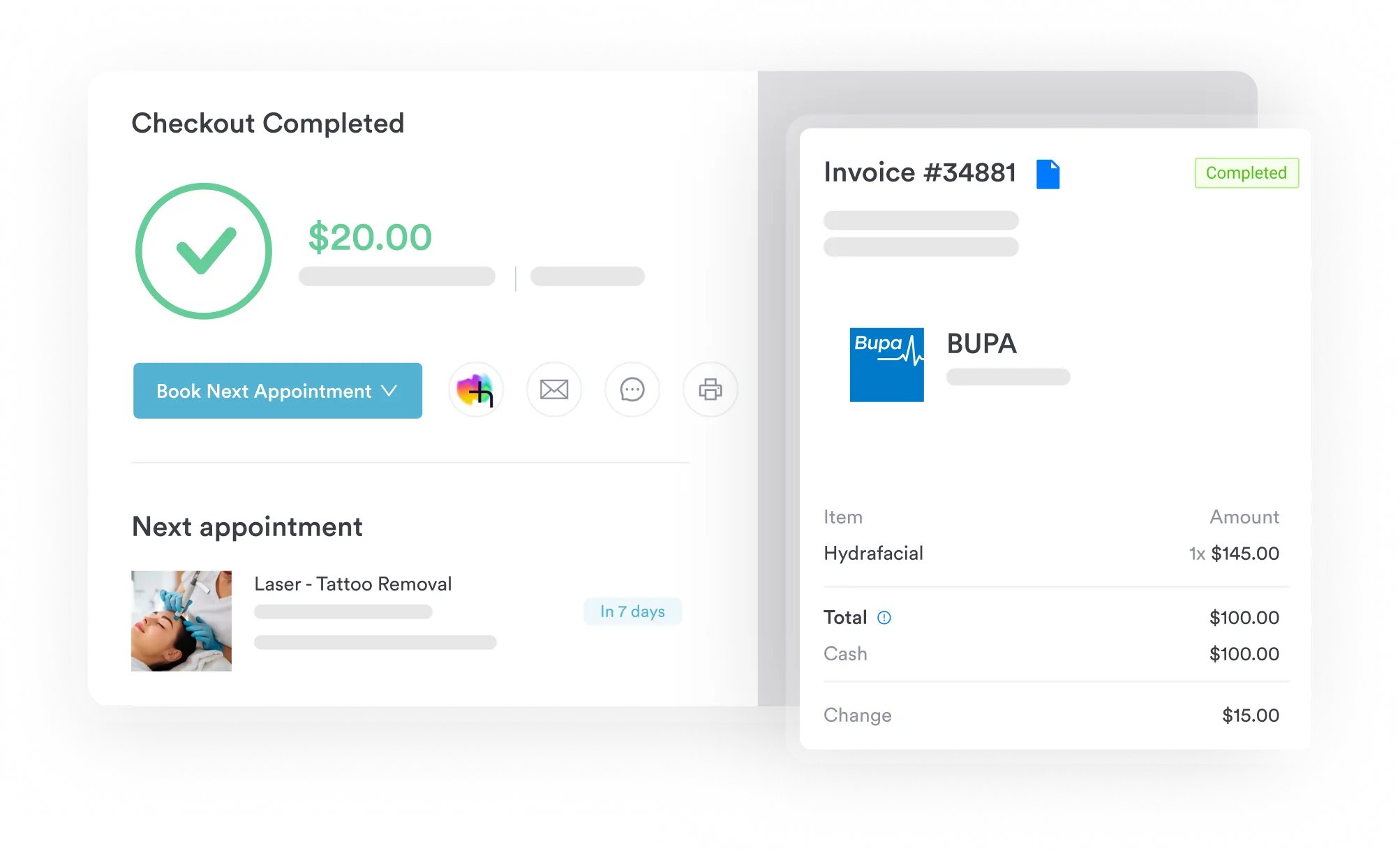

Pabau’s claims management and Claim.MD integration help you submit clean electronic claims and track them to payment.

Treat the seventh character on W28.XXXD as a statement about treatment status, and let the provider’s note make that statement. Once the note says active treatment has ended, the injury code and W28.XXXD both take D, and the injury code goes first.
The trade-off is a little more documentation discipline at each follow-up in exchange for claims that clear the first time. Start with the note template your providers use for wound checks and suture removal, and add a line that records the care status.
Pabau’s claims management and Claim.MD integration then handle electronic submission, real-time eligibility checks and claim status tracking in one system. Book a demo to see how it fits your follow-up billing.

Need a structured approach to claim denials? Denial management in healthcare covers the end-to-end workflow for tracking, appealing, and preventing claim rejections.
Looking for a reference on common billing denial codes? Denial codes in medical billing explains CARC codes and how to read a remittance advice for actionable denial data.
Want to understand the clearinghouse step in your billing cycle? Medical claims clearinghouse explains what clearinghouses do, how 837P files work, and what to expect from real-time eligibility checks.
W28.XXXD is the ICD-10-CM code for contact with a powered lawn mower at a subsequent encounter. The patient is receiving routine care or aftercare after active treatment of the injury has ended. The code belongs to Chapter 20 (External Causes of Morbidity) and is always reported as a secondary code after the nature-of-injury diagnosis.
Yes, W28.XXXD is a billable ICD-10-CM code, valid for FY2025, FY2026 and FY2027. It cannot be submitted as the sole or principal diagnosis, though. A nature-of-injury code, such as a laceration or amputation code, must appear in the first diagnosis position on the claim.
Yes, every claim using W28.XXXD must include a nature-of-injury code as the principal or first-listed diagnosis. As a Chapter 20 external cause code, W28.XXXD cannot stand alone. Common pairings include foot laceration codes (S91-), crush injury codes, and traumatic amputation codes, each with seventh character D for a subsequent encounter.
Yes. W28.XXXD appears in the ICD-10-CM tabular list for FY2025 (effective October 1, 2024), FY2026 (effective October 1, 2025) and FY2027 (effective October 1, 2026). Its descriptor and billable status are unchanged across all three years. Coders can confirm current validity with the CDC/NCHS ICD-10-CM web tool at icd10cmtool.cdc.gov.



