ICD-10 Code S02.602D: Fracture of mandible, subsequent encounter
ICD-10 Code S02.602D: Definition and billable status ICD-10 Code S02.602D is the...

Last Updated: Oct 8, 2026
Billable Code Specific Code
V00.228A is the billable ICD-10-CM code for other sled accident, initial encounter.
Most sledding injuries presenting on day one belong here, yet practices routinely reach for the wrong sibling or omit the required principal injury diagnosis entirely. Valid for fiscal year 2026 (effective October 1, 2025), it requires a principal injury diagnosis and documents the external cause, not the injury itself.
Where practices lose money is in two recurring mistakes: selecting V00.228 (the non-billable parent) instead of V00.228A, and assigning the 7th character A when the patient has been in follow-up for weeks and the correct character is D.
Let Pabau's smart automation suggest the right codes, reduce claim denials, and keep your practice compliant—effortlessly.
Automate repetitive tasks and focus on what matters most—your patients.
Reduce coding errors and ensure compliance with the latest regulations.
Clean claims, fewer denials, and faster reimbursements.
Powerful insights and reporting to help your practice thrive.
HIPAA compliant SOC 2 certified GDPR-compliant Trusted by 4,000+ clinics worldwide
ICD-10 code V00.228A, other sled accident, initial encounter, is a billable ICD-10-CM external cause code. It applies when a sledding injury is still in active treatment. The mechanism has to be neither a fall from the sled nor a collision with a stationary object.
According to the CDC/NCHS official ICD-10-CM tool, the code became effective October 1, 2025. It is valid for fiscal year 2026 HIPAA-covered transactions.
The word “other” is what makes this code residual. V00.22 covers sled accidents broadly, and the tabular list splits the group three ways. V00.221 codes a fall from a sled. V00.222 codes a sledder colliding with a stationary object.
V00.228 then takes the sled accidents that neither of those descriptions fits, such as contact between two moving sleds. When the documented mechanism lands in that residual group and the patient is in active treatment, V00.228A is the correct code.
One clarification prevents most coding errors. V00.228A codes the mechanism of injury, not the injury itself. The wrist fracture, concussion, or shoulder contusion the patient sustained belongs in the principal diagnosis. V00.228A rides along as the external cause code. A practice that submits V00.228A as a standalone or primary diagnosis will receive a denial.

V00.228A covers a sled accident that is neither a fall from the sled nor a collision with a stationary object.
Two siblings carry the common mechanisms. V00.221 codes a fall from a sled, and V00.222 codes a sledder colliding with a stationary object.
V00.228A is billable and specific. Its parent V00.228 is non-billable and cannot be submitted for reimbursement.
7th character A applies only to the initial, active-treatment encounter. Follow-up visits require D and late effects require S.
V00.228A is an external cause code, always secondary to a principal injury diagnosis such as a fracture or laceration.
Practice management software like Pabau supports ICD-10 documentation and claim submission, reducing coding errors before claims reach the payer.
The table below summarizes the key facts coders need before submitting a claim. Refer to the CMS ICD-10-CM codes page for the annual update files and official tabular list.
Understanding the parent chain prevents the single most common submission error. Coders submit V00.228, which is non-billable, instead of the required 7th-character child. Every level above V00.228A is non-billable, because ICD-10-CM grants billing validity only to the most specific child.
Clinicians treating sports or recreational injuries should also confirm the correct category. Sledding is classified under pedestrian conveyance accidents, not under the Y93 activity codes. An activity code from Y93 may still be reported alongside V00.228A as an additional external cause code.
The 7th character is not optional and cannot be left off a claim. V00.228 without a 7th character is non-billable. The character also has to match the phase of treatment at the time of the encounter. How many visits came before it makes no difference.
The most frequent error here is using A for every encounter. Per the ICD-10-CM Official Guidelines for Coding and Reporting, “initial encounter” describes the phase of treatment rather than the count of visits. Once active treatment ends and the patient moves into monitoring or rehabilitation, D applies.
The tabular list does not enumerate the events that belong under “other,” so coders work by elimination. Check the two named siblings first. If the mechanism was not a fall and not a collision with a stationary object, V00.228A is what remains at the initial encounter.
That three-way split is worth memorizing, because it repeats across the whole V00 family. Snowboard accidents run V00.311 for a fall, V00.312 for a stationary-object collision, and V00.318 for other. Snow-ski accidents follow the same pattern under V00.32, giving V00.321, V00.322, and V00.328. The grid below sets the rule out across all three conveyances.
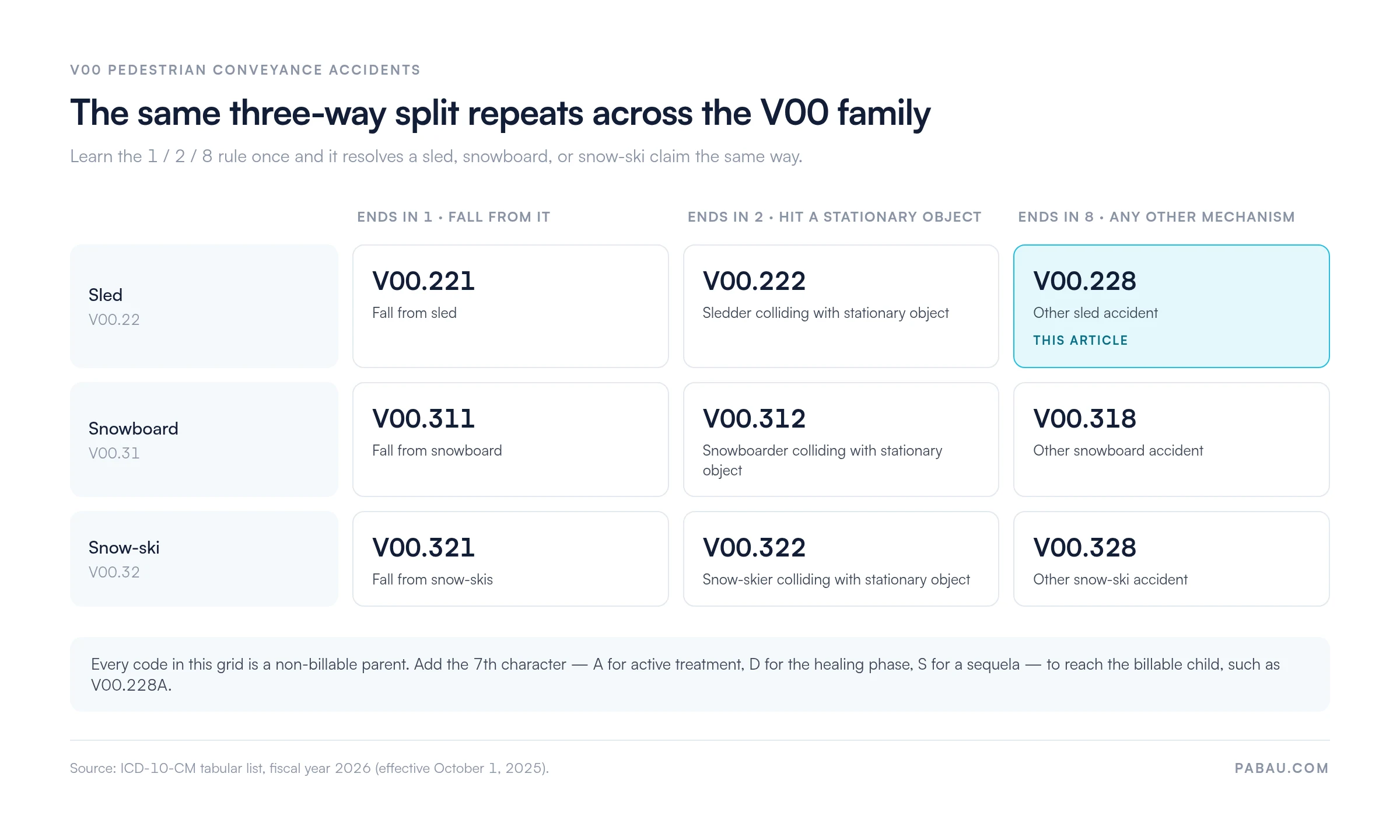
Documenting the mechanism clearly in the chart note is what lets a coder place the event in V00.228A rather than a sibling code. A note that says only “sledding injury” leaves the coder guessing between a fall, a collision, and an “other” event. Specificity in the clinical narrative decides the code, the same way it does across every trauma family in ICD-10-CM.
V00.228A inherits the notes attached to the V00 category. Coders should read them before assigning the code, because several of them route common winter injuries out of V00 altogether.
The tabular list gives V00.22 no Applicable To note and does not define which conveyances count as a sled. In practice, the category is used for non-motorized sliding conveyances on snow or ice, including toboggans and plastic disc sleds. If the note describes a conveyance that does not read as a sled, check the other gliding-type codes under V00.28 before defaulting to V00.22.
An Excludes1 note means the excluded condition cannot be coded alongside V00.228A for the same encounter. The V00 category carries five.
A motorized snow vehicle is not a pedestrian conveyance at all, so a snowmobile injury belongs in the V86.x block rather than V00.22. Verify the current-year tabular list before each annual update, since CMS and NCHS can revise these notes.
V00 also carries a use-additional instruction for place of occurrence (Y92.-) and activity (Y93.-) codes, where the record supports them. A sledding injury usually supports both. Y93.23 is the activity code covering sledding, tobogganing, and snow tubing, and it sits alongside V00.228A rather than replacing it.
The V00.22 group contains nine billable codes across three mechanisms. Selecting the wrong sibling is the most common error on sled accident claims.
The table below lists every code a coder should evaluate when a sledding injury presents. Refer to the AAPC ICD-10-CM code lookup for up-to-date descriptions and any mid-year edits.
There is no V00.229 in this group. A claim carrying that code will reject as invalid. The fix is almost always V00.228 with the correct 7th character.
The ICD-10-CM Official Guidelines for Coding and Reporting, published jointly by CMS and NCHS, govern how V00.228A must be applied. Four documentation rules determine whether a claim passes or stalls.
Run a pre-submission code pairing check on every sled accident claim. If V00.228A appears on the claim without a principal injury diagnosis code (fracture, contusion, concussion, etc.), flag it before transmission. Payers treat unpaired external cause codes as an incomplete claim, not an unbundling issue, so the fix is a correction rather than an appeal.
Chapter 20 codes, including V00.228A, describe how an injury occurred. They are never sequenced first. The principal diagnosis must carry the injury, such as a closed fracture of the distal radius, a concussion, or a soft-tissue contusion.
Payers routinely deny claims where an external cause code appears without a matching injury diagnosis. Clean claim workflows that validate code pairing before submission catch these errors at the source rather than after a denial.
This nuance trips up even experienced coders. Consider a patient who sees a primary care physician, is referred to an orthopedic surgeon, and then visits a physical therapist. If all three visits fall in the week of the injury, each provider may report V00.228A.
Each one is providing active treatment. The 7th character does not flip to D because another clinician has already seen the patient. It flips when the phase of care shifts to healing, monitoring, or rehabilitation.
The chart note has to support the code. “Patient injured while sledding” supports the V00.22 group. It does not separate a fall (V00.221A) from a stationary-object collision (V00.222A) or an “other” event (V00.228A). Coders cannot make that call from a vague note.
The note should record what the sled did and what the rider did. Say whether the rider came off, whether the sled struck something fixed, or whether another sled was involved. Those three details resolve the code on their own. Without them, the coder defaults to the non-billable parent and the claim stalls.
For all HIPAA-covered transactions, ICD-10-CM is the required diagnosis coding system. V00.228A is valid for fiscal year 2026 submissions.
Practices submitting through a clearinghouse should confirm that it validates code pairing before forwarding to payers. A clearinghouse edit that catches a missing principal diagnosis costs minutes. The same miss caught by the payer costs a denial and a resubmission cycle.
Practices that see repeated denials on external cause code claims should sort them by reason code first. The pattern is usually a missing principal diagnosis or a wrong 7th character. Some payers simply do not cover external cause codes. Our guide to medical billing denial codes explains how to read each reason code and work the batch behind it.
ICD-9-CM had no sled-specific external cause code. Sledding injuries were captured under the general fall and recreational accident E-codes. None of those codes named a sled or described the mechanism at this level of detail.
The granularity of the V00.22 block arrived with ICD-10-CM. Practices converting historical records or running longitudinal analyses on sled injuries should expect no precise ICD-9 equivalent.
General-equivalence mappings exist for parts of the V00 block, but for V00.228A they are approximate rather than exact. For practices whose records span both eras, historical sled injury claims have to be re-evaluated rather than migrated directly. Payer data from before October 2015 carries no equivalent V00.228A record.
In most practices, a V00.228A pairing error surfaces after the payer finds it. The claim goes out, the remittance comes back denied, and someone rebuilds it from the chart note weeks later. By then the coder is working a different batch of injuries.
Practice management software like Pabau turns that order around. Pabau’s claims management software builds the claim from the clinical record, so the principal injury diagnosis and the external cause code travel together.
Its Claim.MD clearinghouse integration then checks ICD-10 and CPT pairings against payer edits before the claim is transmitted.
The payoff is a much shorter loop. A missing principal diagnosis gets flagged while the coder still has the chart open. A denial and a resubmission cycle turn into a correction that takes seconds.

Practice management software like Pabau builds the claim from the clinical record, so the injury diagnosis and the external cause code travel together. Payer edits are checked before transmission, not after a denial.

V00.228A has a narrow scope, and the narrowness is the point. Reach for it only once the note has ruled out a fall from the sled and ruled out a stationary object. If the note rules out neither, the fix is a better chart note rather than a residual code.
Four mistakes account for most sled accident denials. Coders submit the non-billable parent V00.228, apply the A character to a follow-up visit, or omit the principal injury diagnosis. The fourth is reaching for “other” when the note describes a fall.
Every one of them is prevented at the moment the note is written, not at the moment the claim is built. Get the mechanism into the chart and the code follows on its own. Book a demo to see how Pabau pairs external cause codes with the principal diagnosis before a sled season claim goes out.

Need to understand how clearinghouse validation works? Our Claim.MD clearinghouse guide explains how electronic claim validation catches ICD-10 pairing errors before payer rejection.
Dealing with repeated claim denials? Denial codes in medical billing covers how to read CARC denial reasons and resolve external cause code errors systematically.
Want to understand the full revenue impact of coding accuracy? Superbill documentation guide explains how complete ICD-10 and CPT pairing on the superbill prevents downstream claim failures.
ICD-10 code V00.228A documents the mechanism of a sled accident at the initial, active-treatment encounter. It applies when the event is neither a fall from the sled nor a collision with a stationary object. Contact between two moving sleds is the common example. It is always paired with a principal injury diagnosis and is never used as a standalone or primary diagnosis code.
The three codes split the V00.22 sled accident group by mechanism. V00.221 is a fall from the sled, V00.222 is a sledder colliding with a stationary object, and V00.228 covers any other sled accident. Each one needs a 7th character of A, D, or S. There is no V00.229 in this group.
Yes, V00.228A is a billable and specific ICD-10-CM code valid for fiscal year 2026 HIPAA-covered transactions. Its parent code V00.228 is non-billable. Only the 7th-character children (V00.228A, V00.228D, V00.228S) can be submitted for reimbursement.
A fall from a sled is coded V00.221, not V00.228. Use V00.221A at the initial, active-treatment encounter, V00.221D for the healing phase, and V00.221S for a sequela. This includes a sled that overturns and throws the rider clear, because the rider still comes off the sled.
The 7th character A in ICD-10-CM trauma codes designates an initial encounter, meaning the patient is receiving active treatment for the condition. It does not mean the first calendar visit. It applies to every visit during the active treatment phase, however many have already occurred.
V00.228A is used during active treatment. V00.228D covers the subsequent healing or recovery phase. V00.228S covers late effects or sequelae that persist after the original injury has resolved. All three describe the same “other sled accident” mechanism. Only the phase of care differs.
V00.228A inherits the Excludes1 notes on the V00 category. There are five. They cover collision with another person without a fall (W51) and a fall caused by two people on foot colliding (W03). A third covers a fall from a non-moving wheelchair or scooter without collision (W05.-). The last two are pedestrian conveyance collision with another land transport vehicle (V01-V09), and a pedestrian on foot slipping on ice and snow (W00.-). Review the current-year tabular list, as these notes can change in annual CMS and NCHS updates.
The 2026 ICD-10-CM edition became effective October 1, 2025. V00.228A is valid for all HIPAA-covered claim submissions from that date through September 30, 2026.