ICD-10 Code S02.602D: Fracture of mandible, subsequent encounter
ICD-10 Code S02.602D: Definition and billable status ICD-10 Code S02.602D is the...

Last Updated: Oct 8, 2026
Billable Code Specific Code
T33.539A is the billable ICD-10-CM code for superficial frostbite of unspecified finger(s), initial encounter.
The code also requires a note that does not name which hand is affected. It is valid for dates of service from October 1, 2025 through September 30, 2026.
Let Pabau's smart automation suggest the right codes, reduce claim denials, and keep your practice compliant—effortlessly.
Automate repetitive tasks and focus on what matters most—your patients.
Reduce coding errors and ensure compliance with the latest regulations.
Clean claims, fewer denials, and faster reimbursements.
Powerful insights and reporting to help your practice thrive.
HIPAA compliant SOC 2 certified GDPR-compliant Trusted by 4,000+ clinics worldwide

T33.539A is a billable ICD-10-CM code for superficial frostbite of unspecified finger(s), initial encounter, valid for FY2026.
The 7th character A denotes an initial encounter. Use D for subsequent encounters and S for sequela coding.
Do not confuse T33.539A with T33.839A. Finger codes sit under subcategory T33.53, while T33.83 covers toes.
Document laterality whenever the record supports it. T33.531A covers right finger(s) and T33.532A covers left finger(s).
Pabau, our practice management software, supports ICD-10-CM code entry and connects to the Claim.MD clearinghouse for US claim submission.
ICD-10 code T33.539A identifies superficial frostbite of unspecified finger(s), initial encounter. It is a billable, specific ICD-10-CM code valid for reimbursement under HIPAA-covered transactions for FY2026, effective October 1, 2025.
Coders assign it when the record documents superficial cold injury to the fingers without naming which hand is affected.
Superficial frostbite (category T33) affects only the skin surface and subcutaneous tissue. Clinical signs include redness, numbness, and pallor of the digits without deep tissue involvement. That depth limit separates T33.539A from category T34, frostbite with tissue necrosis, where the injured tissue does not survive.
Emergency physicians, urgent care providers, and wilderness medicine practitioners assign this code most often. Hospitalists and primary care clinicians also apply it at the first visit for a cold-injury presentation.
The 7th character decides which version of T33.539 applies to a given visit. Without it, T33.539 is not billable, because HIPAA-compliant submission requires the full seven-character code. Across the injury chapters of ICD-10-CM, the 7th character follows the same A, D, and S logic.
A common coding error is reading “initial encounter” as the patient’s first visit to a specific provider. It means the first active-treatment visit for that injury episode.
Per the CMS ICD-10-CM coding guidelines, the 7th character A applies for as long as the patient receives active treatment. The number of providers involved does not matter. A follow-up wound check after the acute phase closes shifts coding to T33.539D.
T33.539A sits inside a defined hierarchical structure in ICD-10-CM. Reading that hierarchy from the top down helps coders step between levels when incomplete documentation puts the most specific code out of reach.
When a provider documents the affected hand, the laterality-specific codes take precedence: T33.531A for the right side and T33.532A for the left. T33.539A is reserved for records that genuinely cannot say which hand is affected.
The frostbite subcategories are numbered by body region, and two of them look almost identical in a code list. T33.53 covers finger(s) and belongs to T33.5, the wrist, hand, and fingers group. T33.83 covers toe(s) and belongs to T33.8, the ankle, foot, and toe(s) group.
A finger injury coded to T33.839A is a body-site error, not a specificity error. The claim describes a foot problem while the note describes a hand problem, so the payer sees a mismatch between diagnosis and treatment. Reading the fourth character before the fifth catches the swap in one glance: 5 means hand, 8 means foot.
The T33.53 subcategory holds three laterality variants for the initial encounter, each with subsequent (D) and sequela (S) counterparts. Payer auditors increasingly flag claims that default to “unspecified” while the clinical note carries laterality information.
When the treating note says “bilateral finger frostbite,” assign both T33.531A and T33.532A. T33.539A does not cover bilateral presentations, because “bilateral” is not the same as “unspecified.” Conflating the two creates a medical necessity mismatch that can trigger a payer audit or a denial.
Choosing between T33 and T34 is a clinical documentation question before it becomes a coding question. The physician’s note has to establish the depth of tissue involvement. Coders cannot assign T34 on inference.
If the provider documents “frostbite” with no further qualification, query the treating clinician before coding. Assigning T34 from an ambiguous note is a common audit trigger. Code to the level the documentation supports, which in many acute-care cases will be T33.
The following terms map clinically to T33.539A. Recognizing them in provider notes helps coders reach the correct code without querying every instance:
Note that “chilblain” (pernio) carries its own ICD-10-CM code and is not a synonym for frostbite. Assign T33.539A when the provider explicitly documents frostbite or frostnip of the fingers. Check the CDC/NCHS ICD-10-CM web tool when a synonym is ambiguous.
Document laterality at triage, not at discharge. In a busy emergency department, laterality is far easier to capture when the patient first presents than to reconstruct from a note written hours later. Building a laterality checkbox into your cold-injury intake workflow keeps T33.539A from becoming a fallback where T33.531A or T33.532A would be correct.
Accurate coding starts with the physician’s note, and the coder decides whether that note supports the code selected. For T33.539A, three documentation elements draw audits consistently: tissue depth, laterality, and encounter type.
Understanding denial management in healthcare helps practices catch frostbite coding errors before they turn into rejected claims. Four denial drivers account for most T33.539A rejections:
Each of these is preventable with a structured documentation review before submission. A short pre-billing checklist catches all four in the time it takes to reread the triage note.
When a rejection does arrive, our reference on common billing denial codes explains what the CARC on the remittance is telling you.
T33.539A is valid on CMS-1500 claims for outpatient and professional billing, and on 837P electronic transactions. Practices billing cold-injury visits benefit from a clearinghouse that checks each claim for errors before it reaches the payer.
Pabau, our practice management software, connects to the Claim.MD clearinghouse for US claim submission. Claim.MD reaches thousands of US payers, and it returns real-time eligibility responses from around 400 of them. Those checks flag a rejected member ID or a missing authorization before the claim is adjudicated.
For inpatient claims, T33.539A maps to MS-DRG groupings under the injury and trauma category. POA (Present on Admission) exempt status likely applies to it as an injury code. Verify that against the CMS ICD-10 codes page and the current CMS POA exempt indicator file before asserting exempt status.
Once the claim goes out, the electronic remittance advice (ERA/835 file) confirms payer adjudication. It flags code-level rejections with CARC denial reasons, which makes post-submission reconciliation faster. An ED or urgent care encounter should also carry the relevant E/M code.
T33.539A fits a narrower set of clinical situations than many coders assume. Assigning it correctly means matching both the clinical picture and the documentation to the code’s definition.
Each exclusion sends the claim to a specific sibling code, and the chart below shows which one.
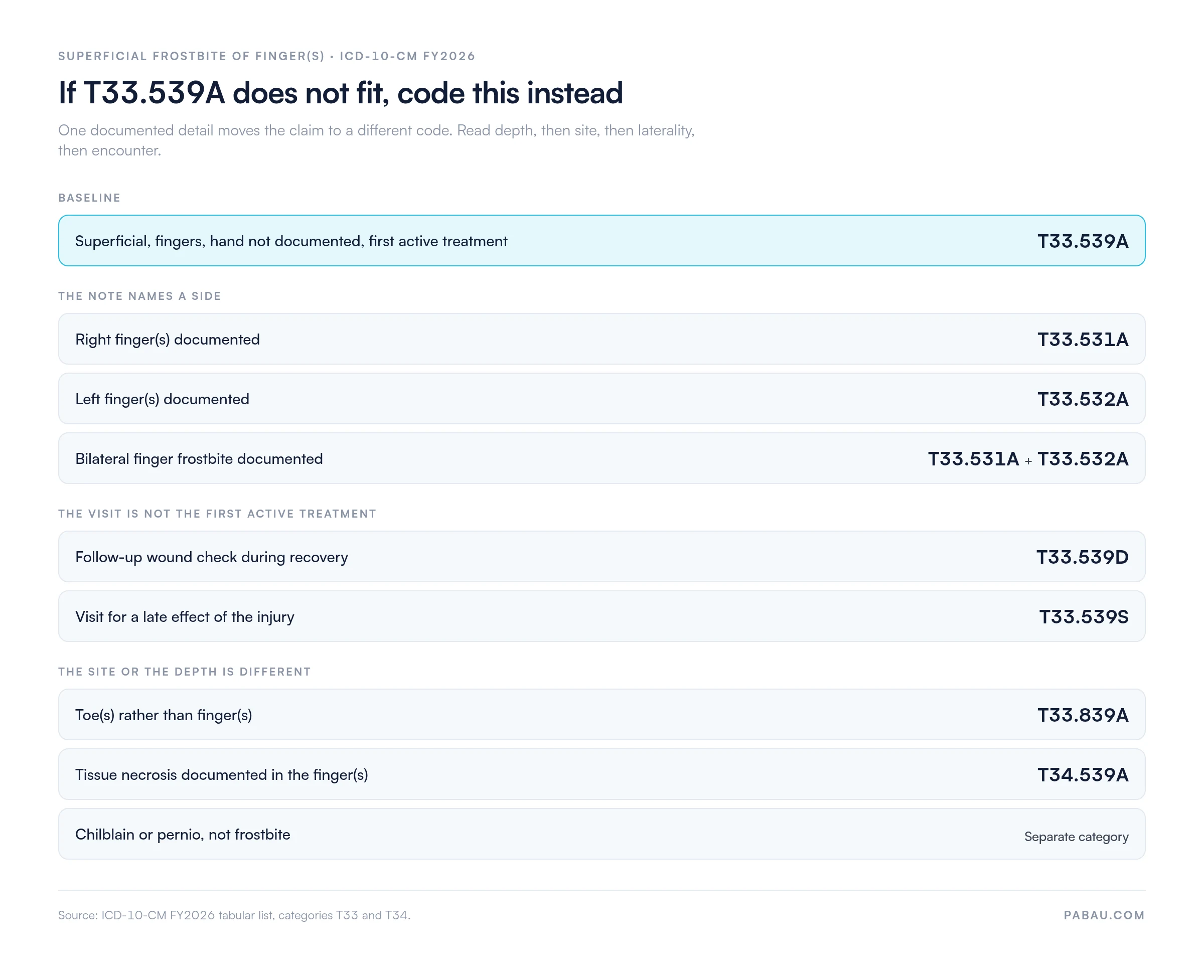
Run a quarterly query on T33.539A claims to see how many were later amended to T33.531A or T33.532A. A high amendment rate points to a documentation workflow problem rather than a coder error. Add a laterality prompt to the cold-injury note template in your EHR and the rate drops.
Legacy system compatibility and retrospective research often call for mapping T33.539A back to its ICD-9-CM predecessors. The General Equivalence Mappings (GEMs) published by CMS provide the official crosswalk.Per the AAPC ICD-10-CM code reference, the approximate ICD-9 ancestors for this code are shown below.
ICD-9-CM carried neither laterality nor encounter-type specificity. Several ICD-10-CM codes (T33.531A, T33.532A, and T33.539A) therefore trace back to the same ICD-9 predecessor.
The ICD-10 to ICD-9 conversion tool is a quick way to check one code, and the CMS GEMs files remain the authoritative source. Verify any crosswalk against the current GEMs files before you rely on it.
A finger-versus-toe swap or a stale encounter character often surfaces only when the remittance comes back. By then the claim has aged, a biller has to rework it, and the visit sits unpaid for weeks. The check that would have caught it takes seconds at the point of coding.
Pabau keeps the diagnosis code with the clinical note. The coder sees the documented site and laterality while selecting T33.539A or one of its siblings.
Our claims software for billers then tracks each claim through submission. It checks the required insurer fields, such as membership and authorization numbers, before the claim leaves your practice.
The result is fewer denials to chase and less rework for billing staff. Payment for a cold-injury encounter arrives on the first pass more often.

Pabau keeps diagnosis codes beside the clinical note and connects to the Claim.MD clearinghouse for US submission. See how that shortens the path from a cold-injury visit to payment.

Frostbite of the fingers is a small code family, and the whole risk sits in four characters. Read depth first, then site, then laterality, then the encounter character. A coder who works in that order will not send a hand injury out on a toe code.
The harder problem is documentation rather than coding. If your amendment rate on T33.539A is high, the cold-injury note template needs the edit, not the coder. Pabau keeps the note and the diagnosis code in one record, so the site and the side are visible while the code is chosen. Book a demo to see how that works in a live billing workflow.

Need a broader overview of how ICD-10 codes work in revenue cycle management? What is revenue cycle management explains how diagnosis codes fit into the end-to-end billing workflow.
Wondering how clearinghouses validate your ICD-10 codes before submission? How a medical claims clearinghouse works covers the 837P validation process and payer routing.
Looking for guidance on clean claims and reducing rejections? What makes a clean claim outlines the documentation and coding requirements that prevent cold-injury denials before they happen.
T33.539A is the ICD-10-CM code for superficial frostbite of unspecified finger(s), initial encounter. It is a billable, HIPAA-valid diagnosis code. Assign it when a patient receives first active treatment for superficial cold injury to the fingers and the record does not name the affected hand.
T33.539A covers superficial frostbite of unspecified finger(s), and T33.839A covers superficial frostbite of unspecified toe(s). The two sit in different body-region subcategories: T33.53 for fingers under T33.5, and T33.83 for toes under T33.8. Using the toe code for a finger injury is a body-site error that payers reject.
Yes. T33.539A is a billable, specific ICD-10-CM code valid for FY2026, effective October 1, 2025. You can use it to indicate a diagnosis for reimbursement in HIPAA-covered transactions, on both CMS-1500 and 837P electronic claim formats.
The 7th character A indicates an initial encounter, meaning the patient is receiving active treatment for the frostbite injury for the first time. Use D (T33.539D) for subsequent follow-up visits during recovery. Use S (T33.539S) for visits addressing a late effect or sequela of a prior frostbite episode.
T33 covers superficial frostbite affecting only skin and subcutaneous tissue. T34 covers frostbite with tissue necrosis, where the injury reaches deeper structures such as muscle or bone. Blistering, necrosis, and woody, non-pliable tissue point toward T34. Coders must rely on the physician’s documentation of depth rather than inferring it from symptoms.
Use T33.539D for a subsequent encounter with unspecified laterality, T33.531D for the right finger(s), or T33.532D for the left. The D suffix applies once the patient has completed initial active treatment and is seen for ongoing wound management during the healing phase.
T33.531A covers superficial frostbite of the right finger(s) at the initial encounter, and T33.532A covers the left finger(s). T33.539A is reserved for records that genuinely cannot say which hand is affected. Bilateral presentations require both T33.531A and T33.532A, never T33.539A.
Yes. T33.539A is valid for the FY2026 ICD-10-CM edition, effective October 1, 2025. Verify current-year status against the official CDC/NCHS ICD-10-CM tabular list, or against the CMS annual code update files, before submitting claims for any fiscal year.