ICD-10 code S61.201A: Open wound of left index finger without nail damage
ICD-10 code S61.201A covers a left index finger wound of unstated type ICD-10 co...

Last Updated: Oct 16, 2026
Billable Code Specific Code
T32.88 is the billable ICD-10-CM code for corrosions involving 80-89% of body surface with 80-89% third degree corrosion. It has been valid for claim submission since October 1, 2015, under the FY2016 ICD-10-CM edition.
The code encodes two percentages rather than one. The first is total body surface affected, and the second is how much of that surface is full thickness. Coders who read only the first figure land on the wrong sibling code, which changes how the claim groups for payment.
Let Pabau's smart automation suggest the right codes, reduce claim denials, and keep your practice compliant—effortlessly.
Automate repetitive tasks and focus on what matters most—your patients.
Reduce coding errors and ensure compliance with the latest regulations.
Clean claims, fewer denials, and faster reimbursements.
Powerful insights and reporting to help your practice thrive.
HIPAA compliant SOC 2 certified GDPR-compliant Trusted by 4,000+ clinics worldwide

T32.88 covers corrosions where total body surface and third-degree extent both fall in the 80-89% range.
The code has been billable since October 1, 2015, under the FY2016 ICD-10-CM edition.
The Rule of Nines gives the adult TBSA figure that decides which T32 subcategory applies.
T32.88 is an additional code, so a site-specific T20-T29 corrosion code leads the claim.
External cause codes are mandatory on inpatient claims and expected by most payers elsewhere.
ICD-10 code T32.88 is a billable, specific ICD-10-CM code for corrosions involving 80-89% of body surface with 80-89% third degree corrosion. It has been valid for claim submission since October 1, 2015, when it took effect under the FY2016 ICD-10-CM edition.
So nothing about it is new for the current fiscal year, whatever an old reference sheet says. What makes the code awkward is the pair of percentages baked into it, and both have to be in the chart before anyone submits.
T32.88 sits at the top of the T32.8x subcategory, and it needs no further digit to be valid. The CMS ICD-10-CM code list carries the current tabular entry. Because the code set updates every October, confirm active status with the CDC/NCHS ICD-10-CM tool before a new fiscal year’s claims go out.
The T32 category sorts corrosive injuries by how much of the body surface is affected, expressed as a percentage of total body surface area (TBSA). The site-specific codes in T20-T29 answer a different question, which is where on the body the injury landed. T32 answers how much.
That split explains why the two families usually appear together. T32 sits inside the burns and corrosions block, T20-T32, in Chapter 19. The AAPC ICD-10-CM code range lookup lays out the whole hierarchy. It runs from superficial burns of the face through to the extent-based codes.
Every code in the T32.8x subcategory describes the same total, a corrosion covering 80-89% of the body surface. The final digit adds a second measurement on top of it, which is how much of that surface is third degree.
Notice where the table stops. The final digit is read off the third-degree percentage, so T32.88 needs that figure to land between 80% and 89% too. A smaller third-degree share moves you down the list.
The subcategory ends there for a simple reason, since a third-degree share cannot be larger than the surface it is measured against. If total TBSA reaches 90% or more, the case leaves T32.8x and moves into T32.9x instead. Getting that final digit right matters, because DRG grouping on major burn cases responds to the third-degree figure.
The subcategories that carry a fifth character all end the same way, at the code where both percentages sit in the same band. In the 10-19% range that endpoint is T32.11.
Total body surface area drives every T32 selection, T32.88 included. For adults, the Rule of Nines is the standard estimate used in burn management, and it gives each region a fixed share of the surface.
Reaching 80-89% takes almost the whole body surface. Sparing one pair of limbs is often what separates a T32.8x code from its neighbors, as the chart below sets out.
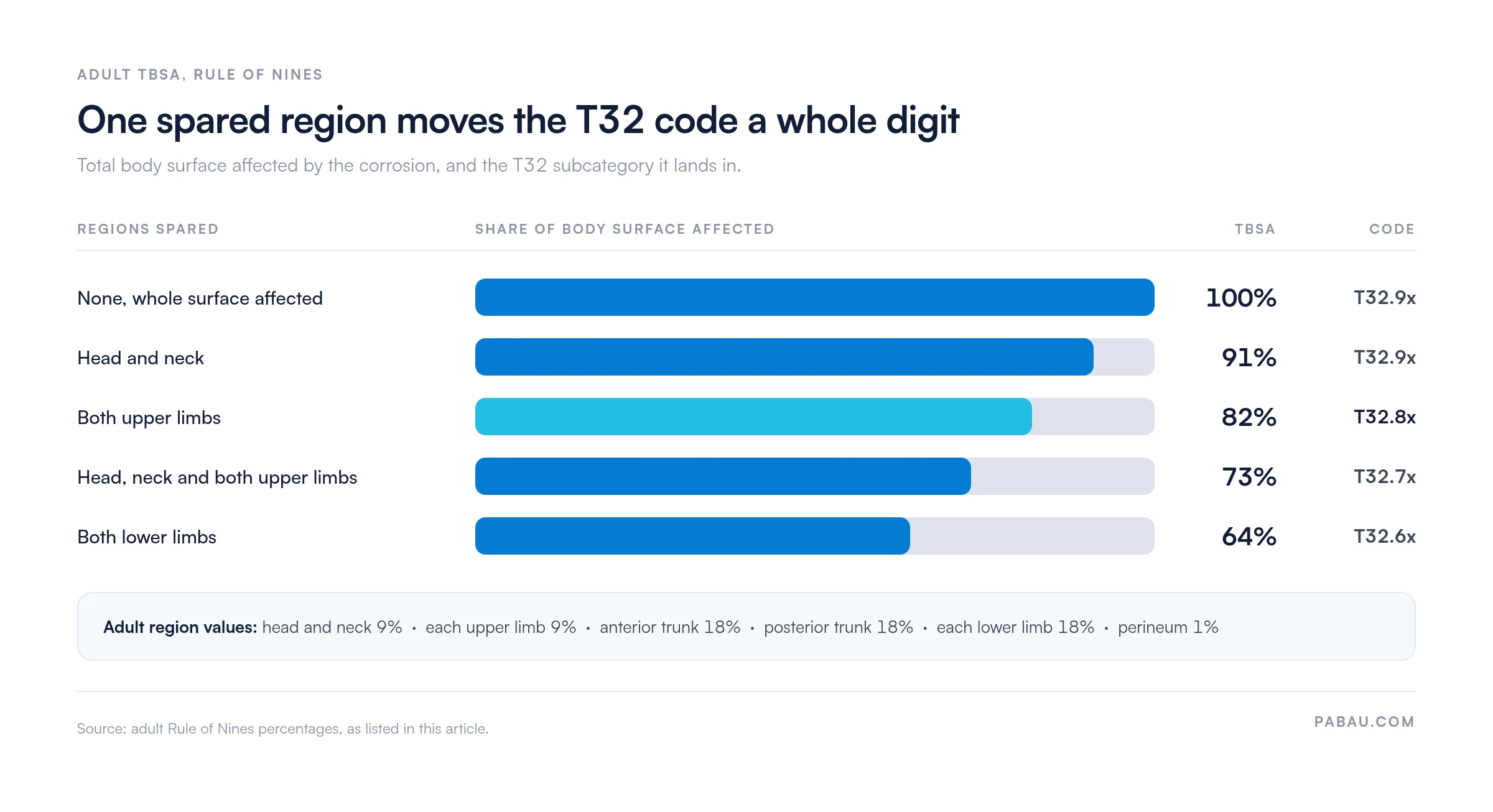
In practice, the clinician sums the affected regions and records the total in the chart. The coder then maps that total to the T32 first digit. For T32.88, the third-degree assessment has to appear as its own percentage as well. One figure without the other leaves the coder unable to pick a final digit.
An 85% TBSA corrosion only becomes T32.88 when the full-thickness share also sits between 80% and 89%. Third-degree corrosion destroys the whole thickness of the skin, unlike superficial first-degree damage or partial-thickness second-degree injury. The first 8 in the code reports total surface, and the second reports how much of it is third degree.
An example makes the difference concrete. Say a patient arrives with 85% TBSA corrosion, and the burn team documents 75% of the body surface as full thickness. The total puts you in T32.8. The third-degree figure sits in the 70-79% band, so the final digit is 7, and the code is T32.87.
The two assessments are made separately and recorded separately. Without the second one, nobody can defend T32.88 when a payer asks how the digit was chosen.
Injuries at this scale are rare, and they arrive through a small number of routes. Almost all of them involve a burn unit admission and a multi-disciplinary team.
In each case the attending physician or burn specialist completes a formal TBSA assessment, then records the total affected percentage and the full-thickness percentage. That assessment is the only source the coder has. If it never reaches the chart in numbers, the claim stalls before it is built.
A corrosion in ICD-10-CM is injury from a chemical or corrosive agent, while a burn is injury from heat. The mechanism decides the family. Thermal burns sit in the burn subcategories of T20-T31, and chemical corrosions sit in the corrosion subcategories of T20-T32.
T32.88 is always a corrosion code, and the distinction shows up at audit time. A claim coded as a corrosion but supported by notes describing a flame injury will fail review. The provider note has to name the agent or the mechanism clearly enough for a coder to tell the two apart.
Section I.C.19 of the ICD-10-CM Official Guidelines for Coding and Reporting governs how T32.88 is sequenced and combined with other codes. Burn unit and emergency coders meet these rules on every admission, so they are worth knowing cold.
T32.88 is normally an additional code, not the principal diagnosis. The guidelines ask you to sequence first the code that reflects the highest degree of injury. For corrosions across several sites, the most severe site leads, and T32.88 follows it to record the overall extent.
Sequencing is not a formality here. A T32.88 that appears as the principal diagnosis, where a site-specific T20-T29 code should lead, can regroup the DRG and underpay the stay.
External cause codes record the agent and the circumstances. They are mandatory in inpatient settings under UHDDS reporting rules and strongly recommended in outpatient settings.
Leaving one off an outpatient claim is not a coding error, but payers increasingly expect it on complex corrosion claims.
Checking that these codes are present before submission is straightforward denial prevention. Payers auditing corrosion claims name missing external cause documentation often, so denial management in healthcare is worth reading for how to structure a pre-submission review.
T32.88 rests entirely on numbers the clinician writes down. A coder may not calculate TBSA from a narrative description, however vivid it is. These are the elements that support the code.
When the note gives a total TBSA but no separate third-degree percentage, query the provider before you code rather than after the denial. A query answered the same week costs a few minutes. Asked after a remittance, the same question costs a rebill and an appeal window. It also earns the rest of the claim a second look from the payer.
T32.88 is almost never assigned alone. These are the codes that show up beside it most often, and what each one is doing there.
If you need to check a companion code before submission, our ICD-10-CM code index holds the rest of the set in one place.
Coding is one stop on a longer route, and knowing the route tells you where a T32.88 claim tends to stall. Here is the sequence on a typical burn unit admission.
Step two is where the money is decided on inpatient claims. T32.88 signals one of the most severe injury classifications in ICD-10-CM, so it can influence the major complication or comorbidity designation and the resulting MS-DRG.
The final grouping still depends on the principal diagnosis, the procedures performed, and the payer’s own rules. Never promise a DRG without running the claim through a certified grouper.
On outpatient claims, T32.88 supports medical necessity for intensive wound management. Payers reviewing surgical debridement, skin grafting or a burn unit transfer expect the diagnosis codes to match the documented severity. When coded severity and billed level of service drift apart, an audit usually follows.
Drugs administered during those procedures bill on separate lines. An injection of meperidine for procedural pain, for example, bills under HCPCS code J2175 and needs a diagnosis establishing its own necessity.
Most T32.8x claims that come back were fixable at the desk. Five checks catch the usual causes.
Three situations come up again and again, and each has a standard answer.
On most burn unit claims the diagnosis codes are assembled in one system and the claim is built in another. Codes get re-keyed between the two, and a missing external cause code only surfaces when the remittance arrives weeks later.
Practice management software like Pabau closes that handoff. Our medical claims management tools link the diagnosis codes on the patient record to the claim itself. The coder sees the full set attached before the claim goes out.
Claims then go out through Claim.MD, our US clearinghouse partner, which reaches thousands of US payers. It returns eligibility checks, electronic remittance advice, and denial reason codes to the same record the claim came from.
For a case coded to T32.88, that pre-submission view is where a missing companion code costs a minute instead of a rebill.


Pabau links ICD-10 codes on the patient record straight to claim submission. Complex multi-code cases like T32.88 keep every companion code on the way to the payer. See how it fits your practice.

T32.88 comes down to two numbers on the page, total TBSA and third-degree extent. Get both documented and the coding is straightforward. So the work that decides this claim happens in the chart, well before anyone opens the encoder.
If your burn and corrosion cases keep coming back, look at the assessment template rather than the coding step. A form that asks for total TBSA and full-thickness extent as two separate fields removes the query that delays most of these claims. The rest of the chain, from sequencing to the external cause code, gets easier once those figures are routine.
Book a demo to see how Pabau keeps diagnosis codes, documentation and claim submission in one place for high-acuity cases.

Need to understand how clean claims are built for high-acuity diagnoses? Clean claim requirements in medical billing covers the elements payers require before processing complex inpatient claims like T32.88.
Exploring how ICD-10 codes map to clearinghouse submission? Claim.MD clearinghouse overview explains how diagnosis codes travel from clinical documentation to payer adjudication.
Want to understand denial codes that apply to burn and corrosion claims? Denial codes in medical billing covers CARC reason codes that appear on remittances for high-acuity injury diagnoses.
No. T32.8x ends at T32.88, because a third-degree share cannot be larger than the total surface it is measured against. Once total TBSA reaches 90%, the case moves to T32.9x instead.
Not without adjustment. In children the head accounts for a larger share of body surface, and the legs a smaller one. Burn teams use a pediatric chart or a Lund and Browder chart instead. The percentage they document still drives the T32 code, whichever method produced it.
No. T32 codes carry no 7th character, so T32.88 is complete as written. The encounter type is carried by the companion T20-T29 corrosion codes, which do take a 7th character for initial encounter, subsequent encounter or sequela.
No. T32 measures external body surface only. Corrosion of the respiratory tract is coded from T27, and corrosion of other internal organs from T28. Those codes are assigned in addition to the surface codes when a patient has both.