

ICD-10 code S61.201A: Open wound of left index finger without nail damage
ICD-10 code S61.201A covers a left index finger wound of unstated type ICD-10 co...

Last Updated: Oct 16, 2026
Billable Code Specific Code
T32.44 is the billable ICD-10-CM code for corrosions involving 40-49% of body surface with 40-49% third degree corrosion.
Two documented figures decide it. One is the total body surface area the corrosion covers, and the other is how much of that surface is full-thickness. Both have to appear in the clinical record before a coder can assign this subcode.
Let Pabau's smart automation suggest the right codes, reduce claim denials, and keep your practice compliant—effortlessly.
Automate repetitive tasks and focus on what matters most—your patients.
Reduce coding errors and ensure compliance with the latest regulations.
Clean claims, fewer denials, and faster reimbursements.
Powerful insights and reporting to help your practice thrive.
HIPAA compliant SOC 2 certified GDPR-compliant Trusted by 4,000+ clinics worldwide

T32.44 is a billable ICD-10-CM code covering corrosions involving 40-49% of body surface with 40-49% third-degree corrosion, effective October 1, 2025.
Both dimensions matter: total TBSA involvement (40-49%) and the third-degree subset (40-49%) must be confirmed in the clinical record before assigning T32.44.
Coders must also assign an additional external cause code alongside T32.44 to satisfy ICD-10-CM Official Guidelines requirements for injury sequencing.
None of the five T32.4x codes is an unspecified option, so a record that omits the third-degree percentage needs a provider query.
Practice management software like Pabau validates T32.44 claims against payer edits before submission, then tracks each one through adjudication.
ICD-10 code T32.44 is a billable, specific ICD-10-CM diagnosis code. It is valid for dates of service from October 1, 2025 through September 30, 2026. It identifies corrosions involving 40-49% of body surface with 40-49% third-degree corrosion.
Both the CDC/NCHS ICD-10-CM web tool and the AAPC confirm T32.44’s billable status for FY2026. Check the effective date when a claim’s date of service spans a fiscal year boundary.
T32.44 captures two simultaneous clinical measurements. Both must be present in the medical record before this code can be assigned.
Third-degree corrosion is a full-thickness injury. The affected tissue is insensate, appears white, brown, or charred, and requires grafting in most cases. Documenting depth alongside TBSA is what supports code specificity and medical necessity on a surgical claim.
Document the TBSA percentage and depth classification (third-degree) explicitly in the clinical record at the time of assessment. Vague documentation such as ‘extensive corrosion’ is not sufficient to support T32.44 on audit. The Rule of Nines calculation method used should also be noted.
T32.44 sits within the T32 category, which classifies corrosions by the extent of body surface involved. Each T32 code encodes two independent percentages. The first digit after the decimal reflects total TBSA. The second reflects the third-degree share, which is the only difference between the five codes below.
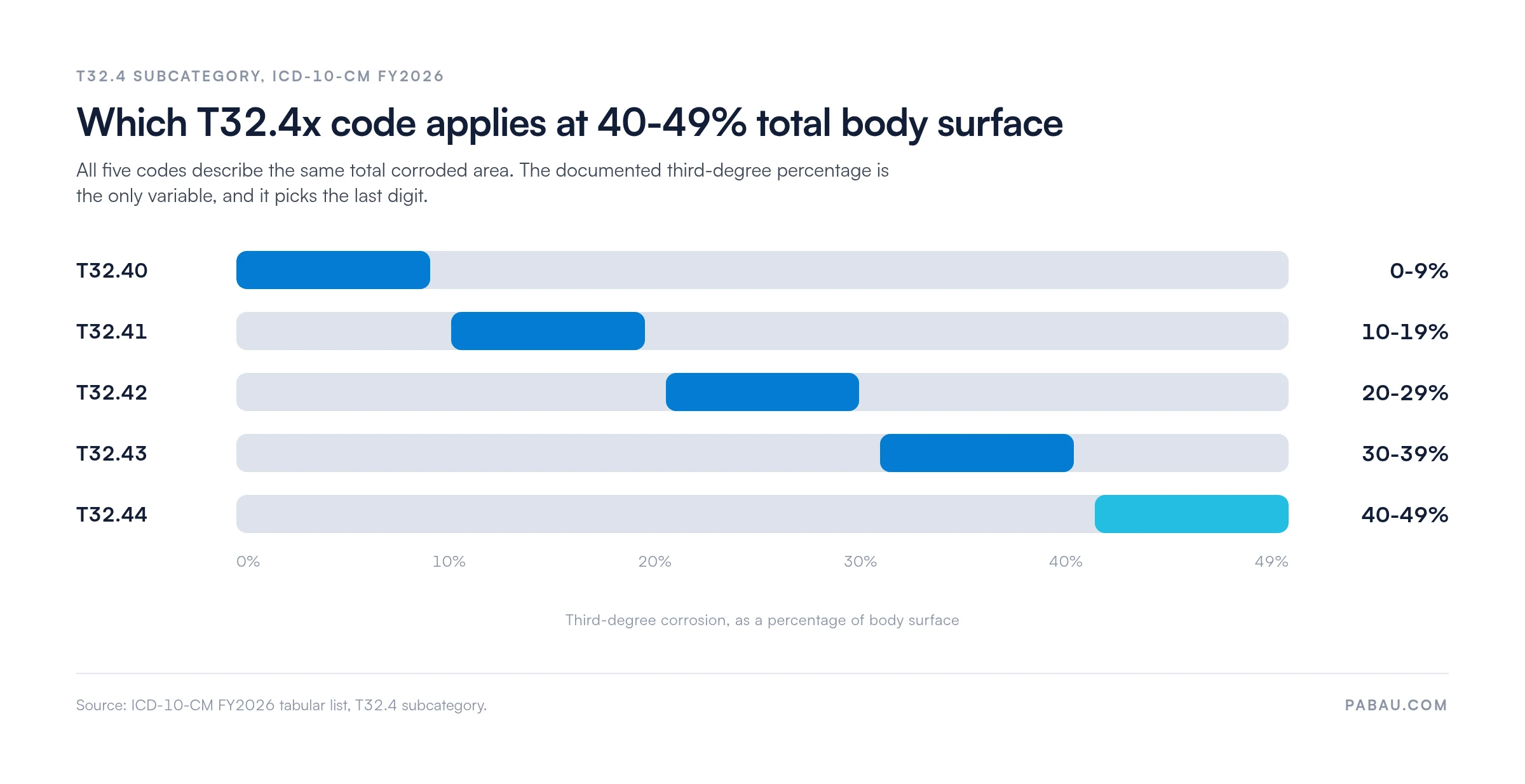
When the record documents third-degree involvement at 40% or more of body surface, T32.44 is the right code in the T32.4x range. The same two-axis pattern runs through the injury categories in chapter S00-T88. A coder who reads it once can apply it to the burn codes as well.
Per the CMS ICD-10-CM Official Guidelines for Coding and Reporting, T32.44 must be coded with additional codes to meet sequencing requirements. Omitting those companion codes is a primary reason corrosion injury claims get denied.
Practice management software like Pabau routes corrosion injury claims through its Claim.MD integration, which checks ICD-10-CM codes against current payer edits before submission. Sequencing errors surface before the claim reaches the clearinghouse, which cuts denials tied to a missing external cause code.
Pabau’s claims management software handles CMS-1500 and 837P submissions for thousands of US payers. An injury encounter follows the same path as a routine visit.
Documentation audits should include T32.44 scenarios, and the external cause code requirement in particular. Smaller practices that rarely handle injury sequencing are the ones most likely to leave it off.
In burn and trauma units, one of the most common coding errors is a T31 thermal burn code on a chemical corrosion. The clinical presentation can look similar, but the cause determines the code category.
ICD-10-CM assigns the parent category by mechanism of injury, not by tissue outcome. A full-thickness injury caused by acid gets a T32 code. The same tissue depth caused by flame gets T31.
Clinicians should name the causative agent in the history of present illness. “Chemical burn” in the assessment will not hold up if the note body says the patient spilled hot liquid. The record has to be internally consistent to support T32 coding on audit.
Coders working in the T32.4x range frequently need to separate T32.44 from the codes next to it. The second digit after the decimal encodes the third-degree percentage only, and all five codes share the same total TBSA range of 40-49%.
Reading a chart that documents 30-39% third degree as 40-49% moves the claim from T32.43 to T32.44. That single character is enough to trigger a documentation-coding discrepancy flag on review.
None of the five is an unspecified option. T32.40 is its own specific band, covering 0% to 9% third-degree corrosion. It is not a fallback for a record that leaves the depth out.
Query the provider for the third-degree percentage before assigning anything in this range. The answer decides the subcode, and the more specific subcode supports higher-acuity DRG assignment in inpatient settings.
Root-cause reviews of T32 denials tend to land on the same discrepancy. A third-degree percentage appears in the operative note but never gets reconciled with the attending assessment. A pre-submission check that compares TBSA documentation across every clinical note closes that off.
Use the AAPC ICD-10-CM lookup or the CDC/NCHS ICD-10-CM web tool to verify the full descriptor of any T32.4x code before assigning it. Both tools display the official long descriptor, making it easy to confirm whether the documented third-degree percentage matches the second character of the subcode.
T32.44 was not added or revised in the FY2026 update cycle. The code carries forward from prior editions without a change in description, billable status, or coding notes.
Its effective date for FY2026 is October 1, 2025, as confirmed by the AAPC ICD-10-CM code lookup and the CDC/NCHS tabular list.
Practices with a settled revenue cycle process put an annual ICD-10-CM update review on the coding calendar. Each code used in the prior year gets checked against the new tabular list before the October effective date. That keeps retired and modified codes off outgoing claims.
Corrosion injury claims coded with T32.44 move through the same 837P and CMS-1500 workflows as other high-acuity injury encounters. The practical challenge is making sure every companion code is appended, and that the TBSA documentation survives claim scrubbing intact.
Pabau connects to the Claim.MD clearinghouse, which reaches thousands of US payers. It supports real-time eligibility checks, electronic remittance advice (835 files), and secondary claim submission. Where an episode of care carries several T32 codes, each claim is tracked through adjudication.
When a corrosion claim does come back rejected, the reason code tells you what to fix. Our guide to medical billing denial codes maps the common CARC values to the documentation that resolves them.
A missing external cause code usually surfaces on the remittance, weeks after the encounter. By then a coder has to reopen the chart, find the causative agent in the notes, correct the sequence, and resubmit. The payment slips a full cycle.
Pabau checks the claim before it leaves the practice. Its Claim.MD integration validates ICD-10-CM codes against current payer edits. A T32.44 claim missing its companion codes gets flagged at submission, not at adjudication.
The documentation sits in the same system. TBSA percentages, depth classification, and the causative agent are recorded against the encounter, so the figures on the claim match the figures in the chart. Remittance posts back automatically, and denial reason codes land on a worklist instead of in a payer portal.

Pabau connects to Claim.MD to validate ICD-10-CM codes, external cause sequences, and submission requirements before claims leave your practice. See how it works for corrosion and burn injury billing.

The work that decides a T32.44 claim happens at the bedside, not in the coding queue. If the assessment records a TBSA figure, a depth classification, and the agent, the subcode picks itself. If it records “extensive chemical burn”, no amount of downstream review will make the code defensible.
So the change worth making is upstream. Require both percentages and the causative agent on every corrosion encounter, then add a pre-submission check for the external cause code. That pair closes off most of what gets these claims rejected.
Pabau’s claims management software runs that second check automatically through its Claim.MD integration. To see how a corrosion claim moves from chart to remittance in one system, book a demo with the team.

Need guidance on managing injury claim denials? Denial management in healthcare covers the most common reasons ICD-10-CM injury claims are rejected and how to build a systematic follow-up process.
Want to understand how clearinghouses validate ICD codes? What makes a clean claim explains the pre-submission checks that prevent T32 and other injury codes from triggering payer edits.
Looking for a revenue cycle framework for your practice? What is revenue cycle management outlines the end-to-end billing workflow from diagnosis coding through payment posting.
T32.44 is a billable ICD-10-CM diagnosis code identifying corrosions involving 40-49% of body surface with 40-49% third-degree corrosion, caused by a chemical or caustic agent. It is valid for reimbursement submission under the FY2026 ICD-10-CM edition, effective October 1, 2025.
Yes. T32.44 is a specific, billable ICD-10-CM code valid for claim submission for dates of service on or after October 1, 2025 through September 30, 2026. Both the NCHS and CMS confirm its valid-for-submission status in the FY2026 tabular list.
Burns (T31 category) result from thermal sources such as flame, hot liquids, or contact heat. Corrosions (T32 category) result from chemical or caustic agents. The tissue damage may look similar, but the causative mechanism determines the correct code category. Always use the clinical documentation of the causative agent, not the tissue appearance, to distinguish T31 from T32.
T32.44 applies when the total TBSA is 40-49% and the third-degree subset is specifically 40-49%. T32.43 applies when the third-degree subset is 30-39%; T32.45 does not exist in the T32.4x subcategory (which runs T32.40 through T32.44). If the third-degree percentage exceeds 40-49% in a 40-49% TBSA case, review the documentation. The total TBSA figure may need reassessing.
ICD-10-CM Official Guidelines require an external cause code identifying the corrosive agent and circumstances of injury alongside T32.44. A place of occurrence code (Y93 activity code) and external cause status code (Y99) may also be required depending on the encounter type and payer. Omitting these companion codes is a common denial trigger for corrosion injury claims.
TBSA is calculated using standardized tools such as the Rule of Nines (adults) or the Lund-Browder chart (pediatrics and adults). The treating clinician documents it at the time of assessment. The third-degree percentage is a subset of the total TBSA. Both figures must be explicitly recorded in the clinical record; estimates or ranges do not support code specificity on audit.



