ICD-10 code S61.201A: Open wound of left index finger without nail damage
ICD-10 code S61.201A covers a left index finger wound of unstated type ICD-10 co...

Last Updated: Oct 16, 2026
Billable Code Specific Code
T31.0 is the billable ICD-10-CM code for burns involving less than 10% of body surface.
T31.0 sits within the T31 category, which classifies burns according to the percentage of body surface involved, not anatomical site or degree. This is the critical distinction that drives companion-code requirements. According to CMS ICD-10-CM guidelines, the T31 family supplements, rather than replaces, the T20-T25 site-specific codes.
Let Pabau's smart automation suggest the right codes, reduce claim denials, and keep your practice compliant—effortlessly.
Automate repetitive tasks and focus on what matters most—your patients.
Reduce coding errors and ensure compliance with the latest regulations.
Clean claims, fewer denials, and faster reimbursements.
Powerful insights and reporting to help your practice thrive.
HIPAA compliant SOC 2 certified GDPR-compliant Trusted by 4,000+ clinics worldwide

ICD-10 code T31.0 classifies burns involving less than 10% of total body surface area (TBSA). It is billable for FY2026, effective October 1, 2025.
T31.0 covers burns of any degree, third-degree included, as long as TBSA stays under 10%. No third-degree sub-digit exists at this level.
T31.0 is an extent code, not a site code. Report it alongside a T20-T25 code that names the burn’s location and depth.
TBSA is estimated with the Rule of Nines for adults, and the Lund-Browder chart for children. A missing TBSA percentage is the most common reason T31.0 claims get queried.
Pabau’s claims management software helps burn-treating practices submit paired codes and track payer responses in one place.
T31.0 does not record whether any of the burned area is third-degree (full-thickness), and that is deliberate. Below 10% TBSA the extent code carries no depth information at all. A third-degree burn of that size still takes T31.0. Depth belongs to the paired T20-T25 code instead.
The T31 category classifies burns purely by how much body surface is affected, expressed as a percentage of total body surface area (TBSA). It answers one question: how extensive is the burn? The T20-T25 codes answer different questions: where is it, and how deep? Both families are needed for complete burn coding.
T31 runs from T31.0 through T31.99, covering TBSA increments of 10 percentage points each. Within each 10% band, a secondary digit indicates what proportion of the burned area involves third-degree injury. The table below shows the full T31 subcategory hierarchy, as verified against the CDC/NCHS ICD-10-CM tool.
T31.0 is the only code in the family with no third-degree sub-digit. A burn under 10% TBSA still takes T31.0 as the extent code, even when the record documents full-thickness injury. The depth is captured by the paired T20-T25 site code, not by escalating to T31.10. TBSA documentation matters most at this tier, because the site code carries the clinical detail.
Calculating TBSA accurately is the prerequisite for assigning any T31 code, including T31.0. The standard adult method is the Rule of Nines. It divides the body into regions, each representing 9% of total body surface area, or a multiple of it. Clinicians assess which regions are affected and add the percentages together.
A burn across one hand and the forearm above it, for example, involves roughly 4.5% TBSA. That is half of the 9% allocated to an upper limb, and it falls under T31.0. Both hands and forearms together reach about 9%, which still sits inside T31.0. The percentage has to reach the note either way.
Pediatric patients: The Rule of Nines is not accurate for children because body proportions differ significantly from adults. For patients under 15, the Lund-Browder chart is the preferred estimation method, assigning different percentages to head and leg regions based on age. Coders should verify which method the clinician used when reviewing pediatric burn documentation.
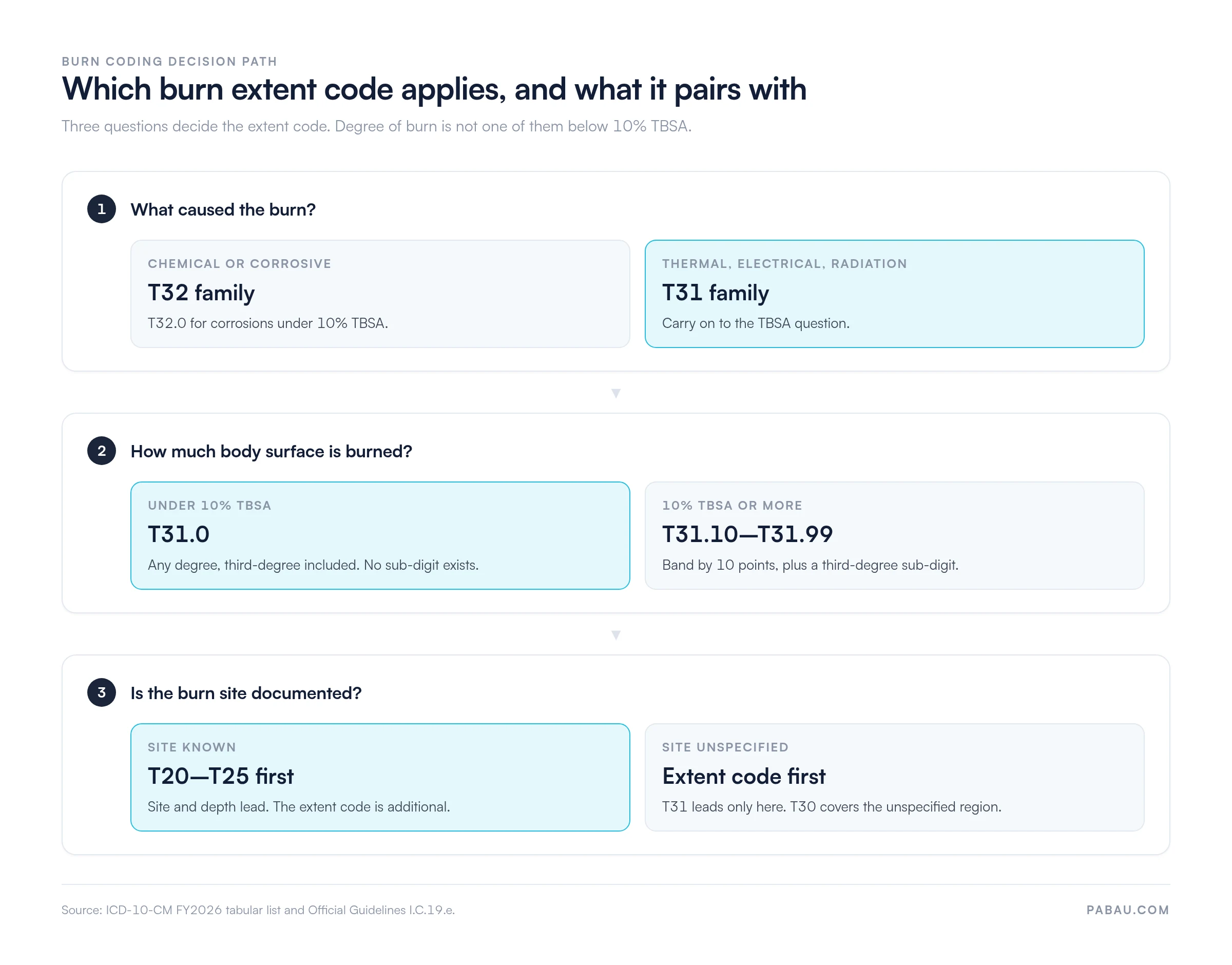
Three code families share burn-injury coding. Knowing where each one starts and stops prevents the errors that show up on burn claims.
T30 causes the most confusion of the three. It is a last-resort code, not a default. Use it only when the anatomical site genuinely cannot be identified, which is rare. Reaching for T30 instead of querying the clinician for the site is both a coding error and an audit risk. The decision path below shows where each family picks up.
The ICD-10-CM Official Guidelines for Coding and Reporting (Section I.C.19.e), published jointly by CMS and NCHS, govern how T31.0 is assigned. According to the AAPC ICD-10-CM reference, T31 codes are sequenced as additional codes to the primary T20-T25 site codes.
Coders should also review AHA Coding Clinic guidance, which periodically addresses specific burn-coding scenarios. Whichever clearinghouse the practice submits through, the T20-T25 site code and T31.0 belong on the same claim.
Incomplete documentation is the leading cause of T31.0 claim queries and retrospective audits. Clinicians treating burns of any extent should capture these elements in the record to support the code assignment.
Audit your last 20 burn encounters and check whether TBSA is documented as a percentage in every record. Missing this single field is responsible for the majority of T31 code query letters from payers. Building a TBSA field into your burn encounter template takes under five minutes and prevents weeks of appeal paperwork.
Burn coding has a higher error rate than most injury categories because it requires two code families working together. Effective denial management strategies for burn-treating practices start with catching these patterns before claims go out.
These scenarios show how T31.0 sequences on a claim alongside the site codes. Read them against your own burn encounters. Any pairing habit that would earn a payer query tends to show up within the first few charts.
A 34-year-old patient presents with a second-degree scald burn to the dorsum of the right hand and the distal forearm. By Rule of Nines, that covers approximately 4% TBSA. No third-degree involvement is noted.
Code assignment: T23.201A (burn of second degree of right hand, unspecified site, initial encounter) leads, with T31.0 added to document TBSA extent. The seventh character “A” is applied to the T23 code for the initial encounter. T31.0 carries no seventh character extension.
A patient attends a walk-in clinic with first-degree erythema across the posterior shoulders and upper back following prolonged sun exposure. The clinician estimates 8% TBSA affected.
Code assignment: T21.13XA (burn of first degree of upper back, initial encounter) as the primary code. T31.0 is added as the extent code. TBSA sits under 10%, so T31.0 is correct whatever the documented depth turns out to be.
A patient reaches urgent care after a flash fire at work. The transfer note records roughly 6% TBSA burned, but it never names the body regions involved, and the patient cannot describe them.
Code assignment: T31.0 is sequenced first here, because the burn site is unspecified. That is the one situation where a T31 code leads. Query the treating clinician for the burn location, then move a T20-T25 code into first position once the answer arrives.
Once TBSA reaches 10%, or a corrosive agent is involved, T31.0 stops being the right extent code. The table below covers the sibling codes and the parallel T32 family. The full ICD-10-CM code index carries the neighboring families a burn encounter tends to touch. The WHO ICD-10 browser gives the international equivalents for global reporting.
Practices that see burn aftercare and wound checks can keep this code family in the encounter template, which cuts per-encounter coding time. Payer remittances flag T31-family rejections with their own reason codes. Reading those codes in batches is the quickest way to spot a pairing error that keeps repeating.
Build a short burn coding checklist into your note template. Ask for the TBSA percentage, the burn depth, the body regions, the causative agent, and the estimation method used. A coder who finds all five in the structured note can assign T31.0 and its companion code without querying the clinician.
T31.0 is valid for HIPAA-covered transactions, but it rarely travels alone on a claim. Payers expect a site-specific T20-T25 code beside it. Many clearinghouses hold a standalone T31.0 for manual review before it ever reaches the payer.
Payment for a burn encounter is driven by the procedure codes, not by T31.0 itself. What the extent code does is establish how much surface was burned. That supports medical necessity for debridement, dressing changes, and the follow-up visits after them.
So a burn claim that clears on the first pass has three things in order. The site code and the extent code are paired, the fiscal year is current, and the TBSA percentage in the note matches the code submitted.
Most burn-treating practices catch a missing extent code the slow way. The claim goes out carrying only the T20-T25 site code. The payer queries it, and someone reopens the chart weeks later to hunt for a TBSA percentage.
Practice management software like Pabau moves that check in front of the submission. Coders work from an encounter template that asks for TBSA, depth, region, and causative agent. The T31.0 pairing is settled while the patient is still in the room. The claim is then screened inside software that checks claims before it leaves the practice.
Payer responses land back in the same record, so a rejected burn claim sits beside the encounter it came from. Your team fixes the pairing once, and the next burn encounter is coded correctly from the start.

Pabau’s claims management software helps wound care and emergency practices submit accurate ICD-10 code pairs. Track eligibility in real time and manage ERA responses through the Claim.MD clearinghouse integration.

Burn encounters under 10% of body surface are common, and coding them still trips people up. T31.0 carries the extent dimension that T20-T25 codes leave out, so the two families travel together on almost every claim. Whether the claim clears often comes down to one number in the note.
The habit worth changing today is the third-degree reflex. Full-thickness wording does not move a sub-10% burn out of T31.0, so confirm TBSA before reaching for a higher subcategory. The same discipline applies in reverse when a burn crosses 10%.
Pabau builds that pairing check into the billing workflow, so the error surfaces before the claim leaves the practice. Book a demo to see how a burn encounter travels from clinical note to paid claim.

Need to understand how burn claims move through the revenue cycle? Our revenue cycle management guide walks through each financial touchpoint from scheduling through final payment.
Struggling with denied burn claims? Our denial management guide covers the most common ICD-10 pairing errors and how to appeal them systematically.
Want to understand how the clearinghouse fits into your claims workflow? Our medical claims clearinghouse overview explains the role clearinghouses play in ICD-10 submission and adjudication.
ICD-10 code T31.0 classifies burns involving less than 10% of total body surface area (TBSA). It applies at any burn degree, third-degree included, because the extent codes carry no depth information below 10%. Report it alongside the T20-T25 site code that names the location and depth.
Yes, T31.0 is a billable and valid ICD-10-CM code for fiscal year 2026 (effective October 1, 2025). It can be submitted for HIPAA-covered transactions, though it typically requires a paired T20-T25 anatomical site code to avoid payer queries.
Yes. T31.0 applies to burns of any degree, as long as TBSA stays under 10%. The third-degree sub-digit starts at T31.10, where TBSA has reached 10% or more. Depth is captured by the paired T20-T25 site code instead.
T31 codes classify burns by the percentage of body surface area affected. T20-T25 codes classify them by anatomical location and depth. Both families appear on most burn claims, with T20-T25 as the primary code and T31.0 as the additional extent code.
For adults, TBSA is calculated with the Rule of Nines. The head and neck take 9%, each arm 9%, and each leg 18%. The anterior trunk and the posterior trunk take 18% each, and the perineum 1%. For children under 15, the Lund-Browder chart is preferred, because it adjusts the proportions for age.
No. Chemical (corrosive) burns use the T32 code family, not T31. For a chemical burn affecting less than 10% TBSA, the correct extent code is T32.0, not T31.0. T31.0 applies to thermal, electrical, and radiation burns only.
T31.0 classifies a burn involving less than 10% TBSA, and it is reported alongside the T20-T25 site codes. T30 covers a burn of an unspecified body region, and it is a last-resort code. Do not reach for T30 simply because documentation was incomplete at the time of coding.