ICD-10 Code S82.242H: Displaced spiral tibial shaft fracture, delayed healing
ICD-10 Code S82.242H: Definition and code details ICD-10 Code S82.242H designate...

Last Updated: Oct 15, 2026
Billable Code Specific Code
T31.74 is the billable ICD-10-CM code for burns involving 70-79% of body surface with 40-49% third degree burns.
Both figures are percentages of the whole body, not proportions of the burned area. That one distinction decides which code in the T31.7 series applies.
ICD-10-CM is updated annually by the Centers for Medicare and Medicaid Services (CMS) and the National Center for Health Statistics (NCHS). The FY2026 edition became effective October 1, 2025.
Let Pabau's smart automation suggest the right codes, reduce claim denials, and keep your practice compliant—effortlessly.
Automate repetitive tasks and focus on what matters most—your patients.
Reduce coding errors and ensure compliance with the latest regulations.
Clean claims, fewer denials, and faster reimbursements.
Powerful insights and reporting to help your practice thrive.
HIPAA compliant SOC 2 certified GDPR-compliant Trusted by 4,000+ clinics worldwide

T31.74 is a billable ICD-10-CM code for burns covering 70-79% of total body surface area (TBSA). Within that, 40-49% of total body surface must be third degree.
Both percentages in the code title are direct shares of total body surface, never a ratio of the burned area.
The Rule of Nines is the standard adult TBSA estimation method, and the Lund-Browder chart is preferred for pediatric patients.
T31.74 is used as an additional code alongside site-specific T20-T25 burn codes under ICD-10-CM guideline Section I.C.19.d.
Pabau’s clinical documentation and claims tools support accurate ICD-10-CM coding for burn injury cases.
ICD-10 code T31.74 is a valid, billable ICD-10-CM diagnosis code. It describes burns involving 70-79% of body surface with 40-49% third degree burns, both figures measured against total body surface. The code applies to discharges and encounters from October 1, 2025 onward under the FY2026 edition.
Knowing where T31.74 sits in the classification tree helps a coder pick the correct code and apply the right sequencing rules. The ancestry chain runs from the broad injury block down to the specific leaf code.
The T31 category classifies burns strictly by extent of body surface involved, not by anatomical site. Site-specific burns are captured separately using T20-T25 codes, which is why sequencing rules matter here.
The fifth character in T31.74 identifies how much of the patient’s total body surface carries third degree, or full-thickness, burns. The fourth character, the 7, fixes total burn coverage at 70-79%. So the fifth character is what separates every code inside the T31.7 subcategory.
Both percentages in the code title measure against total body surface, so no division is required. A patient with 75% TBSA burns and 45% of total body surface in full-thickness injury takes T31.74. If only 35% of total body surface is third degree, the correct code is T31.73. The bands below map each fifth character onto that same scale.
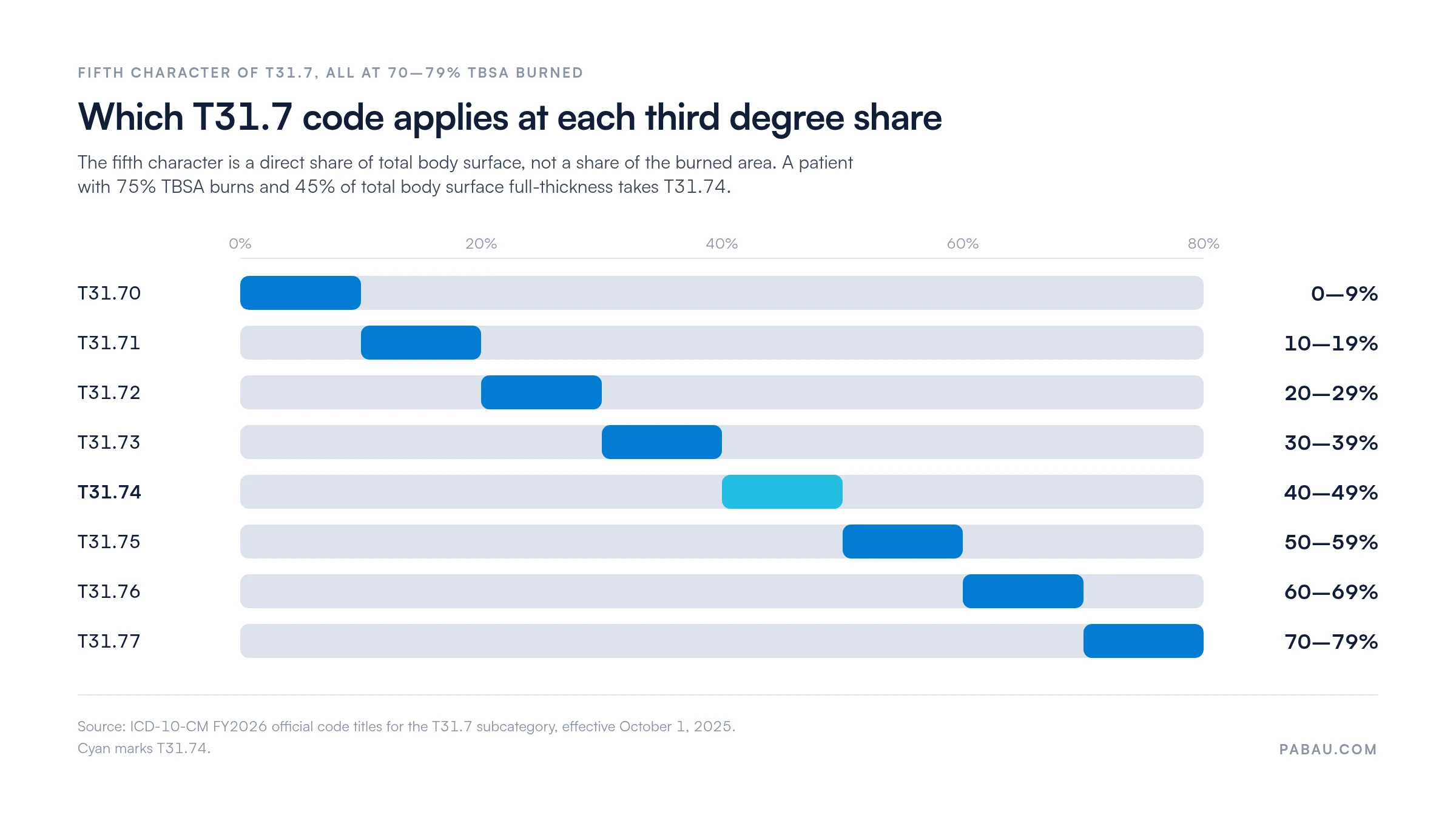
Staying inside the 70-79% band, only the third degree share moves the code. A chart documenting 55% of total body surface as full-thickness supports T31.75 instead.
If the documented TBSA falls outside 70-79%, the correct code sits in a different T31 subcategory. The ICD-10-CM diagnostic codes index lists each subcategory and its fifth-character options.
TBSA estimation is a clinical function, not a coder function. The physician documents the calculation and the coder applies the code. Knowing the method helps a coder spot incomplete documentation before the claim goes out.
The Rule of Nines is the standard adult estimation tool. It assigns percentage values to body surface regions as follows:
For pediatric patients, the Rule of Nines produces inaccurate results, because children have proportionally larger heads and smaller lower extremities. The Lund-Browder chart adjusts for age-related surface area variation. It is the preferred method for pediatric burn TBSA estimation, per American Burn Association clinical practice guidelines.
Third degree burns are full-thickness injuries that destroy the epidermis and dermis and extend into subcutaneous tissue. The skin cannot regenerate on its own, so grafting is typically required. Burn depth must come from physician documentation, not coder inference, when you assign ICD-10-CM diagnosis codes.
Clinical indicators that physicians document to support a third degree classification include:
Coders cannot independently classify burn depth. If the record does not state “third degree” or “full-thickness” with a documented percentage, query the physician before assigning T31.74.
Incomplete documentation is the primary cause of T31.74 claim denials. The medical record must contain all of the following before the code can be assigned:
Practices that submit these claims electronically need the documentation captured in the clinical record before the claim reaches the payer. Practice management software like Pabau sends the encounter to a clearinghouse only once those elements are present. Claims with a missing TBSA calculation get flagged for medical review, which delays payment.
Run a pre-claim documentation checklist before submitting any T31.74 encounter. The chart needs total TBSA with the calculation method noted, plus a third degree percentage of total body surface between 40% and 49%. It also needs a physician-authored burn assessment and site-specific T20-T25 codes for each burn location. Missing any one element is a denial risk.
T31.74 does not stand alone in most burn encounters. The key reference is ICD-10-CM Official Guidelines Section I.C.19.d, which governs the coding of burns and corrosions.
The general principle, consistent with the guidance published through the CDC’s ICD-10-CM coding tool, works like this:
Sequencing can affect DRG assignment and reimbursement directly. Verify the current year’s guidelines against Section I.C.19.d rather than a prior-year interpretation. This matters most when the admission diagnosis and the principal treatment focus differ.
Several clinical terms map to T31.74. A coder searching an EHR, a physician note, or a discharge summary may meet any of these alternate descriptions:
These approximate synonyms appear in ICD-10-CM reference databases and clinical documentation systems. The code itself does not change with the wording, provided the clinical meaning is equivalent.
Most T31.74 errors cluster around two failure modes. One is wrong code selection inside the T31.7 series. The other is documentation that leaves the chosen code undefendable on audit. Both end in appeals, which is why denial management for burn claims begins in the clinical record rather than the billing queue.
A clean claim for T31.74 needs documentation that closes off each of these error types before it leaves the facility.
Patients with burns over 70% TBSA frequently present with comorbidities that need their own ICD-10-CM codes. Two of the most common are inhalation injury and secondary wound infection.
Inhalation injury: Smoke inhalation and respiratory burns need separate ICD-10-CM coding beyond T31.74. The right additional code depends on the type of inhalation injury documented. Common options include the T59.X range for toxic effects of other gases, or J68.0 for chemical pneumonitis. Verify the choice against the current CMS tabular list inclusion notes for T31, which name the additional codes that apply.
Burn wound infection: A secondary infection complicating a burn wound needs an additional code identifying the organism, where documented. That code sits alongside T31.74 rather than replacing it. Payers vary on sequencing for complication codes, so check payer-specific guidance before submission.
T31.74 has been part of ICD-10-CM since the US transition from ICD-9-CM. CMS and NCHS maintain the US adaptation of the WHO ICD-10 classification for domestic use.
The code description has stayed stable since the transition, with no substantive revisions to its definition. Re-confirm validity each year against the CMS ICD-10-CM update files, because the code set is revised effective every October 1.
Burn cases at this TBSA level generate long documentation requirements and multi-code claims. A loosely structured clinical record is the most common source of T31.74 denials and audit findings.
Pabau’s medical records management lets practitioners build a structured encounter record for a burn admission. One chart holds the TBSA calculation, the burn depth assessment by region, and the comorbidity notes. Its medical claims management then applies built-in ICD-10-CM and CPT catalogues to validate codes before a claim reaches the payer.
For a burn encounter that needs several ICD-10 codes, that structure makes a missing additional code far easier to catch before submission.


Pabau’s structured clinical records capture TBSA calculations, burn depth by region and comorbidity notes in one patient chart. Its claims management validates ICD-10-CM codes before the claim reaches the payer, so T31.74 encounters go out supported.

T31.74 turns on two numbers that a chart either states or does not. If the physician documents 70-79% TBSA and a third degree share of total body surface between 40% and 49%, the code holds up. If either number has to be inferred, it does not.
The trade-off worth remembering is that querying a physician costs a day, while a denied burn claim costs weeks of appeal. Build the query into the pre-billing step rather than the rework queue.
Book a demo to see how Pabau keeps burn documentation and ICD-10-CM code validation inside the same workflow.

Need to understand revenue cycle management for complex cases? What is revenue cycle management covers the full billing lifecycle from coding through payment.
Looking for guidance on ICD-10 coding compliance? Medical billing compliance outlines key requirements for maintaining audit-ready records.
Want to reduce claim denial rates? Denial codes in medical billing breaks down the most common denial reason codes and how to address them.
ICD-10 code T31.74 is a billable ICD-10-CM diagnosis code for burns covering 70-79% of total body surface area (TBSA). Within that, 40-49% of total body surface must be third degree, or full-thickness. It sits in the T31 category, which classifies burns by extent of body surface rather than by anatomical site.
Yes, T31.74 is a valid billable/specific ICD-10-CM code that can be used to indicate a diagnosis for reimbursement purposes. It became effective October 1, 2025 for FY2026 encounters.
Both codes describe burns covering 70-79% of total body surface area. They differ in the third degree share of total body surface, which is 40-49% for T31.74 and 50-59% for T31.75. The physician’s documented burn depth percentage decides which one applies.
Per ICD-10-CM Official Guidelines Section I.C.19.d, T31.74 is typically assigned as an additional code alongside site-specific T20-T25 codes. Those codes identify each individual burn location, and they are generally sequenced as principal diagnosis when the encounter is for burn treatment. T31 codes capture total body surface involvement for severity and statistical purposes.
No, T31.74 does not capture inhalation injury. Inhalation and smoke inhalation injuries need separate additional ICD-10-CM codes from the T59.X or J68.0 range, depending on the mechanism and physician documentation. Verify the specific additional codes against the current CMS tabular list instructional notes for T31.
The Rule of Nines is the standard clinical tool for estimating total body surface area burned in adults. It assigns 9% increments to major body regions. The resulting TBSA percentage drives T31 code selection. A calculated TBSA of 70-79% is required before T31.74 can be assigned. The Lund-Browder chart is preferred for children, because it adjusts for age-related surface area variation.