ICD-10 code S61.201A: Open wound of left index finger without nail damage
ICD-10 code S61.201A covers a left index finger wound of unstated type ICD-10 co...

Last Updated: Oct 16, 2026
Billable Code Specific Code
T28.5XXA is the billable ICD-10-CM code for corrosion of mouth and pharynx, initial encounter.
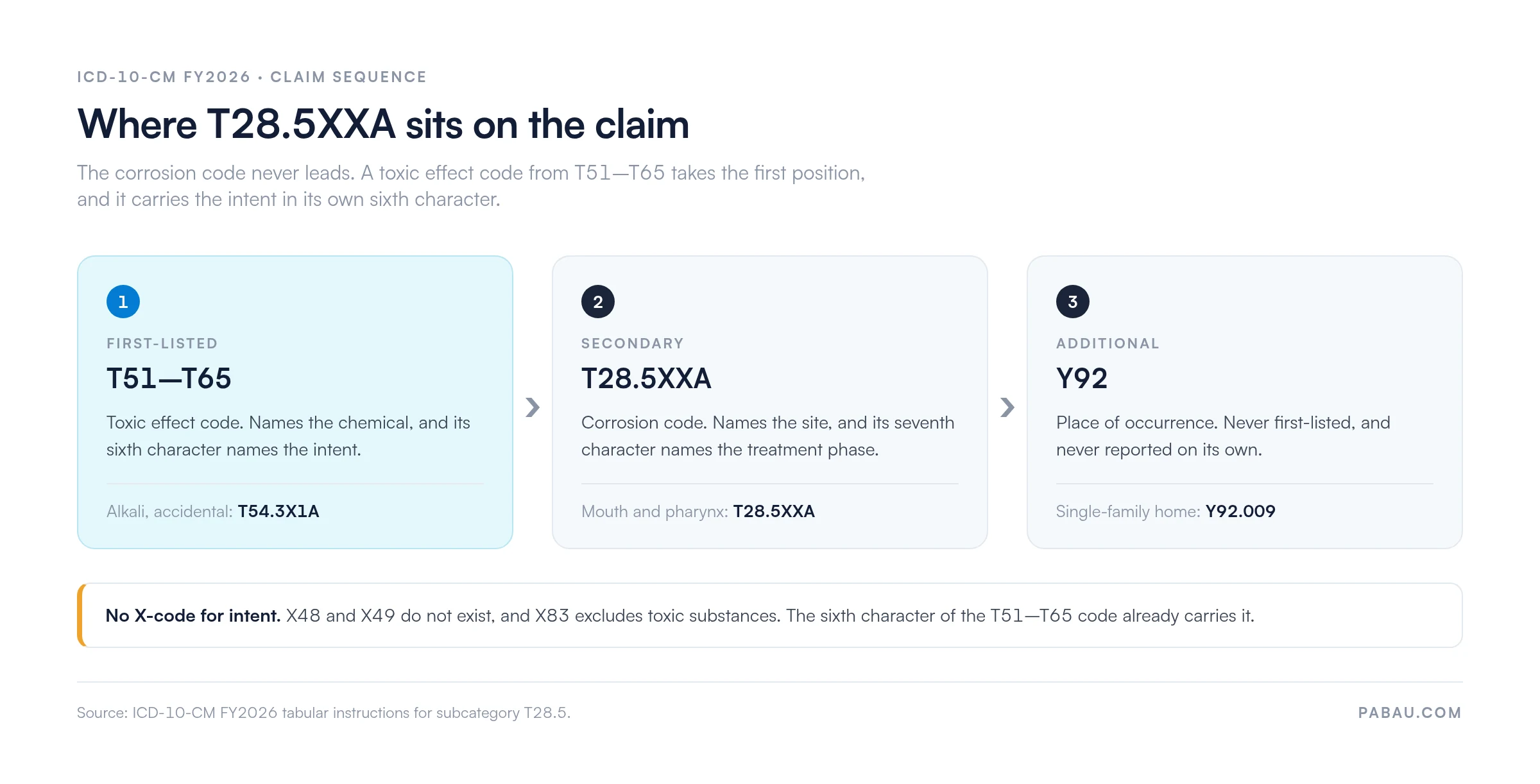
Sequencing is the second thing to get right. T28.5 is not reported on its own and it is not the first-listed code on the claim. The tabular list attaches a Code first instruction to it, so a toxic effect code from T51-T65 has to lead.
Let Pabau's smart automation suggest the right codes, reduce claim denials, and keep your practice compliant—effortlessly.
Automate repetitive tasks and focus on what matters most—your patients.
Reduce coding errors and ensure compliance with the latest regulations.
Clean claims, fewer denials, and faster reimbursements.
Powerful insights and reporting to help your practice thrive.
HIPAA compliant SOC 2 certified GDPR-compliant Trusted by 4,000+ clinics worldwide

ICD-10 Code T28.5XXA reports chemical corrosion of the mouth and pharynx at the initial encounter, and it is billable for FY2026.
T28.5 carries a Code first (T51-T65) instruction, so the toxic effect code naming the chemical is sequenced ahead of T28.5XXA.
Intent is carried by the sixth character of that T51-T65 code, so no freestanding intent code from the X range is reported here.
T28.5 also carries a use additional code note for place of occurrence (Y92), which is separate from the intent question.
The 7th character ‘A’ covers the active treatment phase; T28.5XXD covers follow-up care and T28.5XXS covers a late effect such as stricture.
Corrosion means chemical injury, so a scald or hot-liquid injury to the same anatomical site is coded to T28.0XXA instead.
ICD-10 Code T28.5XXA is a specific, billable ICD-10-CM code effective October 1, 2025 for fiscal year 2026. The table below captures every attribute a coder or biller needs before submitting a claim that carries this code.
The “XX” in positions 5 and 6 are placeholder characters, not optional padding. Subcategory T28.5 has no fifth or sixth character of its own, so the placeholders hold the code out to the length the 7th character needs. The CDC/NCHS ICD-10-CM coding tool rejects an entry that omits them, so enter T28.5XXA in full at seven characters.
Corrosion of the mouth and pharynx is chemical damage to the oral mucosa and the pharyngeal tissues after contact with a corrosive agent. The usual route is caustic ingestion: a household drain cleaner, a concentrated descaler, an industrial solvent, or a decanted cleaning product swallowed by mistake.
This is not a thermal burn. The ICD-10-CM Official Guidelines for Coding and Reporting treat corrosion as injury from a chemical agent, while burns come from heat, electricity, radiation, or friction. The two injury types sit in different halves of category T28 and carry different documentation expectations.
Prompted intake templates help on injury encounters. The provider records the agent and the extent of the injury during the visit, rather than reconstructing both at billing time.
Knowing where T28.5XXA sits in the tree makes the sibling codes and the category-level rules much easier to navigate. The hierarchy runs from the injury chapter down to the seven-character billable code.
Category T28 covers burn and corrosion of internal organs that are not classified elsewhere. Its neighbors inside T26-T28 handle the eye and adnexa (T26) and the larynx, trachea and lung (T27). An oral or pharyngeal injury never belongs in either of those. When one exposure injures several sites down the alimentary tract, each injured site takes its own T28 code.
For reference, the WHO ICD-10 browser traces the international hierarchy. It also shows how the US ICD-10-CM edition refines that base classification for clinical and billing use.
The tabular list attaches two instructional notes to subcategory T28.5. Both of them change what else has to appear on the claim, and neither one is advisory.
A “Code first” note is not advisory. It means the corrosion code is a secondary code, and the toxic effect code from T51-T65 is the one that leads. On an outpatient claim that makes the T51-T65 code the first-listed diagnosis, with T28.5XXA reported after it to show the anatomical site.
T51-T65 covers toxic effects of substances that are chiefly nonmedicinal in source. You reach the right code through the ICD-10-CM Table of Drugs and Chemicals, using the substance named in the record. The corrosive agents behind most oral and pharyngeal injuries sit in category T54.
T54.0 through T54.3 each take a placeholder “X” in the fifth position, then the intent character, then the 7th character for the encounter. That gives a seven-character code such as T54.3X1A.
T54.9 breaks that pattern. It carries the intent character in the fifth position and the placeholder “X” in the sixth, so accidental exposure to an unidentified corrosive is T54.91XA. Anyone who assumes the T54.0-T54.3 shape holds across the whole category ends up writing T54.9X1A, which is not a code.
The T51-T65 code carries the intent itself. That is what “to identify chemical and intent” means in the note, and it is the reason no freestanding intent code is reported alongside T28.5XXA.
So a child who swallows drain cleaner and presents with oral and pharyngeal burns is coded T54.3X1A first, then T28.5XXA. An adult who drinks the same product in a self-harm attempt is coded T54.3X2A first, then T28.5XXA. The injury code never moves; only the leading toxic effect code changes.
The second note on T28.5 asks for a Y92 code to identify where the exposure happened. Y92.009 covers an unspecified place in a single-family house, Y92.59 covers other trade areas, and Y92.69 covers other industrial and construction areas. Add the activity code Y93 and the status code Y99 when the record supports them.
External cause codes are never first-listed and never reported alone. Chapter 20 is explicit on that point, which is another reason the T51-T65 code, not an external cause code, has to open this claim.
Put together, the rule fills three positions on the claim.
T28.5XXA, T28.5XXD, and T28.5XXS are the three valid extensions of subcategory T28.5. Each one signals a different phase of care for the same corrosion injury, and picking the wrong one sends the claim back.
Common mistake: coders sometimes keep using T28.5XXA across every visit in a multi-week episode. Once active management ends and the visits become healing checks, the code moves to T28.5XXD. The Official Guidelines define “initial encounter” by treatment phase, not by whether it is literally the patient’s first visit to that provider.
For sequela coding, the late effect is sequenced first and T28.5XXS follows it as the cause. A pharyngeal stricture, for example, takes its own code ahead of T28.5XXS.
Section I.C.19 of the ICD-10-CM Official Guidelines for Coding and Reporting governs injury and poisoning coding, and its burns and corrosions subsection applies directly here. It also confirms that burns and corrosions of the eye and internal organs, the T26-T28 block, are classified by site rather than by degree. There is no depth axis to document for T28.5XXA.
Capturing these elements in structured intake fields rather than free text is what keeps them in the note. Submitting a clean claim for an injury code depends on the record supporting every axis of the code set. That means the chemical, the intent, the site, the place, and the phase.
Build the causative agent and the intent into your triage form as structured fields, not free text. Emergency and urgent care notes routinely describe the injury without ever naming the product. The coder is then left with T54.94XA, the undetermined-intent default, and a weaker claim. Capturing both before the clinical note closes removes the provider callback.
T28 covers burns and corrosions of internal organs that are not classified in T26 (eye and adnexa) or T27 (larynx, trachea and lung). The siblings split along two axes: anatomical site, and burn versus corrosion. Documentation has to settle both before you can choose.
Two rows in that table do not take the XX placeholders. T28.4 and T28.9 subdivide at the fifth character first, so the unspecified-organ codes are T28.40XA and T28.90XA. T28.4XXA and T28.9XXA are not valid ICD-10-CM codes, and a claim carrying either one is rejected on format.
The split matters beyond code selection. The burn codes T28.0-T28.4 take a “use additional external cause code” note for the heat source, and a bursting aerosol can is reported with W36.1XXA. The corrosion codes T28.5-T28.9 take the Code first (T51-T65) instruction instead. Applying the burn convention to a corrosion claim produces exactly the sequencing error this article opened with.
Corrosion and thermal burn are separated in ICD-10-CM because the mechanisms differ, the clinical pathways differ, and inpatient DRG assignment can move with the choice.
Checking the T28 variant against the documented mechanism takes seconds, and it is what catches a scald coded as a corrosion. The AAPC ICD-10-CM code lookup is a searchable reference for the full sibling range.
Four errors account for most of the rework on these claims, and three of them are sequencing problems rather than code selection problems.
A clearinghouse that runs code-combination edits before submission surfaces most of these before the payer ever sees the claim. When one slips through, the remittance names the reason, and the standard denial reason codes say which part of the claim the payer rejected.
T28.5XXA is mostly an emergency department and outpatient code. Inpatient caustic ingestion cases usually generate additional codes for associated injuries, endoscopy, and complications, and those drive DRG assignment. On an outpatient claim the T51-T65 toxic effect code is the first-listed diagnosis and T28.5XXA sits behind it.
Three reimbursement considerations shape how a practice handles these encounters from the start:
When a single caustic ingestion injures both the pharynx and the esophagus, report T28.5XXA and T28.6XXA together rather than picking the worst site. Both sit behind the same T51-T65 code and share the same 7th character. Payers expect anatomical specificity whenever the documentation supports it.
Injury codes like T28.5XXA need more than a single diagnosis on the claim. The leading toxic effect code, the place of occurrence code, and the encounter phase all have to line up. So does the documentation sitting behind each of them.
Pabau, our practice management software, keeps the clinical record and the billing workflow in one system. The coder reads the same note the provider wrote. Structured intake and consultation forms capture the causative agent, the intent, and the place of occurrence at the point of care. That is where the T51-T65 code actually comes from.
For US practices, Pabau’s claims software for practices submits and tracks claims through the Claim.MD clearinghouse integration. Claim.MD reaches thousands of US payers and applies its own pre-submission edits to what you send. Code selection and sequencing stay with your coder. Pabau carries the record and the claim.
The electronic remittance advice (ERA/835) workflow pulls denial reason codes back from the clearinghouse. A rejection tied to sequencing or a missing 7th character lands next to its own encounter. For practices with a steady volume of injury claims, handling those rejections in one place cuts preventable rework.

Pabau keeps the clinical note, the coding workflow, and the Claim.MD submission in one system, so injury claims leave with the documentation behind them. See how it works for your practice.

ICD-10 Code T28.5XXA is a precise, billable code, but it is a secondary one. Three things have to be right: the chemical mechanism (corrosion, not thermal burn), the 7th character matching the treatment phase, and the sequencing. The toxic effect code from T51-T65 leads, carrying the chemical and the intent in its own characters. T28.5XXA sits behind it, with a Y92 place code alongside.
Get the order wrong and you have added a denial cycle to a claim that should have cleared on first pass. The fix is upstream, in a note that names the product and the circumstances while the patient is still in front of the clinician. To see how Pabau keeps that documentation attached to the claim, book a demo with our team.

Need to understand how claim denials are categorized? Denial codes in medical billing breaks down the most common CARC codes and how to respond to each one.
Submitting 837P claims electronically for the first time? 837 file format guide explains the structure of electronic claim files and what each segment carries.
Looking for guidance on insurance credentialing before billing? How to get credentialed with insurance companies walks through the payer enrollment process step by step.
ICD-10 Code T28.5XXA is the billable ICD-10-CM diagnosis code for corrosion of mouth and pharynx, initial encounter, valid for FY2026 claims. It reports chemical injury to oral and pharyngeal tissue. It is a secondary code: a toxic effect code from T51-T65 identifying the chemical is sequenced ahead of it.
Yes. T28.5XXA is a specific, billable ICD-10-CM code valid for submission and reimbursement in FY2026, effective October 1, 2025. It runs to seven characters: T28.5 as the subcategory, XX as required placeholders, and A as the 7th character for initial encounter.
Subcategory T28.5 carries a Code first (T51-T65) instruction. A toxic effect code identifying the corrosive chemical is sequenced ahead of T28.5XXA, for example T54.3X1A for accidental exposure to a corrosive alkali. That code’s sixth character carries the intent, so no separate freestanding intent code is reported.
Use A while the patient is receiving active treatment for the corrosion. That covers the emergency visit, the first specialist consultation, and any visit during active wound management. Once care shifts to monitoring the healing, move to D for a subsequent encounter. The 7th character reflects the treatment phase, not the visit count.