ICD-10 code S61.201A: Open wound of left index finger without nail damage
ICD-10 code S61.201A covers a left index finger wound of unstated type ICD-10 co...

Last Updated: Oct 16, 2026
Billable Code Specific Code
S99.239A is the billable ICD-10-CM code for salter-Harris Type III physeal fracture of phalanx of unspecified toe, initial encounter for closed fracture.
The seventh character carries most of the coding risk on this code. It tracks the stage of the care episode rather than the severity of the injury, so it changes across the visits that treat one fracture.
The table below summarizes what a coder or clinician needs at a glance for S99.239A.
Let Pabau's smart automation suggest the right codes, reduce claim denials, and keep your practice compliant—effortlessly.
Automate repetitive tasks and focus on what matters most—your patients.
Reduce coding errors and ensure compliance with the latest regulations.
Clean claims, fewer denials, and faster reimbursements.
Powerful insights and reporting to help your practice thrive.
HIPAA compliant SOC 2 certified GDPR-compliant Trusted by 4,000+ clinics worldwide

ICD-10 code S99.239A describes a Salter-Harris Type III physeal fracture of the phalanx of an unspecified toe, at the initial encounter.
S99.239A is a billable ICD-10-CM code effective October 1, 2025, so it can be submitted for reimbursement on its own.
Seventh character A covers a closed fracture during active treatment, and B covers an open fracture at the same stage.
Once active treatment ends, the seventh character moves to D, G, K or P, and S marks a sequela.
Practice management software like Pabau validates ICD-10-CM codes through the Claim.MD clearinghouse before the claim reaches the payer.
S99.239A means a Salter-Harris Type III physeal fracture of the phalanx of an unspecified toe, treated at an initial encounter. Each segment of the code adds a layer of specificity.
The “unspecified toe” designation means the clinical record does not identify which toe is affected. Coders should assign a laterality-specific code whenever the record supports one. The seventh character A confirms an initial encounter, so the patient is under active treatment for a closed fracture.
Yes. S99.239A is a billable and specific ICD-10-CM code that can go on a claim by itself to indicate a diagnosis for reimbursement. It took effect on October 1, 2025 as part of the 2026 ICD-10-CM edition maintained by CMS.
A clean claim for S99.239A carries three things. It needs the correct seventh character and the imaging report that names the fracture type. It also needs an external cause code where the mechanism of injury is documented.
The Salter-Harris classification grades physeal (growth plate) fractures by how far the fracture line runs through the physis, metaphysis, and epiphysis. Robert B. Salter and W. Robert Harris published it in 1963. ICD-10-CM uses the system directly, and picking the wrong type is one of the most common coding errors on pediatric fracture claims.
Type III fractures are intra-articular, so the fracture line enters the joint space. The operative or radiology report must specify “Type III” or “Salter-Harris III” for the code to hold up, a rule S59.032G shares at the ulna. An imaging description such as “epiphyseal fracture” or “growth plate injury” carries no type, so it does not support S99.239A.
ICD-10-CM requires a seventh character on every fracture code in chapter S00-T88. The S99.239- code group takes seven valid extensions. Choosing the wrong one is the single most common reason for payer rejection on physeal fracture claims.
Per the ICD-10-CM Official Guidelines for Coding and Reporting, Section I.C.19, seventh character “A” applies while the patient is receiving active treatment for the fracture. That holds whether it is the first visit for that purpose or a later one. Once active treatment has ended, use “D” through “S” as appropriate.
The choice comes down to two questions, asked in this order.
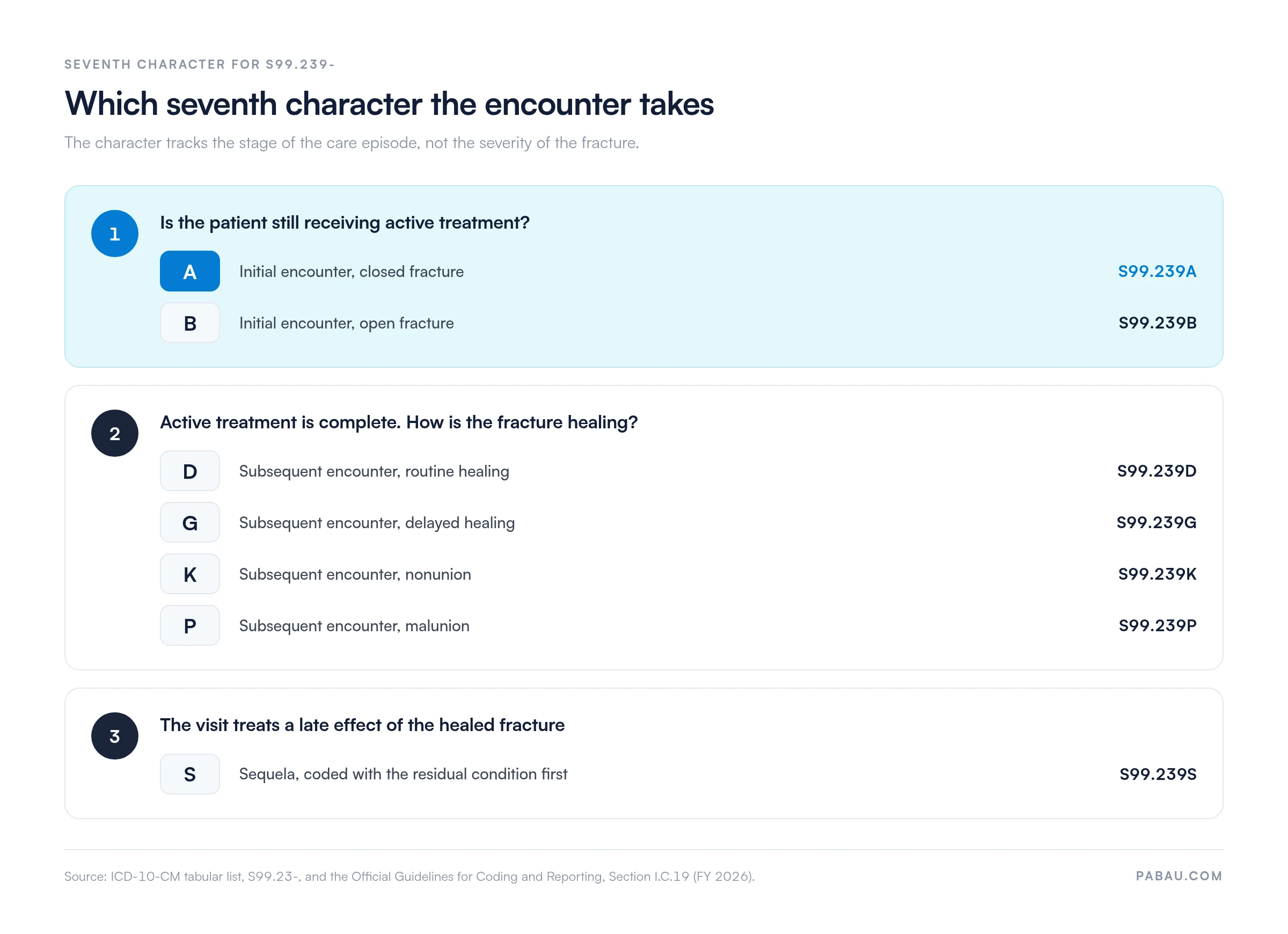
Check the encounter type before assigning a seventh character. ‘Initial encounter’ does not mean the patient’s first visit; it means active treatment is still being provided. A patient in a cast at a follow-up visit is still in the initial encounter phase and requires seventh character A.
S99.239A sits at the bottom of a layered classification path. Knowing the levels above it helps coders find a more specific code when the documentation supports one.
When the record names a particular toe, assign the more precise sibling code instead. The ICD-10-CM code index covers the rest of the S99 family. The AAPC Codify ICD-10-CM lookup tool and the CDC/NCHS ICD-10-CM web tool both display the complete sibling set.
Accurate coding of S99.239A depends on what the clinical record contains. The provider must document each element the code asserts, and a missing element leaves the claim open to audit or denial.
Running the record through software that validates claims against payer edits before submission catches a missing element while the claim can still be corrected.

Several ICD-10-CM official coding rules apply directly to S99.239A and to toe fractures generally. Review them alongside the tabular list before assigning the code.
Four errors generate most of the denials and audit flags on this code.
Tracking denial reason codes against S99.239A submissions shows which of the four errors a practice repeats. Correcting the pattern at source beats reworking rejected claims one at a time.
Several clinical terms map to S99.239A in the ICD-10-CM alphabetic index. Coders searching under any of them should confirm the entry reaches S99.239A before assigning it.
“Lesser toe” is not a separate laterality designation in this subcategory. It refers to toes 2 through 5 rather than the great toe, and both map into the same S99.23- codes.
Practices running historical billing audits, legacy system reconciliations, or reviews of pre-2015 records need the ICD-9-CM equivalent for S99.239A. The conversion is approximate, because ICD-9-CM did not classify toe fractures by Salter-Harris type.
Because ICD-9-CM carried no Salter-Harris detail for toe phalanges, treat any crosswalk to 826.0 as approximate. Verify it against the CMS ICD-10 code reference files when the result will be used for audit work.
When using ICD-9 to ICD-10 crosswalks for historical audits, document the crosswalk tool and version used. Approximate conversions should be flagged in the audit record so reviewers understand the mapping is not a 1:1 equivalency.
A seventh-character error usually surfaces once the remittance advice arrives. The claim goes out with “A” on a follow-up visit, the payer rejects it, and a biller reworks it weeks later.
Pabau is practice management software that keeps the diagnosis code, the clinical note, and the claim in one patient record. A coder can see the imaging report that names the Salter-Harris type on the same screen as the code they are about to submit.
Claims then reach the payer through the Claim.MD clearinghouse, which validates every ICD-10-CM code against payer edits first. Errors surface while the claim is still editable, so a mistyped seventh character costs a minute rather than a full rework cycle.

Pabau connects directly to the Claim.MD clearinghouse, validating ICD-10-CM codes before they reach the payer. Seventh-character errors and missing documentation surface immediately, not after a denial.

S99.239A is simple to look up and easy to get wrong at the seventh character. Three pieces of documentation settle it. The imaging report must name the Salter-Harris type, and the note must name the phalanx. The chart must also show which stage of treatment the visit belongs to.
Fix the documentation and the code follows. Practices that record the fracture type and the encounter stage at the point of care spend far less time reworking these claims. Book a demo to see how Pabau validates ICD-10-CM codes before a fracture claim reaches the payer.

Need to understand how claims reach payers? How a medical claims clearinghouse works explains the validation steps between a submitted claim and a payer decision.
Seeing repeated denials on fracture codes? Denial codes in medical billing maps common remittance advice codes to the documentation problems behind them.
Managing billing compliance across a growing practice? Medical billing compliance covers the regulatory framework practices must follow when coding and submitting claims.
S99.239A is a billable ICD-10-CM diagnosis code for a Salter-Harris Type III physeal fracture of the phalanx of an unspecified toe, initial encounter. It belongs to category S99 (Other and unspecified injuries of ankle and foot). The code took effect on October 1, 2025 as part of the 2026 ICD-10-CM edition.
Yes. S99.239A is a specific, billable ICD-10-CM code that can be submitted on a claim to indicate a diagnosis for reimbursement. It is not a header or non-billable category code.
A Salter-Harris Type III fracture passes through the growth plate (physis) and into the epiphysis, entering the joint space. It is intra-articular by definition. The record needs radiographic confirmation that the fracture line runs through both the physis and the epiphysis.
All three describe the same Salter-Harris Type III physeal fracture of the phalanx of an unspecified toe. S99.239A is the initial encounter for a closed fracture. S99.239B is the initial encounter for an open fracture, and S99.239D is a subsequent encounter with routine healing.
The approximate ICD-9-CM equivalent is 826.0 (closed fracture of one or more phalanges of foot). The crosswalk is approximate because ICD-9-CM did not classify physeal fractures by Salter-Harris type for toe phalanges. Verify it against CMS crosswalk reference files before applying the conversion to audit work.
The clinical record must document four elements. It needs the Salter-Harris Type III classification confirmed by imaging, and the phalanx of a toe as the anatomical site. It also needs laterality, or a note that laterality was not documented. Finally, it needs the encounter context that supports the seventh character selected.