ICD-10 code S61.201A: Open wound of left index finger without nail damage
ICD-10 code S61.201A covers a left index finger wound of unstated type ICD-10 co...

Last Updated: Oct 16, 2026
Billable Code Specific Code
S90.453S is the billable ICD-10-CM code for superficial foreign body, unspecified great toe, sequela.
That condition is usually persistent pain, scar tissue, or limited mobility, and the original injury has already healed. The 7th character S carries the distinction. It tells the payer the original injury is no longer active or healing.
The 2026 edition of ICD-10-CM S90.453S became effective on October 1, 2025, per the CMS FY2026 ICD-10-CM release. It is valid for Medicare, Medicaid, and commercial claim submission under HIPAA's standardized code set requirements.
The code sits inside the wider ICD-10-CM code set, which CMS revises every October. The parent code S90.453 carries no 7th character, so it is not billable on its own. Every code in this family needs one.
Let Pabau's smart automation suggest the right codes, reduce claim denials, and keep your practice compliant—effortlessly.
Automate repetitive tasks and focus on what matters most—your patients.
Reduce coding errors and ensure compliance with the latest regulations.
Clean claims, fewer denials, and faster reimbursements.
Powerful insights and reporting to help your practice thrive.
HIPAA compliant SOC 2 certified GDPR-compliant Trusted by 4,000+ clinics worldwide

ICD-10 Code S90.453S describes a superficial foreign body of the unspecified great toe, sequela. It is a billable, specific ICD-10-CM code valid for reimbursement in the 2026 edition.
The 7th character S designates a sequela encounter. The patient presents with a residual condition left by a prior foreign body injury that has already resolved.
Applying S while the injury is still active or healing is a leading cause of sequela claim denials.
Document the prior injury and its causal link to the current condition before the claim goes out.
Pabau’s claims management software with Claim.MD integration supports ICD-10 code lookup, sequela coding workflows, and electronic claim submission to thousands of US payers.
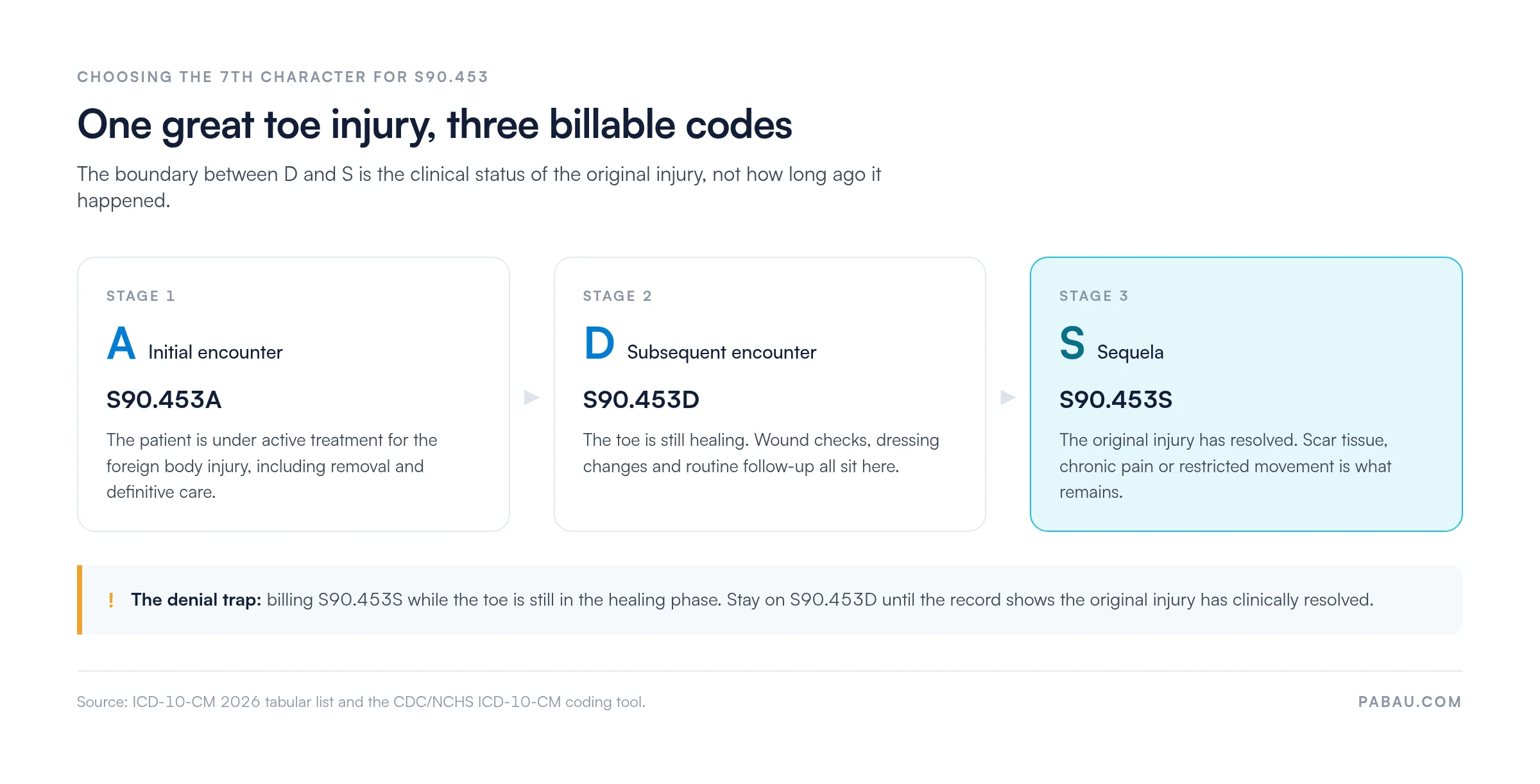
The 7th character is not optional in the S90.453 family. It defines the clinical context of the encounter, and misapplying it is one of the most common sources of denial for injury codes. The CDC/NCHS ICD-10-CM coding tool confirms three valid extensions for S90.453. Each one represents a different stage of care.
The most common sequela coding mistake: using S90.453S when the patient is still healing. If the foreign body came out at the last visit and the toe is still recovering, the correct code is S90.453D.
Switching to S before the original injury has clinically resolved usually draws a payer denial, because the record shows ongoing healing. The three stages below map each 7th character to the clinical status the chart has to show.
The ICD-10-CM Official Guidelines for Coding and Reporting (Section I.C.19) call for two codes in most sequela cases. The first is S90.453S, which identifies the nature of the residual condition. The second describes the specific late effect under treatment. Document both in the patient record before submitting the claim.
A superficial foreign body injury of the great toe happens when an external object embeds in the skin or subcutaneous tissue without reaching deeper structures.
Splinters, glass shards, thorns, and metal fragments are the usual culprits. “Unspecified” in this code means the laterality was not documented or is unknown. For laterality-specific coding, use S90.451S (right great toe) or S90.452S (left great toe).
In the sequela context, the patient is no longer presenting for removal or acute treatment. They come in because the original injury left behind a residual condition. Common sequela after a great toe foreign body injury include:
The ICD-10-CM code hierarchy for injury codes helps coders navigate adjacent codes and confirm the right selection. S90.453S sits on a well-defined path through Chapter 19 of the ICD-10-CM tabular list.
Several codes in the S90.453 family and the broader S90 category sit close to ICD-10 Code S90.453S. Coders treating foot and toe injuries should know these adjacent codes well. They settle laterality, injury type, and encounter type, and choosing correctly at every level of specificity reduces denials.
When laterality is documented in the clinical record, always prefer S90.451S (right) or S90.452S (left) over S90.453S. Payers increasingly flag “unspecified” laterality codes when the documentation clearly states which side was affected. On a sequela encounter, laterality specificity also supports the medical necessity review.
Check your clinical notes before assigning S90.453S over S90.451S or S90.452S. If the chart names the right or left toe during the original injury encounter, carry that laterality forward to the sequela code. Payers expect the same specificity from sequela coding as from initial encounters.
Sequela coding carries a higher documentation bar than initial or subsequent encounter coding. Payers auditing S90.453S claims look for a specific chain of evidence in the patient record.
Drop one element from that chain and the claim gets denied. Sequela documentation follows the same structure whatever the code, so a note template built once serves every sequela encounter.
Practices that struggle with sequela denials often benefit from a structured note template. It prompts the clinician to capture each of these elements at a sequela encounter. Denial prevention starts at the documentation level, before anyone builds the claim.
S90.453S is a billable ICD-10-CM code valid for claim submission. Sequela codes as a group carry payer-specific acceptance rules, so verify them before you submit. Knowing how a sequela encounter moves through the billing workflow helps a practice avoid routine errors.
Common billing errors with 7th character S:
Practice management software like Pabau submits claims electronically through Claim.MD, a clearinghouse connecting to thousands of US payers. That covers CMS-1500 and 837P workflows, plus real-time eligibility verification before claims go out.
Sequela claims get the same scrubbing and validation as any other diagnosis code. A clearinghouse that checks code pairs before payer submission cuts rejections on sequela-coded encounters.
Payer policies for sequela codes vary. Some Medicare Administrative Contractors (MACs) publish local coverage determinations that decide which residual conditions count as medically necessary for continued treatment. Reviewing the relevant determination before coding a sequela encounter is standard compliance practice in an at-risk specialty.
Coding sequela encounters accurately takes more than knowing the right code. It takes a workflow that surfaces the prior injury record and prompts the clinician to document the causal relationship.
That workflow then builds the claim with the correct code pair before submission. Manual processes break down at each of those steps. Busy podiatry, urgent care, and physical therapy practices feel it most, because they carry high volumes of injury follow-up.
An integrated platform connects clinical documentation to billing, so the coder sees the whole encounter and not just the diagnosis code a clinician typed in.
Pabau’s medical claims management tools support ICD-10 code validation, sequela code pairing, and clean claim submission through the Claim.MD integration. The system flags a likely encounter-type mismatch before the claim leaves the practice, instead of catching it after a denial.
A central view of which codes draw denials, and why, lets a practice repair the documentation upstream. That beats appealing sequela claims one at a time downstream.
Run a monthly denial report filtered by 7th character S codes. A cluster of S90.453S denials under reason code CO-4 or CO-57 usually points at missing documentation rather than a mistyped code. Fix the note template first, then work the outstanding claims.

Pabau connects clinical documentation, ICD-10 code lookup, and electronic claim submission in one place. Sequela encounters like S90.453S get coded correctly and submitted cleanly, every time.

Sequela coding for ICD-10 Code S90.453S hinges on one clinical fact. The original injury must be fully resolved before the 7th character S becomes correct. When that is true and documented, S90.453S is valid and billable in the 2026 ICD-10-CM edition. When it is not, code S90.453D and revisit sequela coding at the next encounter.
The trade-off worth remembering is small. Specificity costs the clinician one extra sentence in the note and saves the biller an appeal later. Pabau’s documentation and claims workflow, including the Claim.MD connection, covers every step from the encounter note through 837P submission. Book a demo to see how a sequela encounter travels from note to paid claim.

Need to understand how medical billing works from the ground up? What Is Medical Billing covers the full revenue cycle from encounter to payment.
Losing revenue to claim denials? Denial management in healthcare explains how to identify, appeal, and prevent the most common denial patterns.
Want to verify eligibility before submitting a sequela claim? Insurance eligibility verification outlines how real-time checks reduce claim rejections before submission.
ICD-10 Code S90.453S is the diagnosis code for superficial foreign body of the unspecified great toe, sequela. It applies when a patient presents with a residual condition caused by a prior foreign body injury to the great toe. That condition is usually scar tissue, chronic localized pain, or restricted toe movement, and the original injury has already resolved. The 7th character S marks this as a sequela encounter rather than an active treatment or healing visit.
Yes, S90.453S is a billable, specific ICD-10-CM code valid for claim submission and reimbursement. It became effective in the 2026 edition of ICD-10-CM (October 1, 2025). The parent code S90.453 without the 7th character is not billable and cannot be used for claim submission.
The 7th character determines the encounter type. S90.453A (initial encounter) is used when the patient is receiving active treatment for the foreign body injury. S90.453D (subsequent encounter) applies during the healing and recovery phase. S90.453S (sequela) applies only after the original injury has fully resolved. The patient now presents with a residual late-effect condition caused by that prior injury.
Use the 7th character S once the original injury has clinically resolved. The patient must be presenting for treatment of a residual condition caused by that injury. Per the ICD-10-CM Official Guidelines (Section I.C.19), the sequela code should generally be sequenced with a code identifying the specific residual condition being treated. Never use 7th character S while the original injury is still healing.
Category S90 covers superficial injuries of the ankle, foot, and toes within Chapter 19 (Injury, poisoning and certain other consequences of external causes). It includes contusions, blisters, superficial foreign bodies, and abrasions of the ankle, heel, foot, and individual toe subcategories. All S90 codes require a 7th character to be billable.
A sequela claim needs four elements in the clinical record. Document the original injury from prior encounter records or history. Document the residual condition under treatment today, and state the causal link between the two. Then confirm the original injury is resolved. Payers audit sequela claims for exactly this chain, and a missing causal statement is the most common reason a correctly coded claim gets denied.