

ICD-10 Code S42.444P: Medial epicondyle fracture, right humerus
ICD-10 Code S42.444P: full descriptor and code validity ICD-10 Code S42.444P car...

Last Updated: Oct 13, 2026
Billable Code Specific Code
S82.855R is the billable ICD-10-CM code for nondisplaced trimalleolar fracture of left lower leg, subsequent encounter for open fracture type IIIA, IIIB, or IIIC with malunion.
Let Pabau's smart automation suggest the right codes, reduce claim denials, and keep your practice compliant—effortlessly.
Automate repetitive tasks and focus on what matters most—your patients.
Reduce coding errors and ensure compliance with the latest regulations.
Clean claims, fewer denials, and faster reimbursements.
Powerful insights and reporting to help your practice thrive.
HIPAA compliant SOC 2 certified GDPR-compliant Trusted by 4,000+ clinics worldwide

S82.855R is a billable ICD-10-CM code for nondisplaced trimalleolar fracture of the left lower leg, effective October 1, 2025 (FY2026).
The 7th character R encodes a subsequent encounter for an open fracture graded Gustilo type IIIA, IIIB, or IIIC with confirmed malunion.
Accurate use requires documentation of left-side laterality, nondisplaced status, Gustilo grade, and radiographic malunion confirmation in the clinical record.
Practice management software like Pabau links ICD-10-CM codes to invoices and claims, which cuts re-keying errors on multi-qualifier codes.
ICD-10 Code S82.855R is a billable, specific ICD-10-CM code. The 2026 edition became effective on October 1, 2025. Its full official description is:
The CDC/NCHS ICD-10-CM web tool confirms billability against the current FY2026 tabular list. The code is valid on claims for dates of service on or after October 1, 2025.
Understanding the parent-to-child hierarchy helps coders move between related codes and confirm that S82.855R is the most specific option available. The ICD-10-CM code index follows the same breadcrumb path, from the broad injury chapter down to a single billable code.
The stem S82.855 is not itself billable. Only the fully specified 7th character variants (S82.855A through S82.855S) are valid for claim submission. The CMS ICD-10 codes page maintains the authoritative tabular list and annual update files.
The 7th character is the most clinically specific element of an ICD-10-CM fracture code. For S82.855R, the character R encodes three clinical facts at once. This is a subsequent encounter, the fracture was open type IIIA, IIIB, or IIIC, and malunion has occurred.
Coders often confuse subsequent encounter coding with aftercare coding, and that mix-up ends in claim rejection. The full S82.855 extension table covers every encounter type and healing outcome, so use it to select the correct suffix for each clinical scenario.
Read as a grid, those 16 suffixes come down to two documented facts.
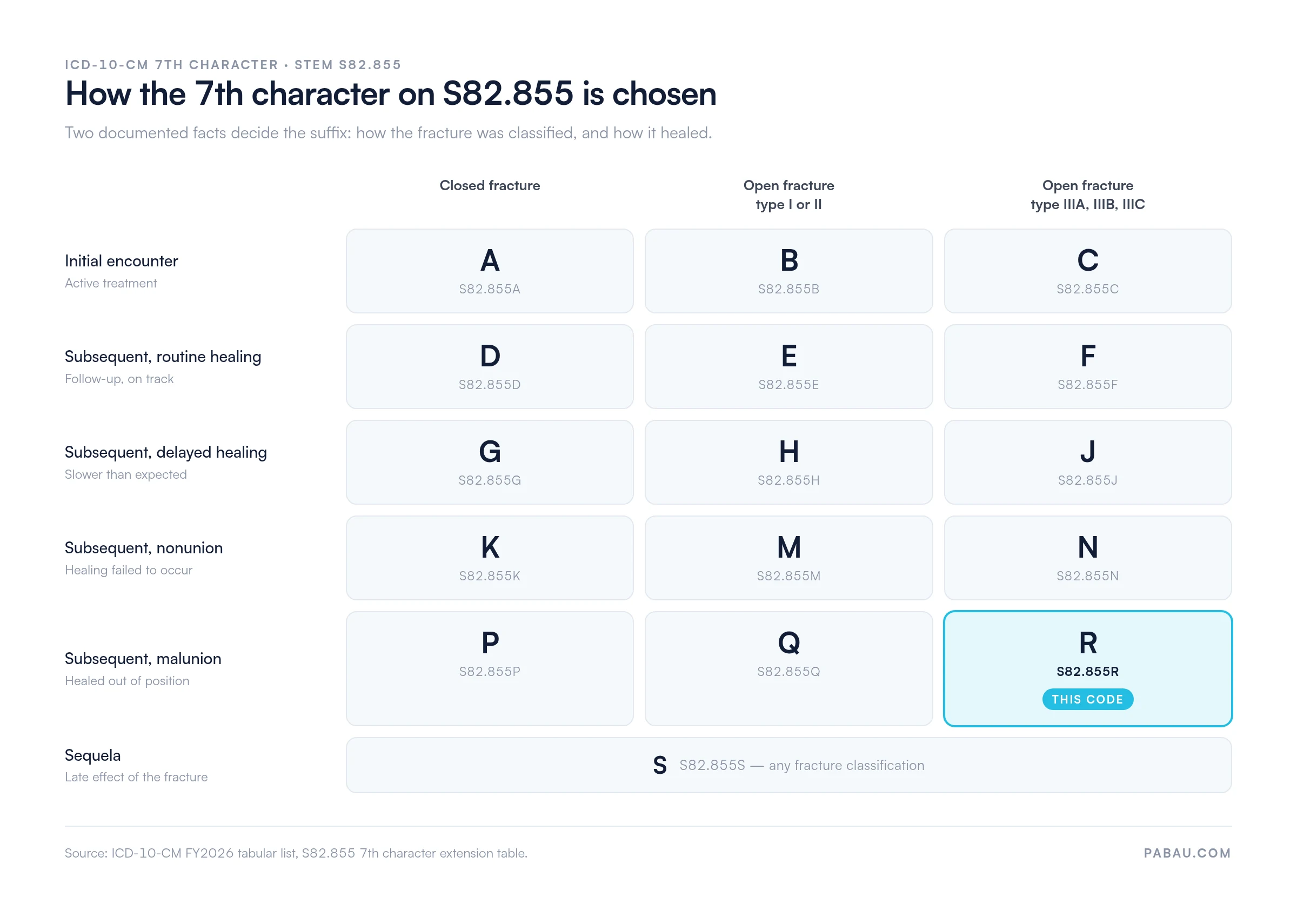
The Gustilo-Anderson classification is the standard system for grading open fractures by wound contamination and soft tissue damage. ICD-10-CM maps Gustilo grades directly to 7th character suffixes.
ICD-10-CM groups Gustilo types IIIA, IIIB, and IIIC under one suffix instead of separating them. The operative or emergency department note still has to record the specific subtype. The 7th character is only defensible if that grade appears in the record.
Check for malunion vs. nonunion before assigning 7th character R. Malunion means the fracture healed in an incorrect position. Nonunion means healing failed to occur. Both take different 7th characters (R vs. N), and the distinction must be supported by radiographic imaging in the medical record. Conflating the two is one of the most common errors on complex ankle fracture claims.
A trimalleolar fracture involves all three bony prominences of the ankle. Those are the medial malleolus (inner ankle), the lateral malleolus (outer ankle), and the posterior malleolus (back of the tibia). Nondisplaced means the fragments stay in anatomic alignment despite the fracture, which changes both management and coding.
Laterality matters for orthopedic billing because insurers cross-reference it against imaging reports. A claim for S82.855R on a right-ankle patient will deny immediately. Confirm left-side involvement in the physician note, the imaging report, and the operative documentation before coding.
Coders meet both fracture types regularly. The distinction is posterior malleolus involvement, which shifts the code family entirely. The comparison below covers the left-side nondisplaced variants.
The operative report must confirm a posterior malleolus fracture to justify a trimalleolar code. Using S82.855R when only two malleoli are documented is an overcoding error that creates audit exposure. Where the posterior malleolus is intact and a closed fracture is healing routinely, the follow-up code is S82.845D.
The ICD-10-CM Official Guidelines for Coding and Reporting define a subsequent encounter as a visit for routine follow-up care after the active treatment phase.
For fractures, active treatment ends once the treating provider has completed the initial clinical decision-making. That covers reduction, fixation, casting, or surgical stabilization.
Every office visit after that point takes a subsequent encounter code. Billing an initial encounter code on a follow-up visit is a leading cause of orthopedic claim denials.
Fracture aftercare codes (Z47.xx) are no longer used for traumatic fractures under ICD-10-CM guidelines. The fracture code itself, with the appropriate subsequent encounter 7th character, captures the aftercare context.
Coders trained under ICD-9-CM habits sometimes default to Z codes for follow-up visits, and compliance reviews flag that substitution as a documentation mismatch.
S82.855R is a diagnosis code. It pairs with CPT procedure codes on the same claim. The CPT codes below are commonly associated with trimalleolar fracture management, based on crosswalk data from the AAPC Codify ICD-10-CM lookup. Verify current-year reimbursement rates and payer-specific coverage before billing.
The pairing of 27822 and 27823 turns on one line of the operative report. Fixation of the posterior lip moves the case from 27822 to 27823. That same posterior malleolus finding is what keeps the diagnosis in the S82.85x family.
S82.855R is a subsequent encounter code, so the surgical codes above are normally billed against an initial encounter code on the date of surgery. The subsequent encounter qualifier pairs most often with evaluation and management codes during the follow-up phase.
Each qualifier in ICD-10 Code S82.855R must be independently supported in the medical record. A claim auditor reviewing this code checks the documentation against five specific elements. Build those checks into the coding review before the claim leaves the practice.
Practice management software like Pabau keeps those five elements in one patient record. Its claims management software links the clinical note to the invoice and the insurance claim. A coder can then trace every qualifier back to its source document.
Run a pre-submission audit on every S82.855R claim. Check five points: left laterality in the imaging report, nondisplaced status, all three malleoli identified, the Gustilo grade stated, and malunion confirmed radiographically. Missing any one of them is enough to trigger a denial or a request for records.
ICD-9-CM did not encode fracture specificity at the level ICD-10-CM does, so there is no one-to-one equivalent for S82.855R. The General Equivalence Mappings (GEMs) give approximate crosswalk guidance, and the conversion is not exact. The closest legacy equivalents for a nondisplaced trimalleolar fracture of the left lower leg are:
GEMs crosswalks are approximations. For retrospective research or historical data mapping, note that ICD-9-CM 824.6 and 824.7 carry far less specificity than S82.855R. Malunion, Gustilo grade, laterality, and displacement status were not separately captured in the legacy system.
Most orthopedic practices code a follow-up fracture visit in one system and bill it in another. A coder reads the radiology report, picks the 7th character, then re-keys the code into a billing screen. Each hop is a chance to drop a qualifier.
Pabau keeps the diagnosis code attached to the record it came from. The code selected on the treatment note carries through to the invoice and the insurance claim, with no second entry.
For a code like S82.855R, that matters most on the follow-up visits. The documentation for laterality, Gustilo grade, and malunion sits beside the claim, so a denial can be answered without hunting through three systems.

Pabau links diagnosis codes to treatment records, invoices, and insurance claims. A multi-qualifier code like S82.855R travels from the clinical note to the claim without re-entry.

Assigning S82.855R comes down to one question. Can the record defend all four qualifiers at once: left-side laterality, nondisplaced status, a Gustilo type III open fracture, and confirmed malunion? Confirm all four before the claim goes out, because a missing one costs a denial on a case that already pays slowly.
The five-point check above is the cheapest part of this code. It takes a coder a minute, and it settles the qualifier an auditor asks about first. Book a demo to see how Pabau keeps fracture coding and claim submission in one record.

Need guidance on medical billing compliance for orthopedic claims? Medical billing compliance covers the documentation standards and audit triggers that affect complex fracture code submissions.
Want to understand how claims clearinghouses validate ICD-10 code pairings? Claim.MD clearinghouse overview explains how electronic claim validation works before a submission reaches the payer.
Looking for a primer on denial prevention for diagnosis codes? Denial codes in medical billing is a reference for the remittance advice denial reasons that hit fracture code claims.
ICD-10 Code S82.855R is a billable ICD-10-CM diagnosis code for a nondisplaced trimalleolar fracture of the left lower leg. The 7th character marks a subsequent encounter for an open fracture type IIIA, IIIB, or IIIC with malunion. It is valid for dates of service on or after October 1, 2025 (FY2026).
The 7th character R indicates a subsequent encounter for an open fracture classified as Gustilo type IIIA, IIIB, or IIIC, with malunion. It separates that scenario from nonunion (7th character N), delayed healing (J), and routine healing (F) in the same encounter category.
A bimalleolar fracture involves the medial and lateral malleoli only (ICD-10-CM category S82.84x). A trimalleolar fracture involves all three: medial, lateral, and posterior malleolus (S82.85x). Posterior malleolus fracture must be documented in the operative or imaging report to support a trimalleolar code.
Yes. S82.855R is a billable, specific ICD-10-CM code valid for reimbursement purposes under the FY2026 edition, effective October 1, 2025. The parent stem S82.855 is not billable; only the fully specified 7th character variants are valid for claim submission.
Use S82.855A for the initial encounter when treating a closed fracture for the first time. Use S82.855D for follow-up visits when a closed fracture is healing routinely. Use S82.855R when the patient returns after a Gustilo type IIIA, IIIB, or IIIC open fracture and imaging confirms malunion.
There is no direct one-to-one ICD-9-CM equivalent. The approximate crosswalk via GEMs maps to 824.7 (trimalleolar fracture, open), but ICD-9-CM lacked laterality, Gustilo grade, displacement status, and malunion qualifier fields. The conversion is approximate only.




