ICD-10 Code S42.444P: Medial epicondyle fracture, right humerus
ICD-10 Code S42.444P: full descriptor and code validity ICD-10 Code S42.444P car...

Last Updated: Oct 13, 2026
Billable Code Specific Code
S82.136K is the billable ICD-10-CM code for nondisplaced fracture of medial condyle of unspecified tibia, subsequent encounter for closed fracture with nonunion.
The claim turns on the 7th character. K records three facts at once. The visit is follow-up care, the skin was never broken, and the bone has stopped knitting.
The character most often reached for by mistake here is the J value. J is reserved for an open fracture of Gustilo type IIIA, IIIB or IIIC with delayed healing. On a closed nonunion it misses on both counts.
Let Pabau's smart automation suggest the right codes, reduce claim denials, and keep your practice compliant—effortlessly.
Automate repetitive tasks and focus on what matters most—your patients.
Reduce coding errors and ensure compliance with the latest regulations.
Clean claims, fewer denials, and faster reimbursements.
Powerful insights and reporting to help your practice thrive.
HIPAA compliant SOC 2 certified GDPR-compliant Trusted by 4,000+ clinics worldwide

ICD-10 code S82.136K reports a nondisplaced medial condyle tibia fracture at a subsequent encounter, once the closed fracture has developed nonunion.
Closed nonunion sits on the 7th character K, not J. J belongs to an open fracture of type IIIA, IIIB or IIIC with delayed healing.
S82.136 accepts sixteen valid 7th characters, so the note has to settle encounter type, skin integrity and healing status separately.
The sixth digit is the unspecified-tibia option. Query the provider for right or left, then report S82.134K or S82.135K instead.
Practice management software like Pabau validates ICD-10-CM codes before submission, so subsequent-encounter fracture claims leave the practice clean.
S82.136K is a billable, specific ICD-10-CM diagnosis code. It goes on claims to Medicare, Medicaid and commercial payers. The diagnosis it reports is a closed, nondisplaced fracture of the medial condyle of the tibia, seen at a subsequent encounter with nonunion. Verify the code year in the CDC/NCHS ICD-10-CM web tool before you submit, because the set changes every October 1.
Every character in S82.136K carries a specific clinical meaning. Misread any one of them and the claim goes back. Here is how the string breaks down, left to right.
“Nondisplaced” means the fracture line is there but the bone ends have stayed in normal anatomical alignment. A displaced fracture is the opposite, with fragments moved out of position. Displacement is the difference between S82.133 and S82.136.
“Closed fracture” means the skin over the fracture site is intact, with no wound communicating with the bone. Both facts have to appear in the provider’s note to support this code.
The 7th character is the most consequential decision on S82.136. Under the CMS ICD-10-CM coding guidelines, it has to record three facts at once. Those are the encounter type, whether the fracture was open or closed, and the healing status.
S82.13x takes the full open-fracture extension set, so sixteen valid 7th characters exist here, not the six that closed-only codes use. The table below runs all sixteen, with the documentation each one assumes.
The set skips I, L and O on purpose, because those letters read too easily as digits on a claim line. That is why nonunion lands on K and malunion on P, rather than on the letters that would follow J alphabetically.
K is not J. This is the single most common mix-up on this code family. J and K sit next to each other in the extension set, and both describe a subsequent encounter, so they look interchangeable. They are not.
J requires an open fracture of type IIIA, IIIB or IIIC, and it requires delayed healing rather than nonunion. Use it on a closed nonunion and you have described a high-grade open wound that the chart never documented. Payers read that as an unsupported diagnosis.
The grid below plots all sixteen characters on the two axes that decide them. It shows how far apart J and K actually sit.
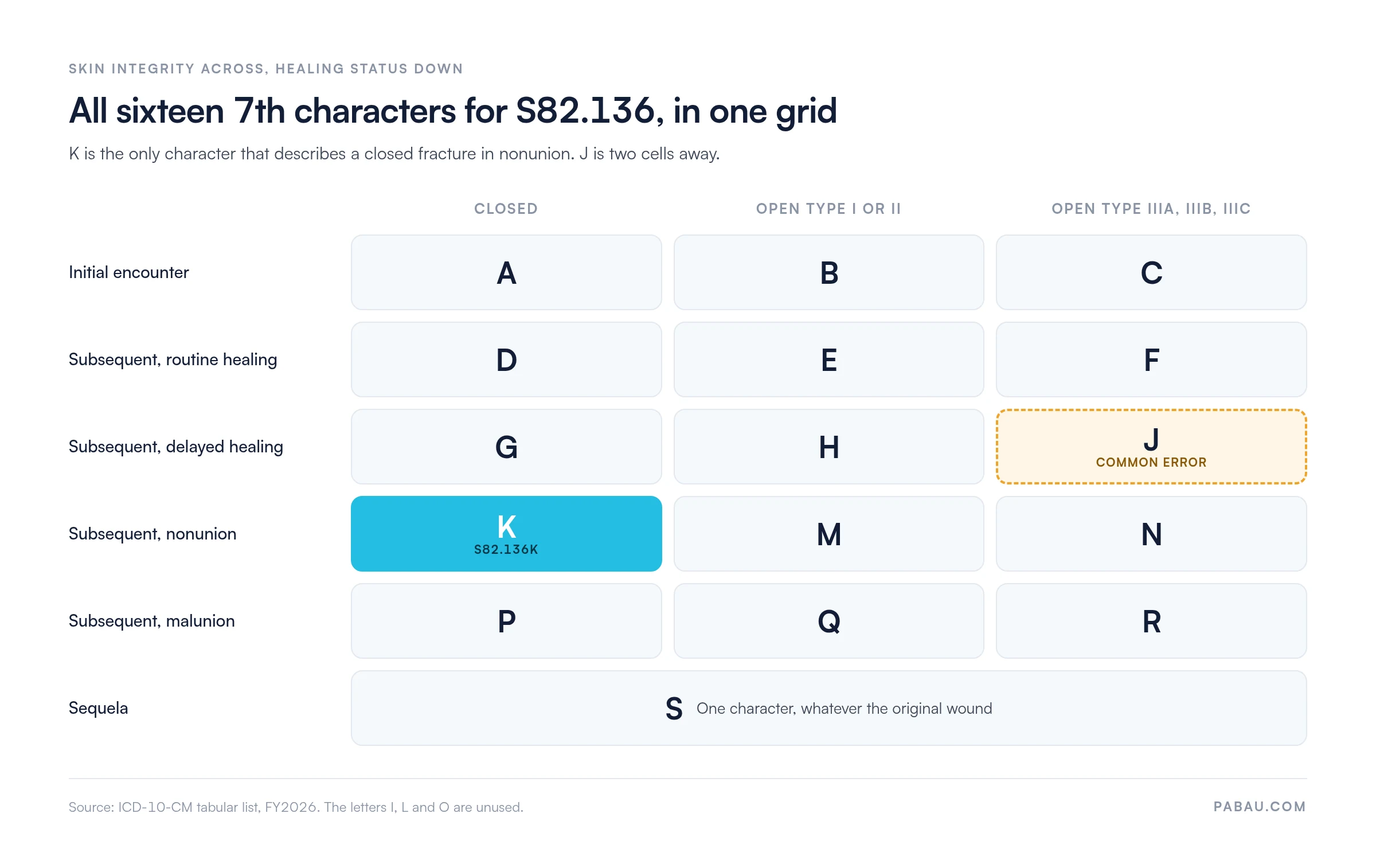
K is not G either. Delayed healing means the biology is still working, just behind schedule. Nonunion means the process has effectively stopped, usually confirmed at six months or more with no bridging callus on imaging. Reaching for G when the films and the note say nonunion is the other habitual error.
Reading the parent structure is the quickest way to confirm you are at the right level of specificity. S82.136K sits at the bottom of a seven-level hierarchy, and each level narrows the clinical picture further. The full tabular list is available through ICD List’s free ICD-10-CM lookup.
S82.136 on its own is not a valid billable code. The 7th character is mandatory everywhere in the S82.13 family, and a claim submitted with only six characters is rejected automatically.
One level up, the S82.1 subcategory holds the other proximal tibia patterns. S82.11x covers the tibial spine, S82.12x the lateral condyle and S82.14x a bicondylar break. Only a fracture confined to the medial condyle belongs in S82.13x.
The medial condyle is the inner prominence of the proximal tibia, and it forms the medial compartment of the knee joint. Fractures here usually follow valgus stress combined with axial loading. Falls, motor vehicle collisions and sports injuries are the common mechanisms.
Orthopedic and physical therapy practices carry most of the recovery phase for this injury, which is where the subsequent-encounter codes get used.
A nondisplaced medial condyle fracture is often managed without surgery, using immobilization and protected weight-bearing. Nonunion still complicates roughly 5-10% of long-bone fractures. Patient factors include osteoporosis, smoking, diabetes and poor vascular supply, and mechanical factors include premature weight-bearing and inadequate immobilization.
Once the provider declares nonunion on imaging, the 7th character moves from D or G across to the K value. Those subsequent encounters often involve bone grafting, revision of internal fixation or electrical bone stimulation. Each of those services leans on the diagnosis code for its medical necessity.
The wording below turns up in provider notes and all of it maps to ICD-10 code S82.136K. Coders should read every one of these variants as the same diagnosis.
The provider’s note has to carry five clinical facts for S82.136K to hold up at audit. Miss one and the coder is left with a less specific code or a query.
Coder tip: if the imaging report mentions nonunion but the provider’s note does not, query the provider first. The ICD-10-CM Official Guidelines require the diagnosis to be stated by the treating provider, not inferred by the coder from diagnostic findings.
Laterality is the sixth item worth chasing. S82.136 is the unspecified-tibia option, and the guidelines reserve unspecified codes for records that genuinely do not name a side. Ask the provider, then report S82.134K for the right tibia or S82.135K for the left.
Picking the wrong 7th character is the most common error on this family. The table below runs the five subsequent-encounter scenarios that come up most often for S82.136, with the correct code and the decision point behind it.
One pitfall shows up in audits again and again. A coder selects S82.136G when the imaging clearly shows nonunion, because “delayed healing” feels like the safer, less severe description.
That choice invites a medical necessity denial. Payers expect K when the provider documents nonunion and the practice bills bone stimulation or surgical revision alongside it.
Review the denial codes in billing to see which rejection messages a payer sends when the diagnosis does not support the service billed.
Query your billing data for every S82.136D and S82.136G claim older than 24 weeks. Where a patient has four or more subsequent encounters on the same character and the notes reference ongoing non-healing, pull those charts for review. Moving them to S82.136K where the provider has documented nonunion prevents retroactive denials and supports medical necessity for grafting or bone stimulation. Run the same query for any claim carrying S82.136J. A closed nonunion coded as a type III open fracture is a description no chart will support.
S82.136K belongs to a family that varies by displacement, laterality and encounter type. The table below covers the siblings that come up most in orthopedic charts. Use the AAPC Codify ICD-10-CM lookup to confirm current descriptions for any code in this family.
Note the pattern in the sixth digit. S82.134 and S82.135 name the right and left tibia for a nondisplaced medial condyle fracture, and S82.136 is the unspecified option. Query for the side whenever the chart allows it, because unspecified codes attract payer scrutiny.
S82.136K is accepted for claim submission under ICD-10-CM. Whether the claim pays depends on the payer’s policy, the medical necessity documentation and the services billed with it. A valid diagnosis code does not guarantee payment. It establishes the condition that the procedure codes have to be necessary for.
For orthopedic practices submitting electronically, practice management software like Pabau sends claims through the Claim.MD clearinghouse, which covers thousands of US payers. That connection supports CMS-1500 and 837P submission with built-in ICD-10 code validation.
Practices using claims management software catch errors such as a missing 7th character or unspecified laterality before the claim leaves the building.
In most practices the 7th character is decided twice. The provider describes the healing status in the note, and days later a biller reads that note and picks a letter. Anything the note left vague gets settled by whoever is closest to the deadline.
Practice management software like Pabau closes that distance. Fracture follow-ups run on structured medical forms. Displacement, skin integrity, laterality and healing status are captured as fields at the visit, rather than reconstructed later. The coder then reads a record that already answers all four questions K depends on.
Claims then go out through the Claim.MD integration, with ICD-10 validation on the way. A six-character stub or an unspecified-laterality code gets caught before submission. Reporting shows which codes get denied and why, which is how you spot a run of S82.136G claims that should have been S82.136K.
The result is a shorter revenue cycle on exactly the encounters that carry the most documentation risk. Every Pabau subscription includes the full feature set, so clinical forms, coding validation and denial reporting arrive together.

Pabau connects ICD-10-CM coding workflows to electronic claim submission through Claim.MD, covering thousands of US payers. See how orthopedic and physical therapy practices cut denials on subsequent-encounter codes.

S82.136K asks three questions of the chart at once. The visit has to be a subsequent encounter, the fracture has to be closed, and the provider has to have declared nonunion. Get one wrong and you have either the wrong code or a query to write.
The letter next door is the one to watch. J describes an open type IIIA, IIIB or IIIC fracture with delayed healing, which is a different injury and a different healing status. Sixteen characters share this base code, and only K carries closed nonunion.
Pabau’s revenue cycle tools and the Claim.MD integration validate ICD-10-CM codes before submission. Orthopedic and physical therapy practices use them to track denials tied to subsequent-encounter coding. To see how that works on your own fracture caseload, book a demo.

Managing fracture billing denials? Denial management in healthcare covers the most common payer rejection patterns for orthopedic and injury codes.
Need to understand the claims submission process? Medical claims clearinghouse explains how 837P electronic claims flow from practice to payer and where errors are caught.
Coding the same fracture at a later stage? ICD-10 code S82.136S covers the sequela character for this base code, once treatment moves to a late effect.
New to the revenue cycle side of coding? What is medical billing walks a claim from encounter to payment, so you can see where the 7th character decides the outcome.
ICD-10 code S82.136K is a billable ICD-10-CM diagnosis code for a nondisplaced fracture of the medial condyle of the tibia. It applies at a subsequent encounter, once the closed fracture has developed nonunion. Each character is specific. S82 is a lower leg fracture and .13 is the medial condyle. The sixth digit 6 means nondisplaced with the side unspecified. The K means a follow-up visit for a closed fracture that has failed to unite.
Yes. S82.136K is a specific, billable ICD-10-CM code valid for FY2026, effective October 1, 2025 through September 30, 2026. It can be reported on claims for diagnosis reimbursement. Payment still depends on the payer’s policy and on the medical necessity of the procedure codes submitted with it.
In S82 fracture codes, the 7th character K means a subsequent encounter for a closed fracture with nonunion. Subsequent encounter means the patient is past active treatment and now in follow-up or complication care. Nonunion means imaging confirms the fracture has failed to unite, usually at six months or more with no bridging callus. That is different from G, which is delayed healing, and from P, which is malunion.
No. S82.136J means a subsequent encounter for an open fracture of type IIIA, IIIB, or IIIC with delayed healing. Closed nonunion is S82.136K. The two are easy to confuse, because they sit next to each other in the extension set. J describes a high-grade open wound and healing that is still progressing. Reporting J on a closed nonunion describes an injury the chart never documented.
Start with the base code for the fracture site. For a nondisplaced medial condyle of unspecified tibia that is S82.136, and the 7th character K completes it. The provider’s note then has to confirm three facts. The fracture is closed with no open wound, the visit is a subsequent encounter, and imaging supports nonunion. The coder cannot infer nonunion from the films alone, since the treating provider has to state the diagnosis.
The closest codes are S82.134 for a nondisplaced right tibia and S82.135 for the left, plus the displaced variants S82.131 and S82.132. Inside the S82.136 family, the tail character does the work. S82.136A is the initial closed encounter, S82.136D is routine healing and S82.136G is delayed healing. S82.136K is nonunion, S82.136P is malunion and S82.136S is sequela.
A subsequent encounter code applies once the patient has had initial active treatment and has moved into recovery or complication care. That covers cast checks, therapy follow-ups, and management of nonunion or malunion. Active treatment, including surgery and the first fracture management, takes the initial encounter characters A, B, or C instead.
Yes, wherever the record allows one. S82.136K is the unspecified-tibia option, and the guidelines reserve unspecified codes for charts that genuinely do not name a side. Once the provider confirms it, report S82.134K for the right tibia or S82.135K for the left. Unspecified codes draw payer scrutiny on high-cost nonunion care.