

ICD-10 Code S42.444P: Medial epicondyle fracture, right humerus
ICD-10 Code S42.444P: full descriptor and code validity ICD-10 Code S42.444P car...

Last Updated: Oct 13, 2026
Billable Code Specific Code
S80.01XS is the billable ICD-10-CM code for contusion of right knee, sequela.
The code belongs to chapter S00-T88. The Centers for Medicare and Medicaid Services (CMS) lists that chapter as Injury, Poisoning, and Certain Other Consequences of External Causes. Within that chapter it sits in category S80, Superficial injury of knee and lower leg.
Right knee contusion claims are usually coded at the initial encounter and never revisited. Months later the patient comes back with chronic stiffness, lingering tenderness, or a functional limitation, and the coder reaches for the wrong seventh character. Medical billing workflows for sequela conditions call for a different code, and that code is S80.01XS.
Let Pabau's smart automation suggest the right codes, reduce claim denials, and keep your practice compliant—effortlessly.
Automate repetitive tasks and focus on what matters most—your patients.
Reduce coding errors and ensure compliance with the latest regulations.
Clean claims, fewer denials, and faster reimbursements.
Powerful insights and reporting to help your practice thrive.
HIPAA compliant SOC 2 certified GDPR-compliant Trusted by 4,000+ clinics worldwide

ICD-10 Code S80.01XS is the billable ICD-10-CM code for contusion of right knee, sequela, effective October 1, 2025.
The seventh character S marks a resolved injury whose late effect, such as stiffness or chronic pain, now needs treatment.
Never use S80.01XS for an active or healing knee contusion, which takes S80.01XA or S80.01XD instead.
Sequela claims are denied most often when the notes never confirm that the acute contusion has resolved.
Practice management software like Pabau scrubs the seventh character and the laterality before the claim reaches the payer.
Use the reference table below to confirm the key attributes of S80.01XS before submitting a claim.
The seventh character is where most knee contusion coding errors originate. All three variants of S80.01X share the same base description, but they indicate different stages of care. Selecting the wrong character triggers denials and documentation audits.
The common error runs like this. A physical therapist keeps using S80.01XD for a patient whose contusion healed three months ago, because the knee still hurts. Once the bruising and the acute inflammatory response have resolved, the correct code is S80.01XS.
That distinction decides how payers classify the claim, and whether they approve it under injury-follow-up or late-effect coverage rules. Three questions, asked in order, settle which character applies.
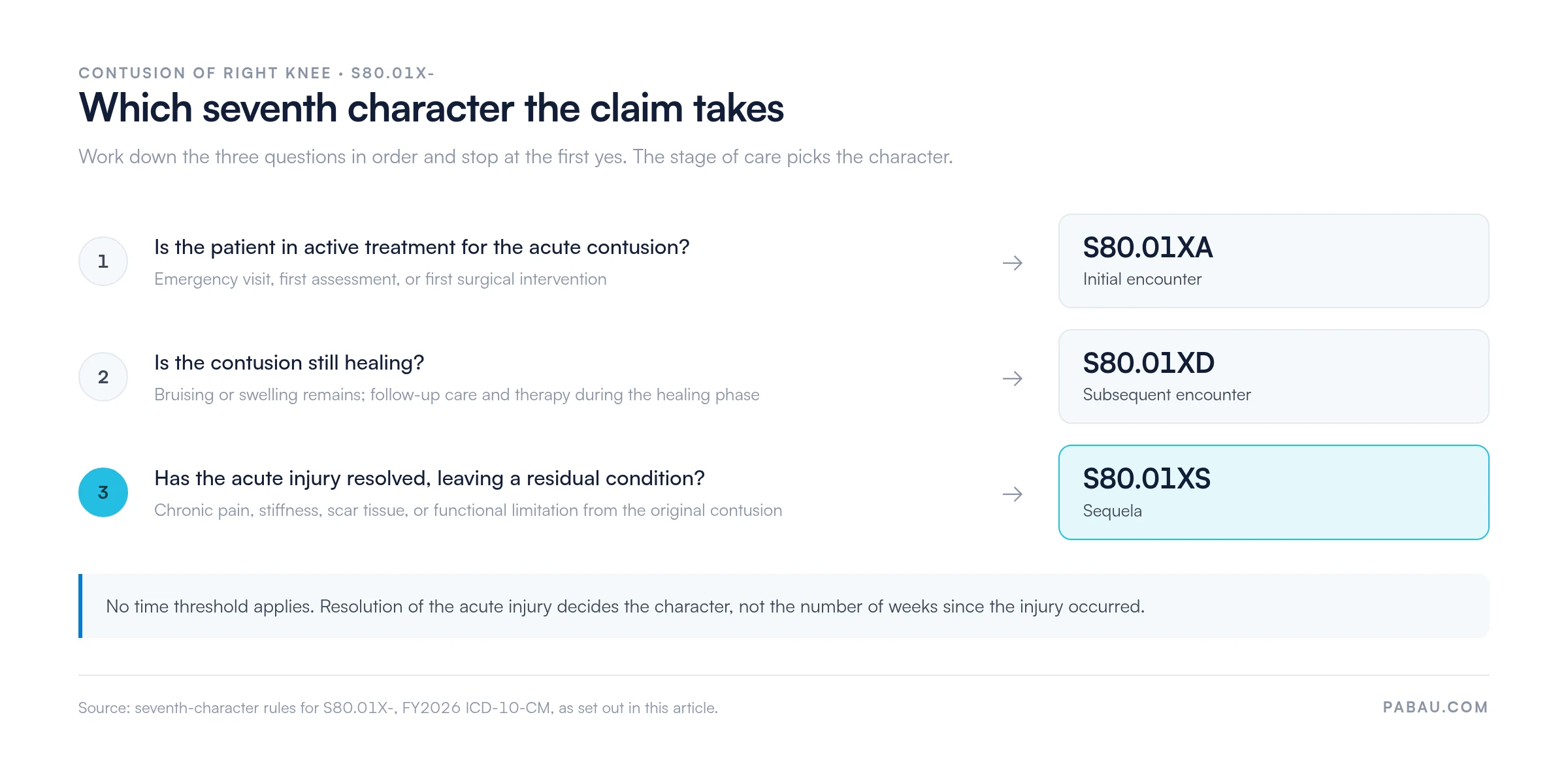
Sequela is the ICD-10-CM term for a late effect. It is a condition that arises as a direct consequence of a prior injury or illness, once the acute phase has ended. The CDC/NCHS ICD-10-CM coding tool classifies sequela under the “S” seventh character across all injury code families, including S80.
Clinicians treating athletes, workers’ compensation patients, and post-injury rehabilitation patients encounter this code most frequently. The scenarios below are the primary clinical situations where S80.01XS applies.
If the patient’s notes still describe active bruising or the contusion as “healing,” S80.01XS is premature. Use S80.01XD until the clinical record explicitly documents resolution of the acute injury.
Document the resolution of the acute right knee contusion explicitly in the clinical notes before switching to S80.01XS. Phrases like ‘acute contusion resolved, patient now presents with residual stiffness’ give payer reviewers the clinical anchor they need to approve sequela-coded claims. Vague notes that do not confirm injury resolution are the leading cause of S80.01XS claim denials.
S80.01XS sits at the most specific level of a seven-tier structure. Reading the levels from the top shows what each character adds, and where a shorter code would have stopped.
The placeholder “X” in the sixth position is a required dummy character. Omitting it and coding “S80.01S” produces an invalid code that payers will reject. Always include the X placeholder when the sixth character position is not otherwise filled.
The S80 code family covers superficial injuries to the knee and lower leg. Knowing the whole set matters for patients who present with bilateral or multi-site contusions, and for crosswalking a claim between encounter types.
Always specify laterality. Unspecified knee codes (S80.00X-) are valid, but they leave the record vaguer than the clinical picture warrants.
Payers and auditors increasingly flag unspecified laterality as a documentation deficiency, particularly in workers’ compensation and Medicare Advantage claims. Confirm right or left from the clinical record before coding.
Not every knee injury note names a bruise. Where the record confirms a superficial left knee wound without naming the type, the S80.91 subcategory applies rather than S80.0. S80.912A covers that presentation at the initial encounter, and the seventh character shifts to S once a late effect is treated. A knee wound caused by heat leaves the S80 family entirely. The block carries an Excludes2 for burns and corrosions, so a second-degree thermal burn of the right knee takes T24.221A at the initial encounter.
Sequela codes require stronger documentation than initial or subsequent encounter codes. The coder has to establish two distinct facts: the original injury occurred, and it has since resolved leaving a residual condition.
Physical therapists in particular should verify that their intake documentation includes all five elements above before submitting S80.01XS on a claim.
Incomplete sequela documentation is the primary reason these claims are returned or denied on initial review. Consult the AAPC Codify ICD-10-CM lookup for additional coding notes specific to this code family.
Sequela codes behave differently from initial and subsequent encounter codes at the payer level. Billing teams that treat S80.01XS like a routine follow-up code will meet denials they could have prevented.
S80.01XS turns up often in physical therapy billing. It applies when a patient starts a course of rehab for residual deficits from a past right knee contusion. Make sure the plan of care names the sequela as the current diagnosis rather than the original injury.
Payers may request the referral or physician order to confirm the treatment rationale. Physical therapy practice software that supports structured ICD-10 coding at the point of care helps here. It lowers the risk of picking the wrong seventh character under time pressure.
Workers’ compensation payers often require pre-authorization for treatment of sequela conditions. The insurer may already have an open claim for the original contusion under S80.01XA or S80.01XD.
A new claim under S80.01XS can then need its own authorization request, with documentation showing the acute injury has resolved.
Check the payer’s claims portal before submitting. Practices that use electronic claims via Claim.MD can validate payer-specific requirements before submission, which cuts the turnaround time on sequela-coded workers’ compensation claims.
Understanding managing claim denials for sequela codes starts with the three most common rejection triggers.
Practices managing a high volume of sequela claims benefit from a clearinghouse that checks claim data before transmission. Claims management software integrated with a clearinghouse catches seventh-character mismatches and missing laterality at the scrubbing stage, before the claim reaches the payer.
Check the code-level edits and pairing logic for the S80 family before you build a clean claim process for injury codes. Physical therapy practices should also revisit their documentation protocols each year, because payer audit standards for sequela codes keep tightening.
When billing S80.01XS alongside a residual condition code, sequence the residual condition first. Take a patient treated for pain in the right knee (M25.561) as a sequela of the contusion. Code M25.561 first, then S80.01XS to indicate the cause. This sequencing follows ICD-10-CM Official Guidelines Section I.B.10 and reduces the likelihood of medical necessity denials.
In many practices this work is split across two systems. The clinical note sits in the EMR and the claim is built somewhere else. Someone retypes the diagnosis from one screen into the other, and that retyping is where a seventh character slips.
Practice management software like Pabau keeps the note and the claim in the same client record. The therapist documents that the acute contusion resolved and names the residual condition being treated. The coder then builds the claim from that note, with no second data entry step in between.
Claims leave through the Claim.MD clearinghouse integration, which checks the code before a payer ever sees it. So your team spends its time on treatment instead of re-submitting a claim that was right apart from one character.

Pabau helps physical therapy, sports medicine, and rehab practices document sequela conditions accurately. Submit claims through the Claim.MD clearinghouse integration and track claim status without switching between systems.

The seventh character is a clinical judgment before it is a clerical one. S80.01XS only holds up when the note says the acute contusion resolved and names what the patient is left with. Without those two statements the code is premature, whatever the calendar says.
So build the check into the documentation step rather than the billing step. A therapist who writes “acute contusion resolved, residual stiffness on the right” has already made the coder’s decision. At the point of submission, the claim stops being a judgment call.
Pabau’s claims management software connects to the Claim.MD clearinghouse and validates ICD-10 codes, including the seventh character, before claims reach payers. To see how a sequela claim runs end to end in a rehab practice, book a demo with the team.

Need to understand how clearinghouse submissions work for injury codes? How the Claim.MD clearinghouse works walks through real-time eligibility, claim validation, and ERA processing for US practices.
Billing trauma codes and need guidance on denial workflows? Denial codes in medical billing covers the most common CARC denial reasons and how to respond to each one.
Running a physical therapy or sports medicine practice? Sports medicine practice management explains how Pabau handles scheduling, documentation, and claims for injury-focused specialties.
S80.01XS is a billable ICD-10-CM diagnosis code for contusion of right knee, sequela. It designates a late effect of a right knee contusion. The residual condition may be chronic pain, stiffness, or reduced range of motion that persists after the acute bruising resolves. It is valid for fiscal year 2026, effective October 1, 2025.
S80.01XA is used for the initial encounter – the first visit where active treatment is provided for the acute right knee contusion. S80.01XD covers subsequent encounters during the healing phase. S80.01XS applies only after the acute contusion has completely resolved and the patient now has a residual condition directly caused by the original injury. Each seventh character represents a distinct stage of care, and selecting the wrong one is a common cause of claim denials.
Yes. S80.01XS is a billable, specific ICD-10-CM code that can be submitted for reimbursement on HIPAA-covered transactions. It became effective October 1, 2025 as part of the FY2026 ICD-10-CM update and remains valid through September 30, 2026.
Use the “S” seventh character once the original injury has fully resolved. The patient’s current presentation must be a direct residual effect of that past injury. There is no minimum time threshold – the trigger is resolution of the acute phase, not the number of days since the injury occurred. Clinical notes must explicitly document that the acute condition has resolved before the “S” seventh character is appropriate.
S80.02XS is the equivalent code for contusion of left knee, sequela. It mirrors S80.01XS in structure, billable status, and documentation requirements, with the only difference being the documented laterality (left vs. right). The same seventh-character rules and sequela documentation standards apply.
Yes. Physical therapists routinely use S80.01XS when treating residual functional deficits from a resolved right knee contusion. The plan of care should reference the sequela as the current diagnosis, and the PT intake documentation should confirm the acute contusion has resolved. Payers may request the referring physician order to validate medical necessity for sequela-based PT services.




