ICD-10 Code S42.444P: Medial epicondyle fracture, right humerus
ICD-10 Code S42.444P: full descriptor and code validity ICD-10 Code S42.444P car...

Last Updated: Oct 13, 2026
Billable Code Specific Code
S72.421N is the billable ICD-10-CM code for displaced fracture of lateral condyle of right femur, subsequent encounter for open fracture type IIIA, IIIB, or IIIC with nonunion.
One detail causes most of the errors here. N is an open fracture character, never a closed one, and plenty of code summaries claim otherwise. Get it wrong and the claim comes back.
Let Pabau's smart automation suggest the right codes, reduce claim denials, and keep your practice compliant—effortlessly.
Automate repetitive tasks and focus on what matters most—your patients.
Reduce coding errors and ensure compliance with the latest regulations.
Clean claims, fewer denials, and faster reimbursements.
Powerful insights and reporting to help your practice thrive.
HIPAA compliant SOC 2 certified GDPR-compliant Trusted by 4,000+ clinics worldwide

ICD-10 code S72.421N is a displaced fracture of the lateral condyle of the right femur.
The 7th character N means a subsequent encounter, open fracture type IIIA to IIIC, with nonunion.
N never describes a closed fracture, so a closed nonunion of the same injury is S72.421K.
Without a documented Gustilo grade, the guidelines send an open nonunion to S72.421M instead.
The digit 1 sets the right femur, while S72.422 is the left and S72.423 is unspecified.
Seven characters carry five separate facts. Three of them describe the injury: the fracture site, the side, and whether the fragments moved. The other two cover what happened next, whether the skin broke and how the bone healed.
Miss one and the code is no longer S72.421N.
The lateral condyle is the outer bony knob at the bottom end of the femur. It forms the outer half of the knee joint surface.
Displaced means the fragments have shifted out of alignment. Types IIIA, IIIB, and IIIC come from the Gustilo-Anderson classification, which grades soft-tissue damage. Nonunion means the bone has stopped moving toward union.
Two of those five elements are where the code goes wrong most often. S72.421 is the right femur, not an unspecified side. And character N belongs to open fractures, not to the closed-fracture nonunion many summaries describe.
S72.421N sits at the deepest level of the femur fracture hierarchy. Reading it from the top down makes the sibling codes easy to find when the documentation points somewhere else.
The wider S72 category covers every femur fracture, from femoral neck at S72.0 to pertrochanteric at S72.1 and lower end at S72.4.
Per the CMS ICD-10-CM code files, every S72 code needs a 7th character. So S72.421 on its own is a stem, not a billable code. A claim carrying it rejects before it reaches the payer.
N means a subsequent encounter for an open fracture type IIIA, IIIB, or IIIC with nonunion. Packed into that one letter are the encounter type, the wound status with its grade, and the healing outcome.
Femur, forearm, and lower leg fracture categories all use the full 16-value set shown below. Upper arm codes in S42 use a shorter seven-value set instead.
That mismatch is one reason coders carry the wrong meanings from one body region to another.
The set skips the letters I, L, and O so nobody misreads them as digits. Laid out as a grid rather than a list, the logic gets obvious. Each healing outcome appears three times, once per wound status.
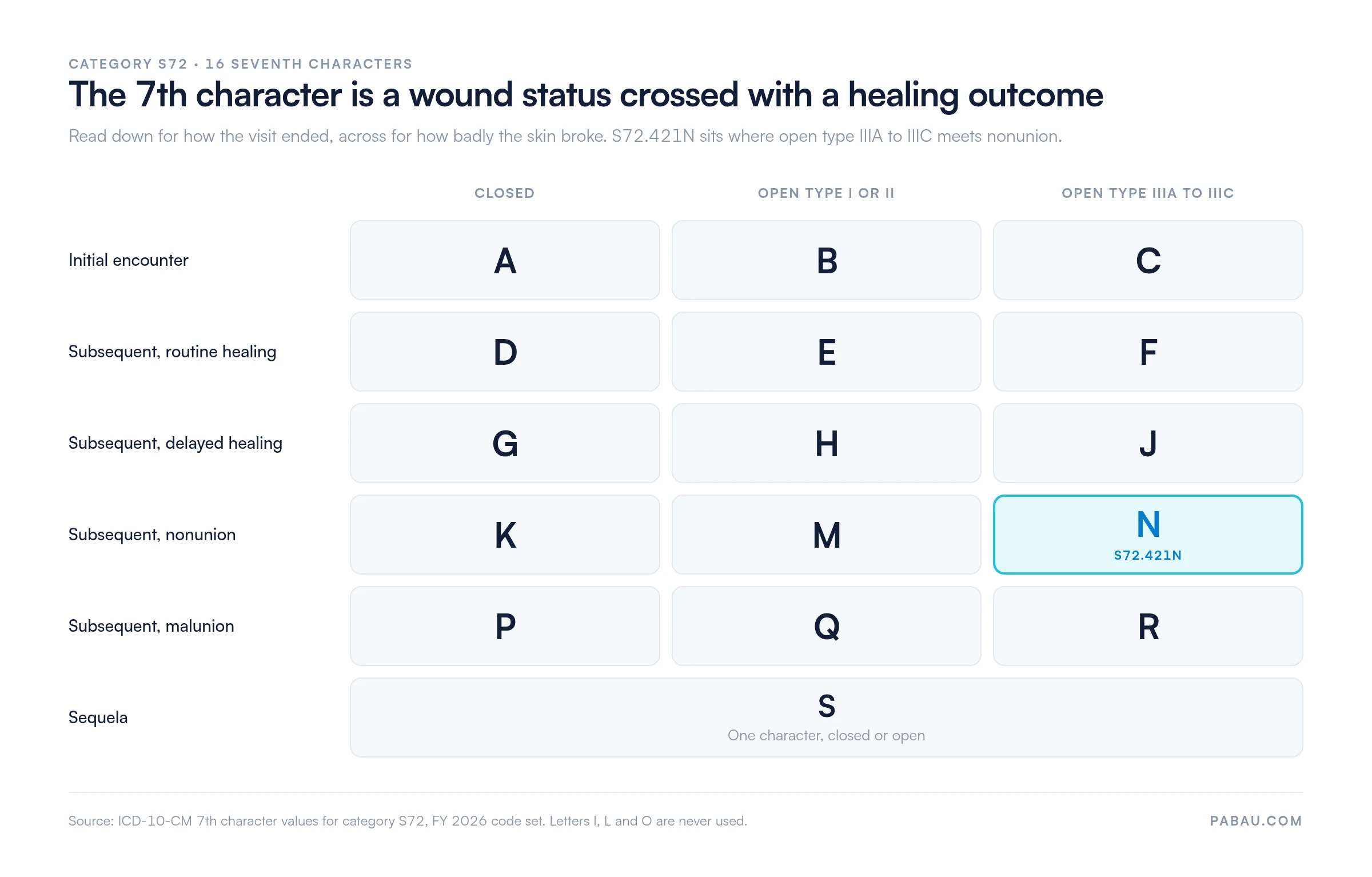
One row of that grid is worth reading twice. N never applies to the first visit for this fracture. Initial treatment of a type IIIA to IIIC open femur fracture takes character C instead.
Only when the patient returns for continued care does N become available. The physician still has to document that the bone has not united.
Those Roman numerals come from the Gustilo-Anderson classification, which grades the soft-tissue damage around an open fracture. Type III is the most severe band, and it splits into three subgrades.
Only three of the five grades reach character N.
The ICD-10-CM Official Guidelines tie the open fracture characters directly to this classification. When the record says open fracture without naming a Gustilo type, the guidelines send the coder to the type I or II characters.
On a nonunion follow-up, that default lands on M, not N, for the same injury. So character N needs the physician note or the operative report to say type IIIA, IIIB, or IIIC.
That default is why S72.421N gets over-assigned. Faced with an open femur fracture and a documented nonunion, a coder reaches for the most severe character available. The grade has to be in the record first.
Both are healing complications, and both are documented on a follow-up visit. They sit in different rows of the grid, though, and mixing them up is a frequent error on S72 claims.
A coder cannot read nonunion off an X-ray. The physician has to state the diagnosis in the note. One query, sent while the chart is still open, heads off both errors at once: the healing status and the missing Gustilo grade.
In S72.421, the 6th character does double duty. It sets the side and the displacement status together, which is why six stem codes are needed to cover one small piece of bone.
Unspecified laterality belongs only in a record that never names a side. An open femur fracture severe enough to reach type IIIA nearly always has one documented, which makes S72.423N rare in an orthopedic practice.
Choosing it when the operative report says right is a specificity error, and payers do query it.
Six stems multiplied by sixteen 7th characters gives 96 lateral condyle codes in total. Only a handful come up in practice, and these are the ones a coder is most likely to be choosing between.
For the rest of the family, the CDC and NCHS ICD-10-CM web tool browses the official code set by fiscal year. Check the exact stem description there before assigning laterality from memory.
Knowing the code is one job. Proving it in the chart is another. Seven elements have to be present before S72.421N holds up in an audit, and the open fracture grade is the one that goes missing.
Soft-tissue detail matters for more than the 7th character. Type IIIB implies periosteal stripping and often a flap procedure, while IIIC implies a vascular repair.
Both change the procedure coding and the DRG, so the wound description has to be specific enough to support the grade.
Those elements belong in the clinical record, captured at the visit rather than reconstructed at billing. Structured note templates keep the wound grade and the side where the surgeon put them.
Practice management software like Pabau pairs those templates with claims management software, so an incomplete field surfaces before the claim leaves the practice.
Audit every S72 subsequent-encounter claim that carries N, F, J, or R. All four assert a Gustilo type IIIA to IIIC open fracture. If the operative note only says open fracture, the correct character sits one tier down, at M, E, H, or Q.
Picking the character is one step in a longer chain. Here is the path a nonunion follow-up claim takes, from the exam room to the remittance.
Two of those steps do most of the damage. Charge capture breaks down when the note never named a Gustilo grade, because nobody downstream can add one. The superbill carries whatever the clinician selected, right or wrong.
Adjudication breaks down for a different reason. A payer that sees a nonunion repair billed against a routine-healing character reads a contradiction, and contradictions get reviewed. Catching that at the scrubbing step costs a minute. After the denial, it costs a whole rework cycle.
On the inpatient side, S72.421N groups to MDC 08, diseases and disorders of the musculoskeletal system and connective tissue. Which MS-DRG the case lands in then depends on two things: whether the admission includes a qualifying operating room procedure, and the patient’s comorbidity level.
Without a qualifying operating room procedure, the case groups to MS-DRG 533 or 534, fractures of femur with and without MCC. Code a surgical revision and it moves instead to MS-DRG 480, 481, or 482, hip and femur procedures except major joint. Those three split by MCC, CC, and neither.
In practice, a nonunion of an open type III femur fracture usually involves surgery. So these claims tend to land in the procedure DRGs rather than the medical ones.
Watch the line between those and MS-DRG 535 and 536, which cover fractures of hip and pelvis. A distal femur fracture is not a hip fracture, and grouping it that way misstates the case.
Verify current assignments against the AAPC ICD-10-CM code lookup and the CMS annual MS-DRG update. Grouper logic and weights change every federal fiscal year.
The healing distinction carries a price, so it is worth working an example. Suppose the record documents an open type IIIA nonunion. The claim goes out coded D, closed fracture with routine healing.
That single letter is a coding error and a revenue understatement in the same line, and neither shows up until the remittance arrives.
S72 subsequent-encounter codes generate a lot of avoidable denials. Six errors account for most of them, and the first two belong to this code in particular.
A quarterly audit catches these patterns before they turn into a denial trend. Pull the S72 subsequent-encounter claims and compare the 7th character distribution against what the operative notes say. When one does come back, our guide to denial codes explains the remark codes payers send with it.
None of the above needs a coding audit to catch. Six questions, asked at the desk while the claim is still editable, cover the errors that cost the most.
Five of those six are answerable from the operative note alone. So the check belongs with the coder, not with the billing team. By the time it gets there, nobody has the chart open.
A reference page answers the lookup. The documentation behind S72.421N gets created hours earlier, in the exam room. In many practices a coder bridges that distance, reading free text and inferring what the surgeon meant.
Practice management software like Pabau closes it differently. Structured note templates prompt for laterality, displacement, open or closed status, and the wound grade while the patient is still in the room. The codes chosen there carry through to the claim form without re-entry, so the coder confirms rather than reconstructs.
Claims then go out electronically, with eligibility checks and automatic remittance return, and every Pabau subscription includes all of it.
For an orthopedic caseload with a steady run of S72 follow-ups, that cuts the manual review load on billing staff. It also means the grade and the side are recorded once, by the clinician who saw the wound.

Pabau’s clinical templates and claims tools help orthopedic teams record laterality, open fracture grade, and healing status while the patient is still in the room.

S72.421N is narrow by design. Change the side, the wound grade, or the healing outcome, and you change the code. That precision only pays off when the operative note carries the same detail the code claims.
That puts the fix upstream of billing. Where the follow-up notes name the Gustilo grade and the healing status every time, the 7th character stops being a judgment call. Without that, no amount of claim scrubbing rescues it.
Pabau keeps that detail in one place, from the clinical note through to the submitted claim. Book a demo to see how it handles fracture documentation for an orthopedic caseload.

Need to understand how clean claims reduce S72 denials? Clean claim requirements in medical billing covers the documentation and coding elements payers check before processing fracture follow-up claims.
Submitting electronic remittances for nonunion fracture claims? Electronic remittance advice (ERA) explained walks through how 835 files communicate payment decisions and denial reasons for ICD-10 claims.
Building a compliant billing workflow for orthopedic follow-up visits? Insurance credentialing for healthcare providers covers the payer enrollment steps required before submitting S72 subsequent encounter claims to Medicare.
ICD-10-CM carries no national mandate for external cause codes, but many payers and state registries ask for one. Chapter 20 codes describe how the fracture happened. On a visit like this, the external cause code takes the same subsequent-encounter 7th character, D.
No. ICD-10-CM does not use aftercare Z codes for injuries. Fracture follow-up takes the acute injury code with a subsequent-encounter 7th character, which is what S72.421N already is.
ICD-10-CM sets no time limit. The character follows the physician’s documented diagnosis, not a clock. Orthopedic practice often looks for no healing progress by around six to nine months, but the code needs the word nonunion in the record.
No. S72 codes traumatic fractures only. A pathological fracture of the right femur is M84.451, and that category carries no open fracture characters. Its nonunion character is K, giving M84.451K whatever the wound looks like.
Then S72.42 is the wrong subcategory. A medial condyle fracture uses S72.43, a supracondylar fracture without intracondylar extension uses S72.45, and one with intracondylar extension uses S72.46. Each takes the same 16 seventh characters.
No. The diagnosis code carries the side for ICD-10 purposes, and CPT modifiers are judged separately. If the procedure code needs RT, it still needs RT. The two systems do not read each other.