ICD-10 code S61.201A: Open wound of left index finger without nail damage
ICD-10 code S61.201A covers a left index finger wound of unstated type ICD-10 co...

Last Updated: Oct 16, 2026
Billable Code Specific Code
S68.113A is the billable ICD-10-CM code for complete traumatic metacarpophalangeal amputation of left middle finger, initial encounter.
The 7th character A applies only while the patient is in active treatment. Both details decide whether the claim pays or comes back denied.
Let Pabau's smart automation suggest the right codes, reduce claim denials, and keep your practice compliant—effortlessly.
Automate repetitive tasks and focus on what matters most—your patients.
Reduce coding errors and ensure compliance with the latest regulations.
Clean claims, fewer denials, and faster reimbursements.
Powerful insights and reporting to help your practice thrive.
HIPAA compliant SOC 2 certified GDPR-compliant Trusted by 4,000+ clinics worldwide

S68.113A reports a complete traumatic metacarpophalangeal amputation of the left middle finger, initial encounter. It is billable and valid for FY2026, effective October 1, 2025.
The code is left-side specific. In the S68.11- block the 6th character carries both the finger and the side, so no laterality-neutral middle finger code exists.
Use S68.112A for the right middle finger at the same level, and S68.123A for a partial amputation of the left middle finger.
The 7th character A marks the initial encounter. Use D for subsequent encounters and S for sequela, because the wrong 7th character is a common denial trigger.
Practice management software like Pabau submits CMS-1500 claims through Claim.MD. That integration also runs real-time eligibility checks, tracks claim status, and posts ERA remittances.
S68.113A is a billable, specific ICD-10-CM diagnosis code valid for HIPAA-covered transaction submission. The 2026 edition became effective October 1, 2025, per the CMS ICD-10-CM annual update. The code has stayed active and unchanged since it entered the tabular list.
One distinction matters before you submit. This is American ICD-10-CM, not the WHO ICD-10 classification that international coders often work from.
Every code in category S68 needs a 7th character that names the episode of care. Get it right and the claim usually pays on first submission. The CDC/NCHS ICD-10-CM coding tool confirms the three options open to this code family.
Common mistake: coders sometimes keep using S68.113A across every follow-up visit after the acute treatment phase has ended. Once the provider is managing healing or rehabilitation rather than the original injury, switch to S68.113D. Sequela applies only when the wound has healed and a complication of the amputation brings the patient back.
The hierarchy explains why the code looks the way it does. Each level adds one piece of specificity, from the chapter down to the 7th character.
The middle finger is the third digit, and S68.113A applies to the left hand. The metacarpophalangeal (MCP) joint is the knuckle where the metacarpal bone meets the proximal phalanx. An amputation that passes through the phalanges rather than a joint belongs in a different S68 subcategory. On the thumb, S68.519D covers a complete transphalangeal loss with the side undocumented at a subsequent encounter.
A complete amputation at this level means the finger separates fully at or through that joint, with no tissue bridge remaining. A partial amputation of the same digit on the same side uses S68.123A.
S68.113A sits in a structured family, and its neighbors differ by a single character. Checking the digit, the side, and the amputation type against the note takes seconds and prevents a rejection.
The 6th character in S68.11- encodes the finger and the side together. S68.112A and S68.113A both describe a complete MCP amputation of the middle finger, and only the side differs. A laterality-neutral middle finger code does not exist in this block.
The side-free options are S68.118A for another finger and S68.119A for an unspecified finger. Reporting S68.119A when the operative note already names the digit invites a denial or a coder query. Use the side-specific code whenever the documentation supports it.
The difference is physical. A complete amputation leaves no soft-tissue continuity, while a partial amputation leaves a tissue bridge. On the left middle finger, the partial code is S68.123A.
Documentation should state complete or partial outright, rather than leaving the coder to infer it from the operative note.
If documentation doesn’t specify complete or partial, ICD-10-CM guidance defaults to complete. That default is still no reason to skip the query, because the record should say what the surgeon found.
Both families use the same 6th-character pairing, so the side is fixed before the 7th character is ever added.
The ICD-10-CM Official Guidelines for Coding and Reporting govern how traumatic amputations are reported. Four facts from the note carry most of the weight, and the path below shows where each one leads.
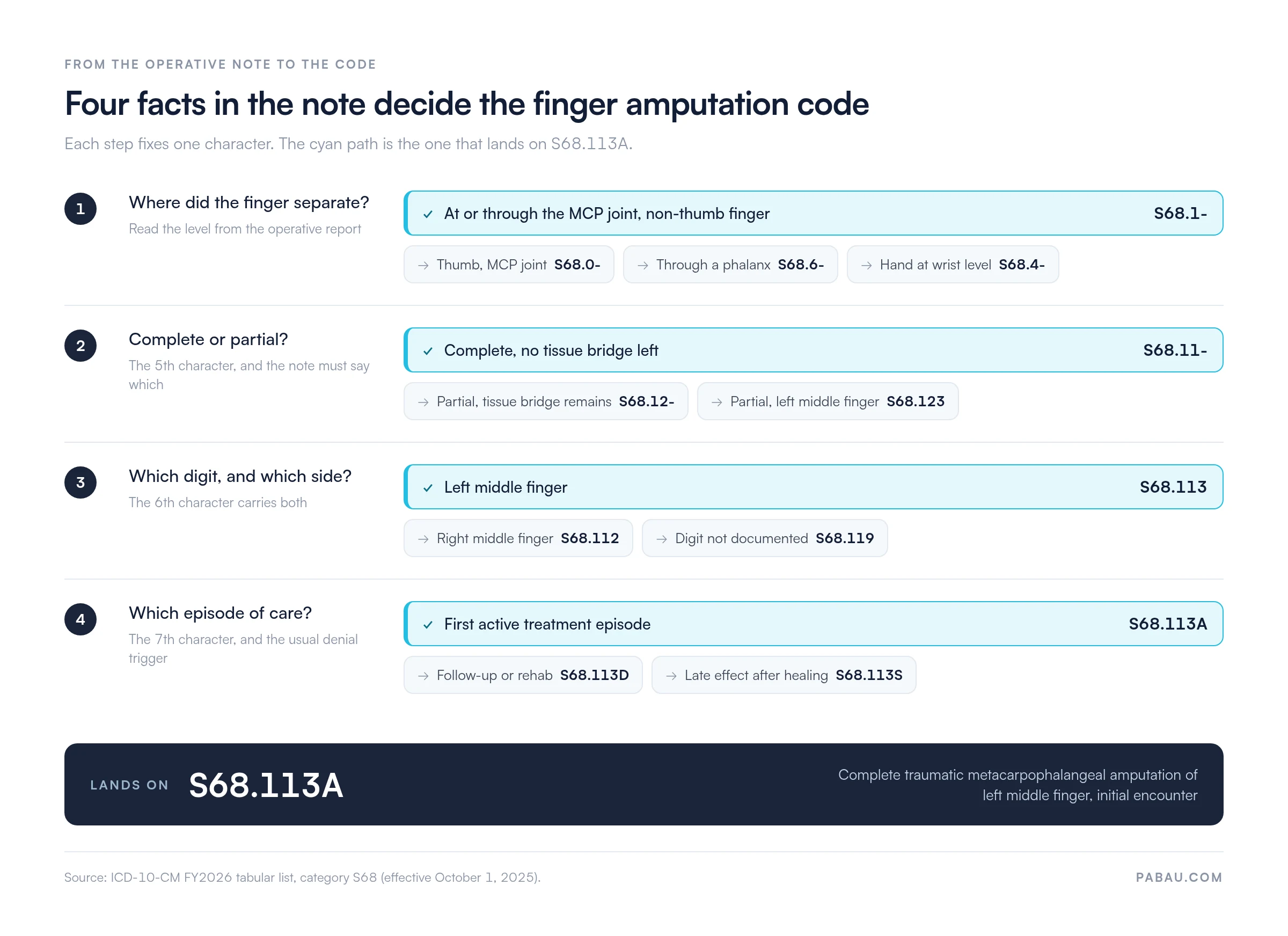
Strong documentation is the foundation of accurate coding. The operative or emergency note must name the digit and the side, such as left middle finger. It also has to record the joint level, the amputation type, and the encounter type.
Document the level and the side explicitly in the operative or emergency note. For S68.113A the note should read ‘complete traumatic amputation at the metacarpophalangeal joint, left middle finger.’ A note that says only ‘finger amputation’ forces a coder query, delays billing, and risks a denial.
Most finger amputation claims pair the diagnosis with procedural documentation from the same encounter. Correct billing means matching S68.113A to a clinically appropriate CPT code, then meeting the payer’s documentation requirements before submission.
S68.113A is valid for HIPAA-covered transaction submission, though payer policy decides reimbursement. Verify medical necessity requirements with the payer before billing, especially on a high-acuity trauma claim.
Practices that submit electronically send the claim through a clearinghouse, which validates the format before the payer sees it. That check catches a malformed code or a missing field, not a wrong 7th character.
On a code like S68.113A one character still decides the outcome, so the accuracy work happens in the record first.
Traumatic amputation codes are a frequent denial source. The usual cause is a 7th character that does not match the date of service against the treatment episode.
Payers return those claims with a remark code, and knowing which denial codes point at a diagnosis problem saves a round of rework.

A short pass over the claim catches most of what comes back. Six items are worth checking by hand on a traumatic amputation.
Coders who search by clinical description rather than code number start in the alphabetic index. Several terms route to S68.113A and to its parent code S68.113.
The AAPC ICD-10-CM code lookup offers a searchable interface for checking index terms against the tabular list.
Always verify in the tabular list before you assign. The index can route to the parent code S68.113, which needs a 7th character before it becomes billable.
The tabular list confirms the 7th-character options and any Includes or Excludes notes. It also settles laterality, which the index does not do on its own.
No revision has touched the description of S68.113A or its place in the hierarchy across recent fiscal year releases. Confirm annual validity with the official CDC/NCHS ICD-10-CM tool, which publishes the complete tabular list for each fiscal year.
Run a fiscal year validity check every October 1. Even stable codes like S68.113A can be affected by hierarchy changes in parent categories or new Excludes notes added to adjacent codes. Set a calendar reminder at the start of each ICD-10-CM update cycle to review the FY release notes from CMS and NCHS before billing continues.
In many practices the diagnosis is written in one system and typed into the claim in another. Someone reads the operative note, picks S68.113A, then re-enters it on the CMS-1500 form. Each retype is a chance to drop the side or the 7th character.
Pabau, practice management software for healthcare practices, pre-fills the CMS-1500 straight from the record. Its claims management software puts the codes attached to the service onto the charge line. ICD-10-CM and CPT lookup libraries sit beside the field, and required claim fields are checked for completeness before the send button unlocks.
In the US, claims then go out through Claim.MD. That connection carries real-time eligibility checks, claim-status tracking, and ERA remittance posting. A returned S68.113A claim surfaces in the practice’s own queue instead of a separate payer portal.
What changes is where the accuracy work happens. The side and the 7th character are settled once, in the note, and the claim inherits both.

Pabau pre-fills the CMS-1500 from the patient record and submits through Claim.MD, with real-time eligibility checks, claim-status tracking, and ERA remittance posting.

The code itself is the easy part. S68.113A is correct when the amputation is complete and sits at or through the MCP joint. The finger must be the left middle one, and the encounter the first active episode. The rest depends on what the note says.
If the documentation is thin, query before you submit rather than reaching for S68.119A. A query costs a day or two. A denial sends the claim back through appeal, and that costs far longer while the patient moves on to rehab.
Getting the note right once is what keeps these claims out of the appeal queue. Book a demo to see how Pabau turns a finished note into a submitted, tracked claim.

Need to understand what happens after a denied claim? Denial management in healthcare explains the full process from initial denial through appeal and resubmission.
Looking for a clearinghouse that checks claims at submission? Pabau’s Claim.MD clearinghouse integration covers how real-time eligibility and claim tracking work in practice.
Want to see how a superbill ties diagnosis codes to reimbursement? Superbill documentation walks through the required fields for a complete hand surgery claim.
Because the thumb has its own subcategory. S68.0- covers thumb amputations at the MCP joint, so S68.1- groups the four remaining digits. Other finger means non-thumb here, and the 6th character then names the digit and the side.
Z89.022, acquired absence of left finger(s), records the amputation status at later visits. Use S68.113S when the patient presents with a late effect of the injury itself, such as phantom pain or a stump complication.
Yes. The diagnosis records the injury the patient arrived with, and the procedure code captures the surgery. Later visits move to S68.113D once care shifts to healing and rehabilitation.
The injury code stands on its own, but ICD-10-CM expects the mechanism to be coded as well. Assign the Chapter 20 code that matches the note, such as W29.xxxA for a powered hand tool. Never sequence it first.
Laterality lives in the diagnosis code, but a digit-specific CPT line often needs a finger modifier too. For the left middle finger that modifier is F2. Check the payer’s policy before you submit.