ICD-10 Code Y76.0: Diagnostic obstetric and gynecological devices
ICD-10 Code Y76.0: Definition and billable status ICD-10 Code Y76.0 is a valid, ...

Last Updated: Oct 23, 2026
Billable Code Specific Code
S66.292A is the billable ICD-10-CM code for other specified injury of extensor muscle, fascia and tendon of left thumb at wrist and hand level, initial encounter.
This page covers the official description, the code hierarchy, the 7th character rules, documentation requirements, related codes, and billing guidance. Coders in hand surgery, orthopedics, emergency medicine, and rehabilitation meet this code family often, and laterality plus encounter type drive most of its denials.
Let Pabau's smart automation suggest the right codes, reduce claim denials, and keep your practice compliant—effortlessly.
Automate repetitive tasks and focus on what matters most—your patients.
Reduce coding errors and ensure compliance with the latest regulations.
Clean claims, fewer denials, and faster reimbursements.
Powerful insights and reporting to help your practice thrive.
HIPAA compliant SOC 2 certified GDPR-compliant Trusted by 4,000+ clinics worldwide

ICD-10 Code S66.292A describes other specified injury of the extensor muscle, fascia and tendon of the left thumb, initial encounter. It is billable and valid for claim submission.
The 7th character A means the patient is in active treatment, while D covers follow-up and S covers sequela. Picking the wrong one is a common denial trigger.
S66.292 without a 7th character is not billable. Only S66.292A, S66.292D, and S66.292S can be submitted to payers.
Practice management software like Pabau captures the diagnosis code at the point of billing, which keeps laterality and encounter type consistent.
S66.292A is a billable, specific ICD-10-CM code. According to the CDC/NCHS ICD-10-CM web tool, it became effective on October 1, 2025, and is valid throughout FY2026. The full official description is: Other specified injury of extensor muscle, fascia and tendon of left thumb at wrist and hand level, initial encounter.
The code targets a precise anatomical site: the extensor muscle, fascia, and tendon complex of the left thumb at wrist and hand level. This is distinct from flexor tendon injuries, which fall under different S66 subcategories. Clinicians must specify the structure (extensor, not flexor) and the laterality (left, not right) in their documentation for this code to be supportable on audit.
The digit matters as much as the structure. For the same kind of injury in the left index finger, the parallel code is S66.391A, because S66.2 covers the thumb only. The same digit rule applies at follow-up, where an extensor injury of the right little finger takes S66.396D.
S66.292A descends from the broader injury chapter. Knowing where it sits helps coders pick the right subcategory when documentation is ambiguous. It also keeps claims off the overly broad parent code.
S66.292 (without the 7th character) is a non-specific, non-billable code. Payers will reject claims submitted with S66.292 alone. Always append the appropriate 7th character before billing.
Read the code from left to right and each segment answers a separate documentation question. The breakdown below shows which fact sits in which position.
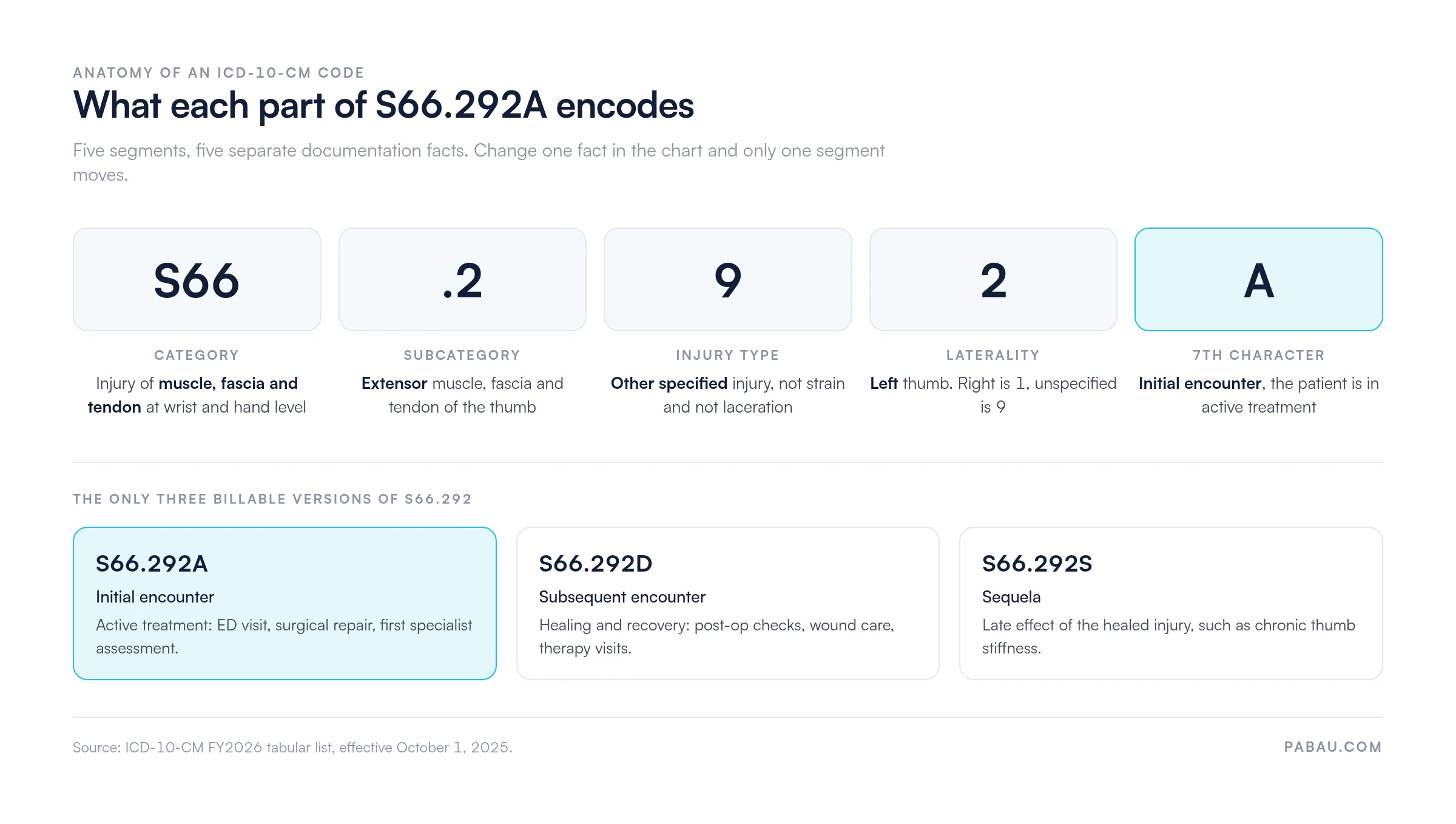
ICD-10-CM requires a 7th character on all injury codes in the S00-T88 chapter. This character tells the payer what phase of treatment the encounter represents. Getting it wrong is one of the most preventable causes of claim denial on musculoskeletal injury codes. The CMS ICD-10 coding guidelines are clear on this. The character reports the clinical situation at that encounter, not the date of injury.
“Initial encounter” does not mean the patient’s first-ever visit to any provider. It means the patient is still in active treatment for this injury at this encounter.
Take a patient who saw an emergency physician three days ago. She now sees an orthopedic surgeon for the first time, so active treatment continues and the A character still applies. Healing starts later, and a routine wound check six weeks after surgery takes D instead.
The same rule runs through the injury chapters of the wider ICD-10-CM code set. The character reports clinical status at the encounter, not the order in which providers saw the patient.
All three codes describe the same anatomical injury (extensor muscle, fascia, and tendon of the left thumb at wrist and hand level). The 7th character is the only differentiator. Use the decision framework below to make the selection at the point of care, before the claim is built.
When documentation is unclear about encounter type, query the treating provider before assigning the 7th character. A wrong character can trigger a clinical audit. Coding A instead of D implies the injury is still in active treatment. Document the query and the clinician’s response in your coding notes.
The extensor pollicis longus (EPL) and extensor pollicis brevis (EPB) tendons run along the dorsal surface of the thumb. Together they extend and abduct it. Injuries at the wrist and hand level, the zone covered by S66.292A, come from lacerations, crush injuries, sports trauma, or degenerative rupture.
The extensor mechanism sits close to the skin, so even a minor laceration can partly or fully transect the tendon. Naming the structure and the mechanism in the note also supports the rehabilitation coding that follows later in the episode.
“Other specified” captures injury presentations that do not fit the strain or laceration categories within S66.2. If documentation describes a complete tendon rupture or a specific laceration, other more precise codes may apply. Coders should review the full S66.2 category before defaulting to S66.292A.
Coding accuracy for ICD-10 Code S66.292A depends on four documentation elements. Miss any one of them and the coder either drops to a lower-specificity code or holds the claim pending clarification.
A brief clinical note that reads “Left thumb extensor tendon injury, initial assessment and treatment” provides all four elements. A note that reads “hand pain, follow-up” provides none and cannot support S66.292A.
Coders working with S66.292A will frequently need to compare it against sibling and parent codes. The table below covers the key related codes within the S66.2 family and the broader S66 category. Linking the correct diagnosis code to the CPT code performed, such as 26418 for extensor tendon repair, is what keeps the claim clean.
The AAPC Codify ICD-10-CM lookup lists every S66.2x code with its 7th character extensions. Check it when you pair a diagnosis code with a CPT code before submission.
Intrinsic hand muscles are a different structure from the extensor tendons this code covers. An intrinsic muscle injury of another finger takes S66.598A at the initial encounter.
Some notes identify a finger other than the thumb and confirm extensor involvement, but record neither the hand nor the injury type. That combination supports S66.308A, an unspecified extensor injury at wrist and hand level during active treatment.
ICD-10-CM replaced ICD-9-CM in the US on October 1, 2015. Anyone migrating legacy records or reviewing older claims may still need the approximate ICD-9-CM equivalent. Crosswalks are approximate, not exact, and one ICD-9 code often maps to several ICD-10 codes.
The closest ICD-9-CM equivalent for S66.292A is 842.12 (Sprain of thumb – metacarpophalangeal (joint)). It does not capture the extensor tendon specificity of the ICD-10-CM code. Check any legacy mapping against the ICD List crosswalk tools before you rely on it for a billing review.
S66.292A is a fully billable ICD-10-CM code, valid for submission to Medicare, Medicaid, and commercial payers. A valid diagnosis code is only half of the claim, because musculoskeletal injury claims pair it with one or more CPT procedure codes.
Two CPT codes come up often for extensor tendon work in the hand. CPT 26418 is “Repair, extensor tendon, finger, primary or secondary; without free graft, each tendon.” CPT 26415 covers excision of an extensor tendon with implantation of a synthetic rod. The code you bill depends on the procedure the surgeon documented.
Clearinghouse edit engines flag 7th character errors automatically, so a claim built on the bare parent code rarely reaches the payer at all. Checking laterality and encounter type before submission costs far less than reworking a rejected claim two weeks later.
Run a pre-bill audit before submitting any S66.29x claim. Confirm three things. First, the 7th character matches the encounter type documented in the note. Second, the laterality in the code matches the chart. Third, the CPT code describes an extensor procedure rather than a flexor one. Those three checks take under a minute and catch the errors this code family is known for.
The four facts this code needs usually get captured twice. The clinician writes them into the note, and a coder reads the note back days later to rebuild them. A vague note turns into a coder’s query, and the claim waits.
Practice management software like Pabau moves that capture to the point of care. Structured clinical notes and digital forms record the side, the structure, and the phase of treatment as the clinician documents the visit. The diagnosis code is then attached to the encounter itself rather than reconstructed afterwards.
Billing staff see the same record the clinician wrote, so a left thumb stays a left thumb from note to claim. Pabau’s claims management software then carries that detail into submission and tracks what each payer does with it.

Pabau helps clinics document encounters with structured clinical notes and digital forms, so the right code details are captured at the point of care. Less rework, fewer denials, and cleaner claims from day one.

S66.292A rewards documentation, not memory. Once the note states the side, the structure, and the phase of treatment, the code writes itself and the 7th character stops being a guess.
So the work worth doing sits upstream of the claim. Build the pre-bill check into the coder’s routine, and query the clinician while the encounter is still recent rather than after a rejection. Book a demo to see how Pabau captures those details in the note, so your coders are not chasing them later.

Want to stop denials before the claim leaves the practice? Claim denial management in healthcare covers the denial reasons that recur across injury coding and how to work them systematically.
Not sure what separates a clean claim from a reworked one? What is a clean claim explains the payer edits a diagnosis code has to survive on first submission.
Need to see where diagnosis coding sits in the wider billing cycle? Revenue cycle management walks through the steps from encounter to posted payment.
ICD-10 Code S66.292A is a billable ICD-10-CM diagnosis code. It describes an other specified injury of the extensor muscle, fascia and tendon of the left thumb at wrist and hand level. The 7th character A marks an initial encounter, meaning active treatment. It became effective on October 1, 2025, for FY2026 and is valid for submission to Medicare, Medicaid, and commercial payers.
Yes. S66.292A is a specific, billable ICD-10-CM code valid for claim submission. The parent code S66.292 – without any 7th character appended – is not billable and will be rejected by payers. Only the completed codes S66.292A, S66.292D, and S66.292S are valid for billing.
The parent code is S66.292. It describes other specified injury of the extensor muscle, fascia and tendon of the left thumb at wrist and hand level. It states no encounter type, so it is not billable. S66.292 itself sits under S66.29, other specified injury of extensor muscle, fascia and tendon of thumb. That sub-subcategory belongs to the broader S66 category, which covers muscle, fascia, and tendon injuries at wrist and hand level.
S66.291A is the right thumb equivalent. It covers other specified injury of the extensor muscle, fascia and tendon at wrist and hand level, initial encounter. Use S66.299A only when laterality is genuinely unspecified. Query the treating clinician to confirm which thumb is affected before you code it that way.