ICD-10 Code S42.444P: Medial epicondyle fracture, right humerus
ICD-10 Code S42.444P: full descriptor and code validity ICD-10 Code S42.444P car...

Last Updated: Oct 13, 2026
Billable Code Specific Code
S65.419A is the billable ICD-10-CM code for laceration of blood vessel of unspecified thumb, initial encounter. It is valid for FY2026 claims dated October 1, 2025 or later.
The code sits in category S65, injury of blood vessels at wrist and hand level. That category belongs to the S60-S69 block covering injuries to the wrist, hand, and fingers. Emergency department and urgent care coders reach for it most often, when a thumb laceration with documented vascular involvement is treated for the first time. Correct assignment turns on the 7th character, on laterality, and on whether the record documents vessel injury at all.
Let Pabau's smart automation suggest the right codes, reduce claim denials, and keep your practice compliant—effortlessly.
Automate repetitive tasks and focus on what matters most—your patients.
Reduce coding errors and ensure compliance with the latest regulations.
Clean claims, fewer denials, and faster reimbursements.
Powerful insights and reporting to help your practice thrive.
HIPAA compliant SOC 2 certified GDPR-compliant Trusted by 4,000+ clinics worldwide

S65.419A is a billable ICD-10-CM code for laceration of a blood vessel of the thumb when documentation omits laterality.
The 7th character A designates an initial encounter, while D covers subsequent care and S covers sequela.
S65.419A carries no Type 1 Excludes note of its own, so no companion diagnosis is blocked by an Excludes1 restriction.
On inpatient claims the code groups to trauma DRGs 913 and 914, or to 963 through 965 for multiple significant trauma.
Practice management software like Pabau puts ICD-10 search in the billing workflow, so coding errors get caught before submission.
ICD-10 code S65.419A is a specific, billable ICD-10-CM code effective for encounters on or after October 1, 2025. It encodes laceration of a blood vessel of the thumb where the record does not name the right or left side. The code is valid on both the CMS-1500 and UB-04 claim forms, according to the CDC/NCHS ICD-10-CM web tool.
Practice management software like Pabau keeps that lookup inside the billing workflow. Its claims software for coders lets your team confirm billable status and valid claim form types without leaving the patient record.
The table below summarizes the core administrative facts coders need before submitting a claim.
S65.419 is the parent code, and the 7th character makes it billable by naming the encounter type. Choosing the wrong character is one of the most common denial triggers for injury codes.
Under CMS ICD-10-CM guidelines, the 7th character must reflect the current encounter’s purpose, not the injury’s date. A patient who lacerated a thumb six weeks ago but is now attending a wound check still receives 7th character D.
S65.419A sits within a nested hierarchy. Knowing that hierarchy helps coders find related codes when laterality is specified, or when the injury involves a different structure.
The full hierarchy is searchable through the AAPC ICD-10-CM lookup tool, which also surfaces excludes notes and crosswalk data at each level.
Documentation may use any of the clinical terms below to describe what S65.419A encodes. Map all of them to the same code when laterality is absent from the record.
S65.419A carries no Type 1 Excludes note of its own. No companion diagnosis is blocked from the same encounter by an Excludes1 restriction at this code.
ICD-10-CM uses two kinds of excludes note. A Type 1 Excludes means the two conditions are mutually exclusive and cannot be reported together. A Type 2 Excludes means the excluded condition is separate, and both codes may appear on the same claim.
Excludes notes also sit at category and block level, so read the notes printed at S65 and at S60-S69 in the current code set. Notes at those levels apply to every code beneath them.
Specificity, not an excludes note, is what limits S65.419A. Do not assign it when the record names the right or left thumb, and do not assign it without documented vessel injury.
For inpatient claims, S65.419A maps to Medicare Severity Diagnosis Related Groups through the CMS IPPS grouper. The DRG that results depends on the complications and comorbidities documented during the same hospital stay.
Under MS-DRG v43.0, S65.419A groups to DRG 913 and DRG 914, traumatic injury with and without MCC. It can also group to DRGs 963 through 965, other multiple significant trauma. Both sets sit in the trauma and injury MDC, not in a musculoskeletal procedure DRG.
MS-DRG relative weights change annually with each IPPS final rule. Check the FY2026 weight in the current CMS MS-DRG Definitions Manual rather than a prior-year grouper table.
POA reporting is required for S65.419A on inpatient UB-04 claims. A thumb laceration with vascular involvement is a traumatic injury that occurs before admission, so the indicator is usually Y.
S65.419A is not on the POA-exempt list. The indicator has to be assigned explicitly on every inpatient claim that carries the code.
Check your facility’s POA policy for traumatic injury codes before submission. If the laceration occurred during a procedure performed at the same facility, the POA indicator may shift from Y to W (undetermined). Query the attending physician when the timing is ambiguous rather than defaulting to Y.
Several ICD-10-CM Official Guidelines rules govern how S65.419A is assigned. Applying them cuts rejections and supports a clean claim on the first pass.
Three questions decide which thumb code applies, and each one is answered from the encounter note alone.
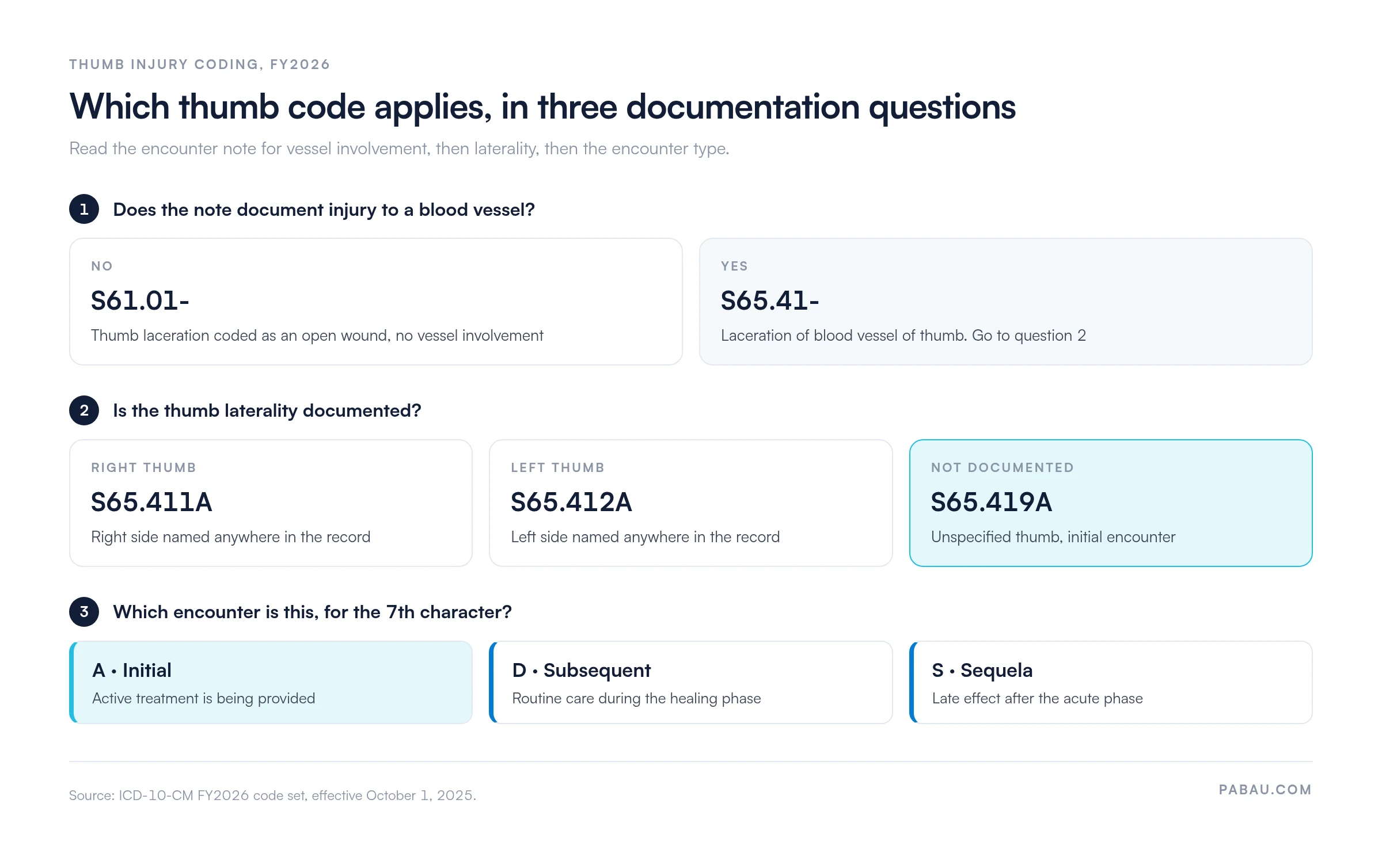
Pabau lets practitioners flag laterality and vessel involvement in the encounter note itself. Coders then read the specificity they need straight from the record, instead of raising a query after the visit.
S65.419A applies when a clinician treats a thumb laceration involving an identifiable blood vessel and the documentation does not specify a side. Three clinical scenarios account for most uses of the code.
Practices running legacy systems, or comparing pre-2015 data against current claims, need the approximate ICD-9-CM equivalent below. The mapping is not exact, because ICD-10-CM’s granularity exceeds what ICD-9-CM was able to encode.
ICD-10-CM replaced ICD-9-CM for US payers on October 1, 2015. No ICD-9-CM code has been billable on a primary claim since that date, so the crosswalk serves reporting and trend analysis only.
When laterality is documented, or when the injury type differs, one of the sibling or parent codes below applies instead of S65.419A. Knowing these relationships stops coders defaulting to the unspecified code when better information exists.
Coding the most specific code available is an ICD-10-CM guideline requirement and an audit safeguard. Facilities tracking rejection patterns for hand injury codes can compare them against the denial codes most often returned on unspecified-laterality diagnoses.
Before assigning S65.419A, run a laterality check across the encounter note, the operative report, and any dictated addenda. If right or left appears anywhere in the record, upgrade to S65.411A or S65.412A. Using the unspecified code when laterality is documented creates audit exposure and invites additional documentation requests.
A practice that codes an injury in one system and bills from another rekeys the diagnosis at least once. The 7th character gets copied from the last visit, and the rejection arrives weeks later.
Pabau holds the encounter note and the claim in the same record. Coders search ICD-10 at the point of billing, so S65.419A is confirmed against the note that supports it.
Claims then route to the Claim.MD clearinghouse, which reaches thousands of US payers. Each claim is validated against the current CMS ICD-10 catalogue, so formatting errors in the 837P file surface before the payer sees them.
The outcome is fewer denials traced back to a code the documentation never supported, and fewer physician queries raised after the patient has gone home.

Pabau puts ICD-10 code search and diagnosis coding inside the patient record, so your team assigns the right code before the claim is ever submitted.

S65.419A is simple to look up and easy to misassign. Two errors generate most of its denials. The first is using it when the record names a side. The second is keeping 7th character A on a follow-up visit.
Both are documentation problems before they are coding problems. Fixing them in the encounter note takes a minute. Fixing them at appeal takes weeks.
Pabau catches both by putting ICD-10 search and code validation inside the billing workflow. Book a demo to see how your coders confirm S65.419A against the note before the claim goes out.

Need guidance on how medical billing workflows connect to diagnosis coding? What is medical billing explains the end-to-end process from encounter to payment posting.
Tracking claim denials tied to injury codes? Denial management in healthcare covers the most common denial reasons and how to build an appeals workflow.
Want to understand how clearinghouses validate ICD-10 codes before claims reach the payer? Medical claims clearinghouse breaks down the submission and validation process.
ICD-10 code S65.419A is the billable ICD-10-CM diagnosis code for laceration of blood vessel of unspecified thumb, initial encounter. It is valid for FY2026 claims dated October 1, 2025 or later. It applies when the physician documents a thumb blood vessel laceration without naming the right or left side.
Yes, S65.419A is a billable and specific ICD-10-CM code valid for FY2026. It can be submitted on CMS-1500 and UB-04 claim forms. Non-billable parent codes such as S65.419, without a 7th character, cannot be used for reimbursement.
The 7th character A designates an initial encounter, meaning the patient is receiving active treatment for the laceration. Use A for every visit during which active treatment continues, whether in the emergency department, in surgery, or with an outpatient specialist. Switch to D when care moves to routine wound management during the healing phase.
All three codes describe laceration of blood vessel of unspecified thumb and differ only by encounter type. S65.419A covers initial, active-treatment encounters. S65.419D covers subsequent encounters during routine healing. S65.419S covers sequela encounters that address a late effect. The 7th character must match the current visit’s purpose, not the date of injury.
S65.419A carries no Type 1 Excludes note of its own, so no companion diagnosis is blocked at this code. Excludes notes may still appear at the S65 category level or the S60-S69 block level, so read those in the current code set. In practice the limit on S65.419A is specificity. Assign S65.411A or S65.412A whenever the record names the side.
The CMS General Equivalence Mappings crosswalk S65.419A to ICD-9-CM 903.5, injury to digital blood vessels. The mapping is approximate, because ICD-9-CM did not encode laterality or encounter type. ICD-9-CM codes have not been valid on US payer claims since October 1, 2015.
Under MS-DRG v43.0, S65.419A groups to DRG 913 and DRG 914, traumatic injury with and without MCC. It can also group to DRGs 963 through 965, other multiple significant trauma. Both sets sit in the trauma and injury MDC, not in a musculoskeletal procedure DRG. Relative weights change each fiscal year, so verify the current assignment in the CMS MS-DRG Definitions Manual.