ICD-10 code S61.201A: Open wound of left index finger without nail damage
ICD-10 code S61.201A covers a left index finger wound of unstated type ICD-10 co...

Last Updated: Oct 16, 2026
Billable Code Specific Code
S60.519A is the billable ICD-10-CM code for abrasion of unspecified hand, initial encounter.
This page works through the coding logic in the order you apply it. That means the hierarchy, the 7th character, the laterality test, documentation, CPT pairings, and what the claim does after submission.
Let Pabau's smart automation suggest the right codes, reduce claim denials, and keep your practice compliant—effortlessly.
Automate repetitive tasks and focus on what matters most—your patients.
Reduce coding errors and ensure compliance with the latest regulations.
Clean claims, fewer denials, and faster reimbursements.
Powerful insights and reporting to help your practice thrive.
HIPAA compliant SOC 2 certified GDPR-compliant Trusted by 4,000+ clinics worldwide

ICD-10 code S60.519A is billable for FY2026 and covers an abrasion of the unspecified hand at an initial encounter.
Reach for it only when the record never names a side, because the right and left hands have their own codes.
The 7th character tracks the phase of treatment, so A holds for as long as the provider is actively treating the wound.
An abrasion sits in S60.5, other superficial injuries of hand, alongside blisters at S60.52x and foreign bodies at S60.55x.
Pair the code only with CPT codes the note supports, and record wound size and tissue type before billing debridement.
S60.519A is a billable, specific ICD-10-CM code and is valid in HIPAA-covered electronic transactions. It describes an abrasion of the unspecified hand at an initial encounter.
The 7th character A signals that the patient is still receiving active treatment. According to CMS, the code took effect on October 1, 2025, in the FY2026 ICD-10-CM update cycle.
The word “specific” is doing real work there. The code carries every axis ICD-10-CM asks for. Those are injury type, body site, laterality status, and encounter phase. Strip the 7th character and S60.519 becomes a header code that no front-end edit will accept.
Here are the administrative details as published in the FY2026 tabular list.
The 7th character is where most hand injury claims go wrong. Under ICD-10-CM Official Guidelines, Section I.C.19, it describes the phase of treatment rather than the number of the visit.
A patient on their tenth appointment can still sit in an initial encounter while active treatment continues.
A worked example makes the split obvious. A patient scrapes their palm on Monday. The wound is cleaned and dressed, so character A is correct for that visit.
They return on Thursday for a dressing change and the wound looks clean, which makes D correct. If the provider instead finds slough and debrides it, the encounter is active treatment again and A still applies.
Document the reasoning either way. Payers audit the move from A to D, and a note reading “wound check, healing well” will not support an initial encounter code.
Every character in S60.519A comes from a level of the tabular list. Reading it from the top makes the sibling codes easy to find. It also shows which parent categories claim-editing software checks a code against.
Only the seven-character versions are billable. S60.519 on its own is a header used for classification, so it will not survive a claim edit. Check current status in the CDC and NCHS ICD-10-CM web tool whenever a code is unfamiliar.
ICD-10-CM guidelines discourage an unspecified code whenever the provider has documented a side. S60.519A belongs in genuinely ambiguous records and nowhere else. Work through the sequence below before you assign it.
The same discipline applies to the D and S variants. If updated documentation names the side later, correct the code on resubmission rather than carrying the unspecified version forward.
Put the two decisions side by side and the code assembles itself.
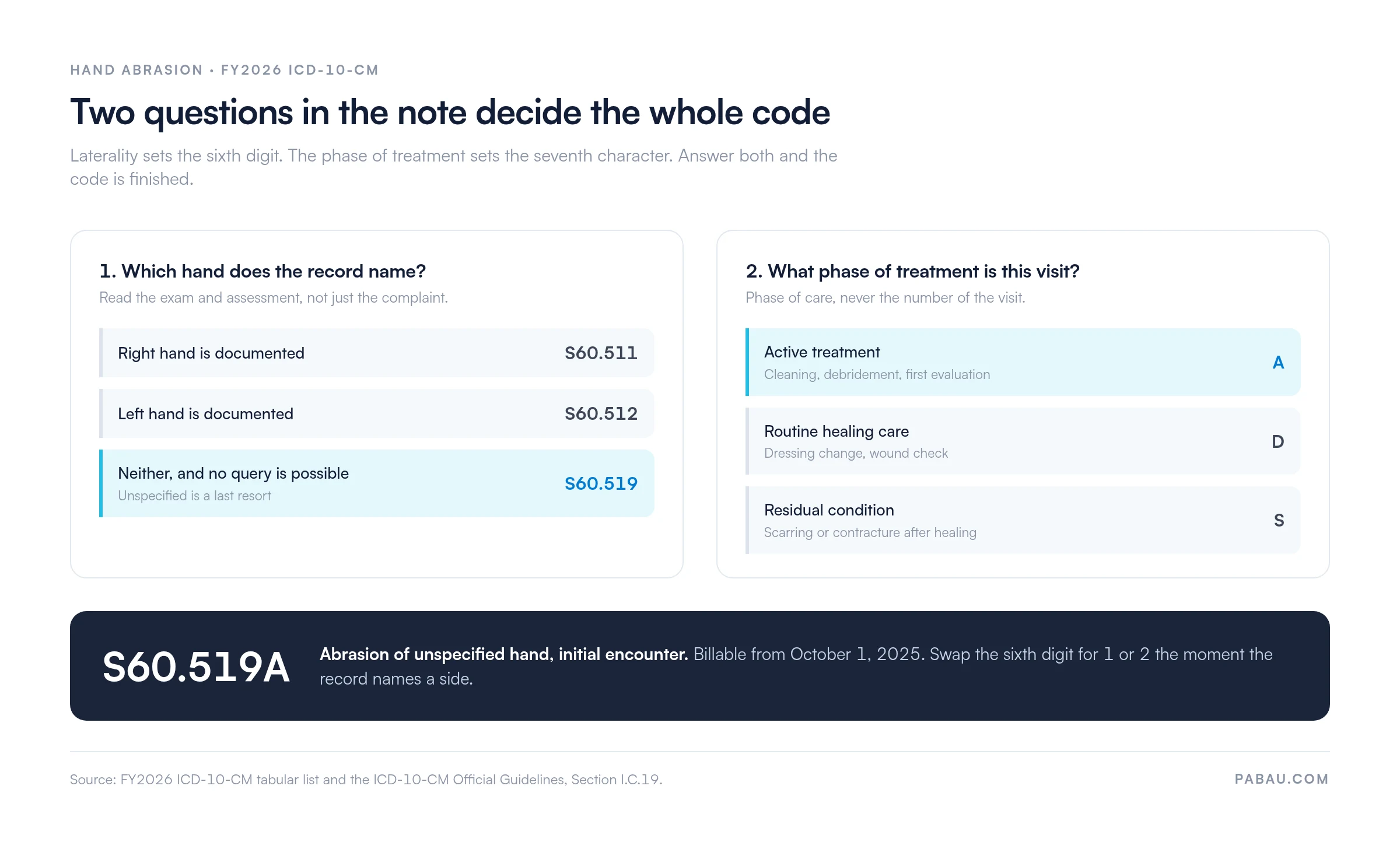
Before you assign S60.519A, search the encounter note for right, left, dominant, and non-dominant. Providers often name the side in the physical exam even when the chief complaint is vague. Finding it there lets you code S60.511A or S60.512A and avoids an unspecified flag at remittance.
The S60.51x family covers all three laterality options across three encounter phases. Coders move between them more often than they expect, so the set belongs on a reference sheet.
The AAPC Codify lookup is a quick way to confirm the full sibling list while you build one.
If the record turns out to describe a different injury, the neighboring families are indexed in our diagnostic codes library.
Answer this one from the skin. An abrasion is friction damage that leaves the dermis largely intact, which keeps it in S60. A full-thickness break moves the claim to S61 and changes the CPT codes that can travel with it.
Two of these can be true at once. If the provider documents an abrasion and a laceration on the same hand, code them separately with S60.519A and the matching S61.4x code. ICD-10-CM allows multiple codes for multiple distinct injuries.
Treat this as a pre-coding checklist. Each item fixes a specific error that turns up on hand injury claims.
S60.519A rarely travels alone on a claim. The table covers the services most often rendered for a hand abrasion in urgent care, the emergency department, and outpatient wound care. Every pairing has to be supported by the note rather than by habit.
One rule governs the whole table. Bill the service the documentation describes, and nothing beyond it. A wound check recorded as a wound check will not support a debridement code, and payer front-end edits reject CPT codes the diagnosis cannot justify.
When you bill 97597 or 97602 alongside S60.519A, make sure the note records the wound size in square centimeters and the tissue removed. Missing those two details is the most common reason wound care codes get downcoded at remittance. The fix is a corrected claim, which pushes payment out by weeks.
Getting the code right is the first half of the job. What happens next decides whether the claim pays without anyone touching it again.
The CPT and ICD-10 pairing is locked in at charge entry, or on the superbill. From there the claim reaches the clearinghouse as an 837P transaction, passes the payer front-end edits, and lands in adjudication.
Claims management software carries the pairing through each step and returns the payer decision as an electronic remittance advice file.
Group all three S60.519x variants into one denial filter and the pattern surfaces quickly. Laterality and encounter-type rejections stop reading as one-off rework and start reading as a documentation fix. The habits that produce a clean claim on the first pass are the same ones that keep this filter quiet.
Most of the errors above start upstream of billing. The side of the body sits in the exam note. The phase of care sits in the plan, and the wound measurement sits wherever the clinician typed it. Billing staff then rebuild the claim from three places at once.
Practice management software like Pabau keeps the clinical note, the charge, and the claim in one patient record.
Coders read the documented side and the wound detail without chasing the chart, and claims go out to the Claim.MD clearinghouse from the same screen. Remittance files return against the original encounter, so a laterality rejection traces straight back to the note behind it.
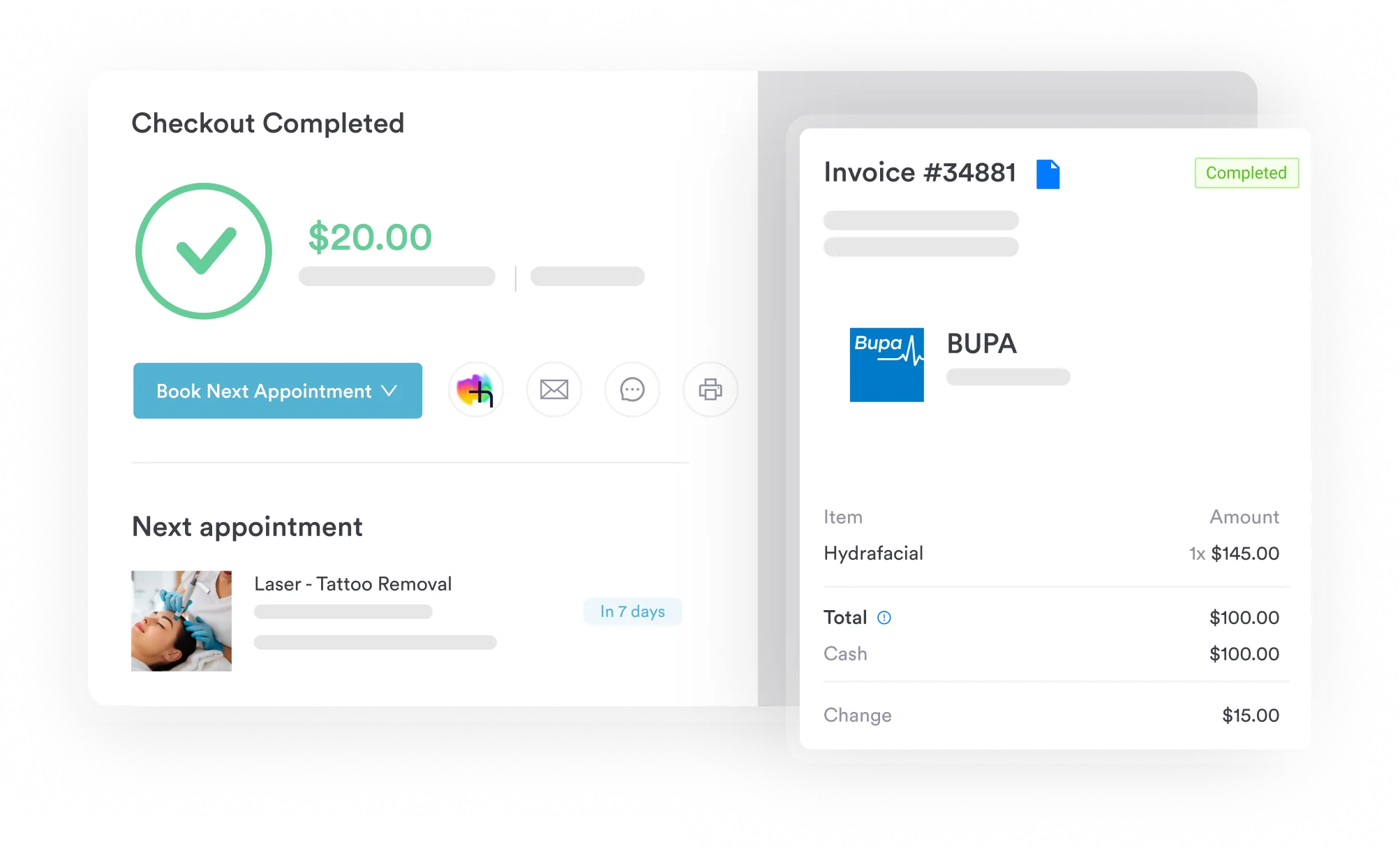

Pabau links the clinical note, the charge and the outgoing claim, so documented laterality and wound detail reach the coder without a chart hunt. Claims submit through Claim.MD and remittance returns against the original encounter.

S60.519A is an easy code to assign and an easy one to assign badly. The decisions that matter sit in the documentation rather than in the code book. Read the note for the side, read it for the phase of care, and read it for what the clinician actually did.
If unspecified laterality keeps appearing on your hand injury claims, the fix is a documentation habit rather than a coding one. Ask providers to name the side in the exam and the code follows on its own. To see how Pabau keeps that detail attached to the claim, book a demo.

Need a reference for denial codes on remittance? Denial codes in medical billing covers the most common CARC and RARC codes that appear when ICD-10 claims are rejected.
Want to understand how clearinghouses process ICD-10 claims? Medical claims clearinghouse overview explains how 837P transactions carry ICD-10 codes to payers.
Looking to streamline how your practice manages wound care billing? Best medical billing software compares the leading platforms for US practices handling injury and wound care claims.
Not as a national requirement. ICD-10-CM does not mandate external cause codes from Chapter 20. Reporting them is optional unless a payer, a state agency or a workers’ compensation program asks. Many do ask. When you report one, add the V00-Y99 code describing how the abrasion happened and sequence it after S60.519A.
Yes. When the abrasion is the reason the patient came in, it takes the first-listed position on the claim. Put another diagnosis ahead of it only when that condition drove the encounter, such as a fall treated alongside the wound. Sequencing follows what the provider treated, not which injury sounds more serious.
No, it is specific to the hand. An abrasion of the wrist uses S60.81x, the thumb uses S60.31x, and the fingers use S60.41x. Each family carries its own laterality digits and needs the same 7th character. Coding a finger abrasion to S60.519A is a site error that shows up on audit.
Then the superficial injury is a foreign body rather than an abrasion. Use S60.55x, superficial foreign body of hand, and code the abrasion separately when the provider documents both. The distinction matters because removing the foreign body changes the CPT code billed alongside the diagnosis.