ICD-10 Code S52.541M: Smith’s fracture of right radius with nonunion (open type I or II)
ICD-10 Code S52.541M: Definition and billable status ICD-10 Code S52.541M is the...

Last Updated: Oct 15, 2026
Billable Code Specific Code
S60.461D is the billable ICD-10-CM code for insect bite (nonvenomous) of left index finger, subsequent encounter. Coders reach for it at follow-up wound checks, suture removal visits, and other return visits for ongoing care of the bite.
The 7th character D separates S60.461D from S60.461A and S60.461S. It signals that the episode of care has moved past the initial encounter. Misassigning A when D is correct is a consistent denial trigger on superficial finger injury claims.
Let Pabau's smart automation suggest the right codes, reduce claim denials, and keep your practice compliant—effortlessly.
Automate repetitive tasks and focus on what matters most—your patients.
Reduce coding errors and ensure compliance with the latest regulations.
Clean claims, fewer denials, and faster reimbursements.
Powerful insights and reporting to help your practice thrive.
HIPAA compliant SOC 2 certified GDPR-compliant Trusted by 4,000+ clinics worldwide

S60.461D is a billable ICD-10-CM code for insect bite (nonvenomous) of the left index finger at subsequent encounter, effective FY2026.
The 7th character D means the patient is past initial treatment. Active management such as a wound check or infection monitoring triggers D, not A.
Excludes1 rules block coding S60.461D alongside an open wound of the same finger. Confirm the bite is superficial before applying this code.
Practice management software like Pabau validates the 7th character before a claim is submitted, which reduces denials on superficial injury codes.
ICD-10 code S60.461D is the billable code for a nonvenomous insect bite of the left index finger, subsequent encounter.
It is accepted for HIPAA-covered electronic transactions in the United States.
The table below summarizes every field a coder or billing team needs before submitting a claim. Practices running software for billing teams can route S60.461D to their clearinghouse once the documentation is confirmed.
Once the code is confirmed, the submission itself is clerical work. Capturing it inside the billing workflow keeps the descriptor, the 7th character and the claim line in one record.
S60.461D is a 7-character ICD-10-CM code, and each segment carries a specific clinical meaning. Read left to right, it names the injury category and the subcategory. The remaining characters give the anatomical site, the laterality and digit, and the encounter type.
The code targets a narrow presentation. It covers a nonvenomous insect bite on the patient’s left index finger, and the visit must fall after the first encounter for that injury.
“Nonvenomous” is the clinical differentiator. Spider bites with systemic venom effects, bee stings with anaphylaxis risk, and other envenomations are coded elsewhere. S60.461D applies when the bite is documented as having no toxin component. Mosquito, flea, ant and mite bites are the typical examples.
The 7th character D means the patient is receiving active treatment after the initial encounter for the injury has already been coded. Coders frequently confuse subsequent encounter with “follow-up” in the colloquial sense. That confusion creates 7th character mismatches and preventable claim denials.
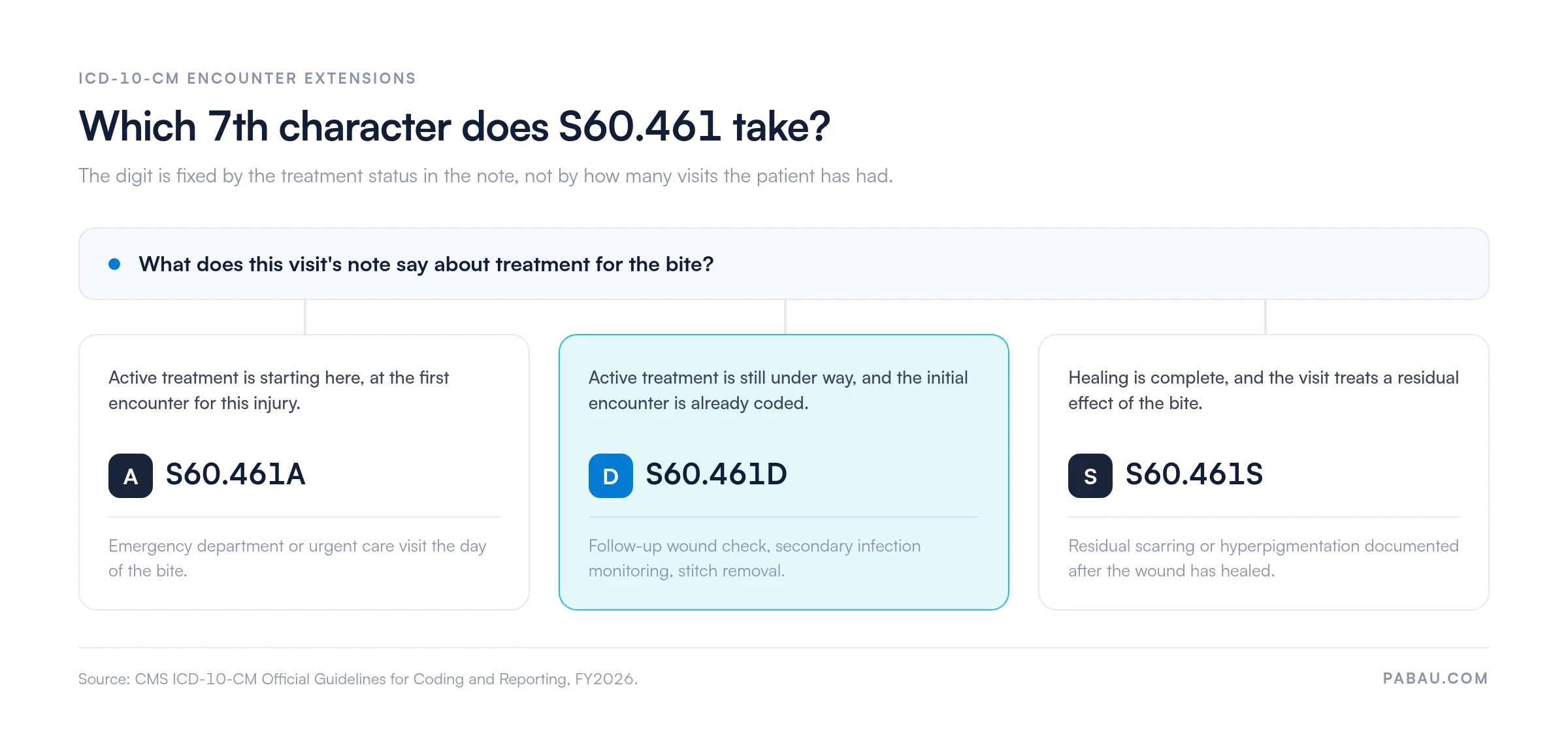
Per the CMS ICD-10-CM Official Guidelines for Coding and Reporting, the three encounter suffixes for injury codes carry distinct meanings.
Bites at other anatomical sites follow the same three-suffix pattern. A nose bite seen for a residual effect after healing takes ICD-10 code S00.36XS, the sequela code for that site.
Clinicians often record “patient returns for wound check” without stating that active treatment is still ongoing. Without that language the record does not support the 7th character D. Query the provider when the note leaves treatment status unstated.
At each visit the choice comes down to one question, and the answer sits in the treatment status rather than the visit count.
S60.461D applies across a predictable set of clinical situations. Each one needs the same three confirmations. The bite must be nonvenomous and on the left index finger, and the visit must follow an earlier encounter for that injury.
Ensuring clean claim submission for these visits depends on documentation language confirming active treatment status. Billing teams can build an internal checklist so the treating provider confirms the encounter type before coding is finalized.
Before assigning S60.461D, confirm three things in the note. The injury is documented as nonvenomous. The affected digit is the left index finger. Active treatment is still ongoing at this visit. If one of the three is missing, the documentation does not support the code.
S60.461D sits inside a parent-child hierarchy in the ICD-10-CM tabular list. Walking it from the chapter down to the billable code confirms that no higher-level, non-billable code was selected by mistake. The CDC/NCHS ICD-10-CM tool provides the authoritative tabular view.
The full ICD-10-CM code index shows how the same nesting works across every chapter. Reading a neighboring code’s entry is often the fastest check. It shows which level of the hierarchy carries the 7th character requirement.
Payers require the most specific billable code, which means S60.461 alone cannot be submitted. The 7th character is mandatory for this code family. Submitting S60.461 without it will trigger a claim rejection.
S60.461D belongs to a family of codes sharing the S60.46 root. Coders routinely navigate these sibling codes when laterality, digit, or encounter type differs from the left index finger. The AAPC ICD-10-CM code lookup and WHO ICD-10 browser both provide navigable views of this code family.
Remittance data shows which codes in a family are generating denials. If S60.461A claims come back as “not medically necessary” on repeat visits, the 7th character is the likely cause. The second encounter should have been coded D, not A again.
The excludes notes applicable to S60.461D come from the S60 category level. They prevent two errors. One is reporting two conditions that cannot coexist. The other is missing a condition that should have been coded separately.
Excludes1 means the conditions are mutually exclusive. The two codes cannot be reported on the same claim for the same patient encounter.
Excludes2 means the excluded condition is not part of S60.461D. If the patient has both conditions, both codes may be reported.
The Excludes1 rule on open wounds matters most for this code. A bite that looks superficial on day one may become an open wound by day three. Scratching or a spreading secondary infection is usually what changes it. The subsequent-encounter note must confirm the wound is still superficial rather than open.
Coders frequently look up codes using clinical language from the medical record rather than alphanumeric codes. The ICD-10-CM alphabetic index and its approximate synonyms bridge clinical documentation phrasing and the correct code.
Documentation might say “bug bite left index finger, follow-up” or “flea bite second digit left hand, return visit.” Either phrasing should route to S60.461D through the index.
Common index pathways to S60.461D:
Approximate synonyms that map to S60.461D in clinical records include:
None of these phrasings suggests an open wound or a venomous sting, so the coding pathway does not change. Standardized documentation templates keep that language consistent, which leaves the coder less to interpret.
A record that says ‘return visit’ or ‘follow-up’ without naming active treatment does not yet support the 7th character D. Query the provider first. Ask for language such as ‘wound still under active management’ or ‘continuing antibiotic course for secondary infection.’
In most practices the 7th character gets checked twice. A coder assigns it, and then a denial three weeks later forces someone to check it again. By that point the encounter is cold, and the note has to be read from scratch.
Practice management software like Pabau keeps that check at the point of coding. Pabau integrates with Claim.MD, the US clearinghouse partner that validates ICD-10-CM codes against payer edits before submission. Eligibility runs in the same step, so an encounter-type mismatch on S60.461D surfaces before the claim leaves the practice.
For a billing team that means fewer rework cycles on superficial injury codes. Claims that would have come back marked “not medically necessary” get corrected while the visit is still fresh.

Pabau connects directly to the Claim.MD clearinghouse to validate ICD-10-CM codes, check payer edits, and flag 7th character mismatches before a claim is submitted. See how the workflow runs end to end.

The 7th character is where this code is won or lost. S60.461D is straightforward to assign once the note confirms active treatment, the left index finger, and a nonvenomous bite.
The failure is almost never the base code. It is a coder repeating A on a visit the record already places past the initial encounter. So the fix sits in the documentation rather than the code book.
Ask the provider for one line confirming treatment status at every follow-up, and the 7th character stops being a judgment call. Book a demo to see how Pabau validates ICD-10-CM codes and encounter types before a claim reaches the payer.

Need guidance on medical billing compliance? Medical billing compliance covers the key regulatory requirements practices must meet to keep claims clean and auditable.
Want to understand how clearinghouse submission works? Claim.MD clearinghouse overview explains how electronic claims are validated and routed to payers through the Claim.MD integration.
Tracking denial patterns on injury codes? Denial management in healthcare outlines how to identify, appeal, and prevent the most common claim rejections.
ICD-10 Code S60.461D is the billable ICD-10-CM diagnosis code for insect bite (nonvenomous) of the left index finger, subsequent encounter, valid for FY2026. It applies when a patient returns for active management of the bite after the initial encounter has already been coded.
Yes. S60.461D is a billable and specific ICD-10-CM code, valid for HIPAA-covered transactions effective October 1, 2025 (FY2026). It can be submitted directly on a claim without a more specific code being required.
S60.461A is used at the patient’s first visit for the insect bite, when they are receiving active treatment for the first time. S60.461D is used at every subsequent visit where active treatment is still ongoing. Using A on a follow-up visit is a 7th character mismatch and a common denial trigger.
The 7th character D signifies subsequent encounter. The patient is receiving active treatment for an injury that has already been seen and initially treated. It applies to every visit after the initial encounter, as long as active treatment continues. Once treatment is complete and only late effects remain, the 7th character shifts to S for sequela.
Use initial encounter (A) on the first visit, when active treatment begins. Use subsequent encounter (D) on every follow-up visit while active treatment continues, such as wound checks, infection monitoring, or suture removal. Use sequela (S) only after healing is complete and residual effects are the reason for the visit.
The key Excludes1 note blocks S60.461D from being coded alongside open wounds of the finger (S61.-). If the bite constitutes an open wound rather than a superficial injury, S61.- replaces S60.461D. An Excludes2 note covers venomous insect bites (T63.4), which may be coded separately when clinical documentation supports both diagnoses.
S60.461D sits under four parent codes. S60.461 is the same code without an encounter extension. S60.46 covers nonvenomous insect bites of the fingers. S60.4 covers other superficial injuries of fingers, and S60 covers superficial injury of the wrist, hand and fingers. None of them is billable on its own.