ICD-10 code S61.201A: Open wound of left index finger without nail damage
ICD-10 code S61.201A covers a left index finger wound of unstated type ICD-10 co...

Last Updated: Oct 16, 2026
Billable Code Specific Code
S56.401D is the billable ICD-10-CM code for unspecified injury of extensor muscle, fascia and tendon of right index finger at forearm level, subsequent encounter.
Laterality and that suffix are also what payer audits pull on. So the coding call here is really a documentation call.
Let Pabau's smart automation suggest the right codes, reduce claim denials, and keep your practice compliant—effortlessly.
Automate repetitive tasks and focus on what matters most—your patients.
Reduce coding errors and ensure compliance with the latest regulations.
Clean claims, fewer denials, and faster reimbursements.
Powerful insights and reporting to help your practice thrive.
HIPAA compliant SOC 2 certified GDPR-compliant Trusted by 4,000+ clinics worldwide

S56.401D covers an unspecified injury of the extensor muscle, fascia and tendon of the right index finger at forearm level, subsequent encounter.
The 7th character D means active treatment has finished and the patient is being seen for healing, therapy, or monitoring.
S56.401 is not billable on its own, so a claim needs A, D, or S appended to it.
The record has to state the right side and the forearm level, or the code is unsupported at audit.
This is not a new code. It has been in ICD-10-CM since October 1, 2015 and stays valid for FY2026.
The table below holds the attributes a biller checks before an aftercare claim goes out. Two rows carry most of the risk: the episode of care, and the status of the parent code.
Read the code left to right and it gives you four facts: the body region, the structure, the side, and the stage of care.
Why “unspecified” matters: the qualifier means the record does not say whether the tendon was strained, lacerated, or ruptured. Where the note does say, a specified child code applies instead. Reach for S56.401D only when the injury type is genuinely absent from the documentation.
Anatomical context: the extensor digitorum and extensor indicis muscles start in the forearm. Their tendons cross the wrist and insert into the back of the index finger. An injury at the forearm level belongs in S56, while the same structure injured at the wrist or hand belongs in S66. Coders miss that boundary more often than they miss the laterality.
Every code in the S56 category needs a 7th character, and only three are valid here. Per the CMS ICD-10-CM code set guidance, S56.401 takes A, D, or S.
The switch between them is a clinical event, not a date on the calendar, which is easier to see laid out side by side.
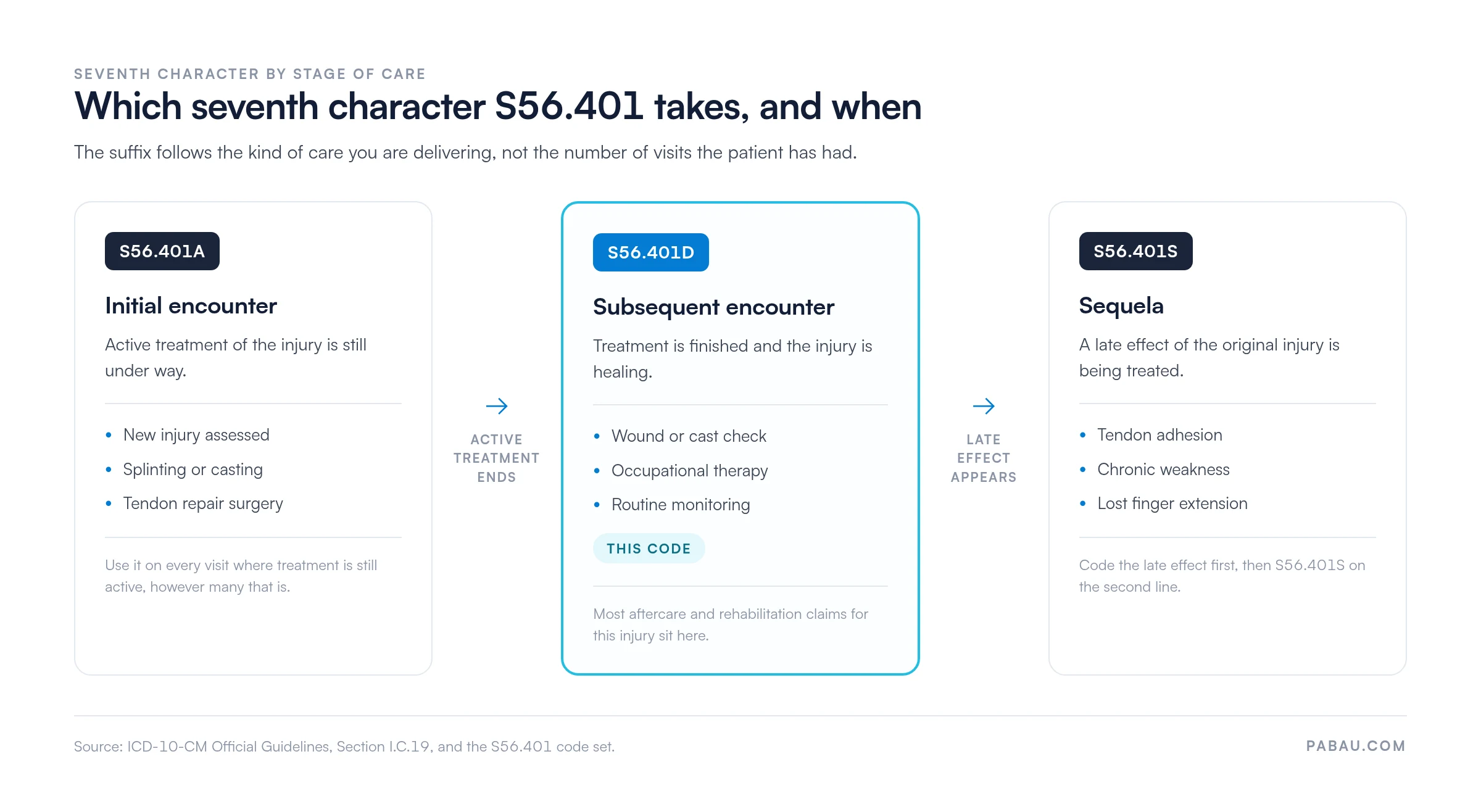
A common misconception: “subsequent encounter” does not mean the patient’s second visit. It means the active treatment phase is finished. A patient can have several A-coded visits in a row if surgical or procedural treatment is still going on. Switch to D once that treatment stops and the visits become follow-up.
Section I.C.19 of the ICD-10-CM Official Guidelines ties the character to the care being delivered, not to the visit count. Therapy visits during recovery almost always take D. Sequela works differently: the residual condition is coded first, then S56.401S on the line below it.
Yes, S56.401D is a billable, specific ICD-10-CM code, and it is valid for HIPAA-covered transactions under the FY2026 edition.
It is also long-standing. S56.401 entered ICD-10-CM on October 1, 2015, in the code set’s first year of use, and no annual update has revised it since. Any source that presents it as a fiscal 2026 addition has it wrong, which matters if you are reconciling an old claim.
One point worth being clear about: a clearinghouse catches an invalid or incomplete code string before the payer sees it. What no software decides for you is whether D was the right suffix for that particular visit. That judgment comes from the note, and it stays with the coder.
That rule has a structural consequence. Only the seven-character codes in this family can be submitted. Every level above them is a grouping used to organize the code set, so a claim built on one gets rejected on arrival.
The ICD List code lookup tool shows the S56 tree in full, including the left-side, other-finger, and flexor branches.
Providers rarely write the descriptor out. These phrases all map to the same code, so any of them in a progress note supports it.
These matter most when an EMR maps natural language to codes. They also help when a coder is working from a therapy note rather than an operative report. The AAPC ICD-10-CM code lookup lists the full set of approximate synonyms tied to S56.401.
S56 stops at the forearm. Two exclusion notes and one instruction decide whether the code fits the encounter in front of you.
Some payers also want an aftercare Z code alongside the injury code to show why the patient came in. That is a plan-level rule rather than an ICD-10-CM one, so check the policy before adding a second line.
Audits on this code chase two details: which hand, and which stage of care. A record supporting an S56.401D claim needs all five of the elements below.
Notice that four of those five are set at the initial encounter, not at this visit. Practices that capture the side, the level, and the injury type in a structured field at the first visit come out ahead. They send far fewer queries back to providers months later.
That is also the cheapest form of denial management available to you. A query answered at the initial visit costs a few seconds. The same question asked after a denial costs a rework cycle and delays payment by weeks.
Most of the codes below sit one digit away from S56.401D, which is exactly how the wrong one ends up on a claim. Per the CDC ICD-10-CM official tool, all of them still need a 7th character to be billable.
Choosing between S56.401 and its specified siblings, S56.421 for a laceration or S56.411 for a strain, is driven by the record alone. Default to the unspecified code only when the provider never named the injury type. If your unspecified rate on this family looks high, the fix sits in the note template, not in the coding.
Documentation is one half of a clean claim. The other half is the route the claim takes, which runs through five steps before payment. Knowing where it can stall tells you which check is worth doing early.
Step two is the one that decides the outcome. The diagnosis and the procedure have to describe the same encounter. Keep the CPT code library open while you code the aftercare visit, not after the denial.
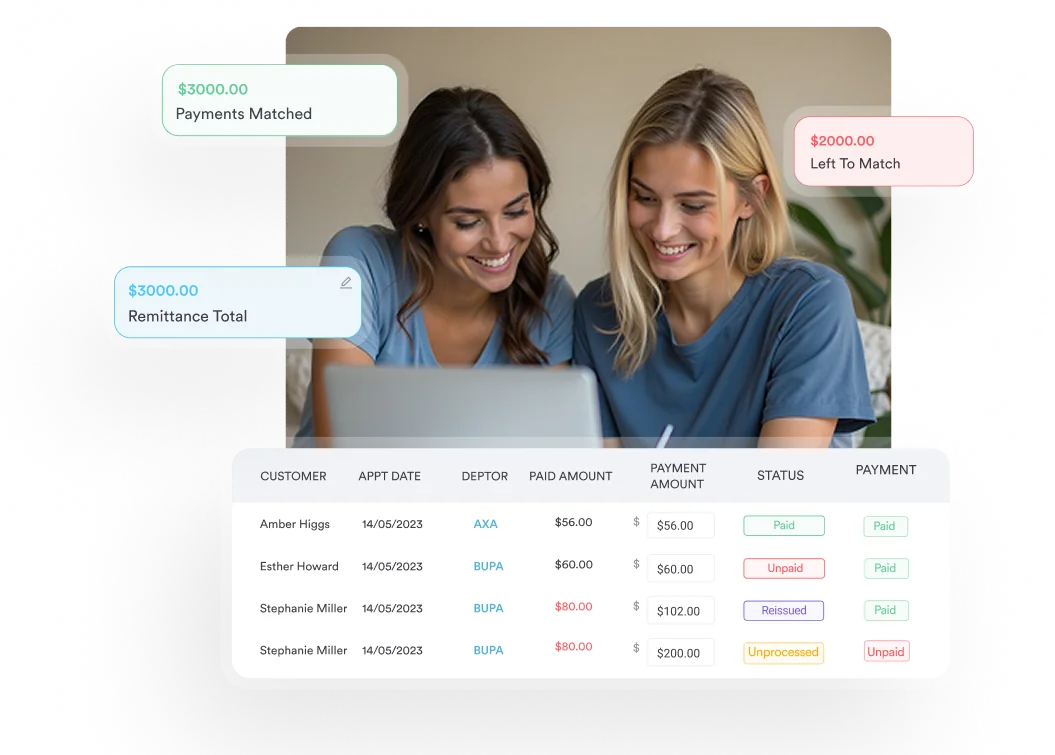
Plenty of practices write up the aftercare visit in one system and bill it from another. The coder retypes the diagnosis, someone checks the membership number by hand, and the remittance only surfaces when a person logs into the payer portal.
Practice management software like Pabau keeps the record and the claim in the same place. Our medical claims management tools pre-fill the CMS-1500 from the client record.
The procedure code attached to the service lands on the charge line, and the ICD-10 slots come from the recorded problem list. Lookup libraries for ICD-10-CM and CPT sit behind a search icon, refreshed with each official release, so nobody is coding from a printout.
Field-level checks hold the claim until the details a payer insists on are complete, such as membership and authorization numbers. On the US pipeline, our Claim.MD connection adds real-time eligibility checks, claim-status tracking, and electronic remittance posting.
The 7th character is still your call, but the paperwork around it gets built once and then followed to payment.

Pabau pre-fills the CMS-1500 from the client record, checks that every field a payer requires is complete, and tracks each claim to remittance. Your team spends less time retyping codes and chasing status.

S56.401D is not a hard code to get right. It gets denied because the note and the suffix drift apart. That usually happens when a patient moves from active treatment into therapy and nobody revisits the coding.
Fix that handoff once, in the template the provider fills in, and this code stops generating rework.
The practices that stop chasing these claims tend to be the ones where the note, the code, and the claim all live in one record. Book a demo to see how Pabau turns a documented aftercare visit into a claim your team can track to payment.

Need to understand how claims flow after an ICD-10 code is assigned? Revenue cycle management fundamentals walks through how diagnosis codes connect to payment from submission through remittance.
Looking for guidance on clean claim submission requirements? Clean claim requirements in medical billing covers what a payer expects on every field of a submitted claim.
Curious how electronic claim files are structured? The 837 electronic claim file explains the EDI format used to transmit ICD-10-coded claims to payers and clearinghouses.
There is no time limit. D applies for as long as the patient is seen for healing, therapy, or monitoring of that injury. Once care for it ends, the code stops being reported, unless a late effect brings the patient back and S56.401S applies.
The external cause code itself can be reported again with a D character. Place of occurrence, activity, and external cause status codes cannot. Those are assigned once, at the initial encounter, so repeating them on an aftercare claim is a coding error.
Query the provider before you code. Without a documented side, S56.401D is unsupported. Where no answer comes back, S56.409D covers an unspecified finger at the same level. Most payers read a run of unspecified codes as a documentation problem.
A fresh injury counts as a new initial encounter, which means the A character applies rather than D at that visit. Reserve the D character for the healing phase of the original injury. Where a second event happens during recovery, the note has to make the new mechanism clear.