ICD-10 code S61.201A: Open wound of left index finger without nail damage
ICD-10 code S61.201A covers a left index finger wound of unstated type ICD-10 co...

Last Updated: Oct 16, 2026
Billable Code Specific Code
S53.143D is the billable ICD-10-CM code for lateral subluxation of unspecified ulnohumeral joint, subsequent encounter.
The code sits inside the S53 category, dislocation and sprain of joints and ligaments of elbow. Its 7th character, D, marks the phase of care rather than the severity of the injury. It applies once active treatment has ended and the patient has moved into follow-up or rehabilitation. Denials on S53.14x claims usually trace back to the wrong 7th character, or to laterality the chart never recorded.
Let Pabau's smart automation suggest the right codes, reduce claim denials, and keep your practice compliant—effortlessly.
Automate repetitive tasks and focus on what matters most—your patients.
Reduce coding errors and ensure compliance with the latest regulations.
Clean claims, fewer denials, and faster reimbursements.
Powerful insights and reporting to help your practice thrive.
HIPAA compliant SOC 2 certified GDPR-compliant Trusted by 4,000+ clinics worldwide

S53.143D is a valid, billable ICD-10-CM code for the 2025 and 2026 fiscal years.
The 7th character D applies once active treatment ends and the patient moves into routine follow-up care.
Code the unspecified option .143 only when the chart names neither the right nor the left elbow.
Payers audit S53.14x claims for laterality, so a note that names the elbow is worth the extra line.
Pair the code with the CPT code for what was done at the visit, such as 99213 or 97110.
ICD-10 Code S53.143D is the billable diagnosis code for lateral subluxation of an unspecified ulnohumeral joint at a subsequent encounter. It is a seven-character code, and each position carries a distinct clinical meaning. Get one position wrong and the claim is invalid. Here is what each character represents.
The parent S53 category covers dislocations, subluxations and sprains across the whole elbow, so it splits into separate nodes for each articulation. The radial head sits at S53.0x, which is also where nursemaid’s elbow lives. The ulnohumeral joint sits at S53.1x, and that is where S53.143D belongs. Reporting the parent S53.1 instead of the full seven-character code is a specificity failure. The diagram below walks the three choices that produce the complete code.
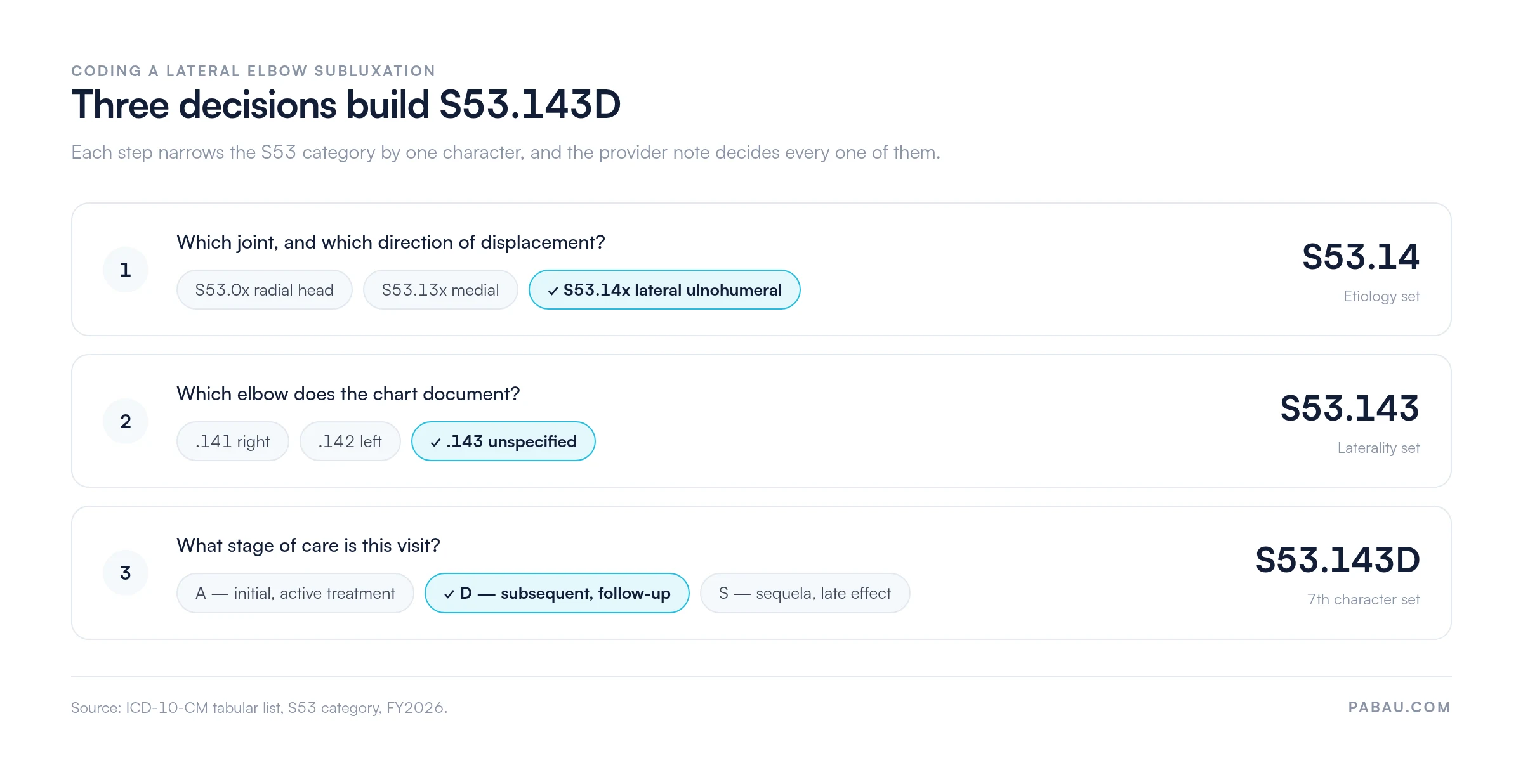
Lateral subluxation of the ulnohumeral joint is partial displacement of the ulna away from its normal seat on the humerus, shifted in the lateral direction. The ulnohumeral joint is the hinge where the trochlear notch of the ulna wraps around the trochlea of the humerus. It carries most of the elbow’s flexion and extension.
It is not a complete dislocation, and the joint surfaces keep some contact. Even so, the displacement is enough to cause pain, mechanical symptoms such as clicking or catching, and a measurable loss of the flexion-extension arc.
Patients typically report elbow pain, a sense that the joint gives way, and apprehension when the arm is loaded in extension. The usual mechanism is a fall on an outstretched hand that drives a valgus and rotatory force through the elbow. Injury to the lateral collateral ligament complex often comes with it.
Accurate clinical documentation by the treating provider is the prerequisite for accurate coding. The note has to state that the displacement is lateral and that it involves the ulnohumeral joint rather than the radial head. It also has to name the affected elbow. When laterality is missing from the chart, the unspecified option S53.143D is the only defensible code. It should be an exception rather than a default.
The 7th character D applies when the patient is receiving routine care for the injury after the active treatment phase is complete. The ICD-10-CM Official Guidelines for Coding and Reporting set that rule out in Section I.C.19.a. Symptoms may well persist. The D signals that the primary intervention has concluded and the visit now involves monitoring, physical therapy, or symptom management.
The same 7th character convention runs through every S-chapter injury code. The A, D and S choice below transfers to fractures, sprains and dislocations elsewhere in the body.
Coders often keep billing S53.143A across several visits because the patient still reports pain. Pain alone does not determine the 7th character. The stage of treatment does. Once the treating provider moves the patient from acute intervention to rehabilitative or monitoring care, D applies, and the note should record that transition explicitly.
The A, D and S characters record where the patient sits in the care continuum, and severity has no bearing on them. Coders often default to A for any visit involving an active complaint, which is incorrect once the acute-treatment phase has passed.
A practical test: if the provider note says “follow-up for elbow subluxation, progressing well with PT,” D is correct. If the note says “presenting with new elbow pain, reducing the subluxed elbow today,” A is correct. If the note says “residual lateral elbow stiffness, sequela of prior subluxation injury,” S is correct. The CDC/NCHS ICD-10-CM web tool provides the official tabular context for each code in the S53.14x cluster to verify your selection against current guidelines.
The S53.14x cluster is narrow, but the surrounding codes in S53 still cause confusion. Their descriptors read alike, and two of them describe a different joint altogether. Read the neighbors before you settle on one.
The most frequent selection error is choosing the unspecified laterality code (S53.143D) when the chart clearly states right or left elbow. Payers increasingly use laterality specificity as an audit trigger. The AAPC ICD-10-CM lookup displays the full S53.14x cluster, which makes it easy to find the laterality-specific code before defaulting to unspecified.
The S53 category carries an Includes list, one Excludes2 note and a code-also instruction, and all three apply to S53.143D by inheritance. Misreading them produces billing combinations that payers reject outright.
The Includes note also marks where S53 stops. If the ulnohumeral joint held its seat and only the ulnar collateral ligament was injured, the S53.4x sprain codes apply. For the left elbow during active treatment, that code is S53.442A.
Verify Includes and Excludes notes against the tabular list for the current fiscal year, rather than against an EHR template that was built years ago. The ICD-10-CM Official Guidelines, published through the CMS ICD-10 codes page, are what to check them against.
The provider note is what a payer reads when an S53.143D claim is questioned. Payers, Medicare included, audit S53.14x claims for laterality and encounter-type alignment. Weak documentation is the leading cause of preventable denials on this code.
An integrated clearinghouse keeps what reaches the payer aligned with what the provider note says. A pre-submission check that reads the diagnosis, the laterality and the encounter character together flags a thin note while the chart is still open.
S53.143D is a diagnosis code, so it must always be submitted alongside a CPT procedure code for what was done at the visit. The CPT code drives reimbursement, and S53.143D establishes medical necessity. Where the procedure side is unsettled, the CPT code reference lists the sections these follow-up visits draw on.
Medical necessity is documented independently for each CPT code billed. A claim for 99214 alongside S53.143D needs a note demonstrating the higher complexity level, not merely the presence of the diagnosis. Therapeutic exercise is the unit-based outlier here. 97110 is billed in 15-minute units, so the note has to record treatment time as well.
Run a pre-submission crosswalk between S53.143D and the CPT code billed. If the pairing triggers a National Correct Coding Initiative (NCCI) edit or a Medically Unlikely Edit (MUE), the claim will deny automatically. Use a code edit tool or your clearinghouse edit checker before submitting. Document the clinical rationale in the note if you expect to override an edit.
Denials on S53.143D are preventable in most cases. The patterns repeat often enough that a short pre-submission checklist catches the majority before they reach the payer. Five triggers account for nearly all of them.
Routing claims through a clearinghouse that performs pre-submission eligibility verification and code validation catches encounter-type errors before they become remittance denials.
The coding error on this code usually surfaces after the remittance lands. A biller opens the 835, sees a laterality or encounter-type rejection, pulls the chart, corrects the seventh character and resubmits. That cycle adds weeks to reimbursement on a claim that was clinically straightforward the first time.
Practice management software like Pabau closes that loop earlier. Claims run through our Claim.MD integration for real-time eligibility verification and payer-specific validation. A mismatch between the diagnosis code and the documented encounter surfaces before submission rather than after. Our claims management software puts those payer requirements in front of the coder, so the correction stays inside the visit.
For a physical therapy or orthopedic practice running a high volume of musculoskeletal follow-ups, the effect compounds. Fewer reworked claims, shorter payment cycles, and a billing team that spends its time on genuine exceptions rather than on avoidable denials.

Pabau integrates with Claim.MD to validate ICD-10 codes like S53.143D at submission. Laterality and encounter-type mismatches are caught before they reach the payer, which cuts denial rates on musculoskeletal claims.

ICD-10 Code S53.143D bills cleanly once the chart settles two questions. The first is whether the injury is a lateral subluxation of the ulnohumeral joint rather than a radial head problem. The second is whether the visit belongs to the subsequent-encounter phase of care. Most denials on this code come from documentation, not from coding ambiguity.
Get the joint and the encounter character right at the point of coding and the claim usually pays first time. To see how Pabau handles musculoskeletal injury billing end to end, book a demo.

Need to understand the clearinghouse submission process for injury codes? Claim.MD clearinghouse guide explains how real-time eligibility checks and ERA processing work for musculoskeletal claims.
Seeing repeated denials on S53.14x claims? Electronic remittance advice explained covers how to read 835 remittance files and trace CARC denial codes back to their source.
Working a queue of denied musculoskeletal claims? Denial management in healthcare sets out how to work that queue and stop the same rejection recurring.
ICD-10 Code S53.143D is the billable diagnosis code for lateral subluxation of unspecified ulnohumeral joint, subsequent encounter. The ulnohumeral joint is the hinge between the humerus and the ulna. The code belongs to the S53 category, dislocation and sprain of elbow. It applies when a patient returns for routine follow-up after active treatment has concluded.
No. S53.143D describes the ulnohumeral joint, the hinge between the humerus and the ulna. Subluxation and dislocation of the radial head is a separate ICD-10-CM family at S53.0x, which also contains nursemaid’s elbow at S53.031 to S53.033. They are different articulations and different codes, so the provider note has to name the joint involved.
Yes, S53.143D is a valid, billable ICD-10-CM code confirmed for fiscal years 2025 and 2026. It is accepted for claim submission by Medicare and most commercial payers, provided the supporting documentation demonstrates the appropriate subsequent-encounter clinical context and laterality.
S53.143A (initial encounter) applies while the patient is receiving active treatment for the lateral ulnohumeral joint subluxation, such as reduction or acute specialist care. S53.143D (subsequent encounter) applies once active treatment is complete and the patient is in follow-up, rehabilitation, or monitoring care. The distinction rests on the phase of treatment, not the severity of symptoms.
S53.143S (sequela) applies when the original subluxation injury has healed but has left a documented residual condition. Chronic lateral elbow instability and a permanent reduction in supination range are typical examples. When the injury is still being actively monitored or treated, D remains appropriate. Sequela coding requires a second code identifying the specific residual condition alongside the S-suffixed injury code.
Three errors account for most denials. The first is using the A suffix (initial encounter) when the visit is a follow-up. The second is using the unspecified laterality code (.143) when the chart documents a specific elbow. The third is submitting S53.143D without a prior S53.143A in the claim history. Aligning the 7th character with the provider note’s documented care stage resolves the majority of these rejections.
Most payers require the provider note to document four points. Those are the mechanism of injury from the initial visit, the specific elbow affected, the current stage of care, and ongoing medical necessity. Medicare and some commercial payers also check the prior claim history before accepting a subsequent-encounter code. They want to see an initial-encounter claim for the same injury.