ICD-10 Code Y76.0: Diagnostic obstetric and gynecological devices
ICD-10 Code Y76.0: Definition and billable status ICD-10 Code Y76.0 is a valid, ...

Last Updated: Oct 23, 2026
Billable Code Specific Code
S52.551C is the billable ICD-10-CM code for other extraarticular fracture of lower end of right radius, initial encounter for open fracture type IIIA, IIIB, or IIIC. The code became effective October 1, 2025, as part of the 2026 ICD-10-CM edition, and it is valid for claim submission. Two details decide whether it holds up. The seventh character must match the encounter stage, and the operative note must name the Gustilo grade.
Let Pabau's smart automation suggest the right codes, reduce claim denials, and keep your practice compliant—effortlessly.
Automate repetitive tasks and focus on what matters most—your patients.
Reduce coding errors and ensure compliance with the latest regulations.
Clean claims, fewer denials, and faster reimbursements.
Powerful insights and reporting to help your practice thrive.
HIPAA compliant SOC 2 certified GDPR-compliant Trusted by 4,000+ clinics worldwide

ICD-10 code S52.551C is a billable 2026 ICD-10-CM code, and it applies to initial encounters only.
The seventh character C designates an open fracture graded Gustilo type IIIA, IIIB, or IIIC at the first course of treatment.
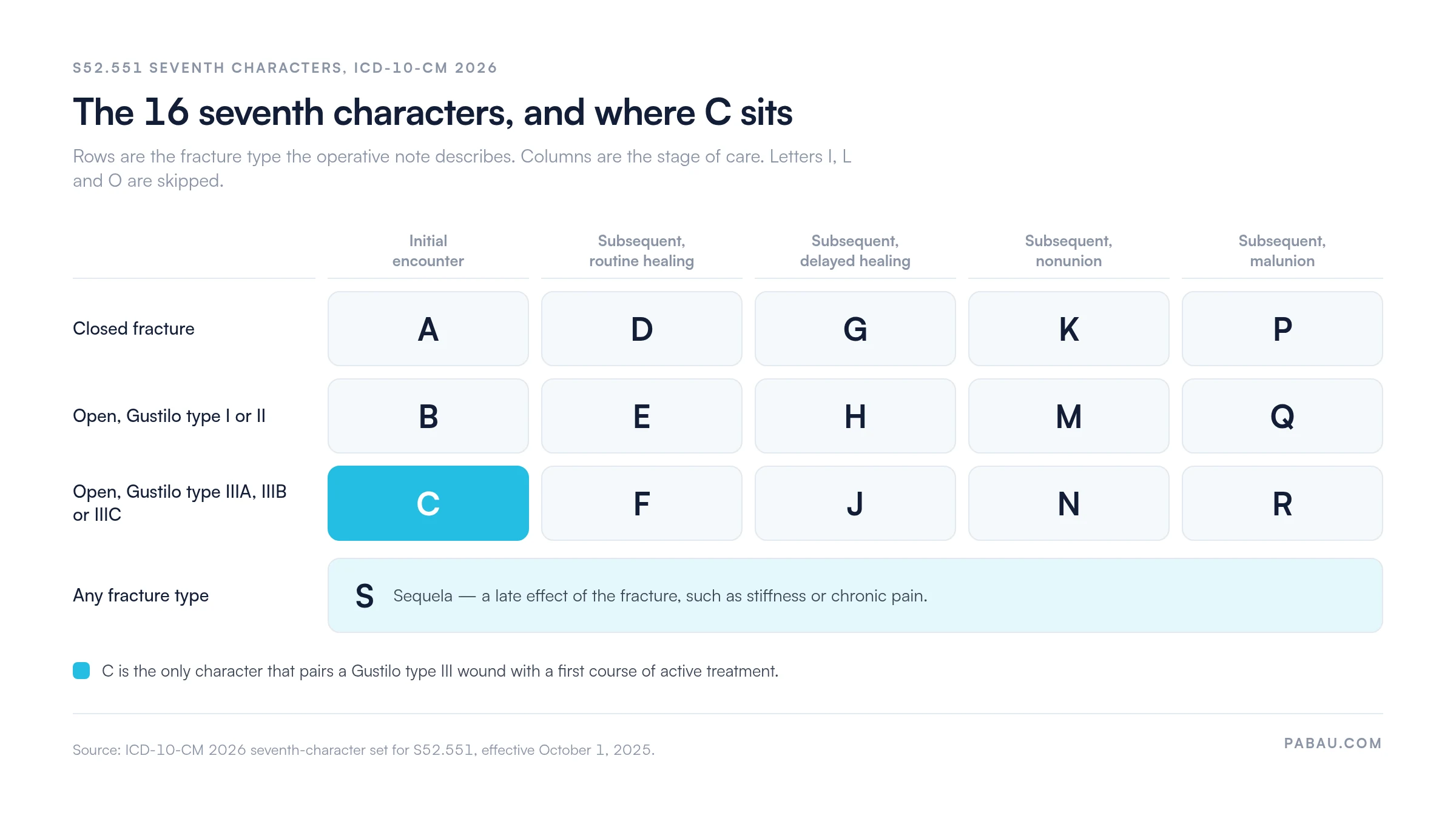
The S52.551 family carries 16 valid seventh characters, because the letters I, L and O are skipped.
Gustilo grade is an intraoperative call by the surgeon, so the operative note must state it before a coder assigns C.
Practice management software like Pabau validates CPT and ICD pairings through Claim.MD before an open fracture claim reaches the payer.
ICD-10 code S52.551C is a valid, billable ICD-10-CM code confirmed in the CDC/NCHS ICD-10-CM web tool for fiscal year 2026. It is specific enough for claim submission without an additional specificity code.
The term “extraarticular” means the fracture does not reach the articular surface of the radiocarpal joint. That separates S52.551C from the intraarticular distal radius fractures coded elsewhere in the S52 block. Laterality is explicit in the code. S52.551 is right, S52.552 is left, and S52.559 is unspecified.
The intraarticular group carries its own laterality and seventh characters. A left-side intraarticular break that reaches nonunion after an open type I or II injury is reported as S52.572M.
S52.551C sits inside the S52 forearm fracture block, nested under several parent categories. Coders should recognize that hierarchy for sequencing and crosswalk work, because it prevents sequencing errors when several fracture codes appear on one claim.
The seventh character in an ICD-10-CM fracture code specifies the encounter type, and choosing the wrong one is a frequent denial trigger. The S52.551 family has 16 valid seventh characters, covering each combination of fracture type and healing status. Per the CMS ICD-10-CM coding resources, the character describes the encounter being billed, not the fracture’s original classification. The grid below lays the set out along its two axes, so the logic behind 16 letters is visible at a glance.
The table below gives the full definitions. Each row names the letter, the encounter it reports, and what the note has to show.
Character C applies only to the initial encounter, which is the first time the patient receives active treatment for this injury. Once care moves to follow-up, the seventh character must change with it. Using C on a later office visit triggers an automated denial on most payer systems.
The Gustilo-Anderson classification is the system ICD-10-CM uses to define open fracture severity. The grade decides whether the seventh character reads B or C for this injury. For S52.551C to be correct, the operative note must document a Type III fracture in one of the three subtypes.
Gustilo grading is an intraoperative determination made by the surgeon, not the coder. A coder cannot assign C independently, so the operative note must state the grade or describe one of the Type III subtypes. If the note records only an “open fracture” with no grading, query the provider before coding S52.551C.
Query the surgeon before assigning seventh character C if the operative note documents an open fracture but does not state a Gustilo grade. Asking for an addendum takes minutes, while a denial for unsupported specificity can delay payment for weeks.
Payers expect the medical record to support every element of ICD-10 code S52.551C. Missing one component usually produces a specific-code denial, or a downcode to an unspecified fracture code.
The operative or emergency department note must document all of the following:
Emergency departments often document laterality inconsistently, naming the “right wrist” in the chief complaint but omitting the side in the fracture assessment. Reconcile every reference in the record before selecting a laterality-specific code.
The seventh-character table above already covers every encounter variant of S52.551. The codes below are the ones a coder reaches for when the side, the articular status, or the named fracture pattern is different.
A named eponym outranks the residual category. If the surgeon writes Colles’, Smith’s, or Barton’s, code the eponym group rather than S52.55. The eponym stays in the code at later encounters. A right-side Colles’ fracture that reaches nonunion after an open type III injury takes S52.531N at the follow-up visit.
The Smith’s group follows the same pattern. A right-side Smith’s fracture that has not united after an open type I or II injury takes S52.541M.
CPT selection follows the surgical technique, not the ICD-10 diagnosis code. The codes below appear on distal radius claims, and only one of them matches the extraarticular pattern S52.551C describes. Verify current reimbursement rates with the CMS Physician Fee Schedule lookup.
CPT 25608 and 25609 describe intra-articular fractures. Pairing either with S52.551C tells the payer the fracture both does and does not enter the joint. Where the note describes a closed reduction instead, CPT code 25600 is the counterpart to check.
For Type IIIB and IIIC injuries, CPT codes for soft tissue coverage or vascular repair usually appear alongside the fracture repair code. Validating those pairings before submission catches the conflicts a payer would otherwise deny.
The ICD-10-CM Official Guidelines for Coding and Reporting govern how fracture codes are selected and sequenced. CMS and the National Center for Health Statistics maintain them jointly, and they are reissued with each fiscal year.
That national consistency does not extend to every code set a practice bills. HCPCS T-codes such as T4524 are state Medicaid agency codes, so each state sets its own rate and its own quantity cap.
The most frequent coding errors on S52.551C claims:
The AAPC ICD-10-CM code lookup carries documentation tips for this code family. Practices with recurring grading disputes between coders and surgeons benefit from a written query policy that standardizes when an addendum is required.
ICD-11 is not adopted for US billing, so ICD-11 codes do not belong on domestic insurance claims. US payers continue to require ICD-10-CM. Practices tracking rejection patterns can work from the standard denial codes. Each one names what the payer objected to and what an appeal has to answer.
Most orthopedic practices catch a seventh-character error after the remittance arrives. The coder assigns C, the visit turns out to be a follow-up, and the remittance comes back weeks later with a denial. By then the operative note sits in one system and the claim in another.
Pabau is practice management software that runs scheduling, charting, and billing on one record. The encounter the clinician documented becomes the encounter the claim reports. Our claims software for orthopedics submits electronically through Claim.MD and returns clearinghouse edits before the claim leaves the practice.
Every Pabau subscription includes every feature, so a single-surgeon practice validates CPT and ICD pairings the same way a multi-site group does. Any denial that still comes back lands in one worklist, with the original operative note attached.

Pabau’s claims tools validate CPT and ICD pairings, run clearinghouse checks, and submit electronically through Claim.MD. Orthopedic and trauma practices submit cleaner claims the first time.

S52.551C is straightforward to assign and easy to lose on appeal. The difference is whether the operative note names the side, the articular status, and the Gustilo grade before the claim goes out.
Fixing the record before submission costs less than fixing it after. A query to the surgeon takes a few minutes, while a denial takes weeks to work through. Practices that write that query into their coding policy stop arguing the same case every quarter.
Pabau validates claims through Claim.MD across thousands of US payers, so open fracture claims clear clearinghouse edits before a payer sees them. Book a demo to see how Pabau handles complex trauma billing end to end.

Need to understand how claims move from submission to payment? What is revenue cycle management covers the end-to-end billing workflow from patient encounter to collected revenue.
Looking for guidance on managing denied claims? Denial management in healthcare outlines how to categorize, appeal, and prevent the most common denial reasons.
Exploring how clearinghouse submission works? Understanding the 837 file explains the electronic claim format used by payers and clearinghouses for professional claims.
ICD-10 code S52.551C is the billable diagnosis code for an other extraarticular fracture of the lower end of the right radius. It reports the initial encounter for an open fracture graded Gustilo type IIIA, IIIB, or IIIC. Coders use it on insurance claims when the patient is receiving initial active treatment.
Yes, S52.551C is a billable, specific ICD-10-CM code valid for claim submission in the 2026 ICD-10-CM edition, effective October 1, 2025. It is specific enough for reimbursement and does not require an additional code.
S52.551A covers the initial encounter for a closed fracture, with no open wound. S52.551C covers the initial encounter for an open fracture graded Gustilo type IIIA, IIIB, or IIIC. The seventh character is the whole difference between them.
The S52.551 family has 16 valid seventh characters. They run A, B, C, D, E, F, G, H, J, K, M, N, P, Q, R, and S in order. The letters I, L, and O are skipped, because they read too easily as digits. Each letter reports one combination of fracture type and stage of care.
S52.551C covers Gustilo-Anderson Type IIIA, IIIB, and IIIC. Type IIIA has adequate soft tissue coverage despite a significant wound. Type IIIB involves extensive periosteal stripping and needs flap coverage. Type IIIC involves an arterial injury requiring repair. All three map to seventh character C.
S52.551C applies to the initial encounter, when active treatment is first rendered for the fracture. S52.551D applies to a subsequent encounter for a closed fracture with routine healing. Once the patient moves to follow-up, the seventh character reports the current encounter, not the original injury severity.
CPT 25607 is the usual pair, because it covers open treatment of an extraarticular distal radial fracture with internal fixation. CPT 25608 and 25609 describe intra-articular fractures, so they conflict with the extraarticular pattern S52.551C reports. CPT selection follows the technique the surgeon documented.
The record must document the right radius, the extraarticular nature of the fracture, and confirmation that the fracture is open. It must also carry a surgeon-determined Gustilo grade of IIIA, IIIB, or IIIC, and show that the visit is an initial encounter. Missing any element leaves S52.551C unsupported and the claim open to denial.