ICD-10 code S61.201A: Open wound of left index finger without nail damage
ICD-10 code S61.201A covers a left index finger wound of unstated type ICD-10 co...

Last Updated: Oct 16, 2026
Billable Code Specific Code
S52.511R is the billable ICD-10-CM code for displaced fracture of right radial styloid process, subsequent encounter for open fracture type IIIA, IIIB, or IIIC with malunion.
Three concepts sit behind the code. Specifically, those are the anatomy of a displaced radial styloid fracture, the Gustilo-Anderson grading system, and the ICD-10-CM 7th character framework. Accordingly, this reference covers all three, with tables for quick lookup and a documentation checklist.
Let Pabau's smart automation suggest the right codes, reduce claim denials, and keep your practice compliant—effortlessly.
Automate repetitive tasks and focus on what matters most—your patients.
Reduce coding errors and ensure compliance with the latest regulations.
Clean claims, fewer denials, and faster reimbursements.
Powerful insights and reporting to help your practice thrive.
HIPAA compliant SOC 2 certified GDPR-compliant Trusted by 4,000+ clinics worldwide

S52.511R describes a displaced fracture of the right radial styloid process, subsequent encounter for open fracture type IIIA, IIIB, or IIIC with malunion
R is the FY2026 billable 7th character for a subsequent encounter with malunion after an open type IIIA, IIIB, or IIIC fracture
Do not read J as malunion on this code family: J means delayed healing, and a closed fracture with malunion takes P instead of R
Accurate assignment requires documented Gustilo classification (IIIA, IIIB, or IIIC), confirmed malunion, and explicit right-side laterality in the clinical record
Practice management software like Pabau submits ICD-10 claims electronically and tracks their status for codes like S52.511R
S52.511R is a valid, billable ICD-10-CM diagnosis code in the FY2026 code set, which took effect on October 1, 2025. It is accepted for HIPAA-covered transactions. According to the CDC/NCHS ICD-10-CM web tool, this code carries full billable/specific status, meaning it can be used directly on a claim without further specificity. Therefore, coders do not need to append or verify further granularity before submission.
Confirm the exact code and its code-set year before billing runs. A denial on this family usually traces back to an inactive or non-specific parent code. Consequently, teams that pair a coding check with claims management software catch that before the payer does.

S52.511R sits within the ICD-10-CM injury chapter. Consequently, understanding where it falls in the hierarchy helps coders navigate to sibling codes when laterality, displacement status, or encounter type differs from this specific case.
The CMS ICD-10 codes page publishes the annual tabular list update files where this hierarchy is formally defined. Therefore, coders should cross-reference those files whenever a code’s effective status is in question after a new fiscal year begins.
The radial styloid process is the bony projection at the distal (lower) end of the radius, on the thumb side of the wrist. For instance, a fracture here commonly results from a fall on an outstretched hand (FOOSH) or high-energy trauma. In short, “displaced” means the broken fragment has shifted from its normal anatomical position, a distinction that matters clinically and for ICD-10-CM code selection.
For coders, three components of this clinical picture drive code selection. First, laterality: S52.511R is right-side only. Left-side equivalents fall under S52.512x. Second, displacement status: S52.511x codes are for displaced fractures; S52.513x covers nondisplaced. Third, fracture character. The open nature of the wound and the Gustilo grade push the code into the IIIA/IIIB/IIIC subset rather than a lower-grade equivalent.
The parent code S52.511 requires a 7th character to be complete and billable. Each character identifies the encounter type, open/closed status, and healing outcome, using every letter A through S except I, L, and O. The table below covers every valid 7th character for this code family.
The AAPC Codify ICD-10-CM lookup publishes the full 7th character table for S52.511 alongside coding guidelines. Specifically, R applies only to an open fracture graded IIIA, IIIB, or IIIC that has healed with malunion.
A closed fracture with malunion takes P; an open type I or II fracture takes Q. Matching the Gustilo tier to the healing outcome is where most errors start.

The R suffix has a precise clinical and coding meaning. Accordingly, each part carries a specific implication for when it applies.
The three other subsequent-encounter characters on the open type III branch differ only by what the radiograph shows. For comparison, the chart below lines them up against R.
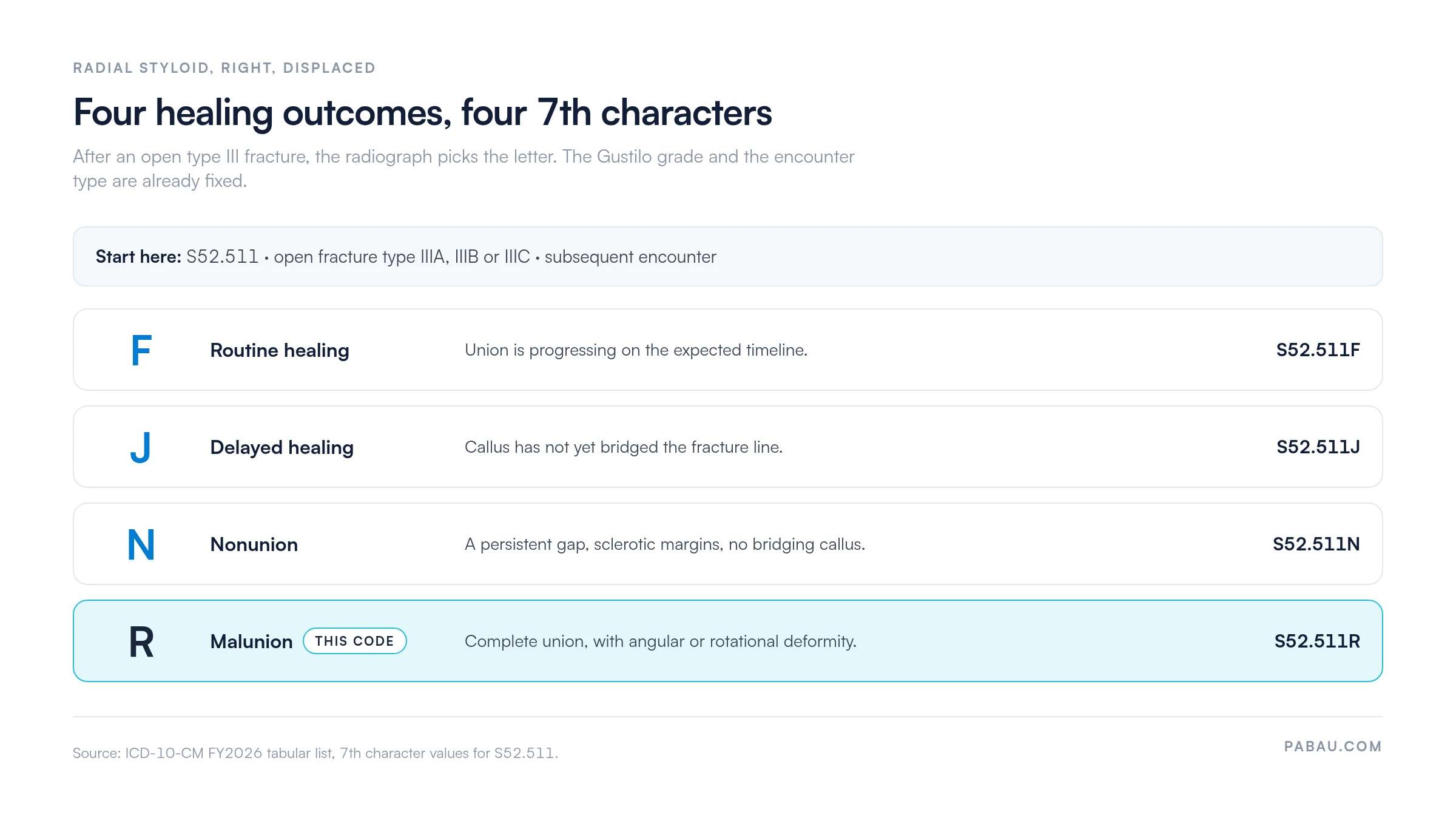
In practice, S52.511R appears on the claim when a patient returns weeks or months after a high-energy wrist injury. Imaging shows the radial styloid healed with angular deformity, and the provider documents all three components. The 7th character framework works the same way across most fracture categories, so the logic transfers once you have it.
The Gustilo-Anderson classification grades open fractures by wound size, soft tissue damage, periosteal stripping, and vascular involvement. It was established by Gustilo and Anderson in 1976, then refined by Gustilo, Mendoza, and Williams in 1984. Types I and II have relatively limited soft tissue disruption. By contrast, type III is subdivided into three categories, each with progressively more severe tissue injury. Accordingly, coders must apply the exact subtype documented by the treating surgeon.
The distinction between IIIA and IIIB hinges on whether soft tissue coverage of the bone is achievable without a flap procedure. The distinction between IIIB and IIIC hinges on whether arterial repair is required. In other words, these are surgical determinations that belong in the operative note. Coders who cannot locate a documented Gustilo grade should query the provider rather than assign a grade independently. ICD-10-CM coding guidelines require the provider’s documented classification to drive code assignment. In short, a coder’s reading of the record does not substitute for it.
Four healing outcomes map to four distinct 7th character groups for subsequent encounters. As a result, using the wrong one produces a claim that misrepresents the patient’s condition and may trigger a denial or audit. According to guidance aligned with AHA Coding Clinic principles, these distinctions are clinical, not coder-determined.
Read that table across the row rather than down the column. The healing outcome sets the row, and the fracture type sets the column. For an open type III fracture, R marks malunion and J marks delayed healing. Radiographically, malunion shows complete union with angular or rotational deformity. By comparison, nonunion shows a persistent gap, sclerotic margins, and no bridging callus, while delayed healing shows callus that has not yet bridged the fracture line.
The R versus N distinction is where 7th character selection most commonly goes wrong. Specifically, malunion (R) means the bone joined in the wrong position, while nonunion (N) means it did not join at all. Both require radiographic confirmation. When the operative or imaging report is ambiguous, query the provider. Otherwise, submitting N when the record supports R risks a medical necessity review for procedures inconsistent with a nonunion diagnosis.
Every element of S52.511R must appear explicitly in the clinical record. Consequently, missing even one element forces a downcode to a less specific code, which may reduce reimbursement or generate a denial. The following checklist covers what the provider’s note must contain.
Orthopedic and urgent care practices with high fracture volumes benefit from note templates that prompt for each of these fields at every encounter. For example, a template that requires an entry for the Gustilo grade stops the note going out with that field blank. The coder then has the grade in front of them instead of a query to raise.
Run a pre-submission documentation audit on every S52.511x claim. Pull the chart note, confirm the Gustilo grade is stated, and check that imaging confirms malunion rather than delayed healing. A five-minute review prevents the most common denial reason on this code family.
S52.511R belongs to a family of codes covering every combination of displacement status, laterality, encounter type, and healing outcome for radial styloid fractures. The table below covers the most commonly referenced codes in this family, verified against the NCHS ICD-10-CM files.
The S52.5 subcategory contains every distal radius fracture, including Colles-type, Smith-type, and styloid variants. Coders managing high orthopedic volumes often keep a reference table covering S52.511 through S52.514 with the 7th character options for each. The wider ICD-10-CM code index lists the neighboring subcategories when documentation points elsewhere.
Five errors account for most claim denials and audit flags on S52.511R and its sibling codes, but each is preventable with a structured review step.
Date of service governs every code on a claim, not just the diagnosis. Q4186 and Q4187 replaced HCPCS code Q4131 in 2019, yet earlier dates of service still take the deleted code.
Practices submitting complex orthopedic codes should check that the workflow reviews code specificity before the 837P file goes out. Practice management software like Pabau routes claims to Claim.MD and flags denied claims for rework.
That turns a specificity problem into a task on someone’s list rather than a write-off at month end. Adding a provider query step to that loop is the core of denial management.
Code reference tools list approximate synonyms for S52.511R that turn up in clinical notes and referral letters. Therefore, cross-referencing these terms helps coders reach this code when the provider writes something other than the official descriptor.
A referral letter may use language like “healed in malposition” or “angular deformity post-open fracture of the right wrist styloid.” That phrasing maps to S52.511R when the Gustilo grade was documented as type III at the original encounter. Coders should also watch for notes that use “distal radius styloid” and “radial styloid process” interchangeably. In short, both terms refer to the same anatomical structure coded in the S52.511 family.
Flag charts where a provider writes ‘healed in malposition’ or ‘angular deformity’ at a subsequent fracture visit. Those phrases signal malunion, which points to S52.511R when the original fracture was graded open type IIIA, IIIB, or IIIC.
Complex codes like S52.511R need three documents to agree. Specifically, the provider note, the imaging report, and the claim all have to carry the same laterality, the same Gustilo grade, and the same healing outcome. Consequently, when one of them falls short, the claim is exposed.
Pabau handles the first two from the charting side. Note templates prompt for laterality, displacement status, Gustilo grade, and healing outcome at every orthopedic encounter, so a downcode is not the default. Digital intake forms capture the malunion confirmation and the original Gustilo grade as structured fields. Both stay out of free text that a coder would otherwise have to interpret.

Claim submission then runs through the Claim.MD integration. Pabau generates the CMS-1500, runs real-time eligibility checks, tracks claim status, and posts ERA remittances back against the patient record. Denied claims come back flagged for rework. A billing lead can then see which fracture codes cost the practice the most time, and fix the documentation upstream.

Pabau helps orthopedic and urgent care practices connect structured clinical documentation to clean claim submission, reducing denials on complex ICD-10 codes like S52.511R.

S52.511R is one of the more specific codes in the ICD-10-CM fracture family. Accurate assignment depends on three elements appearing in the record. The note must confirm right-side laterality and grade the open fracture at Gustilo IIIA, IIIB, or IIIC. It must also document radiographic malunion at a subsequent encounter. When any one is missing, the code cannot be supported, and a downcode is the only defensible alternative.
Malunion on this code family is carried by the R character. J on the same family means delayed healing, so the two are never interchangeable. A quick check of the healing outcome against the Gustilo grade settles the choice before the claim goes out.
Practices with high orthopedic or urgent care volumes can head off most of these omissions by building note templates that prompt for each required element. To that end, book a demo to see how Pabau connects orthopedic charting to clean claim submission.

Need guidance on medical billing fundamentals? What is medical billing covers the full revenue cycle from charge capture to remittance advice.
Working through a claim denial? Denial management in healthcare explains the most common remittance codes and how to appeal effectively.
Want the wider revenue picture? What is revenue cycle management traces a claim from the appointment through to posted payment.
Checking your documentation holds up? Medical billing compliance sets out what claim data has to match in the clinical record.
ICD-10 Code S52.511R is a billable diagnosis code for a displaced fracture of the right radial styloid process. It applies at a subsequent encounter, after an open fracture graded Gustilo type IIIA, IIIB, or IIIC has healed with malunion. S52.511 identifies the displaced right radial styloid fracture. The 7th character R adds the encounter type, the open type III classification, and the malunion outcome.
Yes. S52.511R is a billable, specific ICD-10-CM code valid for HIPAA-covered transactions. It is active in the FY2026 code set, which took effect on October 1, 2025. No further specificity is needed before it goes on a claim.
The S52.5 subcategory covers all fractures of the lower end of the radius. Radial styloid codes include S52.511x (displaced, right), S52.512x (displaced, left), S52.513x (nondisplaced, right), and S52.514x (nondisplaced, left). Each carries the same 7th character set for encounter type, open fracture grade, and healing outcome. Related patterns in the same subcategory include Colles fracture (S52.53-) and Smith fracture (S52.54-).
Assign the parent fracture code, then choose the 7th character that matches the fracture type. On the S52.511 family, malunion takes P for a closed fracture and Q for an open type I or II fracture. The R character covers an open type IIIA, IIIB, or IIIC fracture with malunion. The record must document the malunion radiographically, along with the original Gustilo grade for the open characters.