ICD-10 Code S82.242H: Displaced spiral tibial shaft fracture, delayed healing
ICD-10 Code S82.242H: Definition and code details ICD-10 Code S82.242H designate...

Last Updated: Oct 15, 2026
Billable Code Specific Code
S52.221N is the billable ICD-10-CM code for displaced transverse fracture of shaft of right ulna, subsequent encounter for open fracture type IIIA, IIIB, or IIIC with nonunion.
Let Pabau's smart automation suggest the right codes, reduce claim denials, and keep your practice compliant—effortlessly.
Automate repetitive tasks and focus on what matters most—your patients.
Reduce coding errors and ensure compliance with the latest regulations.
Clean claims, fewer denials, and faster reimbursements.
Powerful insights and reporting to help your practice thrive.
HIPAA compliant SOC 2 certified GDPR-compliant Trusted by 4,000+ clinics worldwide

S52.221N is the billable ICD-10-CM code for a displaced transverse fracture of the right ulna shaft. It applies at a subsequent encounter for an open type IIIA, IIIB, or IIIC fracture with nonunion.
The 7th character N is valid only when the record documents both a Gustilo type III open fracture and nonunion.
Parent code S52.221 carries no 7th character, so payers reject it outright. Use N only at follow-up visits where nonunion is confirmed.
A missing Gustilo subtype at the initial encounter rules out N at every later encounter, so query it early.
Practice management software like Pabau flags missing documentation before submission, so orthopedic teams send cleaner fracture claims.
ICD-10 Code S52.221N identifies a displaced transverse fracture of the shaft of the right ulna.
It applies at a subsequent encounter, where the fracture was classified as an open type IIIA, IIIB, or IIIC and has since developed nonunion. It is a fully billable ICD-10-CM diagnosis code, valid for the FY2026 edition and effective October 1, 2025.
The clinical picture behind the code is a severe open forearm fracture that has failed to heal. This reference covers the code structure, the Gustilo criteria, and the definition of nonunion. It also covers the documentation each element needs and the rest of the S52.221 family.
Use the table below for a quick reference to the key attributes of S52.221N before diving into the clinical detail.
Every character in S52.221N carries clinical meaning. Misreading any segment produces a code that points to a different fracture, encounter type, or healing status entirely.
The full 7th character set for S52.221 is large. Coders commonly confuse N with adjacent characters. The table below maps all encounter/healing-status options so you can verify the right selection against what is documented.
Laid out as a grid, the same set is far easier to check. The wound status runs down one axis and the healing status runs across the other.
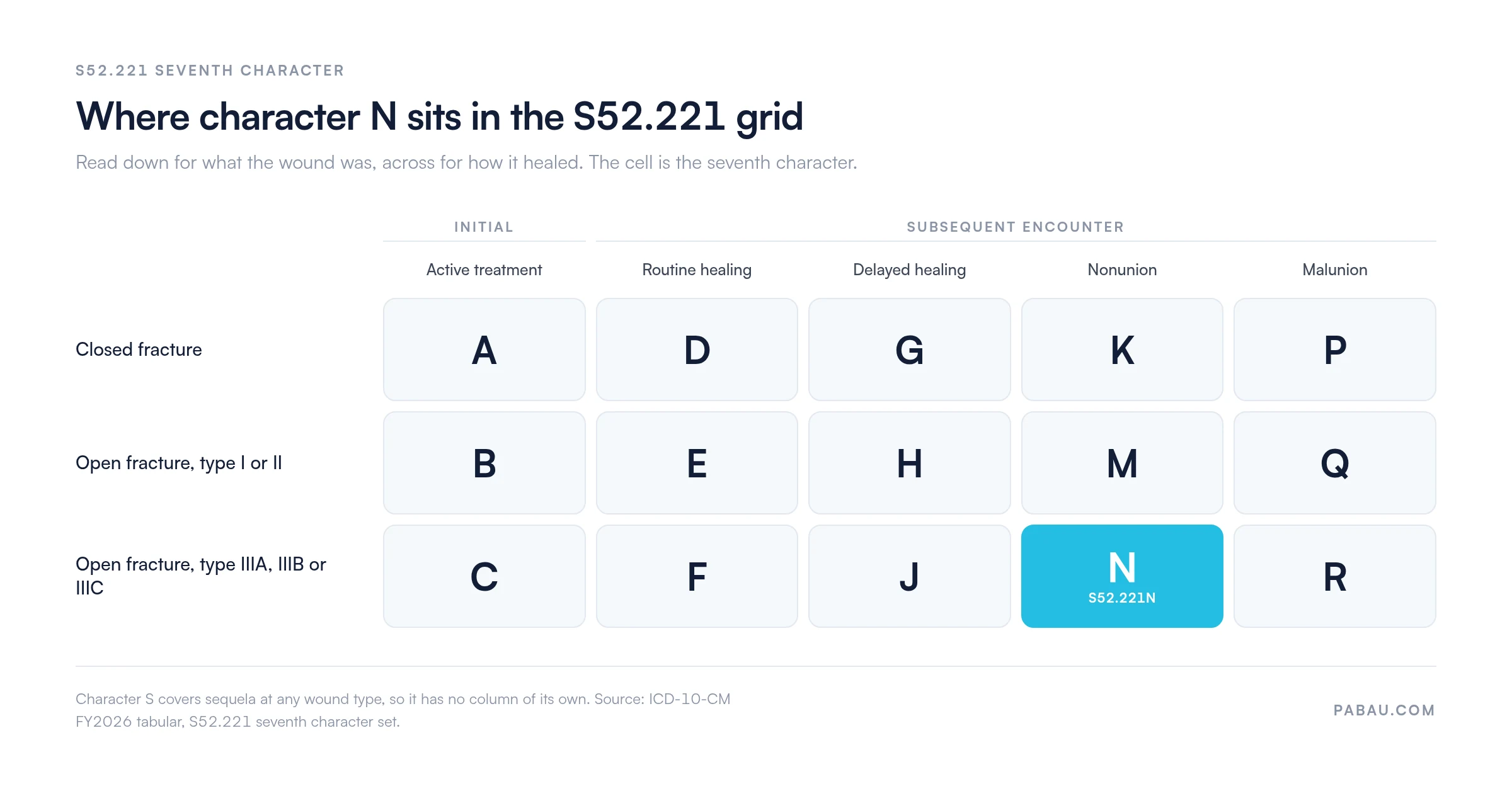
Three conditions must all be true for S52.221N to be correct. Miss any one of them and a different 7th character applies.
The Gustilo-Anderson classification is the accepted grading system for open fracture severity. Gustilo and Anderson described it in 1976, and it was later refined to add the type III subcategories. For S52.221N, the physician must document one of the three type III subtypes. The ICD-10-CM tabular does not accept a generic “type III” without a subtype for 7th character selection.
The Gustilo subtype has to appear in the operative report or clinical note from the initial encounter. Coders cannot infer the subtype from wound size alone.
If the original record says only “open fracture” with no Gustilo classification, ICD-10-CM Official Guidelines Section I.C.19.c defaults the fracture to closed. That means 7th character A, D, G, K, P, or S, depending on the encounter type. A missing classification at the initial encounter rules out S52.221N at every subsequent encounter.
Nonunion means the fracture has failed to heal within the expected timeframe, with no radiographic evidence of bridging callus or progressive healing. A fracture is generally considered nonunion when healing has not occurred after roughly six months. The treating physician makes that call from imaging and clinical assessment, since ICD-10-CM guidelines set no fixed timeframe.
Distinguishing nonunion from the other two abnormal healing statuses is essential for 7th character selection. The wrong character produces a billable but clinically inaccurate code, which can trigger a medical necessity audit. Accurate clinical notes at each follow-up visit are the most reliable defense against coding disputes and post-payment reviews.
Malunion (7th character R) and nonunion (7th character N) are mutually exclusive. Malunion implies healing has occurred, just improperly. Nonunion means no consolidation. Reviewing the imaging report alongside the physician note at each encounter is the most reliable way to confirm which status applies.
Claims for orthopedic fracture follow-up care are among the most frequently denied for incorrect encounter-type coding. The “subsequent encounter” designation covers any visit after the patient has received active, definitive treatment and has moved into routine care. It is not a count of visits.
That includes ongoing monitoring, physical therapy referrals, cast changes, and complication management such as nonunion treatment. Correct encounter-type coding also reduces the automated rejections triggered by conflicting date-of-service logic.
Bloodwork ordered during a nonunion workup does not ride on the orthopedic claim. A laboratory test such as HCPCS code P2029 is paid from the Clinical Laboratory Fee Schedule and needs its own supporting diagnosis.
Understanding medical billing fundamentals for traumatic injury codes helps practices recognize when the encounter type shifts. Clinical context decides that transition, not the calendar date. Once the patient enters a phase of routine monitoring or complication management, subsequent encounter codes apply.
Check the treating provider’s notes before assigning a subsequent encounter code. Some visits describe a new intervention or a change in treatment plan, such as surgical revision for nonunion. Confirm with the physician whether that counts as a new initial encounter for the complication.
S52.221N specifies the right ulna. Displaced transverse ulna shaft fractures split across three codes by side. Payers frequently reject the unspecified-laterality option when the record makes the side clear.
Use S52.223N only when the clinical documentation genuinely does not specify which arm was injured. Payers including Medicare apply medical necessity edits that flag laterality-unspecified codes when the claim includes procedures that are anatomically specific. The site of surgery or casting documented in operative or procedure notes typically makes laterality determinable.
Clean claims for ICD-10 Code S52.221N depend on documentation that covers every element of the code description. Missing a single element forces the coder to a less specific code, which may not support medical necessity for the billed procedures. Build the elements below into the encounter template, so none of them has to be reconstructed later.
The CMS ICD-10 coding resources page publishes the ICD-10-CM Official Guidelines for Coding and Reporting, which is the authoritative source for all fracture coding rules. Section I.C.19 covers traumatic fractures specifically and should be reviewed alongside this reference.
Understanding the full S52.221 family and its adjacent codes prevents miscoding when the clinical scenario is similar but slightly different. Review the CDC/NCHS ICD-10-CM official code lookup tool to verify current descriptions for any of the following codes, as effective dates vary.
The 7th character logic in S52 fracture codes mirrors the rest of Chapter 19. The same grid reading transfers directly to the radius shaft codes in S52.3, which carry an identical character set.
When the note records a shaft fracture but never names the pattern, the right ulna falls to the unspecified S52.201 family instead. An initial visit for an open type I or II fracture in that family reads S52.201B.
Claims billed with S52.221N are rejected or audited when documentation does not support the code’s specificity. The errors below are the ones most frequently flagged in orthopedic and musculoskeletal billing. Reading the denial codes a payer returns tells you which of them your practice keeps repeating.
The ICD-10-CM Official Guidelines for Coding and Reporting, Section I.C.19.c govern all traumatic fracture coding. Key rules that affect S52.221N include the following.
The WHO ICD-10 browser gives the international classification context for musculoskeletal injury codes. For US billing, reference the ICD-10-CM (Clinical Modification) maintained by CDC/NCHS instead. Only the CM version carries the 7th character extensions that make codes like S52.221N possible.
A fracture coding error usually surfaces after the payer sends the claim back. The coder appends a 7th character from the follow-up note, while the initial operative report sits in another system. Nobody confirms that a Gustilo subtype was ever recorded.
Practice management software like Pabau keeps the full course of care in one patient record. The initial encounter note, the imaging report, and every follow-up sit side by side. Its claims management software checks a claim for missing documentation before it leaves the practice, then tracks which codes come back denied.
On a nonunion claim that hinges on a subtype documented months earlier, one record is the difference between a clean submission and a query cycle. Coders read the history instead of reconstructing it.

Pabau’s claims management tools help orthopedic and musculoskeletal practices build cleaner claims and track denial patterns. Your team spends less time on rework and more time on patient care.

ICD-10 Code S52.221N covers a narrow scenario. The patient has a displaced transverse fracture of the right ulna shaft, seen at follow-up. The fracture was originally classified as Gustilo type IIIA, IIIB, or IIIC, and nonunion is now confirmed. All three conditions have to be documented before the code is defensible.
The element that fails most often is the Gustilo subtype, and it fails at the initial encounter rather than at the visit being coded. If the original operative note says only “open fracture”, character N is off the table for every encounter that follows. Send that query while the record is still fresh.
Get the encounter template right once and the 7th character stops being a judgment call. Book a demo to see how Pabau keeps fracture documentation and claim coding in step across a full course of care.

Want the codes a payer sends back when a claim like this fails? Denial codes in medical billing maps the common rejection reasons to the documentation that fixes them.
Need the wider claim workflow around a diagnosis code? What is medical billing walks through how a coded encounter becomes a paid claim.
Looking to cut denials across your orthopedic billing? Denial management in healthcare covers how to build denial prevention in from the coding stage.
Tracking what fracture follow-up care actually collects? What is revenue cycle management explains where coding accuracy shows up in the numbers.
ICD-10 Code S52.221N is a billable ICD-10-CM diagnosis code for a displaced transverse fracture of the shaft of the right ulna. It applies at a subsequent encounter for an open fracture originally classified as Gustilo type IIIA, IIIB, or IIIC, where nonunion has developed. It is valid for FY2026 billing, effective October 1, 2025. Three conditions must all be documented: the right ulna, the Gustilo type III subtype, and confirmed nonunion.
Yes, S52.221N is a fully billable, specific ICD-10-CM code. Parent code S52.221 without a 7th character is not billable and causes immediate claim rejection. The 7th character N is what makes the code billable. It also records the clinical scenario accurately: a subsequent encounter for an open type III fracture with nonunion.
In S52 fracture codes, the 7th character N means a subsequent encounter with nonunion. The fracture must have been an open type IIIA, IIIB, or IIIC on the Gustilo scale. It tells the payer three things: the patient is past the initial treatment phase, the fracture was a severe open injury, and healing has stopped. Neighboring characters J and R cover delayed healing and malunion for the same fracture type.
Nonunion, character N for open type III fractures, means the fracture has not healed at all. There is no bridging callus and no progressive consolidation on imaging. Malunion, character R, means the fracture healed in an incorrect position or alignment. The two are mutually exclusive, because malunion implies healing occurred and nonunion means it did not. The wrong character produces a clinically inaccurate code that may trigger a medical necessity audit.
The treating physician must document the Gustilo subtype explicitly, as IIIA, IIIB, or IIIC. A generic “type III open fracture” without the subtype is not enough. The original operative or emergency department record has to carry the classification, because subsequent encounter codes rely on it being established first. If the Gustilo type was never documented at the initial encounter, the ICD-10-CM default rule codes the fracture as closed at every stage.
Use a subsequent encounter code, 7th characters D through R, once the patient has received active, definitive treatment. The visit then falls under routine monitoring, follow-up care, or complication management. That includes physical therapy visits, cast changes, hardware removal, and nonunion management. The clinical phase of care drives the shift, not the calendar date or the visit number.