ICD-10 Code S82.242H: Displaced spiral tibial shaft fracture, delayed healing
ICD-10 Code S82.242H: Definition and code details ICD-10 Code S82.242H designate...

Last Updated: Oct 15, 2026
Billable Code Specific Code
S52.202H is the billable ICD-10-CM code for unspecified fracture of shaft of left ulna, subsequent encounter for open fracture type I or II with delayed healing.
The wound has to have been graded Gustilo-Anderson type I or II. The encounter has to be a subsequent one. The record also has to state that healing is delayed. Coders often reach for H when the note says malunion, but malunion belongs to a different character.
Let Pabau's smart automation suggest the right codes, reduce claim denials, and keep your practice compliant—effortlessly.
Automate repetitive tasks and focus on what matters most—your patients.
Reduce coding errors and ensure compliance with the latest regulations.
Clean claims, fewer denials, and faster reimbursements.
Powerful insights and reporting to help your practice thrive.
HIPAA compliant SOC 2 certified GDPR-compliant Trusted by 4,000+ clinics worldwide

S52.202H means unspecified fracture of shaft of left ulna, subsequent encounter for open fracture type I or II with delayed healing
Character H needs three documented facts: a subsequent encounter, an original Gustilo-Anderson type I or II open wound, and delayed healing
Delayed healing takes character H. For that same type I or II wound, nonunion takes M and malunion takes Q
A type IIIA, IIIB, or IIIC wound with delayed healing takes character J, and a closed fracture with delayed healing takes G
Pabau’s claims management connects to the Claim.MD clearinghouse, so fracture aftercare claims move from the patient record to the payer without retyping
S52.202H is a billable, specific ICD-10-CM diagnosis code. Its official descriptor reads: Unspecified fracture of shaft of left ulna, subsequent encounter for open fracture type I or II with delayed healing. The FY2026 edition took effect on October 1, 2025. It comes from the annual update maintained by the Centers for Medicare and Medicaid Services (CMS) and the National Center for Health Statistics.
The 7th character is what makes the code usable. S52.202 on its own is a non-billable parent code. A claim carrying it without a 7th character extension rejects before it reaches adjudication.
Each segment of the code narrows the diagnosis by one step. Misreading any one of them sends the claim out under the wrong code.
The hierarchy runs from the injury chapter (S00-T88) through the forearm category (S52) to the ulna shaft subcategory (S52.2). The 20 in S52.20 says the fracture pattern was never documented. Transverse, oblique, spiral, comminuted, and segmental patterns each have their own subcategory. If the operative note names a pattern, a more specific base code applies. As the AAPC ICD-10-CM code reference notes, the 7th character extension must always be appended to complete a code in this category.
The 7th character on S52.202 encodes three facts at once. It carries the encounter type, the wound status at the original injury, and the healing outcome. All three have to be documented before you select a character, and the diagram below traces the only path that ends at H.
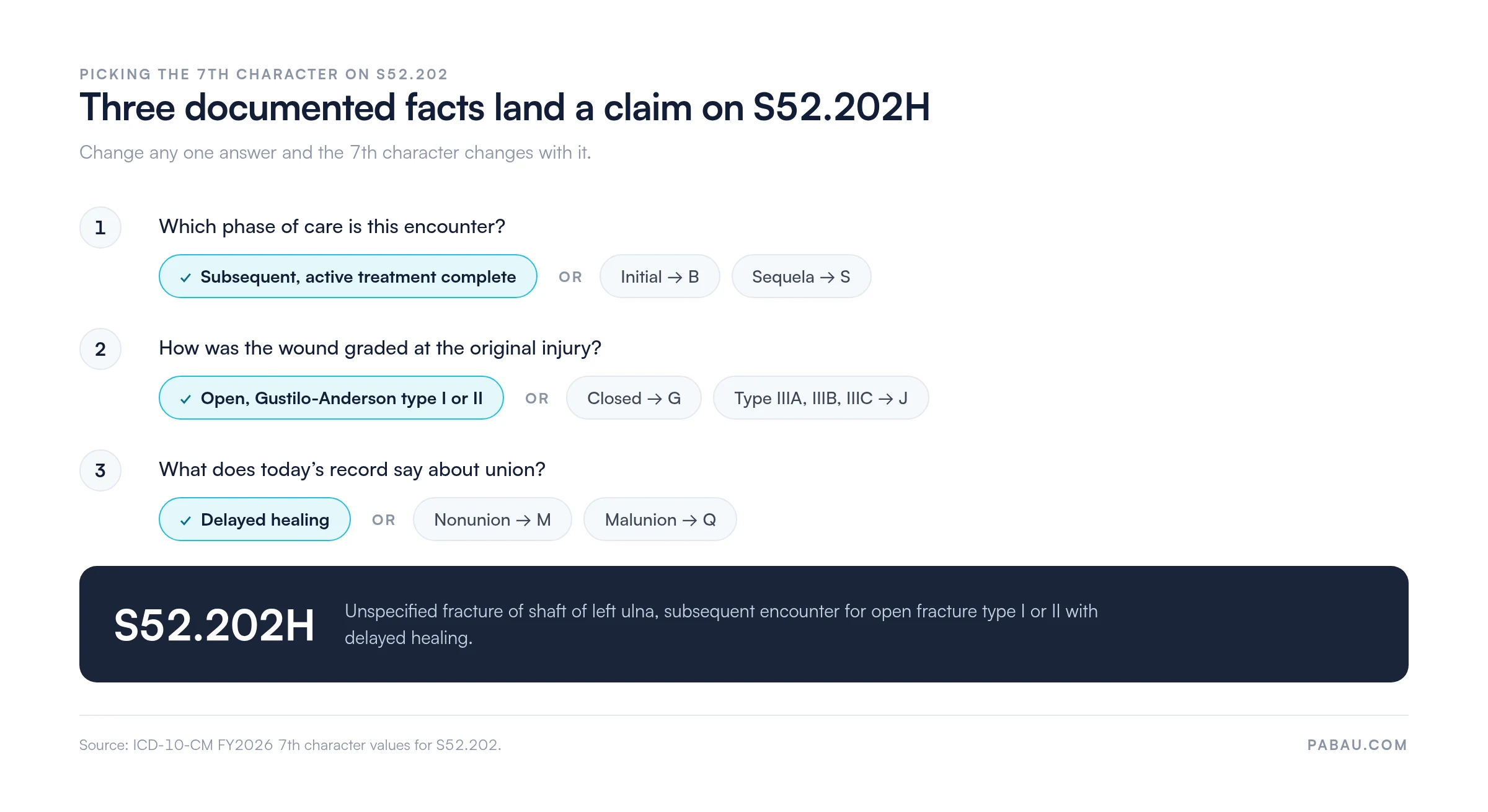
ICD-10-CM groups the Gustilo-Anderson grades into two buckets. Types I and II travel together, and types IIIA, IIIB, and IIIC travel together. That grouping is why character H covers two grades rather than one. The letters I, L, and O are never used, which is why the sequence jumps from H to J and from K to M.
Delayed healing is a clinical judgment rather than a calendar rule. ICD-10-CM sets no timeframe for it, so character H rests entirely on what the provider writes. Ask for a note that says union is delayed or slower than expected, and keep the serial imaging that shows callus still forming. A record that only says the patient is not healed yet will not hold up on audit.
Character H applies only when the original wound was graded Gustilo-Anderson type I or II. That grade comes from the initial injury encounter, usually the emergency department record or the first operative report. If the wound was type IIIA, IIIB, or IIIC, delayed healing takes character J instead. Assigning H without documentation of the lower grade is a coding error, and payers audit for it.
The boundary that matters for this code sits between type II and type IIIA. It turns on the extent of soft tissue damage, not on wound length alone. When the operative note is ambiguous, ask the treating surgeon for an addendum before you assign H.
These three outcomes describe different things, and ICD-10-CM gives each one its own 7th character. Substituting one for another is among the most common fracture coding errors flagged in payer audits. The wound grade and the healing outcome together decide the letter.
The record has to say which outcome applies. Phrases such as slow to heal, delayed union, or not yet united support delayed healing, which is what character H records. A documented nonunion or malunion moves the claim to a different letter. That holds even when the visit looks identical.
Subsequent encounter coding starts once active treatment of the fracture is complete. The patient is then in the healing or recovery phase. The ICD-10-CM Official Guidelines tie this to the phase of care, not to how many times the practice has seen the patient.
For S52.202H, active treatment has ended and the patient is in follow-up. The original wound was an open type I or II. Imaging and the provider note both point to union running behind schedule. If the surgeon takes the patient back to the operating room to promote union, that episode reverts to an initial encounter character.
One patient can move through five or six characters on the same code inside a year. The base code S52.202 never changes. Only the 7th character moves, and it moves with the documented phase of care. A single left ulna shaft fracture with a grade II open wound might run like this.
Swap the side and the same sequence runs on the right ulna. That day-of-injury visit opens at S52.201B instead.
Character H is a stage, not a permanent label. Re-read the current imaging at every visit, because the same patient on the same code can need a different letter three months later.
Working the neighboring codes prevents the usual laterality, wound-status, and healing-outcome mix-ups. The table below covers the codes most often confused with S52.202H.
Two neighbors account for most of the errors around H. S52.202G is the closed-fracture version of delayed healing, and S52.202J is the type III version. Confirm the original wound grade in the operative note before choosing between the three. Pabau’s ICD-10-CM code library carries the same breakdown for the neighboring forearm codes.
The ICD-10-CM index recognizes several alternate clinical phrasings that lead to S52.202H. Coders searching under any of these terms land on this code or its parent category.
Notes using any of these phrasings map to S52.202H during chart abstraction. The wound grade still has to be confirmed as type I or II at the initial encounter. A clean audit trail links the follow-up code back to that original record.
S52.202H is billable on a CMS-1500 claim or an 837P electronic transaction. The code carries no payment of its own. It establishes medical necessity for the service the visit actually delivered, which is why the pairing with the procedure code decides whether the claim pays.
Five things need to be in the record before the claim goes out.
Pair S52.202H with the CPT code for the service delivered that day. A follow-up assessment usually bills an established patient evaluation and management code, such as 99213 or 99214. Fracture care codes carrying a global period do not fit, because active treatment is over. Radiographs taken and read in the office bill separately when the practice owns the equipment.
When a follow-up visit also dispenses a splint, the device code turns on what happened at the fitting rather than on the fracture code. HCPCS code L3924 covers a prefabricated orthosis handed over as manufactured, and modifying it at fitting moves the line to L3923.
For US practices, Pabau supports electronic claims through Claim.MD, a clearinghouse connected to thousands of US payers. It submits and tracks the claim using the record data the practice already holds. Eligibility checks and electronic remittance advice come back against the same patient. That matters on a fracture patient billed across half a dozen follow-up visits.
Four of those five come down to one habit. Read the original injury documentation before you pick the 7th character, rather than coding from this month’s note alone. When one of these slips through, denial management is where the recovery starts.
A delayed-healing claim depends on records created months apart. The wound grade sits in an emergency department note from the day of injury. The evidence of slow union sits in this month’s imaging. In many practices those two documents live in different systems, so the coder rebuilds the story by hand at every visit.
Practice management software like Pabau keeps the whole fracture episode on one patient record. The original operative note, each follow-up note, and the imaging reports stay attached to the same timeline. When the coder opens this month’s visit, the original wound grade is a click away instead of a phone call to the hospital.
That same record feeds claims management without retyping. Pabau sends the encounter to the clearinghouse for submission and tracking, then files the payer’s remittance back against the same record. So when a delayed-healing claim returns with a denial code, the note that answers it is already in front of the biller.
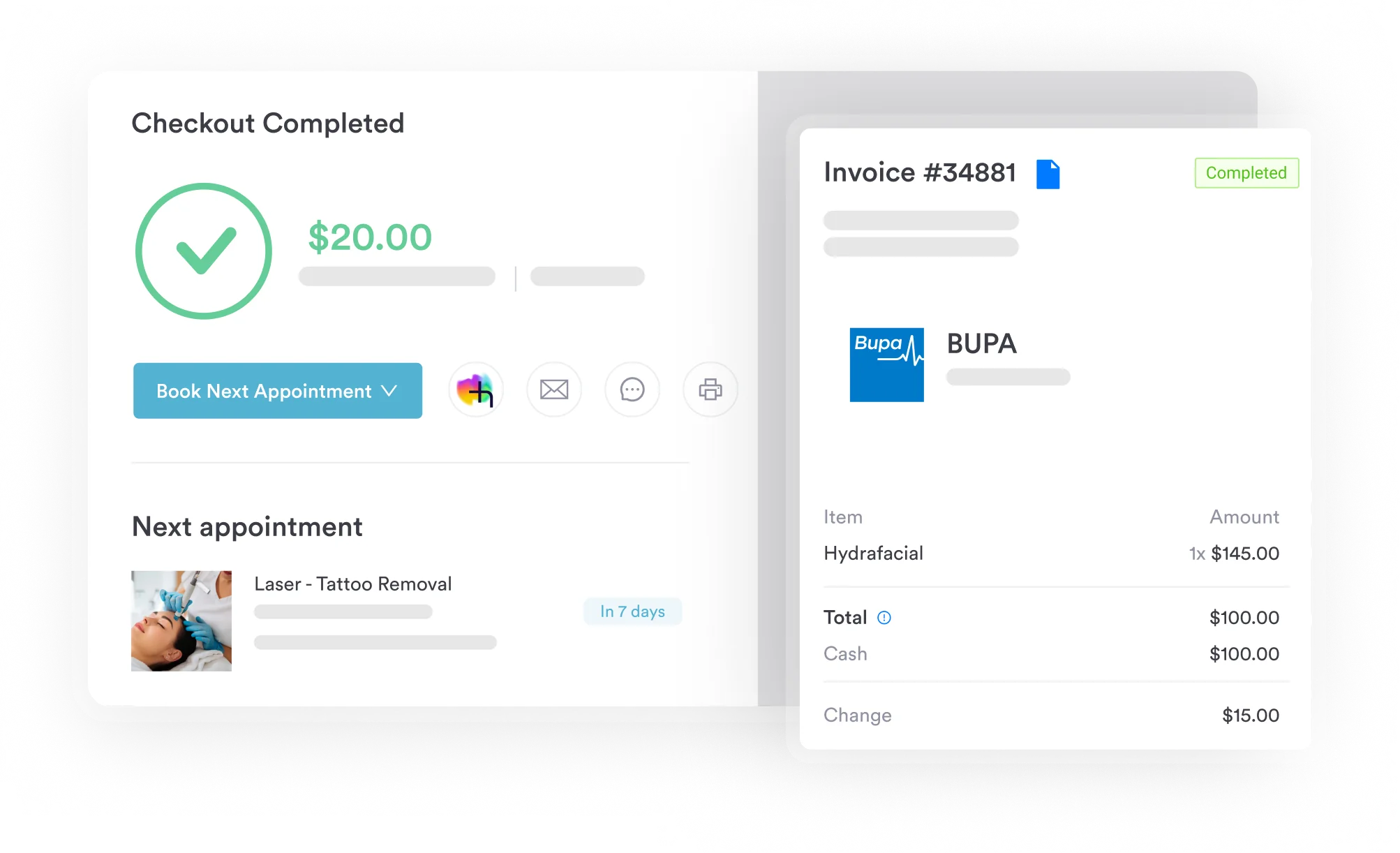

Pabau keeps the original injury note, each follow-up, and the claim on one patient record, and submits through Claim.MD for US practices. See how it handles a multi-visit fracture episode.

Character H on S52.202 records one narrow scenario. The left ulna shaft fracture was open at grade I or II, active treatment has finished, and union is running behind schedule. Change any one of those facts and the character changes with it. A type III wound takes J. A closed fracture takes G. Nonunion takes M, and malunion takes Q.
The habit that prevents most denials on this code is simple. Read the original operative note before every follow-up claim, not just the imaging in front of you. Pabau keeps that note, the follow-up documentation, and the claim on one record, so fracture billing stops depending on memory. To see how it handles a multi-visit fracture episode, book a demo with the team.

Need to understand how clearinghouse claims submission works? Medical claims clearinghouse guide explains the end-to-end submission process from practice to payer.
Looking for denial reason code definitions? Denial codes in medical billing breaks down common CARC reason codes and how to respond to them.
Want to understand how 837P electronic files are structured? 837 file guide covers the transaction set used for electronic claim submission.
S52.202H means unspecified fracture of shaft of left ulna, subsequent encounter for open fracture type I or II with delayed healing. It applies once active treatment of the fracture is complete and union is running slower than expected. The original wound must have been graded Gustilo-Anderson type I or II.
No. Malunion of an open type I or II left ulna shaft fracture is S52.202Q. Character H is delayed healing, which means union is still progressing but behind schedule. Malunion means the bone united in an abnormal position, so the two are not interchangeable.
Character H covers type I and type II open wounds only. Type I is a wound under 1 cm with minimal soft tissue damage. Type II is larger, with moderate soft tissue damage. A type IIIA, IIIB, or IIIC wound with delayed healing takes character J instead.
Use a subsequent encounter character, D through R, once active treatment of the fracture is complete. The patient is then receiving aftercare, monitoring, or management of a healing complication. If a new procedure is performed to promote union, that episode reverts to an initial encounter character.
That depends on the service delivered at the visit. Follow-up assessments usually bill an established patient evaluation and management code, such as 99213 or 99214. Radiographs taken and read in the office bill separately. Fracture care codes carrying a global period do not fit, because active treatment has ended.