ICD-10 Code S82.242H: Displaced spiral tibial shaft fracture, delayed healing
ICD-10 Code S82.242H: Definition and code details ICD-10 Code S82.242H designate...

Last Updated: Oct 15, 2026
Billable Code Specific Code
S52.092Q is the billable ICD-10-CM code for other fracture of upper end of left ulna, subsequent encounter for open fracture type I or II with malunion.
The original wound was open type I or II, and the bone has healed with malunion.
Four facts sit inside those eight characters. They are the bone, the side, the encounter type, and the healing outcome. The 7th character carries the last two, and it drives most of the denials on this code.
The neighboring character G is the usual culprit. On this code G means a closed fracture with delayed healing, so one letter changes both the wound type and the outcome the claim reports.
Let Pabau's smart automation suggest the right codes, reduce claim denials, and keep your practice compliant—effortlessly.
Automate repetitive tasks and focus on what matters most—your patients.
Reduce coding errors and ensure compliance with the latest regulations.
Clean claims, fewer denials, and faster reimbursements.
Powerful insights and reporting to help your practice thrive.
HIPAA compliant SOC 2 certified GDPR-compliant Trusted by 4,000+ clinics worldwide

ICD-10 code S52.092Q covers a subsequent encounter for another fracture of the upper end of the left ulna, open type I or II, with malunion.
The code is billable and specific. It is valid for fiscal year 2026, effective October 1, 2025, and it is exempt from present-on-admission reporting.
The 7th character Q carries three facts at once. It marks a subsequent encounter, an original open wound graded type I or II, and a malunion.
Character G is not the malunion character. On this code G means a closed fracture with delayed healing, and that mix-up is a frequent denial trigger.
Practice management software like Pabau checks ICD-10-CM detail before submission and connects to Claim.MD, so fracture claims leave the practice complete.
ICD-10 code S52.092Q is a billable, specific ICD-10-CM diagnosis code valid for the 2026 fiscal year. It took effect on October 1, 2025, per the CMS ICD-10-CM code updates.
Every segment of S52.092Q carries clinical meaning. Misreading any one character produces a different code, and that code reflects a different encounter type, fracture site, or healing outcome.
The term “other fracture” in S52.09 is an ICD-10-CM NEC designation, short for not elsewhere classified. It covers proximal ulna fractures that the more specific subcategories do not name. A torus fracture codes to S52.01x. An olecranon process fracture codes to S52.02x without intraarticular extension, or S52.03x with it. A coronoid process fracture codes to S52.04x. Monteggia’s fracture of the ulna is not part of this group at all. It has its own code, S52.27, with a 7th character of its own. The laterality digits are S52.271 for the right side, S52.272 for the left, and S52.279 when the side is undocumented.
S52.092Q sits at the end of a five-level chain. Knowing each parent level matters when you search the ICD-10-CM index, or when a payer asks for a less specific code for grouping. Verify the full hierarchy against the CDC/NCHS ICD-10-CM web tool.
S52.092 is not billable on its own. It needs a valid 7th character extension to reach billable specificity. Submitted without that character, the claim comes back as incomplete.
The 7th character system governs every fracture code in the S52 family. For forearm fractures, ICD-10-CM uses an extended set of 16 characters that combine encounter type, open fracture grade, and healing status. Read the table in three columns rather than as a single alphabetical run, because the letters cycle through wound type inside each healing outcome.
Q applies only when both conditions hold. The original fracture was documented as open type I or II, and the current encounter shows the bone healed in a malunited position. Both have to be confirmed in the clinical record. The grid below reduces that 16-row list to the two questions a coder actually answers.
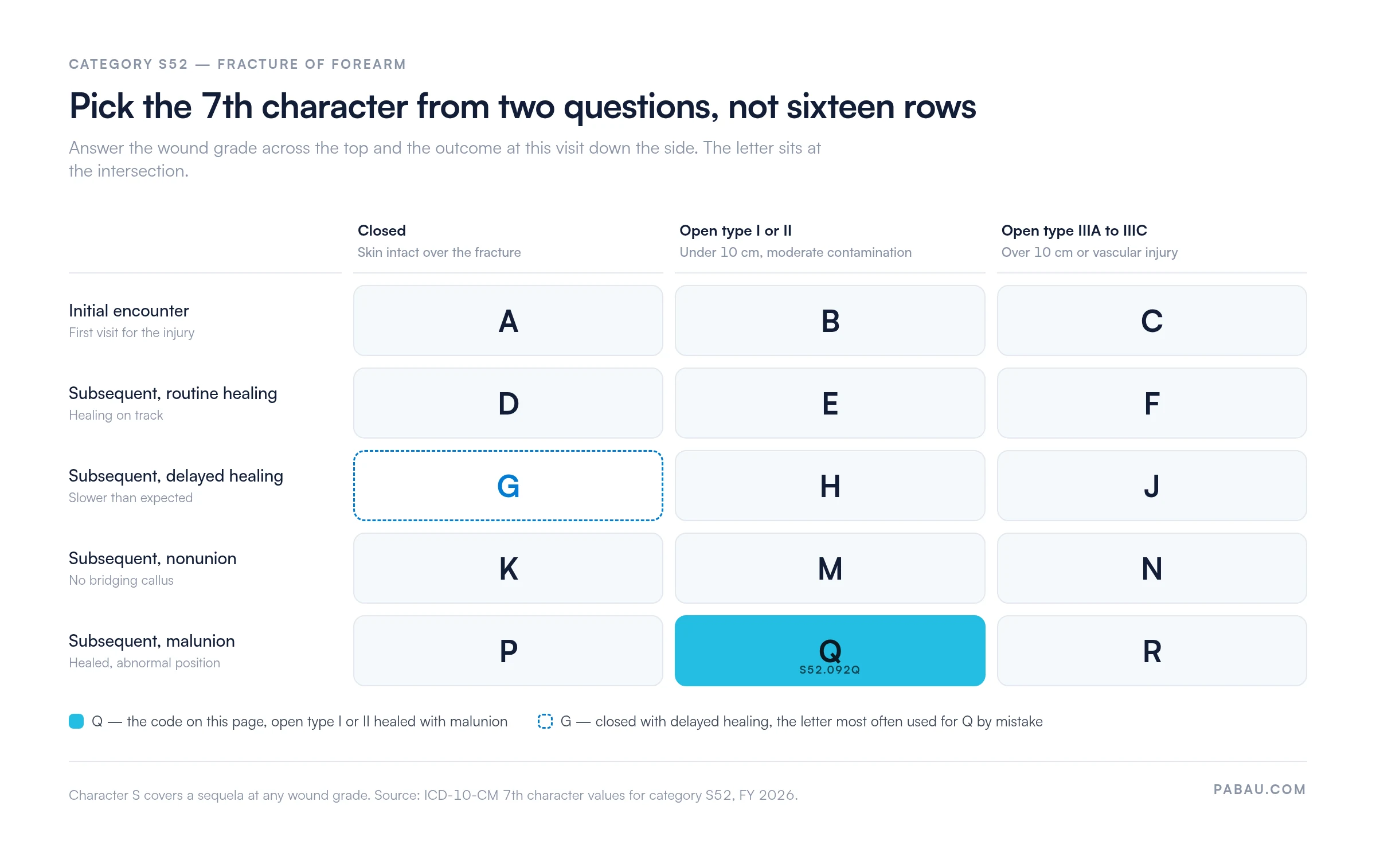
Read the 7th character as a pair, not a single letter. The first question is the wound. It is closed, open type I or II, or open type IIIA to IIIC. The second question is the outcome at this visit. It is routine healing, delayed healing, nonunion, or malunion. Answer both, then take the letter at the intersection. G and Q both mark subsequent encounters. G is a closed fracture with delayed healing. Q is an open type I or II fracture with malunion.
Malunion means the fracture has healed, but in a suboptimal or angulated position. Nonunion means healing has failed, with no bridging callus forming across the fracture site. The clinical record has to support whichever one the coder selects.
ICD-10-CM open fracture coding follows the Gustilo-Anderson classification, which orthopedic surgeons apply at debridement to grade wound contamination and soft tissue damage. That grade decides the 7th character at the initial encounter, and it carries forward to every subsequent encounter code for the same injury.
Types I and II share one pair of characters, B for the initial encounter and Q for a subsequent encounter with malunion. Types IIIA through IIIC share a separate pair, C and R. S52.092Q therefore applies only to fractures originally graded Gustilo type I or II.
When the operative report does not state the Gustilo type, query the surgeon before you assign a 7th character. Suppose the wound was type I or II and you default to type IIIA. The claim then moves from B and Q to C and R. That mismatch between the note and the code can surface during an audit.
Coders working with S52.092Q regularly need sibling codes for the same fracture at a different encounter stage, laterality, or healing outcome. These are the most clinically relevant codes in the S52.092 family.
The Q versus M distinction is the most audit-sensitive comparison in this family, because both describe the same open wound grade at a follow-up visit. Radiology reports settle it. Callus with angulation supports Q, and a persistent fracture line with no bridging callus supports M.
Six documentation elements have to be stated clearly in the record before S52.092Q can be assigned. Miss one and the coder cannot justify the code, which forces a query back to the treating provider. Each element has to appear explicitly in the note rather than by inference.
When the note reads ambiguously between malunion and nonunion, query rather than default. A 7th character that contradicts the initial encounter code can surface at a Medicare contractor during post-payment review.
Most rejections on this code come from the 7th character rather than the base code. These are the errors that show up most often on proximal ulna follow-up claims.
S52.092Q is a diagnosis code, so every claim pairs it with a procedure code. The CPT code reflects what happened at this encounter, which is usually corrective or aftercare work rather than the original fracture treatment. These codes sit inside the wider CPT code set, alongside the casting, imaging, and wound-care families a malunion follow-up draws on.
Two payer rules deserve a check before submission. CPT pairing varies by payer, and NCCI edits bundle some of these codes together. Global periods matter more than usual here, since a malunion often follows operative treatment and much of the aftercare sits inside the surgical package.
Splint and cast application codes cover work done at the visit, not a prefabricated brace supplied for the patient to wear home. A wrist support like HCPCS code L3916 carries its own order requirement, which must name the device rather than say splint or brace.
ICD-10 code S52.092Q is billable and specific. Payers adjudicating on ICD-10-CM accept it for fiscal year 2026 without an unspecified-code rejection. Specificity does not guarantee payment, though. Coverage policy decides that.
The ICD-10-CM alphabetical index reaches S52.092Q by several entry paths. For traumatic fractures the main term is always “Fracture”, with subterms for site, laterality, wound type, and outcome. Confirm every index reference against the AAPC ICD-10-CM code lookup.
The WHO browser gives international context for forearm fracture classification. The US clinical modification aligns with the WHO ICD-10 international classification but can differ from it. For US billing, always work from the current ICD-10-CM tabular list rather than the WHO version.
Re-check the index entry paths for S52.092Q each October, when the new fiscal year tabular takes effect. Code descriptions and hierarchy shift between editions from time to time, and carrying prior-year codes forward without verification creates compliance exposure.
In most orthopedic practices the 7th character gets checked twice. The coder picks it, and whoever works the denial three weeks later checks it again. The detail that decides the character sits in the operative note and the radiology read. It rarely travels with the charge, so the coder rebuilds the history by hand at every follow-up visit.
Practice management software like Pabau keeps that detail attached to the patient record instead. The original wound grade, the imaging, and the encounter history stay on the chart the coder is already reading. Choosing between G, H, M, P, Q, and R then takes one screen rather than a hunt through old files. That single record also supports cleaner claims management, which flags subsequent-encounter codes for review before they leave the practice.
Pabau also connects to Claim.MD, which submits ICD-10-CM coded claims to thousands of US payers, including Medicare, Medicaid, and Blue plans. Eligibility checks and ERA files come back against the same record. Reporting across initial and subsequent fracture encounters then shows where 7th character errors cluster, so you fix the pattern instead of the individual claim.

Pabau keeps the wound grade, the imaging, and the encounter history on the record your coder is already reading. Claims then submit through Claim.MD, with eligibility checks and ERA matching built in.

The base code on a proximal ulna follow-up is rarely what fails. The 7th character is, because it reports a wound grade recorded months ago alongside a healing outcome recorded today. A coder who cannot see both records is guessing at one of them.
That makes the fix an upstream one. Keep the original Gustilo grade and the current radiology read on the same chart. Choosing between G, H, M, P, Q, and R then stops being a judgment call. Where either record is missing, query the provider and accept the delay.
Practices that see a steady volume of fracture follow-ups get the most out of a workflow that checks 7th character consistency before submission. Pabau pairs that check with the Claim.MD integration, so orthopedic and physical therapy practices can submit subsequent encounter claims accurately the first time. Book a demo to see how the workflow runs end to end.

Need a reference for electronic claim submission workflows? 837 file submission guide explains how ICD-10-CM diagnosis codes are structured and transmitted to clearinghouses.
Want to see how ERA responses confirm payment for fracture codes? Electronic remittance advice explained covers how payer ERA files report adjudication results for submitted diagnosis codes.
Looking for guidance on eligibility before a fracture follow-up visit? Insurance eligibility verification details how to confirm coverage ahead of subsequent encounter appointments.
ICD-10 code S52.092Q is a billable diagnosis code for another fracture of the upper end of the left ulna, seen at a subsequent visit. The original fracture was open and graded Gustilo type I or II. It has since healed with malunion, meaning the bone united in an angulated or otherwise abnormal position.
Yes. S52.092Q is a billable, specific ICD-10-CM code valid for fiscal year 2026, effective October 1, 2025. It can be reported on claims without an unspecified-code rejection from payers working off current ICD-10-CM data.
S52.092G covers a subsequent encounter for a closed fracture of the upper end of the left ulna with delayed healing. S52.092Q covers a subsequent encounter for the same fracture when the wound was open type I or II and the bone has healed with malunion. The two differ on both wound type and healing outcome.
The 7th character Q signals three conditions at once. The encounter is a subsequent visit rather than the initial one. The original fracture was open and graded Gustilo type I or II. The fracture has healed with malunion. All three have to be documented in the record.
Malunion means the fracture healed in an abnormal or angulated position. In this code family it takes 7th character P when the fracture was closed. Open type I or II takes Q, and open type IIIA to IIIC takes R. Nonunion means healing failed with no bridging callus. It takes K, M, and N across those same three wound types.
Gustilo type I is an open fracture with a wound under 1 cm and minimal contamination. Type II has a wound of 1 to 10 cm with moderate soft tissue damage and no extensive loss of coverage. Both share the same ICD-10-CM 7th characters, B at the initial encounter and Q at a subsequent encounter with malunion.
S52.092A applies to the initial encounter for a closed fracture of the upper end of the left ulna. That is the first visit, where the injury was identified and treated. S52.092Q applies to a later visit, where the original fracture was open type I or II and has since healed with malunion.
Corrective repair codes 25400 and 25405 pair with S52.092Q when the malunited radius or ulna is repaired without or with an autograft. Monitoring visits usually pair with an office visit code such as 99213 or 99214, or with 99024 when the encounter falls inside a global period.