ICD code S52.002F – Unspecified fracture of upper end of left ulna
Billable Code•Specific Code
Code Definition
S52.002F is the billable ICD-10-CM code for unspecified fracture of upper end of left ulna, subsequent encounter for open fracture type IIIA, IIIB, or IIIC with routine healing.
First, this reference covers the full code description, every valid 7th character for S52.002, and the Gustilo grading that drives the choice. It then works through documentation requirements, common coding errors, sibling codes, and the CPT codes paired with this diagnosis.
Related Information
Chapter
S00-T88 Injury, poisoning and certain other consequences of external causes
Category
S52 Fracture of forearm
Group
S52.002 Unspecified fracture of upper end of left ulna
Billable
Yes
Save time. Improve accuracy. Get paid faster.
Automate coding with Pabau
Let Pabau's smart automation suggest the right codes, reduce claim denials, and keep your practice compliant—effortlessly.
S52.002FUnspecified fracture of upper end of left ulna
ICD Code Suggestion
AI
Suggested code
S52.002FUnspecified fracture of upper end of left ulnaHigh match
Confidence score
98%
Why this code?
Matches patient diagnosis
Supported by clinical notes
Commonly used for this condition
Why practices choose Pabau
Save hours every week
Automate repetitive tasks and focus on what matters most—your patients.
Improve accuracy
Reduce coding errors and ensure compliance with the latest regulations.
Get paid faster
Clean claims, fewer denials, and faster reimbursements.
Grow with confidence
Powerful insights and reporting to help your practice thrive.
HIPAA compliant•SOC 2 certified•GDPR-compliant•Trusted by 4,000+ clinics worldwide
Key takeaways
S52.002F is a billable ICD-10-CM code for an unspecified fracture of the upper end of the left ulna. The 7th character F adds: subsequent encounter for open fracture type IIIA, IIIB, or IIIC with routine healing.
The 7th character F marks a follow-up visit for a Gustilo type III open fracture that is healing normally. So it is not a closed fracture, and it is not a healing complication.
Documentation must confirm laterality (left), fracture site (proximal ulna), the documented Gustilo grade, and that healing is progressing on schedule.
Practice management software like Pabau validates patient and insurance details, then submits fracture follow-up claims and tracks their status through integrated clearinghouses.
ICD-10 Code S52.002F: quick reference
The table below gives coders a fast lookup for ICD-10 Code S52.002F before the full breakdown.
Field
Details
ICD-10-CM code
S52.002F
Full description
Unspecified fracture of upper end of left ulna, subsequent encounter for open fracture type IIIA, IIIB, or IIIC with routine healing
Billable?
Yes. Valid for HIPAA-covered transactions.
Code validity
Active for FY2025 and FY2026
7th character
F = Subsequent encounter for open fracture type IIIA, IIIB, or IIIC with routine healing
Fracture type
Open, Gustilo type IIIA, IIIB, or IIIC
Healing status
Routine (no delayed healing, nonunion, or malunion documented)
Parent code
S52.002 (Unspecified fracture of upper end of left ulna)
Code category
S52 – Fracture of forearm (Injuries to elbow and forearm, S50-S59)
Laterality
Left
What is S52.002F?
S52.002F is a billable ICD-10-CM code for a follow-up visit after a high-grade open fracture of the proximal left ulna. So the patient is past active treatment, the wound was graded Gustilo type III at presentation, and the bone is knitting on schedule. Each element of the description carries its own coding consequence.
Unspecified fracture: The fracture type (displaced or non-displaced) is not documented in the clinical record. When physician notes do not specify displacement, ICD-10-CM guidelines direct coders to the “unspecified” subcategory. However, this is not an error. Instead, it reflects the documentation as written.
Upper end of ulna: The upper end of the ulna is the proximal end, so it covers the olecranon process and the coronoid process. Coders sometimes confuse “upper end” with “shaft” fractures. However, proximal ulna fractures belong under S52.0.
Left ulna: Laterality is required at the most specific code level. So using a right-ulna code (S52.001F) or an unspecified-laterality code for a documented left-sided injury is a coding error under CMS ICD-10-CM guidelines.
Subsequent encounter: The patient is no longer in the active treatment phase. They are receiving routine aftercare while the fracture heals.
Open fracture type IIIA, IIIB, or IIIC: The original injury broke the skin and was graded type III on the Gustilo scale. Type III therefore means extensive soft-tissue damage, and in type IIIC an arterial injury that requires repair. Also, the grade is set by the initial injury record, not by today’s exam.
Routine healing: At this encounter the physician documents healing that is progressing as expected. So nothing in the note describes delayed union, nonunion, or malunion.
The CDC/NCHS ICD-10-CM tool also confirms S52.002F as an active, billable code. Check the official tabular list before each new fiscal year, since the annual update cycle can revise a description without retiring the code.
The 7th character F: open type III with routine healing
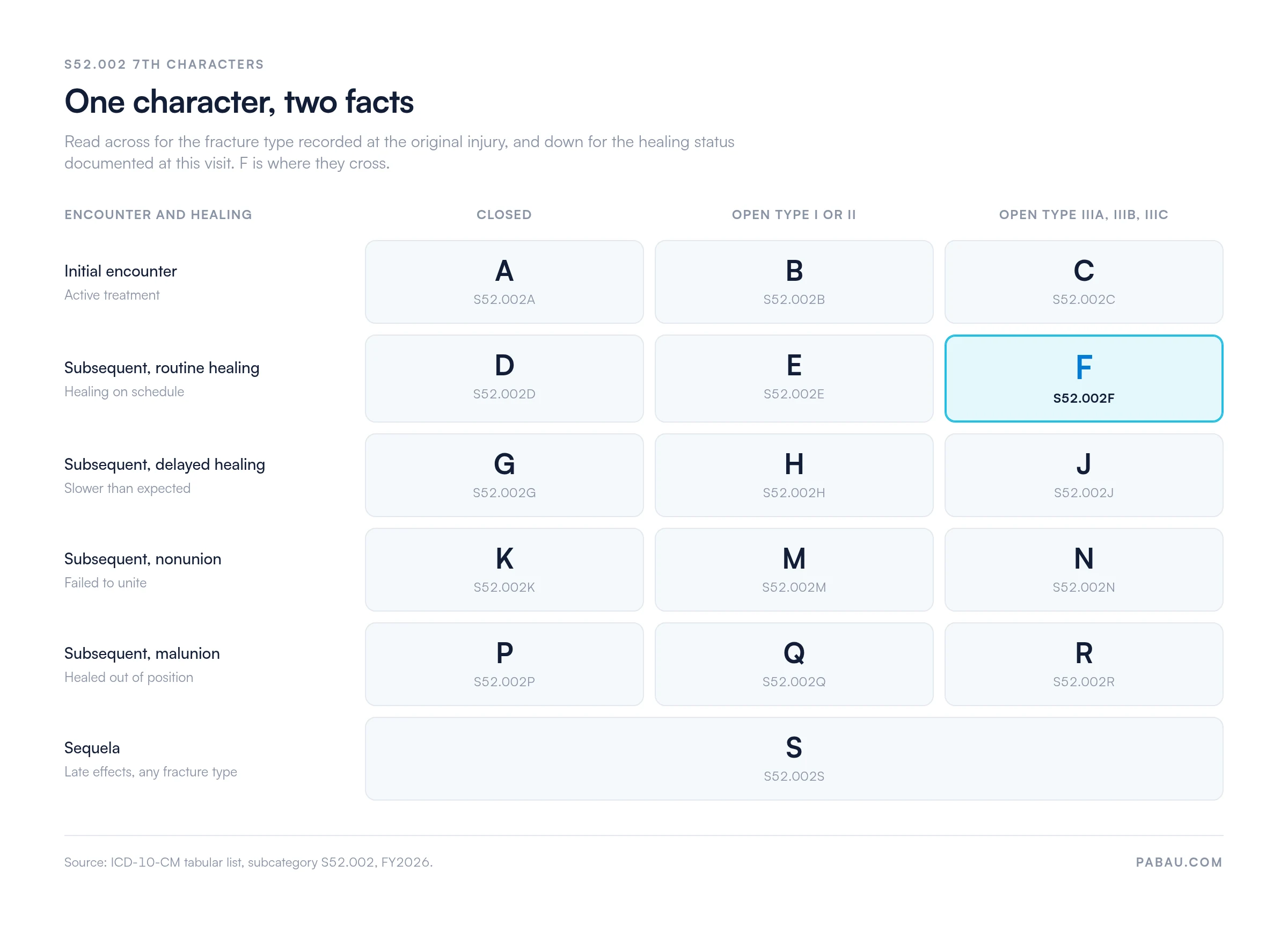
The 7th character is the coding decision that matters most on any S52.002 claim. It is easy to read it as a single fact, but it encodes two. The first is the fracture type at presentation: closed, open type I or II, or open type IIIA, IIIB, or IIIC. The second is the healing status at this encounter: routine, delayed, nonunion, or malunion. In fact, sixteen characters cover every pairing, and F sits where open type III meets routine healing.
F is the cell where open type IIIA to IIIC meets routine healing. In contrast, delayed healing on that same fracture is J. Grid built from the ICD-10-CM tabular list for S52.002.
7th Character
Full Code
Encounter Meaning
Clinical Context
A
S52.002A
Initial encounter for closed fracture
Active treatment; first treatment contact for a fracture with intact skin
B
S52.002B
Initial encounter for open fracture type I or II
Active treatment; Gustilo type I or II open fracture, or an open fracture with no documented grade
C
S52.002C
Initial encounter for open fracture type IIIA, IIIB, or IIIC
Active treatment; Gustilo type III high-grade open fracture
D
S52.002D
Subsequent encounter for closed fracture with routine healing
Follow-up; closed fracture healing on the expected timeline
E
S52.002E
Subsequent encounter for open fracture type I or II with routine healing
Follow-up; Gustilo I/II open fracture healing normally
F
S52.002F
Subsequent encounter for open fracture type IIIA, IIIB, or IIIC with routine healing
Follow-up; Gustilo III open fracture healing normally; wound care, cast or splint changes, imaging review
G
S52.002G
Subsequent encounter for closed fracture with delayed healing
Follow-up; closed fracture healing slower than clinically expected
H
S52.002H
Subsequent encounter for open fracture type I or II with delayed healing
Follow-up; Gustilo I/II open fracture with documented delayed healing
J
S52.002J
Subsequent encounter for open fracture type IIIA, IIIB, or IIIC with delayed healing
Follow-up; Gustilo III open fracture healing slower than expected
K
S52.002K
Subsequent encounter for closed fracture with nonunion
Follow-up; closed fracture has failed to unite
M
S52.002M
Subsequent encounter for open fracture type I or II with nonunion
Follow-up; Gustilo I/II open fracture with documented nonunion
N
S52.002N
Subsequent encounter for open fracture type IIIA, IIIB, or IIIC with nonunion
Follow-up; Gustilo III open fracture with documented nonunion
P
S52.002P
Subsequent encounter for closed fracture with malunion
Follow-up; closed fracture healed in an abnormal position
Q
S52.002Q
Subsequent encounter for open fracture type I or II with malunion
Follow-up; Gustilo I/II open fracture healed in an abnormal position
R
S52.002R
Subsequent encounter for open fracture type IIIA, IIIB, or IIIC with malunion
Follow-up; Gustilo III open fracture healed in an abnormal position
S
S52.002S
Sequela
Late effects of the original injury; used after active healing is complete for residual conditions
Notice, then, what the set does not contain. There is no character for delayed healing on its own, because every subsequent-encounter character names a fracture type as well. That is why F cannot mean delayed healing. Delayed healing lives in G, H, and J, split by fracture type, while routine healing lives in D, E, and F on the same pattern.
F vs. D: Both describe routine healing at a follow-up visit. However, D is for a closed fracture and F is for a Gustilo type III open fracture. So the deciding evidence is the wound status recorded at the original injury.
F vs. E: Both cover open fractures healing routinely, so the split is the Gustilo grade.
F vs. J: Both cover Gustilo type III fractures. Thus the split is whether the treating physician documents healing as routine or delayed.
Pro Tip
The fracture-type half of the 7th character is fixed by the original injury record, while the healing half changes visit by visit. Pull the ED or operative note once and record the graded fracture type on the problem list. Also, reuse that fact for every follow-up claim in the episode. Then the only question at each visit is which healing tier the physician documented.
Gustilo classification: what makes an open fracture type IIIA, IIIB, or IIIC
ICD-10-CM ties the open-fracture 7th characters directly to the Gustilo-Anderson classification. Notably, the scale grades the wound and the surrounding soft tissue, not the bone. A coder does not assign the grade. The surgeon does, so the coder reads it out of the record.
Gustilo type
What the record describes
7th character group
Type I
Wound under 1 cm, clean, with minimal soft-tissue damage
Open type I or II (B, E, H, M, Q)
Type II
Wound over 1 cm with moderate soft-tissue damage and no extensive loss
Open type I or II (B, E, H, M, Q)
Type IIIA
Extensive soft-tissue damage, but enough tissue remains to cover the bone
Open type IIIA, IIIB, or IIIC (C, F, J, N, R)
Type IIIB
Extensive soft-tissue loss with periosteal stripping; needs flap coverage
Open type IIIA, IIIB, or IIIC (C, F, J, N, R)
Type IIIC
Any open fracture with an arterial injury that requires repair
Open type IIIA, IIIB, or IIIC (C, F, J, N, R)
ICD-10-CM collapses IIIA, IIIB, and IIIC into one character, so a coder never has to separate the three subtypes. However, telling type III apart from type I or II does matter, because it decides whether the routine-healing follow-up is coded F or E.
Pro Tip
The ICD-10-CM Official Guidelines for Coding and Reporting are explicit on this point. When the Gustilo type is not specified for an open fracture, assign the 7th character for open fracture type I or II. So F requires the record to say type III. An open fracture with no documented grade is coded E at a routine-healing follow-up, never F.
S52.002F in the ICD-10-CM code hierarchy
Knowing where S52.002F sits in the ICD-10-CM structure helps coders reach the correct parent code and check its exclusion notes. The WHO ICD-10 browser provides the global classification framework. In contrast, the US ICD-10-CM system adapts that structure with the extra detail that laterality and 7th characters require.
Level
Code
Description
Chapter
S00-T88
Injury, poisoning, and certain other consequences of external causes
Block
S50-S59
Injuries to the elbow and forearm
Category
S52
Fracture of forearm
Subcategory
S52.0
Fracture of upper end of ulna
Code (no 7th)
S52.002
Unspecified fracture of upper end of left ulna (requires 7th character)
Billable code
S52.002F
Subsequent encounter for open fracture type IIIA, IIIB, or IIIC with routine healing (left ulna, upper end, unspecified type)
So S52.002 itself is not billable. A 7th character is always required before the code can go on a claim. As a result, submitting S52.002 without the character appended will trigger a claim edit as an invalid code.
Documentation requirements at a follow-up visit
The open-fracture half of this code is where documentation most often falls short. Notably, payers reviewing an S52.002F claim look for the Gustilo grade and the wound status. Neither one can be inferred from a follow-up exam, so both have to be carried forward from the original injury record.
Laterality (left): First, the note must clearly name the left side. Vague language such as “the ulna” or “the affected arm” is not enough when ICD-10-CM requires laterality specificity.
Fracture site (upper end/proximal ulna): The note must place the fracture at the proximal ulna. A note that names the olecranon or the coronoid process supports the upper end classification. A shaft note, however, does not.
Encounter type (subsequent): The encounter must be a follow-up visit, not the first treatment contact. The note should reflect aftercare such as wound checks, cast or splint changes, imaging review, or a physical therapy referral.
Open fracture with a documented Gustilo type III grade: This is the element that sets F apart from every other routine-healing character. The initial injury record must therefore state that the fracture was open and grade it IIIA, IIIB, or IIIC. Carry that grade forward into the follow-up note so the claim stands on its own.
Wound and soft-tissue status at this visit: Describe the wound as it is now. Also note closure, graft or flap status, drainage, and any signs of infection. This then supports both the open-fracture character and any wound care billed alongside the visit.
Evidence of routine healing: The note must also show healing on the expected timeline. Language such as “callus formation appropriate for six weeks post-injury” or “alignment maintained on repeat imaging” supports routine healing. In contrast, a note describing delayed union, nonunion, or malunion moves the code to J, N, or R.
Fracture type (unspecified): If the original fracture type is not documented, unspecified is appropriate. If later imaging clarifies displacement, then move to the more specific code. So coders should not assume displacement or non-displacement without documentation.
Also review the clean claim submission requirements that apply to injury diagnosis codes. Then make sure the open-fracture grade and the healing assessment appear in the assessment or plan section, not only in the history.
Per AAPC ICD-10-CM coding guidance, the fracture type and the healing assessment must both come from the treating physician. A coder cannot upgrade an open fracture to type III because the wound looks severe in a photograph. Nor can a coder call healing routine simply because no complication was mentioned.
Common coding errors with S52.002F
Most S52.002F denials are easy to avoid. Indeed, the errors below account for most rejections on proximal ulna fracture follow-up visits.
Reading F as delayed healing: This is the most common error on this code, and it comes from learning only part of the extension list. Instead, F means open type III with routine healing. Delayed healing is G for a closed fracture, H for open type I or II, and J for open type III.
Using F on a closed fracture: If the record describes intact skin at presentation, the routine-healing follow-up is S52.002D. Indeed, F asserts an open wound that the record has to support.
Using F when the Gustilo grade is missing: An open fracture with no documented type defaults to the type I or II character. The routine-healing follow-up is then S52.002E. Query the surgeon rather than assume type III.
Changing the fracture-type letter mid-episode: Open versus closed and the Gustilo grade are fixed by the original injury. So only the healing tier moves as the episode progresses. A patient coded C at presentation moves to F, J, N, or R later, never to D, G, K, or P.
Using an initial-encounter character on a follow-up visit: A, B, and C are for active treatment. A patient returning for a wound check or imaging review weeks later is a subsequent encounter. So repeating C on follow-up visits is both a coding error and an audit flag.
Omitting laterality: S52.002F specifies the left ulna. Submitting a laterality-unspecified code when the side is documented is a specificity error under ICD-10-CM guidelines.
Submitting S52.002 without a 7th character: S52.002 is not billable. Every claim needs a complete seven-character code, since clearinghouses reject incomplete codes.
Using the right-ulna code: S52.001F describes the right ulna. When the documented injury is the left ulna, only S52.002F applies. Laterality swaps often start in copy-paste EHR workflows.
So tracking which of these errors drives the most rework lets a coding team target its retraining. On a proximal ulna episode, audit the fracture-type letter first. It is the one element a follow-up note cannot establish on its own.
Laterality also behaves differently once a supply code joins the claim. An orthosis code such as HCPCS code L3913 names no side, so the line needs an RT or LT modifier instead.
Pro Tip
Run a regular internal audit on subsequent fracture encounters, then compare the 7th character against the initial encounter character on the same episode. A patient coded C at presentation should never later carry one of the closed-fracture characters (D, G, K, or P). Any such pair is thus a fracture-type conflict inside one episode. It is the fastest way to catch the F-means-delayed-healing mistake before a claim goes out.
Related ICD-10-CM codes: sibling codes and adjacent diagnoses
The table below covers the S52.002 codes a coder is most likely to weigh against S52.002F. It also lists the right-ulna and unspecified-laterality codes, because laterality swaps are a frequent source of rejections.
Code
Description
Key distinction
S52.002C
Unspecified fracture of upper end of left ulna, initial encounter for open fracture type IIIA, IIIB, or IIIC
The active-treatment counterpart of S52.002F
S52.002D
Unspecified fracture of upper end of left ulna, subsequent encounter for closed fracture with routine healing
Routine healing, but the fracture was closed
S52.002E
Unspecified fracture of upper end of left ulna, subsequent encounter for open fracture type I or II with routine healing
Routine healing on a lower-grade open fracture, and the default when the Gustilo type is not documented
S52.002F
Unspecified fracture of upper end of left ulna, subsequent encounter for open fracture type IIIA, IIIB, or IIIC with routine healing
This code: a Gustilo type III open fracture healing on schedule
S52.002G
Unspecified fracture of upper end of left ulna, subsequent encounter for closed fracture with delayed healing
Delayed healing on a closed fracture, and the code most often confused with F
S52.002H
Unspecified fracture of upper end of left ulna, subsequent encounter for open fracture type I or II with delayed healing
Delayed healing on a type I or II open fracture
S52.002J
Unspecified fracture of upper end of left ulna, subsequent encounter for open fracture type IIIA, IIIB, or IIIC with delayed healing
Same fracture type as F, but healing is slower than expected
S52.002K
Unspecified fracture of upper end of left ulna, subsequent encounter for closed fracture with nonunion
A closed fracture that has failed to unite
S52.002N
Unspecified fracture of upper end of left ulna, subsequent encounter for open fracture type IIIA, IIIB, or IIIC with nonunion
Same fracture type as F, but union has failed
S52.002R
Unspecified fracture of upper end of left ulna, subsequent encounter for open fracture type IIIA, IIIB, or IIIC with malunion
Same fracture type as F, but healed in an abnormal position
S52.002S
Unspecified fracture of upper end of left ulna, sequela
Late effects after healing is complete
S52.001F
Unspecified fracture of upper end of right ulna, subsequent encounter for open fracture type IIIA, IIIB, or IIIC with routine healing
Right-side equivalent of S52.002F
S52.009F
Unspecified fracture of upper end of unspecified ulna, subsequent encounter for open fracture type IIIA, IIIB, or IIIC with routine healing
Use only when laterality is truly unknown
Associated CPT codes for proximal ulna fracture treatment
S52.002F is a diagnosis code, so it must be paired with a procedure code on every claim. The CPT code reflects what was done at this subsequent encounter, which is usually aftercare rather than definitive fracture treatment. Those procedure codes also sit inside the wider full CPT code set, alongside the casting, imaging, and wound-care families this diagnosis draws on.
CPT Code
Description
Use with S52.002F when…
24685
Open treatment of ulnar fracture, proximal end (eg, olecranon or coronoid process[es]), includes internal fixation, when performed
The most relevant procedure for a type III open fracture, since these injuries are usually treated operatively. Bill it at the definitive procedure, not at the follow-up visit.
24675
Closed treatment of ulnar fracture, proximal end (eg, olecranon or coronoid process[es]); with manipulation
Closed reduction was performed on the proximal ulna after the wound was managed
24670
Closed treatment of ulnar fracture, proximal end (eg, olecranon or coronoid process[es]); without manipulation
The proximal ulna fracture was stabilized without manipulation
99024
Postoperative follow-up visit, normally included in the surgical package
The subsequent encounter falls inside the global period of the open treatment
29105
Application of long arm splint (shoulder to hand)
A long arm splint is applied or replaced at the follow-up encounter
29065
Application, cast; shoulder to hand (long arm)
A long arm cast is applied or replaced at the follow-up encounter
73070
Radiologic examination, elbow; 2 views
Repeat imaging confirms that the proximal ulna is healing on schedule
97597
Debridement of an open wound, first 20 sq cm or less, per session
Selective wound care is performed at the open fracture site during aftercare
99213
Office or other outpatient visit, established patient, low level of medical decision making
Evaluation and management at a routine-healing follow-up outside a global period
99214
Office or other outpatient visit, established patient, moderate level of medical decision making
Wound management or additional workup raises the level of medical decision making
Two payer rules deserve a check before submission. First, CPT pairing rules vary by payer, and NCCI edits may bundle certain procedure codes together. Global periods, however, matter more than usual here. A type III open fracture is often treated surgically, so much of the routine aftercare falls inside the surgical package.
Is S52.002F valid for FY2026?
S52.002F is valid for both FY2025 and FY2026, confirmed through the CDC/NCHS ICD-10-CM tool. Also, no description changes affected this code in the FY2026 update cycle. CDC/NCHS manages the update process under CMS oversight, and each October 1 it may add or revise fracture subcodes. So verify the code’s status at the start of every fiscal year.
FY2025 status: Active and billable
FY2026 status: Active and billable, with no changes to the S52.002 subcategory in the FY2026 update
HIPAA validity: Accepted for electronic claims under HIPAA transaction standards when paired with a valid CPT or HCPCS procedure code
Annual check: Review the CMS FY update files each October 1, or instead use the CDC ICD-10-CM web tool for real-time validity lookups
Refresh the encoder and the stored code sets at the start of each fiscal year, so a retired code never reaches a payer. An annual internal audit of S52 usage against the updated guidelines also catches what an encoder alone will miss.
How Pabau supports claim submission for fracture codes
In most orthopedic and urgent care practices, a fracture follow-up claim often gets assembled twice. The clinician documents the visit in the chart, and a biller then re-keys the patient and insurance details into a separate portal. Every re-keying step is a chance for a mismatched policy number or date of birth. As a result, those mismatches come back as rejections that have nothing to do with the coding itself.
Practice management software like Pabau removes that second pass. Patient and insurance details are validated inside the record before a claim is built. A stale policy number gets caught before submission rather than after. Claims then go out through Pabau’s clearinghouse integrations, including Healthcode in the UK, Claim.MD in the US, and Tyro Health in Australia. Status updates flow back onto the patient’s record, so a biller can see where a claim sits without logging into a separate portal.
For a practice running a high volume of S52 aftercare visits, the result is therefore fewer needless rejections from bad patient data. It also means far less time spent chasing claim status. Overall, coding judgment stays with the coder, which is where the 7th character decision belongs.
Pabau’s claims management screen submits fracture follow-up claims and reports each status back onto the patient record, so nobody re-keys policy details.
Spend less time chasing fracture follow-up claims
Pabau validates patient and insurance details inside the record, then submits claims through integrated clearinghouses and reports each claim’s status back to your team.
Selecting S52.002F correctly depends on four elements. The encounter must be subsequent and the site must be the left proximal ulna. The fracture must then be open at Gustilo type IIIA, IIIB, or IIIC, and healing must be routine. Change any one of those and the code changes with it. In short, the mistake to guard against is treating F as a delayed-healing character. Delayed healing on a closed fracture is instead S52.002G, and delayed healing on this same open fracture is S52.002J.
For practices billing across the S52 family, Pabau also supports cleaner claims management from inside the patient record. It validates patient and insurance details, submits the claim, and then reports its status back without a second portal. To see how it handles fracture follow-up billing, book a demo.
Continue your research
Need to understand how clean claims are built?Clean claim submission requirements covers what a valid claim looks like before it reaches the payer.
Want to reduce denial rates on injury codes?Denial management workflows outlines how to track, appeal, and prevent claim rejections on musculoskeletal diagnoses.
Looking for electronic claim submission guidance?Medical claims clearinghouse explains how clearinghouses validate and route claims to payers, and what happens when one is rejected.
Which denial code came back on the claim?Denial codes in medical billing decodes the common rejection reasons on diagnosis and procedure pairings.
New to the billing cycle?What is medical billing walks through each step from the encounter note to the payer remittance.
Frequently asked questions
What does ICD-10 Code S52.002F mean?
ICD-10 Code S52.002F is a billable diagnosis code for an unspecified fracture of the upper end of the left ulna. It applies at a subsequent encounter for an open fracture type IIIA, IIIB, or IIIC with routine healing. First, unspecified means the fracture type (displaced or non-displaced) is not documented. Subsequent encounter then means the patient is past the active treatment phase. Open fracture means the original injury broke the skin and was graded type III on the Gustilo scale. Routine healing means the bone is knitting on the expected timeline.
What is the 7th character F in ICD-10 fracture codes?
The 7th character F designates a subsequent encounter for an open fracture type IIIA, IIIB, or IIIC with routine healing. The same meaning also applies across the S42, S52, S72, S82, and S92 fracture categories. However, F does not mean delayed healing. Instead, delayed healing at a subsequent encounter is G for a closed fracture and H for an open type I or II fracture. For an open type IIIA, IIIB, or IIIC fracture it is J.
Is S52.002F a billable ICD-10-CM code?
Yes. S52.002F is indeed a valid, billable ICD-10-CM code accepted for HIPAA-covered electronic transactions. It is also active for FY2025 and FY2026. The parent code S52.002 without the 7th character is not billable, so the full seven-character code is always required for claim submission.
When should I use S52.002F versus S52.002G or S52.002J?
S52.002F applies when the fracture was open at Gustilo type III and healing is routine. Use S52.002J when that same type III open fracture is documented as healing slower than expected. S52.002G applies only when the fracture was closed and healing is delayed, which is a different injury type entirely. The fracture type also comes from the original injury record and does not change during the episode. Meanwhile, the healing tier is judged again at each visit.