ICD-10 code S61.201A: Open wound of left index finger without nail damage
ICD-10 code S61.201A covers a left index finger wound of unstated type ICD-10 co...

Last Updated: Oct 16, 2026
Billable Code Specific Code
S32.058S is the billable ICD-10-CM code for other fracture of fifth lumbar vertebra, sequela.
Let Pabau's smart automation suggest the right codes, reduce claim denials, and keep your practice compliant—effortlessly.
Automate repetitive tasks and focus on what matters most—your patients.
Reduce coding errors and ensure compliance with the latest regulations.
Clean claims, fewer denials, and faster reimbursements.
Powerful insights and reporting to help your practice thrive.
HIPAA compliant SOC 2 certified GDPR-compliant Trusted by 4,000+ clinics worldwide

S32.058S is a billable ICD-10-CM code for other fracture of fifth lumbar vertebra, sequela, valid for FY2026 (effective October 1, 2025).
The 7th character ‘S’ designates a sequela encounter, used only after active fracture treatment is complete and a late effect persists.
S32.058 has six encounter variants: A, B, D, G, K, and S. Picking the wrong 7th character is a common cause of claim denial.
A sequela claim carries two codes. The sequela condition goes first, then S32.058S to identify the original injury.
Practice management software like Pabau helps practices document the correct encounter type and submit clean ICD-10-CM claims to payers.
ICD-10 Code S32.058S is a billable ICD-10-CM diagnosis code for other fracture of fifth lumbar vertebra, sequela. Use it when a patient’s L5 fracture has been fully treated and a residual condition, a sequela, now drives the encounter.
The CDC/NCHS ICD-10-CM tool confirms the code as active for FY2026, effective October 1, 2025. It sits within the S32 category, which covers fractures of the lumbar spine and pelvis. That category falls under the broader injury range S00-T88.
This reference covers the code details table, all six S32.058 variants, and the rules for choosing between sequela and subsequent encounters. It also sets out the code hierarchy, the approximate synonyms, and the instructional notes that affect claim accuracy.
The table below summarizes the administrative facts coders need to verify before submitting a claim using ICD-10 Code S32.058S.
The CMS ICD-10 codes page maintains the annual update files. Verify code validity each October 1, when new fiscal year editions take effect. S32.058S carries no changes for FY2026 beyond confirmation of its active status.
The 7th character extension is a required element in fracture coding, not an optional one. It decides whether a claim processes or rejects. For ICD-10 Code S32.058S the ‘S’ designates a sequela encounter, which ICD-10-CM treats differently from both initial and subsequent encounters.
A sequela is a late effect. It is a condition that arises as a direct consequence of a prior injury, after the acute phase of treatment has ended.
In practice, that means the original L5 fracture is resolved. The patient now presents with chronic pain, a neurological deficit, or a postural deformity that follows from that fracture.
All six S32.058 encounter variants are billable, specific codes. Select the one that matches the documented encounter type.
Document what has changed between the last active-treatment visit and the current encounter. Sequela coding needs a clinical note stating that the acute fracture is resolved. That note must also name the late effect driving today’s visit, such as chronic lumbar pain or radiculopathy. Without it, auditors may recode the encounter to a subsequent-encounter 7th character.
Use S32.058S only after active treatment of the L5 fracture is complete. Mixing it up with S32.058D is one of the most frequent lumbar fracture coding errors. It is also a steady source of the rework that denial management exists to absorb.
Per ICD-10-CM Official Guidelines Section I.C.19, sequela coding applies after active treatment is complete. Subsequent encounter codes (D, G, K) apply while the fracture itself is still the active clinical problem. That holds even when the patient is seeing a different provider for follow-up care.
The chart below maps each documented state to the 7th character it takes.
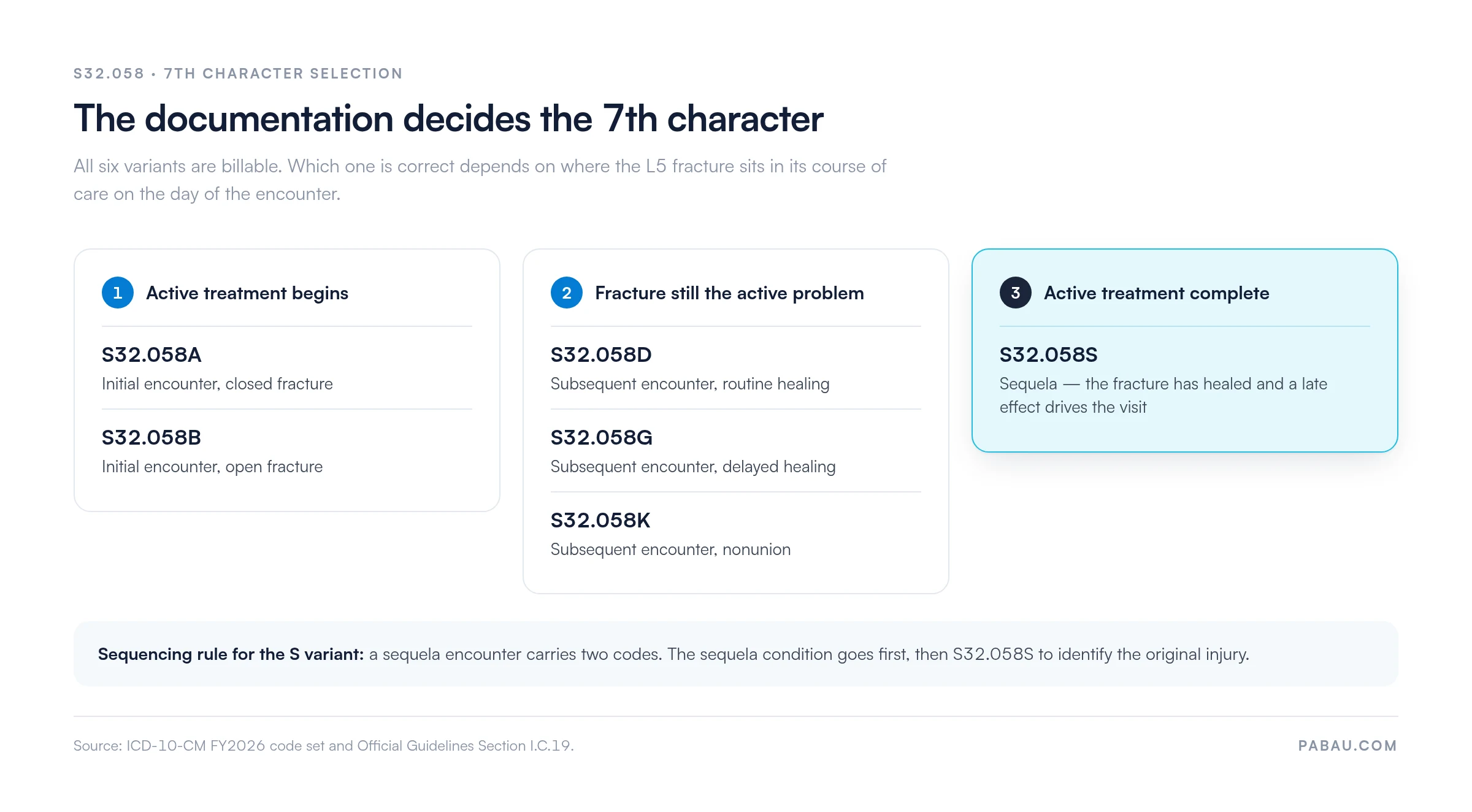
A sequela encounter needs two codes. Code the condition resulting from the fracture first, then ICD-10 Code S32.058S to identify the original injury.
Knowing what makes an L5 fracture fall under the “other” classification helps coders confirm the code before submission. That distinction is made in the clinical note, not at the coding desk.
The fifth lumbar vertebra sits at the lumbosacral junction, the transition point between the lumbar spine and the sacrum. L5 bears significant mechanical load. It is vulnerable to high-energy trauma, such as motor vehicle accidents and falls from height, and to stress fractures in athletes.
Within the S32.05x subcategory, the “other” classification (S32.058) captures fracture types that the more granular codes do not address. Common patterns include transverse process fractures, spinous process fractures, and L5 patterns that are not classifiable as burst or compression fractures.
When the note names the specific fracture pattern, the coder can go straight to the right base code. When it says only “L5 fracture”, S32.058 is often the safest reading of an unspecific record.
The code tree shows when a more or less specific code applies. S32.058S occupies the deepest level of a five-tier parent structure.
S32.058 is a non-billable header code. A 7th character must always be added to create a billable code. S32.058S is the only valid choice when the fracture is historical and a late effect drives the encounter.
Coders searching by clinical documentation language rather than code number will meet these alternate terms for S32.058S. All of them point to the same billable diagnosis.
When mapping from clinical notes, look for two statements. The first is that the original fracture is healed or resolved. The second is that the current symptom or condition follows directly from that prior injury.
That pattern points to ICD-10 Code S32.058S, rather than to a subsequent encounter code.
The S32 category carries instructional notes that decide when S32.058S is appropriate. Verify them before you code, because a note you skipped is a claim the payer rejects.
Applicable to (S32). The category also covers these documented terms:
Excludes1 (S32): transection of abdomen (S38.3). That condition cannot be coded alongside S32.058S in the same encounter, because the two are mutually exclusive by definition.
Use additional code (S32): use an additional code to identify any associated spinal cord and spinal nerve injury (S34.-). On a sequela encounter, code the neurological deficit as the primary sequela condition. Radiculopathy and myelopathy are the common examples. S32.058S then follows as the causal code.
External cause coding: for a sequela encounter, the 7th character S is used with any injury code. That holds even where an external cause code is required. An external cause code for a sequela also carries the S extension. A sequela claim missing the correctly coded external cause may be questioned during audit.
The table below covers the related S32 codes for other lumbar vertebra fractures by level. Use it to confirm the vertebral level before submitting. The AAPC ICD-10-CM lookup allows cross-verification by code range for the full S32.0x family.
Each of these base codes takes the same 7th character set (A, B, D, G, K, S) to become billable. If the operative report or clinical note identifies a specific vertebral level, code to that level rather than to unspecified.
Sequela claims for lumbar fractures usually pair with CPT codes for evaluation and management, physical therapy, or pain management. S32.058S justifies the medical necessity of continued care after the L5 fracture itself has resolved. What is being treated is the resulting pain or functional deficit.
Pre-submission code validation catches these errors early. Pabau connects to the Claim.MD clearinghouse and checks ICD-10-CM codes before a claim reaches the payer. That flags a missing 7th character, or an incomplete sequela code pair, at submission rather than after a denial.
Common denial triggers for S32.058S claims fall into three groups. The companion sequela condition code is missing. The sequencing is reversed, with the sequela code listed before the condition code. Or the clinical note describes an active treatment encounter while the claim carries the sequela 7th character.
Code reference databases stop at the code itself. They say nothing about the documentation a practice has to capture before a coder can defend S32.058S. That is where sequela coding errors start.
Pabau’s claims tools for coders start from the clinical note rather than the code list. When a clinician records that the L5 fracture is resolved, the note itself supports sequela coding. It also has to name what today’s visit is treating, such as chronic lumbar pain.
Structured clinical records carry that wording through to the billing workflow without manual re-entry. The coder reads the same sentence the clinician wrote, so the 7th character stops being a judgment call made after the fact.
Practices handling denials on spinal injury codes gain most from this. Keeping the clinical note, the encounter type, and the claim in one system removes the back-and-forth that 7th character rejections create.

Pabau checks ICD-10-CM codes against the clinical note, flags a missing 7th character, and submits clean claims for lumbar fracture sequela encounters.

S32.058S denials almost always trace back to one of three problems. The 7th character is wrong. The companion sequela condition code is missing. Or the clinical note describes active treatment rather than a sequela.
Fixing that at the point of care costs less than appealing it later. A coder who reads “fracture resolved, chronic lumbar pain” in the note has no guessing left to do. Book a demo to see how Pabau keeps lumbar fracture and spinal injury claims aligned with the clinical record.

Need guidance on ICD-10-CM fracture claim denials? Denial codes in medical billing covers the most common remittance advice codes and how to respond to them.
Want to understand the clearinghouse submission process? 837 file formats and electronic claims explains how ICD-10-CM diagnosis codes are transmitted to payers in EDI transactions.
Looking for the full revenue cycle context? Revenue cycle management covers how diagnosis code accuracy affects reimbursement at every stage from charge capture to payment posting.
ICD-10 Code S32.058S is a billable ICD-10-CM diagnosis code for other fracture of fifth lumbar vertebra, sequela. Use it when the original L5 fracture has healed and the patient presents with a lasting condition caused by that injury. The code is valid for FY2026, effective October 1, 2025.
Yes. S32.058S is a billable, specific ICD-10-CM code, valid for claims submission in FY2026. The base code S32.058 is not billable on its own. Adding the ‘S’ for sequela makes it valid for reimbursement.
S32.058D covers subsequent encounters while the fracture is still healing with routine progress. S32.058S covers encounters after the fracture has resolved, when the visit addresses a residual condition caused by the original injury. The clinical note has to distinguish active fracture treatment from sequela management.
Use sequela (7th character S) after active fracture treatment is complete and a late effect remains, such as chronic pain, radiculopathy, or functional limitation. Use subsequent encounter codes (D, G, or K) while the fracture is still the active clinical problem. That applies regardless of which provider sees the patient.
S32.058S commonly pairs with office visit E/M codes (99202-99215), physical medicine codes, and pain management procedure codes. Which CPT code applies depends on the service provided at the sequela encounter, not on the diagnosis code.
The clinical note has to state that the original L5 fracture has resolved. It also has to name the residual condition driving the current encounter and link it to the prior fracture. Per ICD-10-CM guidelines, the claim carries both the sequela condition code and S32.058S, with the condition sequenced first.