ICD-10 Code S42.444P: Medial epicondyle fracture, right humerus
ICD-10 Code S42.444P: full descriptor and code validity ICD-10 Code S42.444P car...

Last Updated: Oct 13, 2026
Billable Code Specific Code
S11.029D is the billable ICD-10-CM code for unspecified open wound of trachea, subsequent encounter.
Let Pabau's smart automation suggest the right codes, reduce claim denials, and keep your practice compliant—effortlessly.
Automate repetitive tasks and focus on what matters most—your patients.
Reduce coding errors and ensure compliance with the latest regulations.
Clean claims, fewer denials, and faster reimbursements.
Powerful insights and reporting to help your practice thrive.
HIPAA compliant SOC 2 certified GDPR-compliant Trusted by 4,000+ clinics worldwide

S11.029D is a billable ICD-10-CM code for an unspecified open wound of the trachea at a subsequent encounter.
Use S11.029D for follow-up visits after initial treatment, and S11.029A for the first treatment visit.
‘Unspecified’ means the wound type is not documented, so upgrade to a specific S11.02x code when the note supports it.
The code took effect on October 1, 2025 under the 2026 edition of ICD-10-CM.
Practice management software like Pabau sends claims to Claim.MD and flags missing details before they go out.
ICD-10 Code S11.029D is a billable ICD-10-CM diagnosis code for an unspecified open wound of the trachea at a subsequent encounter.
It covers a follow-up visit for a tracheal wound whose type the record never names.
Its full official description reads: Unspecified open wound of trachea, subsequent encounter. The code took effect under the 2026 edition of ICD-10-CM on October 1, 2025, per the CMS ICD-10-CM annual update schedule.
It is valid for reimbursement in HIPAA-covered transactions across Medicare, Medicaid, and commercial payers in the US.
This reference covers the code’s hierarchy, its 7th character rules, when to use it, the official notes, related codes, and the common mistakes.
The table below pulls together the administrative and classification facts for S11.029D, drawn from the official CDC/NCHS ICD-10-CM web tool.
Reading the parent-child structure is how you land on the right level of specificity. S11.029D sits at the bottom of the open wound of neck hierarchy, one step below the S11.02 subcategory for tracheal wounds.
The 7th character is the most misapplied element in the S11.029 subcategory. The ICD-10-CM Official Guidelines for Coding and Reporting are explicit on this. The character must reflect the encounter type at the time of the visit, not when the injury happened.
The S11.029 subcategory has exactly three 7th character options. Picking the wrong one is the main reason claims in this range come back.
Key distinction: “subsequent encounter” does not mean a second injury. It means the same injury is being managed beyond its initial treatment episode. A patient who returns for a wound check a week after tracheal repair is a subsequent encounter. Code that visit S11.029D.
The timeline below maps all three characters onto a single episode of care.
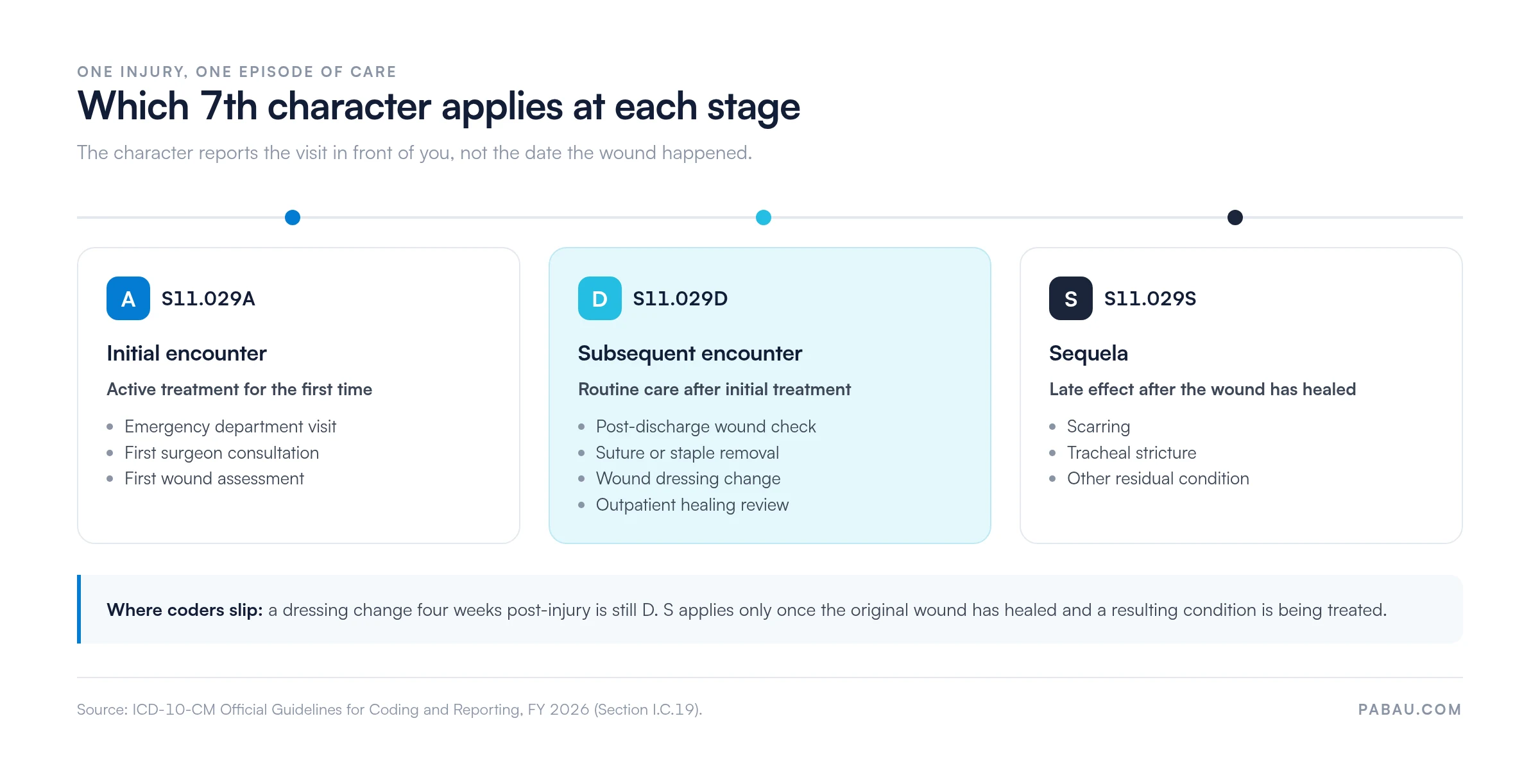
S11.029D applies when the patient has already had initial care for an unspecified open tracheal wound and is back for ongoing management. These are the visits it covers.
The unspecified qualifier applies only when the clinical documentation does not name the wound type. If the record clearly identifies a laceration without a foreign body, use S11.021D instead. Always code to the highest specificity the documentation supports.
Check the documentation before defaulting to S11.029D. If the wound type appears anywhere in the note (laceration, puncture, bite), a more specific S11.02x code is available and preferred by payers. Use S11.029D only when the wound type is genuinely not documented.
The S11 category carries official notes that set the code’s boundaries and tell you when a second code is required. Applying S11.029D outside those boundaries is a short route to a rejected claim.
Neither S11 nor S11.0 carries an Excludes1 note. No code in this range is barred from appearing on the same claim as S11.029D on convention grounds alone.
Two S11 notes ask for an extra code rather than a choice between codes. Add each one when the record documents it.
These are the codes most often reported alongside S11.029D, or mistaken for it. The wound-type rows are the ones to check first, because a documented wound type moves the claim off the unspecified code.
S11.029D is accepted by Medicare and Medicaid when the documentation supports the subsequent-encounter classification. Pair the diagnosis code with the evaluation and management or procedure code that matches the follow-up service you delivered.
Practices submitting electronically can send claims to Claim.MD from inside Pabau, which checks for missing details before the claim leaves the practice. That check is the cheapest place to catch an encounter-type mismatch. Submitting clean claims is far quicker when the code is verified at the point of billing rather than after a denial.
Payer-specific coverage policies may set medical necessity criteria for follow-up wound care visits, so verify coverage with each payer rather than assuming it. Configuring those payer rules once in your billing setup is the shortest route to cleaner claims management on repeat follow-up claims.
Four of the five errors below come down to the 7th character rather than the wound itself. When a claim does come back, the medical billing denial codes on the remittance usually name the mismatch outright.
Document the encounter stage explicitly in your clinical notes. Try a phrase like ‘follow-up for tracheal wound sustained [date], previously treated at [facility]’. That gives your billing team the evidence it needs to assign the 7th character D.
Encounter-type errors like the S11.029A and S11.029D mix-up are rarely about coder knowledge. They happen when the billing step never prompts anyone to check whether the patient has been seen for this wound before.
Pabau keeps insurer details and claims on the same patient record as the appointment history. Whoever codes a follow-up visit can see the earlier encounter for the same wound without opening a second system. That is the check that separates D from A.
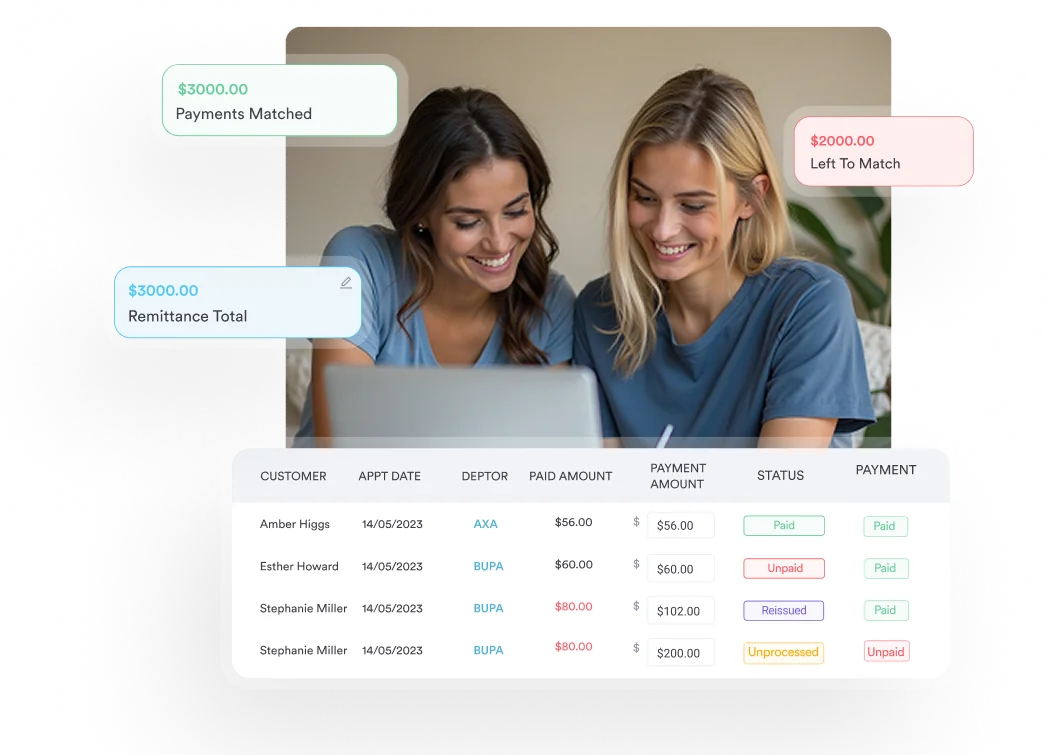
Claims then go out to Claim.MD from inside Pabau, and missing details get flagged before they leave. Payments come back matched against the visit they belong to, so an underpaid follow-up claim is visible rather than lost in a spreadsheet.
For a practice running a steady volume of post-acute wound care, that means less time reworking rejections and more predictable cash flow on follow-up visits.

Pabau keeps insurer details on the patient record and sends claims to Claim.MD without leaving the practice. Missing details get flagged before submission, so fewer follow-up claims come back.

S11.029D is a simple code once the 7th character logic is clear. The character describes the visit in front of you, not the injury behind it.
So before you submit, do two things. Confirm the record shows that initial treatment already happened, and check whether the wound type is named anywhere in the note. Get both right and the unspecified qualifier stops being a denial risk.
Want to see where that check sits in a live billing workflow? Book a demo and we will walk through how Pabau handles encounter-type validation on follow-up claims.

Need to understand how denials are handled after submission? Denial management in healthcare covers the workflows that turn rejections into resubmissions.
Looking for the full picture on injury code billing requirements? Medical billing workflows explained outlines how diagnosis codes connect to claim submission in practice.
Want to verify eligibility before submitting follow-up claims? Insurance eligibility verification explains how to confirm coverage before the appointment.
S11.029D is a billable ICD-10-CM diagnosis code that means “unspecified open wound of trachea, subsequent encounter.” It is used for follow-up visits after a patient has already received initial treatment for an open tracheal wound. The unspecified qualifier applies when the wound type is not documented.
Use S11.029A for the first visit where active treatment is provided, typically the emergency department visit or the first surgical consultation. Use S11.029D for every later visit managing the same wound, including wound checks, suture removal, dressing changes, and follow-up appointments.
Yes. S11.029D is a valid, billable ICD-10-CM code effective October 1, 2025 under the 2026 edition. It can be used on claims for reimbursement under Medicare, Medicaid, and commercial payers for HIPAA-covered electronic transactions in the US.
The 7th character D designates “subsequent encounter” in ICD-10-CM injury codes. It applies when the patient is receiving routine care after the initial treatment of an injury. The three options for most injury codes are A for the initial encounter, D for a subsequent encounter, and S for sequela.
CPT code pairings for tracheal wound care are payer-specific, so verify them against current AMA CPT guidelines and each payer’s coverage policy. Commonly paired codes include E&M visit codes for wound check encounters and wound repair codes, depending on the service rendered.
Assign S11.029D, or a more specific S11.02xD code if the wound type is documented. Pair it with the appropriate E&M or procedure code for the follow-up service. Confirm the note documents that initial treatment was already given, and that this visit is ongoing wound management rather than a new injury.