ICD-10 code S61.201A: Open wound of left index finger without nail damage
ICD-10 code S61.201A covers a left index finger wound of unstated type ICD-10 co...

Last Updated: Oct 16, 2026
Billable Code Specific Code
S02.620B is the billable ICD-10-CM code for fracture of subcondylar process of mandible, unspecified side, initial encounter for open fracture.
The 7th character is where assignment turns. B applies only when the record documents an open fracture at the first encounter for active treatment. A closed fracture takes A, and a follow-up visit takes D, G, K, or S.
Let Pabau's smart automation suggest the right codes, reduce claim denials, and keep your practice compliant—effortlessly.
Automate repetitive tasks and focus on what matters most—your patients.
Reduce coding errors and ensure compliance with the latest regulations.
Clean claims, fewer denials, and faster reimbursements.
Powerful insights and reporting to help your practice thrive.
HIPAA compliant SOC 2 certified GDPR-compliant Trusted by 4,000+ clinics worldwide

ICD-10 code S02.620B is a valid, billable FY2026 ICD-10-CM code covering open subcondylar process fractures of the mandible at an initial encounter only.
The 7th character B signals an open fracture at an initial encounter. Using A or D when the operative note says otherwise triggers audit flags.
Documentation must state the open fracture, the subcondylar location, the mechanism of injury, and the encounter type. Imaging reports alone do not satisfy payer medical necessity rules.
Claims management software like Pabau submits and tracks S02.620B claims through Claim.MD in the US. Your coders still choose every code.
ICD-10 code S02.620B describes a fracture of the subcondylar process of the mandible that is open and occurs at an initial encounter. It is valid for FY2026 billing under the CMS ICD-10-CM coding framework and carries no age or sex edits. The hierarchy runs S00-S09 (head injuries) to S02 (fracture of skull and facial bones), then S02.6 (fracture of mandible). From there it narrows to S02.62 (subcondylar process), S02.620 (unspecified side), and S02.620B (open, initial encounter).
The same 7th character logic applies across every fracture code in the S00-S09 block. Reading the parent category first keeps skull fracture exclusion notes from being applied to mandibular injuries.
The subcondylar process is the narrow neck of the mandible that connects the condylar head to the ramus. It sits just below the condyle and is one of the most frequently fractured regions of the mandible in blunt facial trauma. High-velocity impacts, motor vehicle collisions, and falls onto the chin all transmit force through it.
Clinically, an open subcondylar fracture means the fracture communicates with the external environment, typically through a skin laceration or an intraoral wound. This is distinct from a closed fracture where the skin remains intact. The ICD-10-CM designation of “open” must reflect the treating clinician’s intraoperative or emergency department findings, not radiographic interpretation alone.
Patients typically present with trismus, deviation of the mandible toward the affected side, malocclusion, preauricular pain, and swelling. Imaging confirms the subcondylar location before coding is finalized, and CT with 3D reconstruction is now the standard study.
Each character segment in S02.620B carries a specific meaning within the ICD-10-CM classification. The table below maps every segment to its clinical or administrative significance.
The 6th character 0 signals unspecified laterality. If imaging or the operative report identifies the right or left side, use S02.621x (right) or S02.622x (left) instead. Defaulting to the unspecified code when laterality is documented is a common audit finding.
Choosing the wrong adjacent code accounts for the majority of S02.62x claim edits. The most frequent error is selecting S02.620A (closed, initial) when the operative report documents wound debridement or an open repair. Coders reach for it because the fracture looked non-displaced on imaging. Open versus closed is decided by the clinician’s findings rather than by the radiology report.
The chart below maps each documented scenario to the 7th character it produces, before the table sets out the full descriptors.
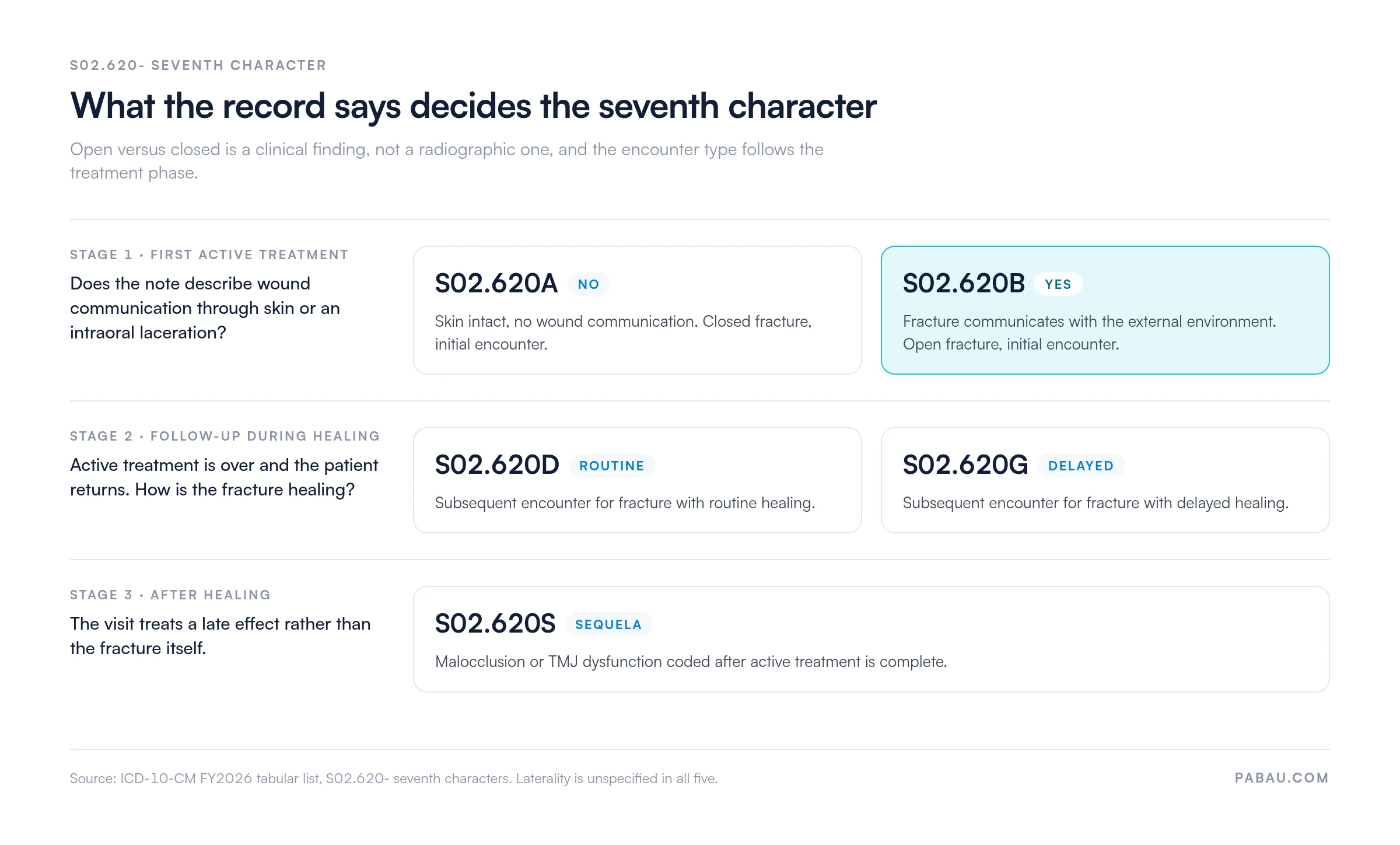
S02.620B inherits its Includes and Excludes notes from the S00-T88 chapter and the S00-S09 block. Review both levels before submitting, because they govern what can appear on the same claim.
Every element of the ICD-10 code must be traceable to the clinical record. “Open fracture, initial encounter” is a three-part designation: each part needs its own supporting entry. Coders relying solely on radiology reports to assign S02.620B risk under-documentation findings on audit. The following elements must appear explicitly in the physician or surgeon note.
Before submitting S02.620B, check the operative or ED note for six elements. Those are the open fracture statement, the subcondylar designation, laterality, encounter type, mechanism, and treatment approach. One missing element is enough for a payer to downcode to a non-specific mandible fracture code.
The CPT code must reflect the treatment rendered, not the fracture’s severity. An open fracture does not automatically require an open CPT procedure code. Payers cross-reference the ICD-10 open or closed designation against the CPT treatment approach; a mismatch will not always trigger denial if documented.
US practices billing electronically submit through Claim.MD, which transmits and tracks the claim. Pabau’s claims management software assembles that claim and follows its status — it does not decide or validate which ICD-10 and CPT codes belong together.
Coverage turns on the operative documentation, per AAPC coding guidance. Verify the procedure note matches the selected CPT before submission. Multi-approach repairs move to 21470, which carries its own documentation requirements.
Coverage for subcondylar fracture treatment is generally available under medical benefits for trauma cases. Oral and maxillofacial injuries sit at a benefit-routing boundary, so verify which benefit category applies before you submit.
Subcondylar fracture claims attract a predictable set of denial patterns. The most preventable ones relate to the 7th character and the open or closed designation. Those are documentation failures transcribed into coding errors, so the clean claim check belongs at documentation time.
The medical billing denial codes reference lists the CARC and RARC reason codes commonly paired with S02.x claims.
ICD-9-CM did separate subcondylar fractures from condylar ones, and it separated open from closed. What it could not carry was encounter type or laterality, so the GEMs crosswalk is approximate rather than exact.
That matters for legacy record review and audit lookbacks against current coding standards. Full GEMs documentation is available via the ResDAC ICD codes in Medicare files reference.
When reviewing pre-2015 claims, 802.32 is the code that corresponds to S02.620B. Do not treat the GEMs crosswalk as a coding authority for current claims. It is a legacy reference tool only.
Keep a crosswalk document that maps your most common ICD-10 mandible fracture codes back to their ICD-9 equivalents. Coders then answer a payer audit from that sheet instead of rebuilding the mapping, which saves hours on each response.
A practice coding facial trauma often works across three systems. The operative note sits in the EHR, the coder works from a separate worksheet, and the claim is keyed into a clearinghouse portal. Every hand-off is a chance for the 7th character to drift away from what the surgeon documented.
Pabau, practice management software for medical and aesthetic practices, keeps the note, the coded diagnosis, and the claim on one patient record. Your coder assigns S02.620B against the operative note in the same system that holds it. Claim.MD then submits the claim in the US and returns its status.
The software does not pick your codes or check an ICD-CPT pairing for you. What it removes is the re-keying between systems, which is where a documented laterality or an initial-encounter character usually gets lost.

Pabau holds the operative note, the assigned codes, and the claim on one patient record. It submits through Claim.MD in the US and tracks the response.

The core challenge with S02.620B is rarely finding the code. The three-part designation of open, subcondylar, and initial encounter has to hold up in every field of the claim.
The ICD-10 code, the operative note, the imaging report, and the CPT selection must tell the same story. One inconsistency is enough for a denial or a compliance flag.
Fix the documentation first and the coding follows. Build the six-element check into your operative note template, and the 7th character stops being a judgment call at billing time. Book a demo to see how Pabau keeps fracture coding and claim submission on one record.

Need a broader billing compliance framework? Medical billing compliance covers the documentation and submission standards that apply across all ICD-10 trauma codes.
Want to understand the US clearinghouse model? Medical claims clearinghouse explains how claims are validated and routed before they reach payers.
Handling denial appeals for S02 claims? Revenue cycle management covers the full workflow from code assignment through payment posting and denial resolution.
Want fewer rejections at first pass? Clean claim submission explains what a payer needs on a first submission.
ICD-10 code S02.620B is the billable ICD-10-CM diagnosis code for an open fracture of the subcondylar process of the mandible. It applies at an initial encounter, is valid for FY2026 billing, and sits in the S02.62 subcategory.
S02.620A covers a closed subcondylar process fracture at initial encounter, meaning the fracture has no wound communication with the external environment. S02.620B covers the same fracture when it is open, where the fracture site communicates through a skin laceration or intraoral wound. The distinction is clinical and must match the treating physician’s documentation exactly.
Open mandible fractures use the B 7th character at an initial encounter, such as S02.620B, and closed fractures use A, such as S02.620A. The designation depends on whether the fracture communicates with the external environment, as documented by the treating clinician. Imaging findings and fracture displacement do not decide it.
The top denial reasons are a wrong 7th character, missing or incorrect laterality, and an ICD-10 to CPT mismatch. Missing external cause codes and initial-encounter codes on follow-up visits round out the list. Most are prevented by reconciling the code against the operative note before submission.