ICD-10 Code S42.444P: Medial epicondyle fracture, right humerus
ICD-10 Code S42.444P: full descriptor and code validity ICD-10 Code S42.444P car...

Last Updated: Oct 13, 2026
Billable Code Specific Code
R75 is the billable ICD-10-CM code for inconclusive laboratory evidence of human immunodeficiency virus [HIV].
Let Pabau's smart automation suggest the right codes, reduce claim denials, and keep your practice compliant—effortlessly.
Automate repetitive tasks and focus on what matters most—your patients.
Reduce coding errors and ensure compliance with the latest regulations.
Clean claims, fewer denials, and faster reimbursements.
Powerful insights and reporting to help your practice thrive.
HIPAA compliant SOC 2 certified GDPR-compliant Trusted by 4,000+ clinics worldwide

ICD-10 Code R75 reports inconclusive laboratory evidence of HIV, so it applies only while a test result stays indeterminate.
R75 is a billable, specific ICD-10-CM code valid for FY2026, effective October 1, 2025.
An Excludes1 note bars R75 from appearing on the same claim as B20 or Z21.
The tabular prints one Applicable To term under R75: nonconclusive HIV-test finding in infants.
Payers expect the test name, the result classification, and the confirmatory testing plan in the provider note.
R75 is a billable, specific ICD-10-CM diagnosis code valid for the fiscal year 2026. Its effective date is October 1, 2025. The official descriptor is: Inconclusive laboratory evidence of human immunodeficiency virus [HIV].
Because R75 sits in the R70-R79 block (abnormal blood findings without a definitive diagnosis), it reflects an intermediate clinical state. The patient has had a lab result, but that result does not establish HIV disease or confirmed HIV-positive carrier status.
An inconclusive HIV lab result occurs when a screening test yields an indeterminate or reactive result that cannot be classified as definitively positive or negative. The common sequence starts with an ELISA or rapid HIV test that reads reactive. The confirmatory step, either a Western blot or a nucleic acid amplification test (NAT), then comes back indeterminate rather than confirmatory.
Clinically, the patient does not yet have a confirmed HIV diagnosis. They are not an asymptomatic HIV-positive carrier either. The encounter is about resolving that uncertainty, and R75 is what records it accurately for the payer.
The ICD-10-CM tabular prints exactly one Applicable To term under R75: nonconclusive HIV-test finding in infants. That single inclusion term is the whole list. R75 is not restricted to infants. The tabular simply names no other scenario, so do not look there for an adult inclusion term.
The infant wording is clinically significant. Newborns of HIV-positive mothers may show maternal antibodies on initial screening. Those results are inherently inconclusive until the infant’s own status is confirmed by NAT testing, typically at 14-21 days, 1-2 months, and 4-6 months. R75 is appropriate throughout that window while each NAT result remains indeterminate.
The Excludes1 notation in ICD-10-CM means the excluded codes describe conditions that cannot coexist with R75 in the same encounter. They are mutually exclusive by clinical definition. Assigning R75 alongside either of them on one claim is a coding error that draws a rejection or audit scrutiny.
If provider documentation confirms HIV disease at the same encounter, assign B20 instead of R75. If it confirms the patient is a known asymptomatic HIV-positive individual, presenting for an unrelated condition, assign Z21. R75 is reserved for the genuinely inconclusive scenario.
These three codes cover every HIV-related encounter short of an AIDS-defining illness. What separates them is the patient’s documented status, so read the provider note before the lab report. The table and the diagram below reduce that to a single question.
The decision path: start with “Is HIV confirmed?” If yes and the patient has HIV disease, code B20. If yes but the patient is asymptomatic and HIV-positive only, code Z21. If HIV status is not yet confirmed because results remain inconclusive, code R75. R75 must never appear on a claim alongside B20 or Z21.
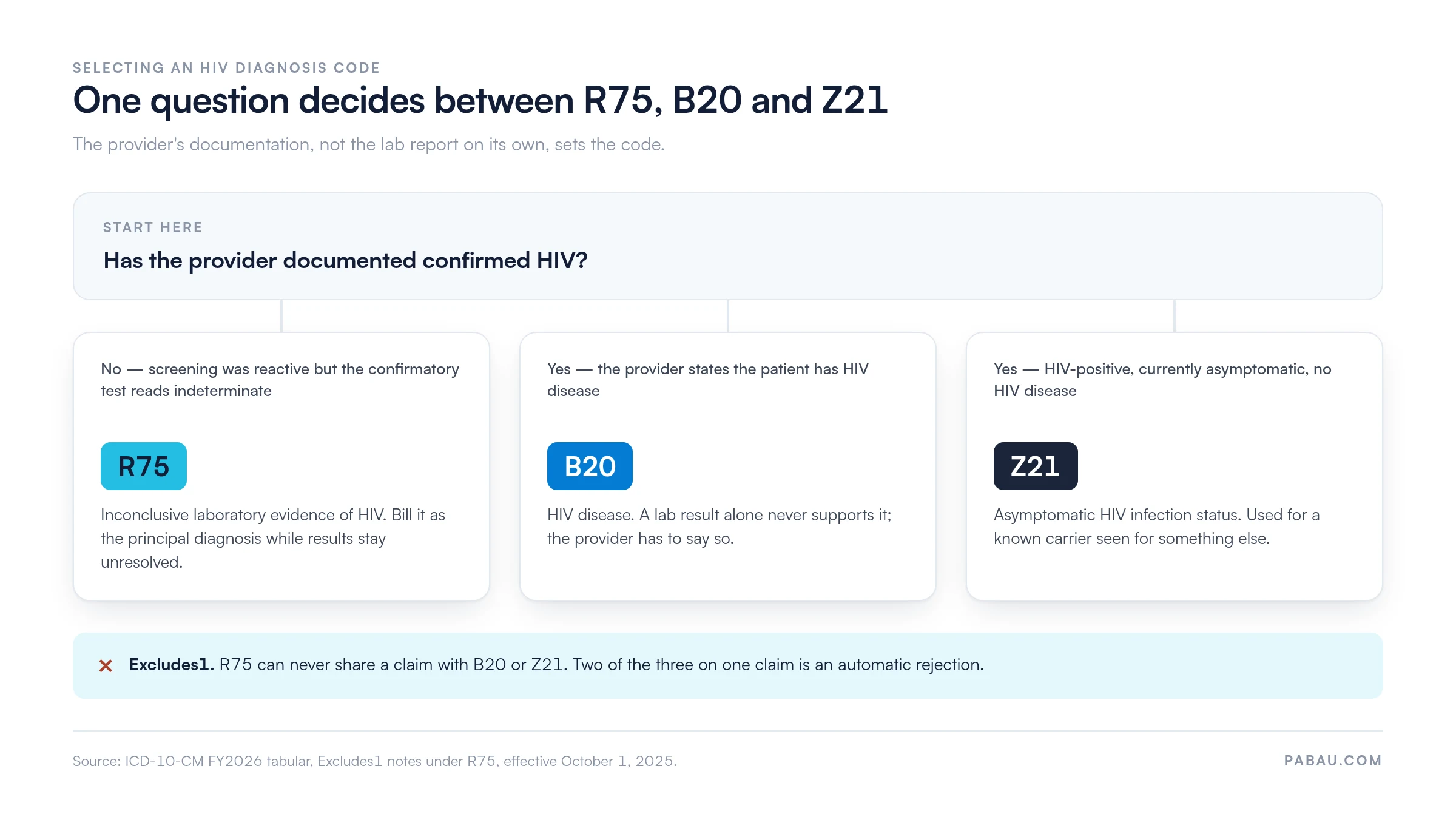
Document the test and its result classification in the encounter note before you assign R75. Name the test, such as Western blot or NAT. State the classification as indeterminate, reactive, or inconclusive. Then record the plan for confirmatory testing. Payers increasingly want that level of detail before they will process an R75 claim.
R75 rarely appears in isolation. HIV-related encounters usually need companion codes for screening or counseling. The codes below are the ones that pair with it most often, and our ICD-10-CM code index carries the full descriptor for each.
Z71.7 is the one worth watching in practice. A clinician may deliver pre-test or post-test counseling at the same visit where the inconclusive result lands. Z71.7 can then be reported as a secondary code. This is not an Excludes1 relationship, so R75 and Z71.7 sit on the same claim when both services are documented.
Practices that run HIV testing at volume need a written internal rule for assigning R75. Without one, coders default to B20 or Z21, and the payer documentation requests start arriving.
The ICD-10-CM Official Guidelines for Coding and Reporting, Section I.C.1.a, govern HIV coding across every code category including R75. Under those guidelines, HIV status may be coded to B20 only where a provider has documented confirmation of HIV disease. Coders may not infer confirmed HIV from a lab result alone. An indeterminate result with no confirming provider statement keeps the coding at R75.
According to the CMS ICD-10 coding page, providers carry the responsibility for the documentation specificity that supports code selection. For R75 that means the note has to characterize the result, not simply carry the lab report as an attachment.
The CDC’s HIV testing and diagnosis guidance sets out the confirmatory testing protocols that underpin R75 documentation. Coders should know the recommended testing algorithm well enough to spot an incomplete provider note.
R75 is a billable code accepted by Medicare, Medicaid, and most commercial payers when the documentation supports it. Payer-specific policies still vary, so verify coverage rather than assuming automatic acceptance.
HIV-related diagnosis codes, R75 included, carry privacy obligations in many US states that go beyond baseline HIPAA requirements. Several states require explicit patient consent before HIV-related information can be disclosed to an insurer or included in a claim. This compliance layer is specific to HIV coding and does not apply to most other ICD-10-CM categories.
State rules for HIV records often add stricter consent, limits on redisclosure, and a documented patient authorization before submission. Coders in California, New York, Illinois, and other states with enhanced HIV privacy laws should confirm local requirements before sending an R75 claim.
Submitting R75 claims through a clearinghouse cuts down on format-related rejections. A code-conflict check before submission is also where an Excludes1 violation gets caught cheaply. Denial management workflows for HIV denials usually require resubmission with the provider attestation attached.
The usual sequence at a busy practice is a denial first and a documentation hunt second. The lab result sits in the record, the provider note never classifies it, and the coder finds out when the payer asks for evidence.
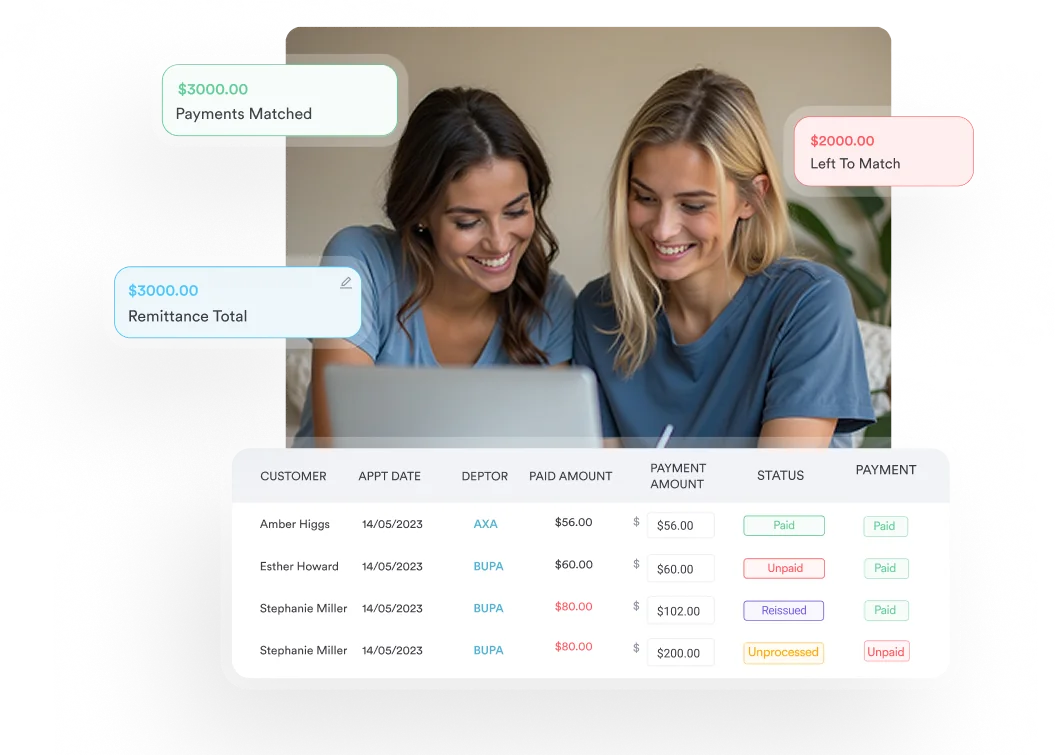
Practice management software like Pabau ties the coding workflow to the clinical record instead. Its tools for cleaner claims management keep what a coder needs to validate R75 in the same record as the claim. That includes the test name, the result status, and the follow-up plan, so the billing team stops chasing the clinical team for them.
Practices can also use Pabau’s digital forms to build an HIV encounter template. The form prompts the provider for the test performed, the result classification, and the confirmatory testing plan. Complete it before the encounter closes and the support for R75 is already in the record when billing starts.
For practices coding R75 at volume, an automated pre-submission review can flag those encounters for a documentation check. That catches Excludes1 conflicts and missing attestations before the payer’s adjudication engine ever sees them.
Set a rule in your practice management system that alerts coders when R75 and B20 land on the same claim. Do the same for R75 and Z21. Most EHR and practice management platforms support configurable code-pair alerts. Catching the Excludes1 violation before submission costs nothing. Catching it after a denial costs time and administrative work.

Pabau helps clinical teams capture the documentation detail that supports R75, so fewer claims come back. See how our practice management tools work for coding-intensive specialties.

ICD-10 Code R75 marks one specific moment in a patient’s chart. The HIV status is genuinely unresolved, and the code says exactly that on the claim. Reach for B20 or Z21 while results are still inconclusive and the Excludes1 edit catches it.
That error is worth designing against rather than appealing. A documentation rule for the provider note and a code-pair alert in the billing system prevent almost all of it, and both are one-time setup.
Pabau’s structured encounter templates capture the detail R75 needs at the point of care, not during a denial appeal. Book a demo to see how Pabau supports coding-intensive specialties.

Need the compliance ground rules behind the note? Medical billing compliance covers the documentation and audit duties that sit behind sensitive codes like R75.
Want fewer payer rejections across your coding? Medical claims clearinghouse guide explains how clearinghouse validation catches errors before a payer adjudicates the claim.
Chasing a higher first-pass acceptance rate? What makes a clean claim sets out the fields a payer needs to pay on the first submission.
ICD-10 Code R75 documents inconclusive laboratory evidence of human immunodeficiency virus (HIV). It applies when an HIV test has produced an indeterminate or inconclusive result. Confirmed HIV disease and asymptomatic carrier status have not yet been established. It is a billable code valid for FY2026.
Yes, R75 is a billable/specific ICD-10-CM code valid for the fiscal year 2026 (effective October 1, 2025). It can be used as the primary diagnosis code for reimbursement purposes when the clinical documentation supports an inconclusive HIV lab result.
R75 is used when HIV laboratory evidence is inconclusive and the patient’s HIV status is not confirmed. B20 is used when HIV disease is confirmed by the treating provider. These two codes carry an Excludes1 relationship, meaning they can never appear together on the same claim.
Use R75 when HIV results are genuinely inconclusive and the patient’s HIV status is not established. Use Z21 when the patient has a documented, confirmed HIV-positive status but is currently asymptomatic with no active HIV disease. Z21 and R75 are mutually exclusive under Excludes1 notation.
R75 carries an Excludes1 notation for B20 (human immunodeficiency virus [HIV] disease) and Z21 (asymptomatic human immunodeficiency virus [HIV] infection status). Both are mutually exclusive with R75 and cannot be coded on the same claim.
Yes. Z71.7 (HIV counseling) does not carry an Excludes1 relationship with R75. Both can be reported when a provider delivers pre- or post-test counseling at the same encounter as the inconclusive result. The counseling has to be documented in the encounter note.