ICD-10 code S61.201A: Open wound of left index finger without nail damage
ICD-10 code S61.201A covers a left index finger wound of unstated type ICD-10 co...

Last Updated: Oct 16, 2026
Billable Code Specific Code
P19.9 is the billable ICD-10-CM code for metabolic acidemia in newborn, unspecified.
Let Pabau's smart automation suggest the right codes, reduce claim denials, and keep your practice compliant—effortlessly.
Automate repetitive tasks and focus on what matters most—your patients.
Reduce coding errors and ensure compliance with the latest regulations.
Clean claims, fewer denials, and faster reimbursements.
Powerful insights and reporting to help your practice thrive.
HIPAA compliant SOC 2 certified GDPR-compliant Trusted by 4,000+ clinics worldwide

ICD-10 code P19.9 is the billable code for metabolic acidemia in newborn, unspecified, valid for FY2026 from October 1, 2025.
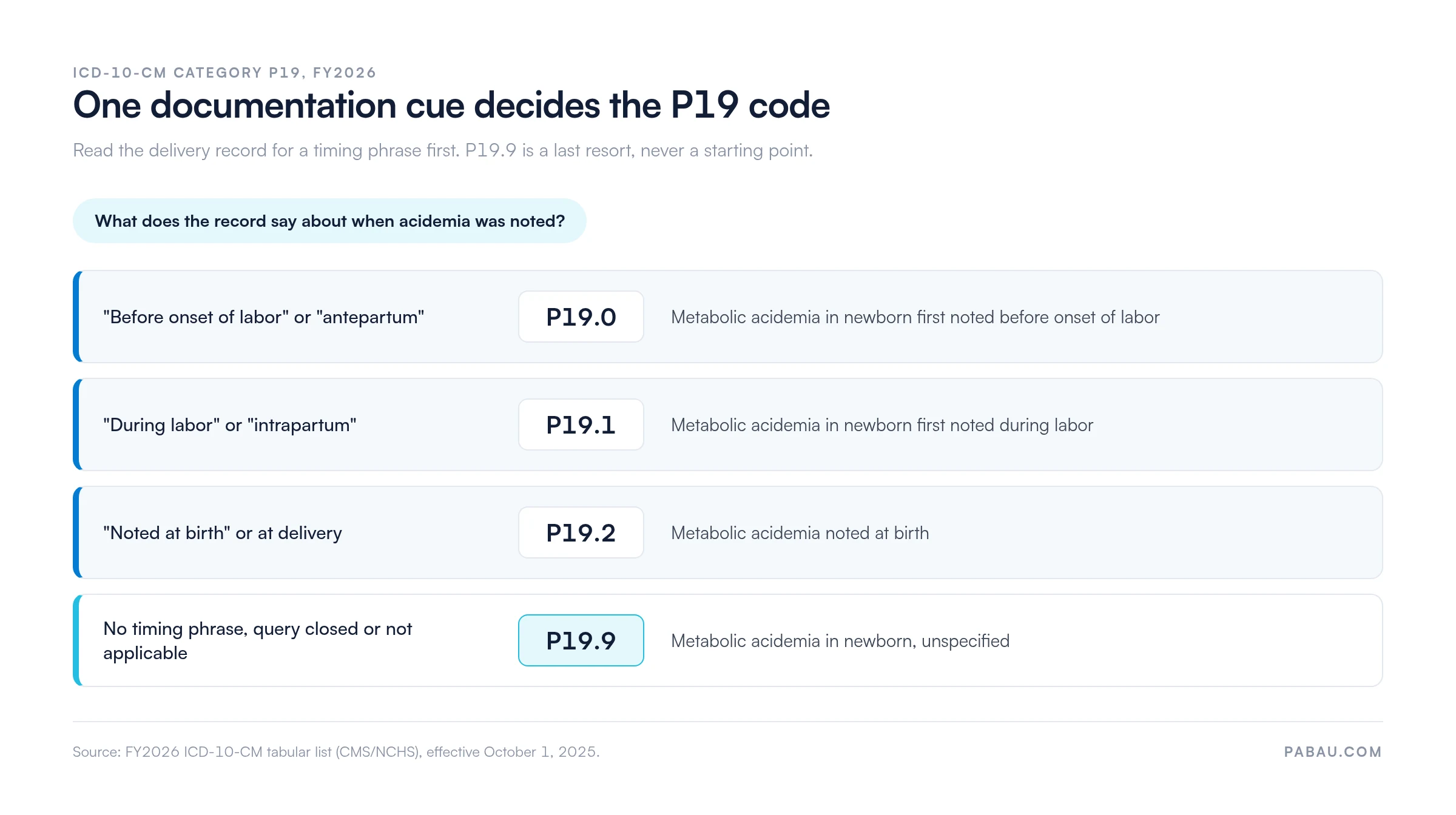
Use P19.9 only when documentation does not say when the acidemia was noted. Otherwise assign P19.0, P19.1, or P19.2.
The P19 category carries one Includes note, metabolic acidemia in newborn, and it governs all four child codes.
P19.2 covers metabolic acidemia noted at birth, so it is a postnatal timing option rather than a fetal code.
Pabau, our practice management software, carries a built-in ICD-10 catalog and a Claim.MD clearinghouse connection for neonatal claims.
P19.9 is a billable, specific ICD-10-CM diagnosis code. It supports a claim for reimbursement on its own, with no more detailed child code beneath it. The table below captures the core reference data.
The CDC/NCHS ICD-10-CM web tool confirms P19.9 as a valid, billable code for the 2026 edition of ICD-10-CM. The code is maintained jointly by the Centers for Medicare and Medicaid Services (CMS) and the National Center for Health Statistics (NCHS). Both bodies issue code updates effective each October 1.
Metabolic acidemia in a newborn is an abnormal accumulation of acid in the blood of a neonate. It usually follows impaired oxygen delivery before, during, or shortly after delivery. When oxygen supply to fetal or newborn tissues runs short, anaerobic metabolism produces lactic acid. The resulting drop in blood pH can cause organ dysfunction affecting the brain, heart, kidneys, and liver.
Clinically, the condition is identified through cord blood gas analysis or neonatal arterial blood gas measurements. A pH below 7.0 with a base deficit greater than 12 mmol/L is commonly cited as the threshold for significant perinatal metabolic acidemia. Protocols vary by institution. Neonatologists and obstetricians use the diagnosis to guide therapeutic hypothermia, resuscitation escalation, and intensive care admission.
For coding purposes, the P19 category applies when metabolic acidemia is documented as a perinatal condition. If the record states when the acidemia was first noted, a more specific sibling code replaces P19.9. Knowing the physiology helps coders recognize which documentation elements to look for before defaulting to the unspecified code.
P19.9 sits within a three-level hierarchy. Understanding that structure prevents miscoding and keeps sequencing correct when P19.9 is assigned alongside other perinatal diagnoses.
The CMS ICD-10-CM annual update files confirm that P19 is a non-billable header code used to organize the P19.x child codes. Coders always assign one of the four child codes, never P19 alone. This is a common compliance error in neonatal units where documentation is completed under time pressure at delivery.
The P19 category contains four child codes. Three of them are separated by when the acidemia was first noted, and the fourth covers records with no timing at all. The table below is the fastest way to decide which one applies.
P19.2 is a postnatal code, not a fetal one. It applies when the record documents metabolic acidemia noted at birth, without placing onset before or during labor. Treating P19.2 as a before-delivery code, or using it for a fetal scalp pH result, is a coding error.
P19.9 is appropriate only when the timing of onset cannot be determined from documentation. A query to the physician should already have been completed, or be clinically not applicable. The ICD-10-CM Official Guidelines for Coding and Reporting require coders to select the most specific code the documentation supports.
The chart below collapses those five steps into the single question the record has to answer.
Practices running a medical billing compliance program should keep P19.9 on their query trigger list. A high rate of P19.9 relative to P19.0 and P19.1 signals under-documentation. It rarely reflects the clinical picture on the unit.
Run a quarterly audit comparing your facility’s P19.9 assignment rate against P19.0 and P19.1. If P19.9 accounts for more than 30 percent of P19 claims, review cord blood gas documentation workflows with the obstetrics and neonatal teams. Timing data is almost always present in the delivery record, so a formal query should be the exception.
Coders and clinicians use several terms interchangeably with the P19.9 description. The ICD-10-CM alphabetical index maps these synonyms to the P19.9 code. Recognizing them in clinical documentation prevents missed assignments.
The term “neonatal metabolic acidosis” appears often in clinical notes. In ICD-10-CM it maps to the same P19 category as metabolic acidemia, so either wording supports a P19 assignment.
The P19 category carries a single Includes note that governs all four child codes. No Excludes1 or Excludes2 notes apply to P19 in the 2026 ICD-10-CM tabular list.
Documentation sometimes records acidemia on both the maternal and the newborn chart. The P19.x code belongs on the newborn’s claim. The maternal record uses obstetric complication codes from Chapter 15, and those are separate, non-duplicative assignments on separate claims.
Confirm with the attending neonatologist which diagnoses belong to the newborn episode rather than carrying over from the maternal record.
P19.9 was not revised or added in the FY2026 update cycle. The code, its description, and its category notes carry forward unchanged from the prior year. The 2026 edition became effective on October 1, 2025, the annual activation date CMS and NCHS use for ICD-10-CM updates.
The AAPC ICD-10-CM code lookup and the WHO’s international classification confirm that the P19 category structure has held steady across recent update cycles. Check that your encoder reflects the FY2026 tabular file if you bill for dates of service on or after October 1, 2025.
P19.9 rarely appears as the sole diagnosis on a neonatal claim. The codes below are frequently coded alongside it, either as complicating conditions or as sequelae of the acidemic episode.
Across ICD-10-CM, the unspecified child code is the fallback rather than the default. Query first, then assign. Sequencing P19.9 as a principal or secondary diagnosis should follow the clinical priority the attending physician documented.
P19.9 identifies the condition, while separate codes describe the care delivered during the stay. When a physician places a patient directly into observation, the hospital bills that admission as HCPCS code G0379.
Accurate code selection is only half the billing equation. Neonatal claims carrying P19.9 still have to clear payer edits before they are paid. Pabau, practice management software for medical and aesthetic practices, connects to the Claim.MD clearinghouse, which reaches thousands of US payers through electronic 837P submission.
Pabau’s built-in ICD-10 catalog lets coders select P19.9 inside the platform, instead of leaving the workflow to cross-reference an external lookup tool. Claims submitted through Claim.MD return eligibility results and electronic remittance advice. The ERA carries CARC denial reason codes, so billing teams can act on rejections before they age.
For neonatal units handling high claim volumes, accurate ICD-10-CM assignment plus medical claims management in one system cuts the administrative time per claim.
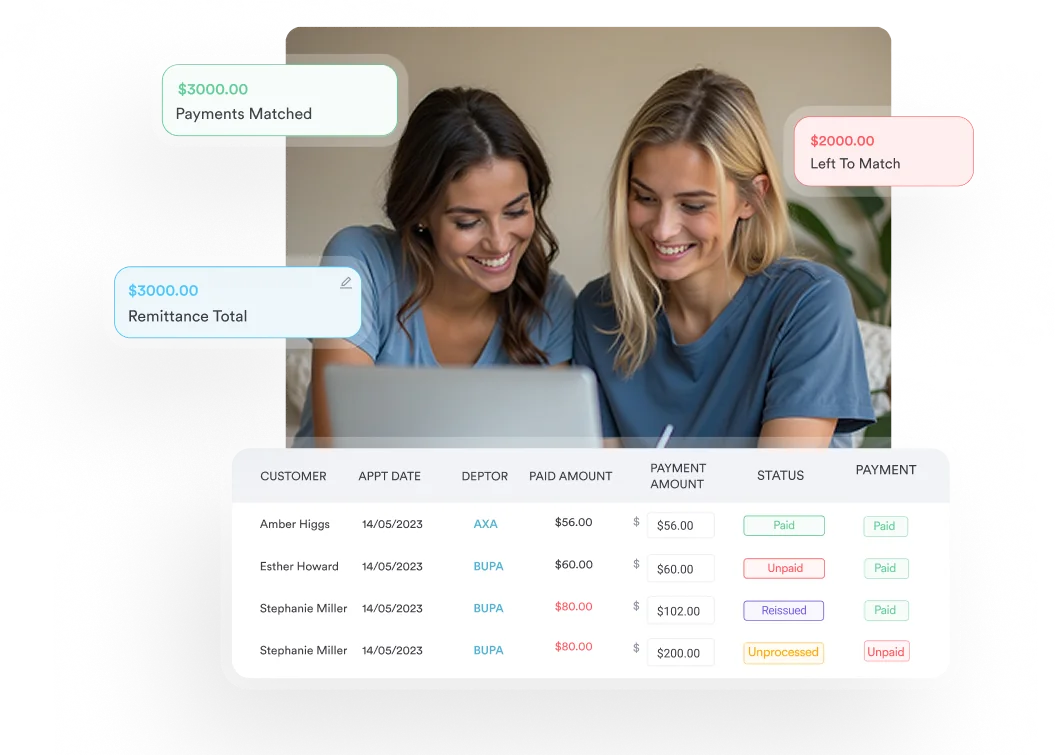
When a P19.9 claim is denied on medical necessity, the denial codes returned in the ERA point straight at the documentation the payer wanted. That makes the appeal faster to assemble.

Pabau connects to the Claim.MD clearinghouse with a built-in ICD-10 catalog, eligibility checks, and ERA processing. An accurate P19.9 assignment reaches the payer without manual re-keying.

P19.9 earns its place in ICD-10-CM as the option for records that never state when the acidemia was noted. The problem is using it as a first pass rather than a last resort. Cord gas reports, delivery notes, and admission summaries usually settle the timing question.
Pabau keeps the ICD-10 catalog and the claim in one screen, so a coder can assign P19.9 without switching systems. Book a demo to see how Pabau handles neonatal billing from code selection through clearinghouse submission.

Need another perinatal ICD-10 code? ICD-10 code P84 covers other problems with newborn, the neighboring category in the same perinatal chapter.
Want to understand how claims move from code to payment? Revenue cycle management explains the end-to-end billing workflow for clinical practices.
Tracking denial patterns on neonatal claims? Denial management in healthcare walks through how to read CARC codes and structure an appeal workflow.
ICD-10 code P19.9 is the billable ICD-10-CM code for metabolic acidemia in a newborn when the record gives no timing. It is assigned after the coder has reviewed the delivery record and, where needed, queried the physician about when the acidemia was noted.
Yes, P19.9 is a billable, specific ICD-10-CM code valid for reimbursement submission. Its parent code, P19, is a non-billable header code and must never be submitted on a claim. Only the child codes P19.0, P19.1, P19.2, and P19.9 are billable.
Use P19.9 only after reviewing the cord blood gas report, delivery note, fetal monitoring summary, and neonatal admission note. Query the attending physician if the timing is still unclear. If none of these sources document whether acidemia began before or during labor, P19.9 is the correct assignment. Using it as a default without reviewing available records is a compliance risk under the ICD-10-CM Official Guidelines.
The 2026 edition of ICD-10-CM became effective on October 1, 2025. P19.9 was not revised, added, or deleted in the FY2026 update cycle. It carries forward unchanged, with the same description, category notes, and billable status.
No. P19.9 and P19.2 are siblings in the P19 category and describe mutually exclusive timing scenarios. P19.2 covers metabolic acidemia noted at birth. P19.9 covers a record that gives no timing at all. Assign one or the other, never both, on the same newborn claim.