ICD-10 Code Y76.0: Diagnostic obstetric and gynecological devices
ICD-10 Code Y76.0: Definition and billable status ICD-10 Code Y76.0 is a valid, ...

Last Updated: Oct 23, 2026
Billable Code Specific Code
O63.1 is the billable ICD-10-CM code for prolonged second stage (of labor). It applies when the stretch from full cervical dilation to delivery runs past the expected limit and the physician documents it as prolonged.
Coders often confuse it with O63.0, prolonged first stage, because delivery notes can read simply "prolonged labor" without naming a stage. Sequencing O63.1 incorrectly against delivery outcome codes is a common cause of claim queries.
Let Pabau's smart automation suggest the right codes, reduce claim denials, and keep your practice compliant—effortlessly.
Automate repetitive tasks and focus on what matters most—your patients.
Reduce coding errors and ensure compliance with the latest regulations.
Clean claims, fewer denials, and faster reimbursements.
Powerful insights and reporting to help your practice thrive.
HIPAA compliant SOC 2 certified GDPR-compliant Trusted by 4,000+ clinics worldwide

ICD-10 Code O63.1 covers a prolonged second stage of labor, the stretch from full cervical dilation to delivery of the infant.
It’s a billable four-character code, and the record needs timestamps for full dilation and delivery plus a physician diagnosis.
O63.0 covers a prolonged first stage, while latent-phase failure of dilation indexes to O62.0 and an arrested active phase to O62.1.
When O63.1 is the indication for a cesarean, report it with a Z37 outcome code and leave O82 off the claim.
ACOG’s 2024 labor guideline defines a prolonged second stage as more than 3 hours of pushing for nulliparous patients and 2 hours for multiparous patients.
ICD-10 Code O63.1 is the billable ICD-10-CM code for a prolonged second stage of labor. The second stage runs from full cervical dilation to delivery, and the code applies once the physician documents that it ran longer than expected.
The second stage of labor begins at full cervical dilation (10 cm) and ends with delivery of the infant. ICD-10 Code O63.1 applies when this stage runs past the limits used in clinical practice. The current limits come from ACOG Clinical Practice Guideline No. 8 (2024), and they vary by parity.
The 2024 guideline replaced the 2014 ACOG/SMFM Obstetric Care Consensus, which added an extra hour for patients with an epidural. It still names epidural analgesia as a factor that lengthens the second stage. Local protocols can differ, so code from the physician’s documented diagnosis rather than from the clock alone.
Three clinical terms are often documented in place of prolonged second stage, and they don’t always map to O63.1:
O63.0 covers a prolonged first stage of labor, and O63.1 covers a prolonged second stage. Both can go on the same delivery record when the physician documents a prolonged first stage and a prolonged second stage. Confusing the two is a frequent error in the O63 category.
When the delivery note says only “prolonged labor” with no stage specified, the coder must query the physician. Selecting O63.0 or O63.1 without supporting documentation is a compliance risk. The map below sorts the common delay descriptions by the code each one indexes to.
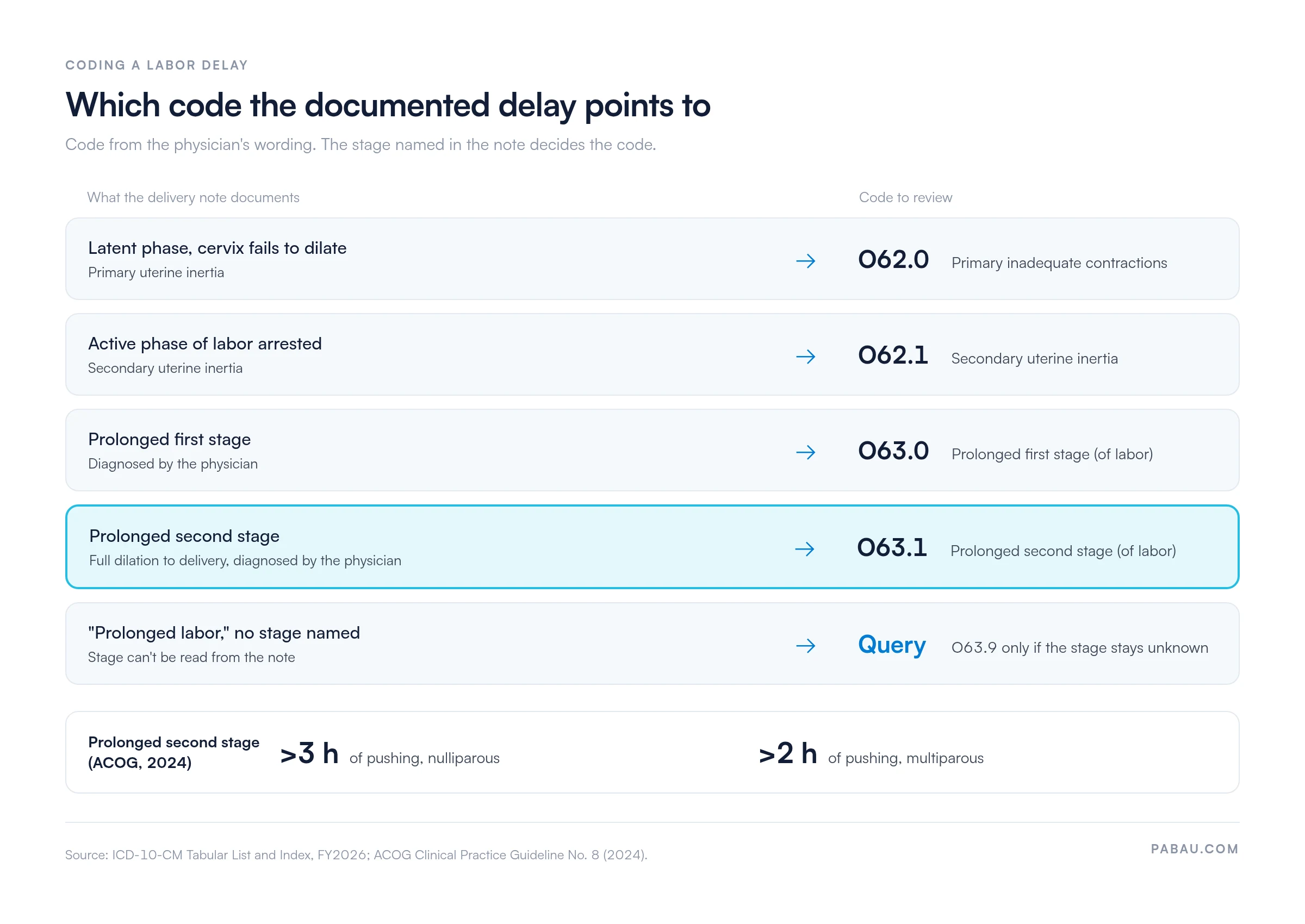
The O63 block covers all long-labor scenarios. Only the subcodes at the fourth-character level are billable. O63 itself (without a fourth character) is a non-billable header code and cannot be reported on a claim.
Always confirm code validity against the CDC/NCHS ICD-10-CM tool for the current fiscal year. Annual updates occasionally affect obstetric codes.
Auditors routinely deny O63.1 claims when delivery notes lack timestamped stage data. Adequate documentation in the medical record must support five specific elements before ICD-10 Code O63.1 can be reported. Build them into your delivery note template so they’re captured at the point of care.
Query the physician when the delivery note records timestamps but contains no explicit diagnosis of prolonged second stage. A note stating ’10 cm at 14:05, delivery at 17:20′ shows a 3-hour 15-minute second stage but does not itself constitute a diagnosis. The physician must confirm the clinical significance before you code O63.1.
The ICD-10-CM Official Guidelines for Coding and Reporting govern sequencing for all obstetric complications. Several rules apply directly to O63.1 on inpatient labor and delivery claims.
O63.1 rarely appears as the only diagnosis code on a delivery claim. The following codes are frequently reported alongside it, with sequencing notes for each.
When ICD-10 Code O63.1 is the documented indication for cesarean delivery, sequence codes in this order:
Leave O82 off this claim. It is a stand-alone Chapter 15 code for a cesarean with no documented indication. Once an indication such as O63.1 is documented, O82 is never reported.
O63.1 appears on inpatient delivery claims and feeds directly into DRG assignment under the Medicare Severity DRG (MS-DRG) system. The specific DRG depends on the delivery method and presence of complications or comorbidities (CC/MCC). If your team is new to inpatient claims, our guide to medical billing fundamentals covers the claim cycle first.
Three payer-specific considerations routinely affect O63.1 claims:
O63.1 denials fall into five recurring patterns. Effective denial management workflows address each at the root rather than claim by claim. When a remittance comes back, the top CARC denial codes tell you which pattern you’re dealing with.
A coder review before submission catches most of these patterns before a payer does. Reworking a denied claim costs staff time and delays reimbursement. Our guide to the clean claim lists the checks worth running first.
The ICD-9-CM predecessor to O63.1 is 662.2x, prolonged second stage of labor. ICD-9-CM already had separate codes for a prolonged first stage (662.0x) and a prolonged second stage (662.2x). Its fifth digit recorded the episode of care, which ICD-10-CM O63.1 does not carry. The CMS General Equivalence Mappings (GEMs) provide the authoritative forward and backward crosswalk.
Use the CMS ICD-10 codes page to download the current GEMs file directly. Third-party crosswalk tools may not reflect the most recent mapping updates. When you compare legacy data, note that the ICD-9-CM episode-of-care digit has no equivalent in O63.1.
In many OB/GYN practices, the delivery note lives in one system and the claim gets built in another. The diagnosis is retyped by hand, and the timestamps behind O63.1 sit in a chart the biller rarely opens.
Pabau, the practice management platform we build for private practices, keeps patient records, treatment notes and billing in one place. US practices submit and track claims electronically through Claim.MD, so your billing team follows each claim from the same system that holds the chart.
The coding decision itself, such as O63.1 versus O63.0, stays with your coders. Pabau’s medical claims management tools put the patient record and the claim status side by side. A physician query or a resubmission then starts from the right information.

Pabau keeps patient records, notes and billing in one system, and US practices submit and track claims through Claim.MD. See how it fits your OB/GYN practice.

O63.1 holds up when the record does the work. That means a timestamp for full dilation, a timestamp for delivery, and a physician diagnosis that names the second stage.
The practical fix sits in the delivery note template rather than on the claim. Once those fields are captured at the bedside, the choice between O63.0, O63.1 and the O62 codes follows from the documentation. O82 then stays off every cesarean that has a documented indication.
Pabau’s practice management software, with claims submission through Claim.MD, supports US private OB/GYN practices from the patient record to the submitted claim. Book a demo to see how it fits your OB/GYN billing workflow.

Need to understand claim rejection patterns across your obstetric codes? Denial management in healthcare covers systematic approaches to tracking and resolving payer rejections.
Want a cleaner submission process for delivery claims? Clean claim submission explains what payer edits look for and how to pass them the first time.
Submitting electronic obstetric claims through a clearinghouse? Medical billing fundamentals walks through the end-to-end submission cycle from encounter to ERA.
Is the delay documented before full dilation? ICD-10 Code O62.1 covers secondary uterine inertia, including an arrested active phase of labor.
Coding a cesarean with no documented indication? ICD-10 Code O82 explains when the stand-alone cesarean code applies.
ICD-10 Code O63.1 is the billable ICD-10-CM diagnosis code for a prolonged second stage of labor. That stage runs from full cervical dilation to delivery of the infant. The code applies when the physician documents that it ran past the expected limit, and it needs no 7th character.
Yes, O63.1 is a fully billable ICD-10-CM code valid for claim submission. Its parent code O63 (without a subcode) is a non-billable header. Always report the specific subcode O63.1, not the header O63, to avoid a straight denial for invalid code.
O63.0 covers a prolonged first stage of labor, and O63.1 covers a prolonged second stage, from full dilation to delivery. The distinction depends on which stage the physician documents as prolonged. Coders shouldn’t infer the stage from timestamps alone without a physician diagnosis statement.
ACOG Clinical Practice Guideline No. 8 (2024) sets the limits by parity. A second stage is prolonged after more than 3 hours of pushing for nulliparous patients and 2 hours for multiparous patients. It no longer sets a longer limit for patients with an epidural. The physician still has to document the diagnosis before you code O63.1.
Yes. When a prolonged second stage is the documented indication for a cesarean, report O63.1 as that indication and add a Z37 outcome code. O82 is not used, because it applies only to a cesarean with no documented indication.
O63.1 maps to ICD-9-CM 662.2x, prolonged second stage of labor: 662.20, 662.21 and 662.23. The fifth digit recorded the episode of care. Use the CMS General Equivalence Mappings (GEMs) for authoritative crosswalk data.