

ICD-10 Code S42.444P: Medial epicondyle fracture, right humerus
ICD-10 Code S42.444P: full descriptor and code validity ICD-10 Code S42.444P car...

Last Updated: Oct 13, 2026
Billable Code Specific Code
O03.9 is the billable ICD-10-CM code for complete or unspecified spontaneous abortion without complication.
Let Pabau's smart automation suggest the right codes, reduce claim denials, and keep your practice compliant—effortlessly.
Automate repetitive tasks and focus on what matters most—your patients.
Reduce coding errors and ensure compliance with the latest regulations.
Clean claims, fewer denials, and faster reimbursements.
Powerful insights and reporting to help your practice thrive.
HIPAA compliant SOC 2 certified GDPR-compliant Trusted by 4,000+ clinics worldwide

ICD-10 Code O03.9 describes complete or unspecified spontaneous abortion without complication, falling under the O03 spontaneous abortion category.
This is a billable, HIPAA-valid code effective from 10/01/2015 through 09/30/2026 per the FY2026 ICD-10-CM tabular list.
Documentation must specify whether the abortion was complete or unspecified and confirm the absence of complications such as hemorrhage, infection, or retained products.
Missed abortion (O02.1), incomplete spontaneous abortion (O03.4), and complications following ectopic or molar pregnancy (O08) are the codes most often mistaken for O03.9.
Practice management software like Pabau supports accurate obstetric coding with structured documentation templates and built-in code validation.
ICD-10 Code O03.9 is the billable diagnosis code for a complete or unspecified spontaneous abortion without complication. Clinically, that is a miscarriage where the record documents no hemorrhage, no infection, and no retained products of conception.
Miscarriage and spontaneous abortion name the same event. ICD-10-CM uses spontaneous abortion throughout, so a chart that says miscarriage still codes from category O03. There is no separate miscarriage heading to look under.
O03.9 sits in ICD-10-CM Chapter 15 (O00-O9A, Pregnancy, Childbirth and the Puerperium), under parent category O03. The full ICD-10 spontaneous abortion descriptor reads: Complete or unspecified spontaneous abortion without complication. According to the CMS ICD-10-CM tabular list, the code has been valid for HIPAA-covered transactions since October 1, 2015. It stays billable through September 30, 2026 under the FY2026 edition. Australian MBS billing changes descriptors and fees periodically, so last year printout is not a safe reference. Coding sits in the middle of the revenue cycle, between registration and payment posting.
O03.9 is billable, specific, and valid for every HIPAA-covered transaction. It is also exempt from present-on-admission (POA) reporting. The table below carries the reference fields coders and billing staff reach for, including the parent category and the dates of the current edition. Keep it open when a chart says miscarriage and you need the matching code quickly.
A complete spontaneous abortion means all products of conception have passed and the uterus is empty. Unspecified means the record confirms the loss but never states whether passage was complete. Both scenarios code to O03.9 when no complication is documented.
That shared code trips coders up. The word unspecified describes what the note says about passage, and it carries no penalty on its own. Unspecified passage still has a valid billable home.
A complete loss follows the same route. A note reading complete miscarriage with no complication routes to O03.9, and so does a note that records the loss without describing passage at all.
The differentiator from incomplete spontaneous abortion is the status of retained products. If the chart documents retained products of conception, the encounter moves into the O03.0-O03.4 range instead. Surgical completion of that loss carries its own procedure code, procedure code, 59812. Denials usually trace back to the passage decision rather than to the diagnosis.
Practices running OB/GYN EMR software with structured pregnancy-loss templates cut that misrouting risk, because the template asks about passage before the note is signed.
Category O03 holds every ICD-10 code for miscarriage, sorted first by passage status and then by complication. O03.9 is the last child code in the category, and the only complete-or-unspecified option that carries no complication.
Knowing the full hierarchy prevents both upcoding and undercoding. Coders working in fertility clinic software meet several of these codes during early pregnancy monitoring.
The O03 range splits into two tracks: incomplete (O03.0-O03.4) and complete or unspecified (O03.5-O03.9). The complication suffix then runs in parallel across both tracks, which is what makes the O03 hierarchy easy to misread.
Each complication has its own subcode inside the same track. Hemorrhage after an incomplete loss is O03.1, and embolism after a complete loss is O03.7.
Run an internal audit quarterly. Pull all O03 claims and check the ratio of O03.9 to O03.4. An unusually high O03.4 rate may signal that coders default to incomplete when the chart supports O03.9. A disproportionate O03.9 rate without supporting ultrasound documentation increases audit exposure instead.
Five lookalikes account for most O03.9 coding errors. The table gives the official meaning of each one, and the reason it does not belong on an O03.9 claim.
A past loss belongs with the obstetric history captured at intake. Z87.59 covers a personal history of pregnancy complications, and it sits alongside the current diagnosis rather than replacing it.
Three notes in the tabular list decide where these boundaries fall. The CDC/NCHS ICD-10-CM web tool shows each one as it reads in the current edition.
Practices managing recurrent pregnancy loss alongside general OB/GYN care should settle these choices before the claim goes out. Sorting N96, O26.2, and O03.9 after a denial costs far more time than asking the question at the visit.
Five elements have to be in the chart before O03.9 survives review. Payers audit spontaneous abortion claims for that specificity, so the note has to support the code at the point of service.
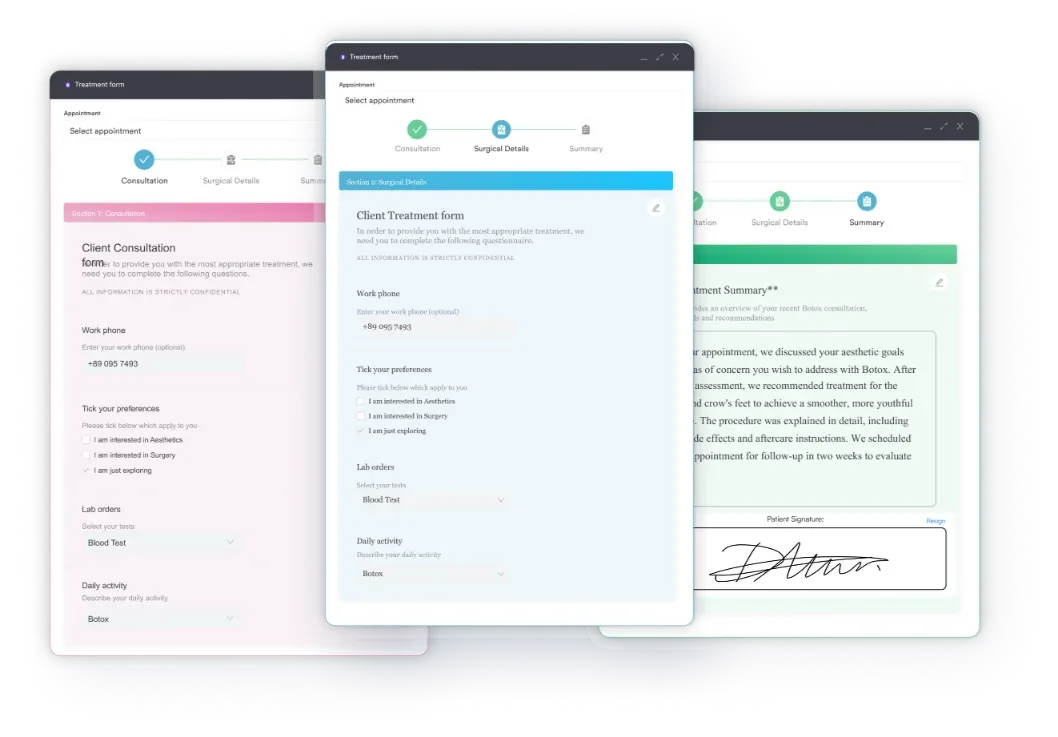
Practices using digital forms for obstetric intake can build these checkpoints into the consultation itself, rather than reconstructing them after a denial. A medical diagnosis form that prompts for passage status and complications does most of that work at the point of care.
Required documentation elements for O03.9:
Record accuracy for obstetric encounters underpins HIPAA-compliant billing. The HIPAA compliance requirements for medical offices set out how clinical documentation supports valid code submission on covered transactions. Keeping those records inside a structured client record keeps the audit trail intact under payer review.

Four errors drive most O03.9 denials and audit findings, and each one traces back to a specific line in the chart.
O03.9 as a principal inpatient diagnosis maps to one of two abortion MS-DRGs. The split turns on whether the stay included a dilation and curettage or a similar evacuation procedure. CMS publishes the MS-DRG classifications and software for each fiscal year, and assignment follows the grouper version in effect during the stay.
Under MS-DRG v43 (FY2026), O03.9 as a principal diagnosis typically routes to:
Reimbursement under these DRGs varies by payer contract and geographic wage index. Practice management software like Pabau tracks DRG-linked payment patterns through its claims management software, so outliers surface early. Multi-site groups also need the right NPI type on each claim, since the billing entity and the treating clinician carry different numbers.
Most spontaneous abortion coding errors start in the chart note rather than the code book. The detail separating O03.9 from O03.4 or O03.5 never made it into the record. The fix sits upstream, in how the encounter gets documented.
Pabau closes that distance in three places:
For OB/GYN practices also handling IVF CPT codes, keeping diagnostic and procedural coding in one workflow reduces mismatched diagnosis-procedure pairings on the same claim.
Before submitting any O03.9 claim, check three things in the chart. Does the note confirm spontaneous rather than induced origin? Does an ultrasound or clinical note confirm complete or unspecified passage? Does the record explicitly rule out complications? If any answer is no, query the provider before you submit.
The day-to-day payoff is a shorter denial queue and fewer records requests landing on a billing team that has moved on to next month’s claims.

Pabau’s claims management software gives OB/GYN and women’s health clinics structured documentation templates and built-in code validation. Coding staff pick the right O03 subcode the first time. See how it works.

Spontaneous abortion coding turns on two documentation questions. Was passage complete or unspecified, and were any complications present? When the chart answers both, ICD-10 Code O03.9 is the correct diagnosis code and the claim submits cleanly.
The trade-off worth remembering is that O03.9 only looks like the safe default. Reaching for it without the passage statement or the complication check is what turns a routine obstetric claim into a records request.
Pabau builds those checkpoints into the clinical workflow, so denials get prevented rather than appealed. Book a demo to see how structured documentation and code validation work on obstetric claims.

Need the embolism subcode instead? O03.2 sets out the incomplete-loss subcode used when embolism is documented.
Is the complication following an ectopic pregnancy? O08.3 covers shock following an ectopic or molar pregnancy, outside category O03.
Coding a postpartum lactation problem? O92.4 shows how the same chapter handles a puerperal diagnosis.
Billing the ultrasound that confirmed the loss? 76801 explains the first-trimester obstetric ultrasound code and what its report must contain.
Coding a three-wheeled vehicle collision follow-up? V33.4XXD three-wheeled collision code covers a patient boarding or leaving a three-wheeled vehicle hurt in a collision, now returning for routine follow-up.
ICD-10 Code O03.9 is a billable ICD-10-CM diagnosis code that describes a complete or unspecified spontaneous abortion without complication. It falls under parent category O03 (Spontaneous abortion), inside the O00-O9A pregnancy chapter. The code has been valid for HIPAA-covered transactions since October 1, 2015.
Yes, O03.9 is a billable and specific ICD-10-CM code, valid for submission on all HIPAA-covered transactions from 10/01/2015 through 09/30/2026 under the FY2026 edition. The parent code O03 itself is not billable. Only the subcodes, such as O03.9, may be submitted.
Complete spontaneous abortion (O03.5-O03.9, depending on complications) means all products of conception have been passed. Incomplete spontaneous abortion (O03.0-O03.4) means retained products of conception are still present. Ultrasound confirming an empty uterine cavity supports the complete designation and directs coding to the O03.5-O03.9 range.
The chart must confirm spontaneous rather than induced origin, and record complete or unspecified passage of the products of conception. It also has to rule out hemorrhage, infection, retained products, and embolism. Capture gestational age too, using an additional Z3A code when clinically relevant.
The miscarriage diagnosis code used in ICD-10-CM billing is O03.9, for a complete or unspecified spontaneous abortion without complication. When complications are present, the appropriate O03 subcode (O03.5 through O03.8x) applies instead. Miscarriage is the lay term, and ICD-10-CM uses spontaneous abortion throughout the O03 category.
Under MS-DRG v43 (FY2026), O03.9 as a principal inpatient diagnosis maps to MS-DRG 770 when a dilation and curettage or similar evacuation is performed. It maps to MS-DRG 779 when no such procedure is coded. Verify against the current grouper version before submitting inpatient claims.
O02.1 is the ICD-10 code for missed abortion, and it is not interchangeable with O03.9. A missed abortion means the pregnancy has ended while the nonviable pregnancy stays in the uterus, with no expulsion documented. O03.9 requires complete passage, or a note that leaves passage unspecified.
Yes. A past, non-recurrent loss in a patient who is not pregnant codes to Z87.59. That is the personal history code for other complications of pregnancy, childbirth and the puerperium. O03.9 describes the current encounter only, and a pregnant patient monitored for recurrent loss codes to O26.2.
SAB is chart shorthand for spontaneous abortion, the clinical term ICD-10-CM uses for a miscarriage. There is no separate SAB ICD-10 code, because the abbreviation maps into category O03. O03.9 applies when the note documents complete or unspecified passage with no complication.
Retained products of conception after a miscarriage code to O03.4 when no complication is documented. O03.1 applies when delayed or excessive hemorrhage is documented alongside them. Retained products rule out O03.9, which requires complete or unspecified passage.




