ICD-10 code S61.201A: Open wound of left index finger without nail damage
ICD-10 code S61.201A covers a left index finger wound of unstated type ICD-10 co...

Last Updated: Oct 16, 2026
Billable Code Specific Code
N94.9 is the billable ICD-10-CM code for unspecified condition associated with female genital organs and menstrual cycle.
CMS ICD-10-CM guidelines ask for the highest level of specificity the documentation allows. As a result, that places N94.9 at the end of the N94 sibling list rather than the start. Overall, this reference covers its billable status, the code hierarchy, all 15 billable siblings, documentation requirements, common errors, and the CPT codes it usually accompanies.
Let Pabau's smart automation suggest the right codes, reduce claim denials, and keep your practice compliant—effortlessly.
Automate repetitive tasks and focus on what matters most—your patients.
Reduce coding errors and ensure compliance with the latest regulations.
Clean claims, fewer denials, and faster reimbursements.
Powerful insights and reporting to help your practice thrive.
HIPAA compliant SOC 2 certified GDPR-compliant Trusted by 4,000+ clinics worldwide

ICD-10 Code N94.9 is a billable ICD-10-CM code for an unspecified condition associated with female genital organs and menstrual cycle.
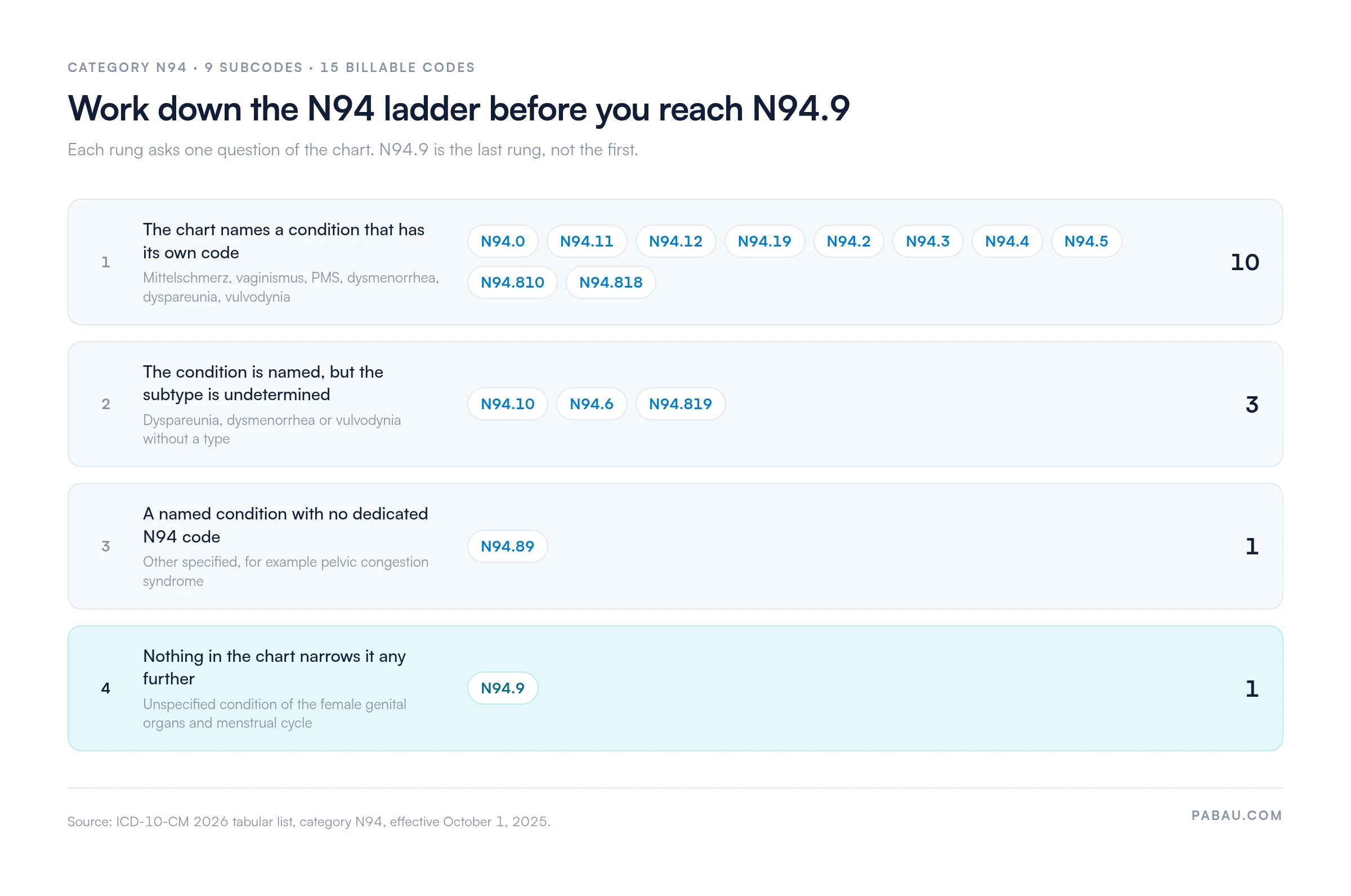
Category N94 holds nine subcodes that resolve into 15 billable codes, and N94.9 is the least specific of them.
Use N94.9 only when the clinical documentation cannot support a more specific N94.x code.
N94.89 covers a condition the clinician named that has no dedicated code, and that is the distinction coders most often miss.
Pabau’s claims management software helps women’s health practices document at the point of care and submit claims cleanly.
ICD-10 Code N94.9 is a billable/specific ICD-10-CM code. That means it can be used directly on a claim to show a diagnosis and get the claim paid. So no extra code is needed to make it billable. The 2026 edition of N94.9 became effective on October 1, 2025. That date follows the annual update cycle run by the CDC National Center for Health Statistics (NCHS).
The full official descriptor is Unspecified condition associated with female genital organs and menstrual cycle. So the “unspecified” qualifier is what decides how the code behaves on a claim. In short, N94.9 is the residual category for N94, and it absorbs cases that do not clearly fit any of the more specific subcodes.
Understanding where ICD-10 Code N94.9 sits within the classification tree helps coders find related codes and apply the hierarchy rules correctly. In practice, the code descends through three levels before reaching the N94.9 leaf.
Chapter 14 (N00-N99) covers the entire genitourinary system. Within that, the N80-N98 block narrows to noninflammatory disorders of the female genital tract. Then category N94 groups pain conditions and other functional conditions involving the female genital organs and menstrual cycle. So N94.9 is the final, least-specified node in that structure.
When auditors review gynecology claims, they check whether the code selected matches the level of detail in the chart note. If your documentation names a specific condition (dysmenorrhea, vulvodynia, mittelschmerz), the expectation is that a specific N94.x code was used, not N94.9. So build a habit of reviewing the N94 subcategory table before you default to the unspecified code.
N94.9 applies when a patient presents with a condition of the female genital organs or menstrual cycle. Even so, the clinician cannot classify it more precisely at the time of the encounter. That is a narrower situation than it might appear. Still, the ICD-10-CM guideline for code assignment states: code to the highest degree of certainty for that encounter. So N94.9 is appropriate in these specific scenarios:
What N94.9 is not for: a condition the chart already names. It is also wrong where the documentation supports a specific subcategory and nobody checked the N94 sibling list. In fact, that second case is the most common audit finding in women’s health coding.
Category N94 holds nine subcodes, which resolve into 15 billable codes at the leaf level. Each one covers a specific clinical presentation, so run through the full sibling list before selecting N94.9. For that, the AAPC’s ICD-10-CM code lookup gives you a searchable reference for the whole block.
A gynecology chart often reaches outside N94 as well, most often into the N80 endometriosis codes. So our ICD-10-CM code library covers those neighboring categories.
In practice, the distinction between N94.89 and N94.9 trips up a lot of coders. N94.89 is for “other specified” conditions, which means the clinician has named a condition that has no individual N94 subcode. N94.9 is for conditions that stay unclear. If the chart says “vulvar pain, cause unknown,” that is N94.9 territory. If it says “pelvic congestion syndrome,” that is a named condition with no N94 code of its own, so N94.89 applies. The ladder below shows the whole family in one view.
N94.9 carries the same documentation burden as any unspecified code. So the chart has to show that specificity was not achievable, rather than not attempted. Without that foundation, the code becomes an audit liability. That’s why structured intake and consultation forms help gynecology teams capture the detail at the encounter itself.

What clinical documentation should support the use of ICD-10 Code N94.9:
To pass a clean claim submission review, the record must show that N94.9 was the most specific code the documentation would support. So building a short checklist into the coding workflow keeps payer queries on unspecified codes down.
The ICD-10-CM guideline on coding specificity is one of the most often flagged issues in gynecology coding reviews. So these are the errors that surface most often with N94.9:
Treat N94.9 as the last resort in the N94 block rather than a convenience code. So building a quick lookup of the N94.x sibling list into the coding workflow keeps that habit in place for every women’s health encounter.
Run a quarterly audit of your N94.9 usage rate. If it appears on more than 15-20% of female genital and menstrual condition encounters, that frequency is a red flag worth investigating. So high unspecified code rates in any category attract payer scrutiny. Then compare against your clinicians’ documentation to see whether the specificity is there but not being captured at coding.
N94.9 appears most often on gynecology office visits, pelvic evaluations, and diagnostic imaging orders. The table below shows CPT codes frequently submitted alongside ICD-10 Code N94.9 in women’s health settings. So verify payer-specific medical necessity requirements before submitting. CPT codes are maintained by the American Medical Association (AMA).
Practices pairing N94.9 with procedures that carry specific medical necessity criteria should confirm those criteria before billing. Pabau submits US claims through the Claim.MD clearinghouse and tracks each one against payer requirements. So a rejection then surfaces in the same place the claim was sent from. Still, choosing the diagnosis code itself belongs to the coder and the chart.
A coding reference cannot rescue a chart that does not support the code selected. So in gynecology and women’s health practices, unspecified codes like N94.9 multiply when the clinician’s findings never reach the note in a structured form.
Practice management software like Pabau keeps the clinical record and the claim in one system. Its claims software for practices submits US claims through Claim.MD and tracks each one against payer requirements. Still, selecting the diagnosis code stays a coding decision. What the platform changes is how quickly a rejected N94.9 claim reaches the person who can correct it.
Structured consultation forms and templates give clinicians somewhere to record the detail that decides between N94.9 and a specific sibling code. When the note names dysmenorrhea, vaginismus, or vulvodynia, the coder can see it. The unspecified fallback then stops being the path of least resistance at the end of a busy clinic day.

Pabau keeps clinical documentation, code selection, and claim submission in one workflow. See how gynecology and women’s health practices use it to cut unspecified code usage and get cleaner claims out the door.

N94.9 is the right code when the condition is genuinely unspecified at the time of the encounter. The word doing the work there is “genuinely.” Gynecology coding audits keep finding N94.9 on charts where a specific sibling code was available and supported. So reading the N94.x sibling table before you default to the unspecified code fixes most of that.
Reducing unspecified code usage is upstream work. So it takes better documentation at the point of care and a look at the claim before it leaves the practice. Book a demo to see how Pabau handles both inside a women’s health workflow.

Need another unspecified code worked through? ICD-10 code R10.9 shows the same specificity test applied to unspecified abdominal pain.
Want to understand how denials connect to code selection? Denial management in healthcare covers the workflow steps that catch coding errors before they reach the payer.
Looking for guidance on building cleaner claims? Clean claim submission explains what payers check and how to structure each claim to pass first-pass review.
Need the code families on one page? Medical coding cheat sheet is a printable reference your coders can keep beside the schedule.
N94.9 is a billable ICD-10-CM code for an unspecified condition associated with female genital organs and menstrual cycle. So it sits in category N94, inside the N80-N98 block of Chapter 14. Use it when the documentation cannot support a more specific N94.x code.
Yes. N94.9 is a billable, specific ICD-10-CM code valid for reimbursement, and the 2026 edition took effect on October 1, 2025. So no extra code is needed to make it billable. Still, the documentation has to justify it over a more specific sibling.
Use N94.9 only when the condition is genuinely unspecified at the time of coding. If the clinician documented dysmenorrhea, vulvodynia, PMS, dyspareunia, vaginismus, or mittelschmerz, the matching N94.x subcode applies instead. N94.9 is not appropriate when the specificity is in the chart but was missed at coding.
The parent is N94, pain and other conditions associated with female genital organs and menstrual cycle. So N94 is a non-billable category code used for organization only. It sits in the N80-N98 block, noninflammatory disorders of female genital tract, within Chapter 14.
N94.9 most often accompanies evaluation and management codes such as 99213 and 99214 for established patients, and 99204 for new patients. Pelvic imaging codes 76830 and 76856 also appear with it. So check payer medical necessity criteria before pairing N94.9 with any procedure code.