ICD-10 Code S42.444P: Medial epicondyle fracture, right humerus
ICD-10 Code S42.444P: full descriptor and code validity ICD-10 Code S42.444P car...

Last Updated: Oct 13, 2026
Billable Code Specific Code
M83.2 is the billable ICD-10-CM code for adult osteomalacia due to malabsorption. It applies to skeletally mature patients whose bone fails to mineralize because the gut absorbs too little vitamin D and calcium.
The parent code M83 carries no fourth character, so payers reject it on submission. M83.2 is specific and valid for HIPAA-covered transactions, and assignment turns on a documented malabsorption diagnosis such as celiac disease or Crohn's.
Let Pabau's smart automation suggest the right codes, reduce claim denials, and keep your practice compliant—effortlessly.
Automate repetitive tasks and focus on what matters most—your patients.
Reduce coding errors and ensure compliance with the latest regulations.
Clean claims, fewer denials, and faster reimbursements.
Powerful insights and reporting to help your practice thrive.
HIPAA compliant SOC 2 certified GDPR-compliant Trusted by 4,000+ clinics worldwide

M83.2 is the billable ICD-10-CM code for adult osteomalacia caused by malabsorption, and its parent M83 is not billable.
The code took effect on October 1, 2025, so it is valid for FY2026 HIPAA-covered transactions.
The note has to name the malabsorption diagnosis, such as celiac disease or Crohn’s, alongside low vitamin D or calcium labs.
Sending M83.2 without an etiology code is the most common reason these claims come back.
Practice management software like Pabau adds code lookup libraries, required-field validation, and multi-region clearinghouse submission.
ICD-10 code M83.2 is the billable diagnosis code for adult osteomalacia due to malabsorption. Bone stops mineralizing properly because the gut cannot take up enough vitamin D and calcium. The CDC/NCHS ICD-10-CM web tool lists it as valid, billable and specific for FY2026.
Structurally, the code sits in Chapter 13, Diseases of the musculoskeletal system and connective tissue (M00-M99). Inside that chapter it falls under section M80-M85, disorders of bone density and structure.
The word “adult” narrows the code sharply. M83.2 covers skeletally mature patients only, because rickets codes handle the same biology in children. Use it on a pediatric encounter and a demographic edit rejects the claim before anyone reads it.
Here are the billing facts worth confirming before the claim goes out.
M83 is a header code for the whole adult osteomalacia family, and payers reject it on submission. The fourth character is what makes a code specific enough to process. So the rule is simple. Pick the child code that matches the documented cause.
M83.2 and M83.3 are the pair coders mix up most often. Malabsorption means the gut cannot take up what the patient eats. Malnutrition means too little went in to begin with.
The AAPC Codify ICD-10-CM lookup notes that both codes can sit on one claim. That takes documentation supporting each cause separately, which is uncommon.
You do not need a long rulebook for this family. Four questions, asked in order, settle nearly every case at the desk. Work down them before the claim leaves your practice.
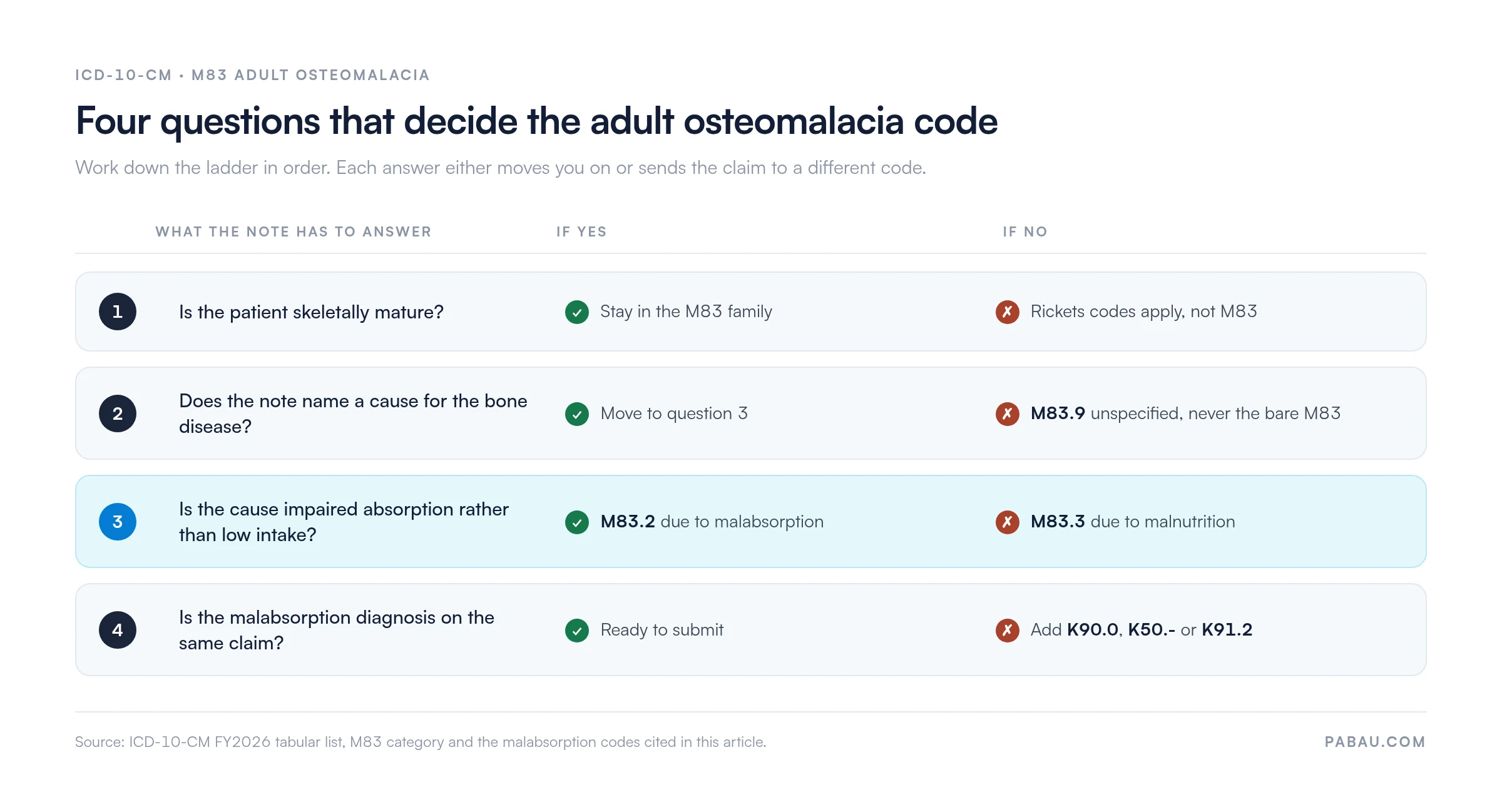
Question three is where M83.2 is won or lost. If the provider attributes the mineralization defect to impaired absorption, M83.2 is the code. Where the note points at intake alone, the claim belongs on M83.3 instead.
Adult osteomalacia describes bone that fails to mineralize because calcium, phosphate or vitamin D runs short. M83.2 narrows that to a single mechanism. The patient absorbs too little, and the gastrointestinal condition behind it belongs in the clinical record.
These are the causes that most often land an encounter on M83.2:
A low vitamin D result on its own (E55.9) does not carry M83.2. The record has to tie that deficiency to a documented malabsorption syndrome and show the bone has been affected. Where the etiology drove the encounter, code it alongside M83.2.
Document the malabsorption diagnosis in the same encounter note that carries M83.2. A low 25-hydroxyvitamin D panel next to a confirmed diagnosis of celiac disease or Crohn’s gives the payer what it needs. The claim then processes without a request for records.
The claim starts in the encounter note, where the provider names the bone disease and its cause. Your coder turns that into M83.2 plus an etiology code. Your clearinghouse then checks the file for completeness and transmits it. Payer edits run last, and a thin claim fails there.
Most stalls come from one thing. M83.2 arrives alone, so the payer sees a bone diagnosis with no cause attached. Below are the codes that usually travel with it.
Sequencing follows the ICD-10-CM Official Guidelines rather than habit, so code what the record documents. When a neighboring code needs checking first, the ICD-10-CM code library groups them by chapter and category.
Documentation decides whether M83.2 holds up under review. Five items, checked in the same order every time, cover almost every denial reason on this code.
Clearinghouse submission catches the mechanical failures first. Required-field checks flag an incomplete claim before it transmits, which saves a rejection you would otherwise rework. Those checks do not read clinical logic, so pairing M83.2 with its etiology code stays a documentation job.
No two metabolic bone conditions get confused more often than these. The underlying defect differs, the labs differ, and the tabular list separates them. Symptoms still overlap enough that the coder needs the provider’s stated diagnosis to choose.
Both conditions can sit in the same patient, particularly in older adults who have inflammatory bowel disease and age-related bone loss. Where the provider documents both, assign both code families. Do not choose whichever looks dominant and drop the other.
Four error patterns account for most M83.2 rejections and audit findings. Each one is avoidable at the point of coding, and each leaves a signature you can spot in a claims report.
Patterns like these surface across a claims history rather than on one claim. Practices running structured denial management see the same M83.2 error repeat. They then fix the documentation prompt at the provider level, rather than reworking claims one by one.
Audit your M83.2 claims once a quarter. Pull every one submitted without a malabsorption etiology code such as K90.0, K50.- or K91.2, then read the source note. The cause is usually in the note and was simply missed at coding, which a short reminder to the provider fixes.
Accurate M83.2 coding starts with what the provider writes at the point of care. It ends with what the billing workflow checks before transmission. Pabau’s practice management platform holds both in one system. That matters on codes where the cause has to travel with the manifestation.
Fixing diagnostic accuracy at the documentation stage beats reworking denials later in the month. Pabau’s tools for cleaner claims management tie the encounter to the billing record. The codes chosen during the visit then populate the claim without manual re-entry.

Pabau’s claims management tools run required-field validation on every claim and submit cleanly through our multi-region clearinghouse partners. See how that works for practices handling complex diagnostic coding.

M83.2 rewards a short discipline. Confirm the patient is skeletally mature, confirm a malabsorption diagnosis sits in the note, and send the etiology code with the claim. Nearly every denial on this code traces back to one of those three steps being skipped.
So the work lives in documentation more than in code selection. Once the provider writes the link between gut and bone, the coder has no judgment call left. The claim then carries its own justification.
Book a demo to see how Pabau keeps that documentation attached to the claim from the first note onward.

Need to understand how claims reach payers? Claim.MD clearinghouse guide explains how electronic claims are validated and transmitted across US payer networks.
Dealing with M83.2 denials? Denial codes in medical billing covers the most common remittance advice codes and how to respond to each one.
Want to reduce documentation rework? Electronic remittance advice (ERA) explains how 835 files surface denial reasons and support automated posting in your billing workflow.
No. M83.2 is complete at four characters. The M83 category carries no laterality digit and no seventh-character extension. The code is never extended for encounter type or side. Adding one makes the code invalid and the claim is rejected at the edit stage.
M83.8, other adult osteomalacia, fits a documented cause that has no dedicated code in the family. Malabsorption has one, so M83.2 takes priority whenever absorption is the stated mechanism. Reserve M83.9 for cases where the provider records no cause at all.
The bone diagnosis stays M83.2, since the mechanism is still impaired absorption. Carry K91.2, postsurgical malabsorption not elsewhere classified, as the etiology code on the same claim. The operative history belongs in the note so the payer can see why absorption is reduced.
It can support the record, but it cannot replace the treating provider’s own statement. Code assignment follows what the provider documents in the assessment. Ask for an addendum linking the malabsorption to the bone disease rather than coding from an ancillary note.