ICD-10 code S61.201A: Open wound of left index finger without nail damage
ICD-10 code S61.201A covers a left index finger wound of unstated type ICD-10 co...

Last Updated: Oct 16, 2026
Billable Code Specific Code
M45.4 is the billable ICD-10-CM code for ankylosing spondylitis of thoracic region. It applies when the record confirms ankylosing spondylitis and names the thoracic spine as the segment involved.
Most M45.x denials come back to one habit. The note states ankylosing spondylitis but never names the region, so the coder falls back to M45.9. Payers flag that substitution when the chart supports a site-specific code.
Let Pabau's smart automation suggest the right codes, reduce claim denials, and keep your practice compliant—effortlessly.
Automate repetitive tasks and focus on what matters most—your patients.
Reduce coding errors and ensure compliance with the latest regulations.
Clean claims, fewer denials, and faster reimbursements.
Powerful insights and reporting to help your practice thrive.
HIPAA compliant SOC 2 certified GDPR-compliant Trusted by 4,000+ clinics worldwide

M45.4 is the billable ICD-10-CM code for ankylosing spondylitis of the thoracic region, which is the mid-back segment of the spine.
The code is valid for FY2026, from October 1, 2025 through September 30, 2026, and it has not changed since 2015.
Reaching for M45.9 when the note documents the thoracic spine is the most common M45 error, and payers flag it.
Non-radiographic axial spondyloarthritis now has its own site-specific codes under M45.A, so it no longer belongs on M46.9.
Pabau checks that required claim fields are complete before submission, then routes the file to the clearinghouse for your region.
ICD-10 code M45.4 is the billable ICD-10-CM diagnosis code for ankylosing spondylitis of the thoracic region. It sits under the parent category M45, inside Chapter 13 of the code set.
The CDC/NCHS ICD-10-CM web tool lists it as both billable and specific. A payer will therefore accept it on a HIPAA-covered electronic claim without asking for a further subcode.
Ankylosing spondylitis is a chronic inflammatory arthritis of the spine and the sacroiliac joints. The M45 category splits it by the part of the spine involved. So the thoracic segment carries its own code, and the clinical note has to say so. Choosing M45.9 instead, when the record names the thoracic spine, is a coding error.
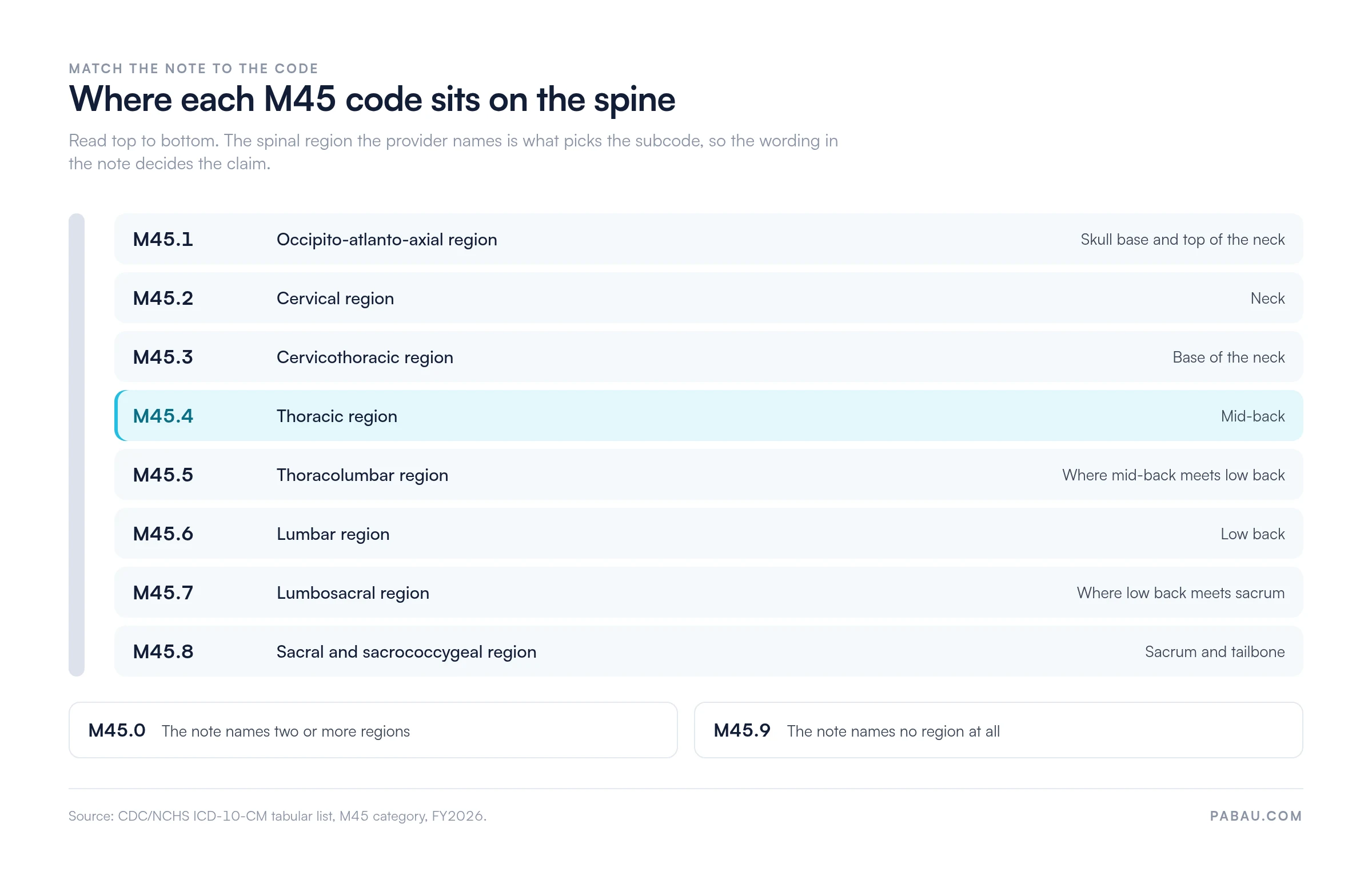
Every M45 subcode names a different part of the spine. Coders pick the most precise one the record supports, so the provider note and the imaging report settle the answer before the code book does. Rheumatology billing staff should confirm the documented region first, then select.
Two subcodes carry no region of their own. M45.0 applies when the note describes two or more distinct spinal regions. M45.9 applies only when it describes none. The same M45 category also holds a separate run of codes, M45.A, for non-radiographic axial spondyloarthritis, and those are covered further down.
The diagram below turns the regional codes into a lookup you can run against a note.
M45 carries one inclusion term and two kinds of excludes note. Read all three before you code, because one kind stops the claim and the other does not.
These phrases turn up in provider documentation and map to M45.4 once the thoracic spine is named:
M45 lists rheumatoid arthritis of the spine as an inclusion term. So a note reading “rheumatoid arthritis of the thoracic spine” can land on M45.4, provided the clinical picture matches ankylosing spondylitis. Query the rheumatologist where it does not.
An Excludes1 note marks two conditions the code set treats as mutually exclusive. Neither of these may be reported with M45.4:
Juvenile AS is the one that catches people out. If onset was before age 16, M08.1 applies, whatever the patient’s age is today. Putting both codes on one claim will trigger an edit.
An Excludes2 note marks a condition that is not part of AS but can coexist with it. M45 lists one, and both codes may be reported when both are documented:
Ankylosing spondylitis is a seronegative spondyloarthropathy driven by inflammation at the entheses, where tendon and ligament attach to bone. Thoracic involvement shows up as mid-back stiffness and pain that is worse at rest and eases with movement.
Inflammation in the thoracic facet and costovertebral joints can also reduce chest expansion, which occasionally affects respiratory mechanics in advanced disease.
On imaging, thoracic AS produces squaring of the vertebral bodies, syndesmophyte formation, and progressive ankylosis on X-ray or MRI. HLA-B27 positivity supports the diagnosis but does not drive code selection. M45.4 follows the treating physician’s confirmed clinical and imaging diagnosis, not a laboratory marker on its own.
When thoracic AS is suspected but not yet confirmed, document the working diagnosis and the supporting evidence, then hold off on M45.4. ICD-10-CM outpatient rules require a confirmed diagnosis, so use a symptom code such as M54.6 for thoracic pain until the picture is settled.
Documentation for M45.4 turns on two things. The record needs a confirmed diagnosis of ankylosing spondylitis, and it needs an explicit statement of thoracic involvement. A note that stops at “ankylosing spondylitis” supports M45.9 at best.
Under the CMS ICD-10-CM official guidelines, code assignment must be supported by the physician’s own documentation. A coder cannot infer the site from an imaging report alone without a matching physician statement.
These four elements should appear in the record:
An M45.4 claim takes the same route as any other diagnosis. What changes is where it can stall.
Two of those steps do most of the damage. Step one fails quietly when the note stops at “ankylosing spondylitis”. Step four fails loudly when a payer edit expects a site-specific code and finds M45.9 instead.

Teams that work to clean claim standards run this check at coding time, not after the denial. Fixing a claim before submission takes minutes. Fixing one afterward takes an appeal.
Ankylosing spondylitis claims fail in a fairly predictable set of ways. Each one below has a fix that lives in the note rather than in the appeal.
Pulling the denial reason codes off your remittances each month tells you which of these five is actually costing money. Sort them by dollar value, and the top line usually shows which correction to make first.
M45.4 is a diagnosis code, so it never travels alone. It supports the CPT code for whatever service the practice delivered that day. Pairings vary by payer, and the AMA CPT code set is revised every year.
Check the current fee schedule before you rely on the table below.
Two neighboring imaging codes get grabbed by mistake. CPT 72148 is the lumbar MRI rather than the thoracic one, and 72080 covers the thoracolumbar junction rather than the thoracic spine.
Confusion around M45.4 runs in both directions. Undercoding means reaching for M45.9 when the thoracic spine is documented. Overcoding means putting M45.4 on a patient whose imaging does not yet support ankylosing spondylitis.
Non-radiographic axial spondyloarthritis does not map to M45.4, and it no longer needs a holding code either. ICD-10-CM carries a separate subcategory, M45.A, with one code per spinal region. The thoracic one is M45.A4.
The line between them is radiographic. Ankylosing spondylitis is the form with structural damage visible on X-ray, meeting the modified New York criteria. Non-radiographic axial spondyloarthritis shows the inflammation without those definitive sacroiliac changes.
So when a rheumatologist writes “axial spondyloarthritis” and the imaging shows no radiographic sacroiliitis, M45.4 is not supported. M45.A4 covers it instead, once the thoracic region is named. When imaging later confirms ankylosing spondylitis, the code moves to M45.4, and the note should carry the reason for the change.
Older coding references still send nr-axSpA to M46.9, inflammatory spondylopathy unspecified. That advice predates the M45.A codes, and following it today costs the practice specificity on every one of those claims.
Coding a chronic patient well means watching the record change. Someone can move from M54.6 to M45.A4 and then to M45.4 over time, and each step needs the documentation that supports it.
M45.4 has been valid since the United States adopted ICD-10-CM on October 1, 2015. The descriptor, the billable status and the excludes notes have all held since then, per the CDC/NCHS ICD-10-CM release.
The wider M45 category did change, though, when the M45.A codes arrived for non-radiographic axial spondyloarthritis.
Add a fiscal-year check to your October coding update. M45.4 has been stable since 2015, but its neighbors have not, and the M45.A codes are the proof. Running the CDC ICD-10-CM tool against your top 20 rheumatology codes each autumn takes half an hour and keeps a revised code off your claims.
In most rheumatology practices, a missing region surfaces after the denial arrives. The chart gets reopened, the provider gets queried, and the corrected claim goes back out weeks later. By then the encounter is cold and nobody remembers the detail.
Practice management software like Pabau shortens that loop. Required fields on the claim are checked for completeness before submission, so an unfinished record does not quietly become an 837 file.
Pabau also connects to the clearinghouse for your region, including Claim.MD in the US. Eligibility checks, claim status and remittance posting then sit in the same system as the chart.
That pays off at month end. The denial data lands next to the notes that produced it. A team working toward cleaner claims submissions can trace an M45.9 rejection straight back to the encounter behind it. The fix then lands on the documentation habit rather than the single claim.

Pabau checks required claim fields before submission, then routes the file to the clearinghouse for your region. Rheumatology teams spend less time reworking rejections.

M45.4 asks for two things. The record must confirm ankylosing spondylitis, and it must name the thoracic spine. Get both and the code holds up under review.
Miss the second and a coder falls back to M45.9, which is where the specificity denials start. The other trap sits one step earlier in the patient’s history, on a chart that still reads “axial spondyloarthritis” with no radiographic confirmation. M45.A4 belongs there, not M45.4.
Both fixes are documentation habits rather than software purchases. Software earns its place on the step after, catching the incomplete claim before it leaves the building. Book a demo to see how Pabau handles rheumatology billing from the encounter through to the remittance.

Need to work an ICD-10 denial once it lands? Denial management in healthcare covers the workflow for appealing and tracking payer rejections on chronic disease codes.
Want the compliance rules behind a clean ICD-10 claim? Medical billing compliance sets out what a compliant submission workflow looks like for US rheumatology practices.
Curious how 837 files carry ICD-10 diagnosis codes to payers? 837 file guide walks through how diagnosis codes map to specific loops in the electronic claim.
Yes. When ankylosing spondylitis of the thoracic region is the reason for the encounter, M45.4 goes in the first position. A chronic condition can be first-listed whenever it is the condition being treated that day. Sequence coexisting conditions, such as sacroiliitis, after it.
No. Modifiers attach to CPT and HCPCS procedure codes, never to an ICD-10-CM diagnosis code. If a payer asks you to correct a modifier on an M45.4 line, they mean the procedure code on that line.
On inpatient claims to payers that require POA reporting, yes. Ankylosing spondylitis is chronic, so it is normally present on admission and reported as Y. Outpatient and professional claims carry no POA indicator at all.
ICD-9-CM 720.0, ankylosing spondylitis. The mapping is approximate rather than exact, because ICD-9 never split ankylosing spondylitis by spinal region. Every M45 subcode traces back to that one ICD-9 code, which matters when you compare data across the 2015 transition.
Diagnosis codes are not prior authorized. The drug or the imaging study is. A biologic prescribed for thoracic AS may well need authorization, and M45.4 is the diagnosis supporting that request rather than the item being approved.