ICD-10 Code S42.444P: Medial epicondyle fracture, right humerus
ICD-10 Code S42.444P: full descriptor and code validity ICD-10 Code S42.444P car...

Last Updated: Oct 13, 2026
Billable Code Specific Code
M34.1 is the billable ICD-10-CM code for CR(E)ST syndrome, the limited cutaneous form of systemic sclerosis. The tabular list prints the descriptor with the parenthetical spelling CR(E)ST, where the E marks esophageal dysmotility.
The code sits in category M34 within Chapter 13, alongside M34.0 for progressive systemic sclerosis. Assignment turns on the extent of skin involvement the physician documents, not on how many CREST components appear in the note.
Let Pabau's smart automation suggest the right codes, reduce claim denials, and keep your practice compliant—effortlessly.
Automate repetitive tasks and focus on what matters most—your patients.
Reduce coding errors and ensure compliance with the latest regulations.
Clean claims, fewer denials, and faster reimbursements.
Powerful insights and reporting to help your practice thrive.
HIPAA compliant SOC 2 certified GDPR-compliant Trusted by 4,000+ clinics worldwide

ICD-10 Code M34.1 is the billable code for CR(E)ST syndrome, valid for fiscal years 2025 and 2026.
CREST stands for calcinosis, Raynaud phenomenon, esophageal dysmotility, sclerodactyly, and telangiectasia. Not all five need to be documented.
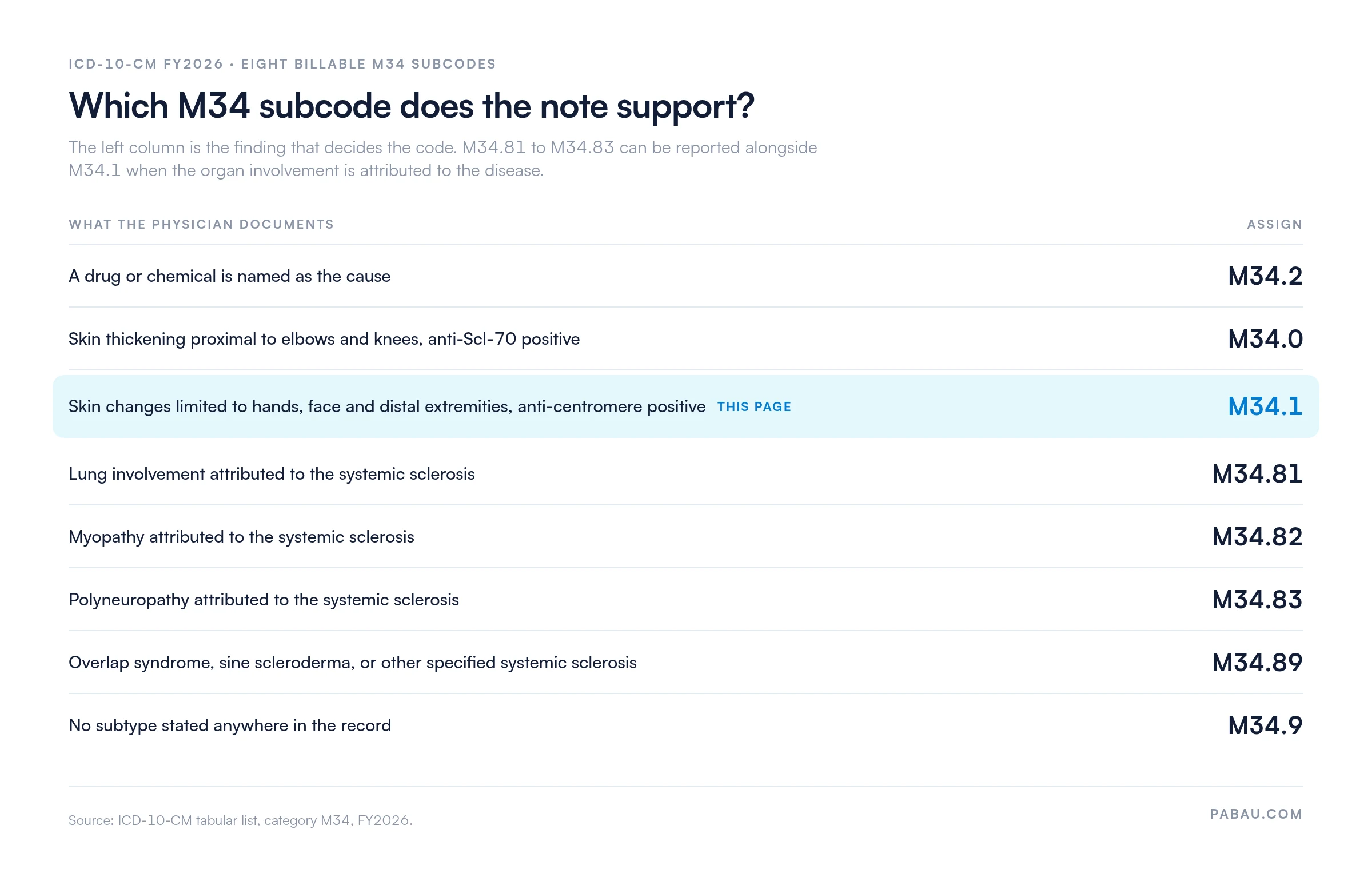
Category M34 holds eight billable subcodes for FY2026, and choosing M34.1 over M34.0 turns on how far the skin involvement extends.
Each documented manifestation carries its own additional code, such as I73.00 for Raynaud, L94.2 for calcinosis, and I78.8 for telangiectasia.
Pabau submits M34.1 claims through Claim.MD, which runs eligibility and clean-claim checks on the codes your coders have already assigned.
ICD-10 Code M34.1 is the specific, billable ICD-10-CM code for CR(E)ST syndrome, the limited cutaneous form of systemic sclerosis. It is valid for claims with dates of service on or after October 1, 2024, through at least September 30, 2026. Whatever system a rheumatology practice bills from, the code has to be mapped to the correct M34 subcategory. Otherwise automated clearinghouse edits reject the claim before a reviewer ever sees it.
The parenthetical spelling in the ICD-10-CM tabular list is “CR(E)ST syndrome.” The “(E)” marks esophageal dysmotility, which joined the acronym later and is sometimes missing from older documentation. The code sits inside category M34 (systemic sclerosis [scleroderma]), within the M30-M36 block of Chapter 13. According to the CDC/NCHS ICD-10-CM web tool, M34.1 is a valid, non-excludable code with no scheduled deletion for FY2026.
CREST syndrome is a limited cutaneous autoimmune connective tissue disease defined by five cardinal features. The acronym maps directly onto the clinical findings a rheumatologist documents: Calcinosis, Raynaud phenomenon, Esophageal dysmotility, Sclerodactyly, and Telangiectasia. Not all five features need to be present at once. The ACR/EULAR 2013 classification criteria for systemic sclerosis use a weighted score rather than a component checklist. A patient with Raynaud, sclerodactyly, and a positive anti-centromere antibody may qualify without overt calcinosis or telangiectasia.
The clinical distinction between limited (CREST/M34.1) and diffuse (M34.0) systemic sclerosis rests on the extent of skin involvement and the serological profile. Limited disease, covered by M34.1, typically shows skin thickening confined to the hands, face, and distal extremities, together with anti-centromere antibody (ACA) positivity. Diffuse disease (M34.0) extends skin changes proximal to the elbows and knees and more commonly presents with anti-Scl-70 (anti-topoisomerase I) antibodies.
M34.1 carries a set of ICD-10-CM coding instructions that directly affect claim submission. Understanding inclusion terms, exclusion notes, and “use additional code” instructions prevents the most common sequencing errors on rheumatology claims. The CMS ICD-10 codes page publishes the full tabular list with these annotations each October.
Sequencing can move. When the reason for the encounter is a complication of CREST syndrome, the complication code may become the principal diagnosis. A pulmonary arterial hypertension evaluation is the usual example. Check the ICD-10-CM Official Guidelines for Coding and Reporting, Section I.C.13, before defaulting to M34.1 as the principal code.
The M34 category carries eight billable subcodes for FY2026. Selecting the wrong one is the most common denial trigger for systemic sclerosis claims. A diffuse-pattern note paired with M34.1 triggers medical-necessity review. An M34.0 claim without documented proximal skin thickening does the same in reverse.
M34.81 and M34.1 are not mutually exclusive. When a patient has CREST syndrome with pulmonary fibrosis or PAH attributable to systemic sclerosis, coding both may be appropriate. Ask the treating rheumatologist whether the lung involvement is attributed to the lcSSc. If the note documents it as a separate condition, leave M34.81 off the claim.
Read the other way round, those eight subcodes form a short decision list. Start from what the note documents, and the code follows from it.
When the physician documents both CREST syndrome and pulmonary arterial hypertension in the same note, query whether the PAH is attributed to the scleroderma. If yes, M34.81 pairs with M34.1. If the PAH is documented independently, sequence I27.21 as a secondary code under M34.1 without M34.81. Getting this distinction right prevents automatic bundling denials at the payer.
CREST syndrome rarely presents as a single isolated diagnosis. Most rheumatology encounters document at least one active manifestation alongside M34.1, and each documented manifestation requires its own additional code. Coding only M34.1 without the companion codes understates disease severity and weakens the medical-necessity record for specialist referrals and PAH therapy prior authorizations.
A clean M34.1 claim starts with the clinical note, not the superbill. Payers reviewing CREST syndrome claims look for four documentation elements that separate M34.1 from its siblings M34.0 and M34.89. Missing any one of them weakens the medical-necessity record.
Clinical documentation improvement (CDI) specialists should query the physician whenever a note describes CREST features but uses only the umbrella term “scleroderma.” One query that returns a confirmed limited-cutaneous diagnosis turns a billable M34.9 into a clinically accurate M34.1. The diagnosis itself does not change. Specificity has to exist in the physician’s own words, and a positive anti-centromere result cannot supply it.
Medicare and most commercial payers do not maintain a Local Coverage Determination specific to M34.1. They still review these claims through automated edits and, in some cases, post-payment audits. Running an eligibility check before the encounter keeps more CREST syndrome claims out of manual review. Submitting through a clearinghouse that returns clean-claim errors does the same. Neither step decides whether the diagnosis code is right; that judgment stays with the coder and the note.
The CPT codes most commonly submitted alongside M34.1 in rheumatology office encounters are 99213, 99214, and 99215. For patients on PAH-targeted therapy, infusion CPT codes and the associated drug HCPCS codes appear on the same claim. Prior authorization requirements for PAH medications vary by plan and change often. Verify current requirements directly with the payer rather than relying on a static policy summary.
M34.1 claims are denied for reasons that clean documentation and a disciplined coding workflow prevent. The five patterns below account for most rejections on CREST syndrome claims. Reading them alongside the reference on denial codes gives billers the CARC context an appeal needs.
Build a standard M34.1 billing checklist into your rheumatology encounter workflow: (1) Confirm subtype language in the assessment. (2) Verify Raynaud specificity – I73.00 vs I73.01. (3) Check for PAH or ILD documentation and add companion codes. (4) Run the claim through a clearinghouse eligibility check before submission. A short pre-submission review catches most of these patterns before they cost a full appeal cycle.
In most rheumatology practices the M34.1 decision happens in one system and the claim happens in another. A coder reads the assessment, picks the subtype, then retypes the code into a billing tool. Each hop is somewhere a subtype qualifier can be dropped.
Practice management software like Pabau keeps the note, the coded diagnosis, and the claim in one patient record. Its claims management software submits what the coder assigned through Claim.MD, runs eligibility and clean-claim checks, and reports the payer response back against the invoice. The coding judgment stays with your team.
For a practice tracking M34 denials across several rheumatologists, one record is what makes a root-cause review possible. You can see whose notes are missing the subtype qualifier, then fix the documentation instead of appealing the same denial every month.


Pabau keeps the clinical note, the coded diagnosis, and the claim in one record, then submits through Claim.MD for eligibility and clean-claim checks. Your coders decide the codes. Pabau tracks what the payer does with them.

ICD-10 Code M34.1 asks one thing of the clinical note. The physician has to name CREST syndrome, CR(E)ST syndrome, or limited cutaneous systemic sclerosis in the assessment. With that statement in place, and companion codes for the manifestations the note documents, the claim adjudicates cleanly. Without it, the denial is predictable.
The trade-off worth remembering is that specificity costs a query and vagueness costs an appeal. A CDI query takes minutes. An appeal on an M34.9 claim takes weeks, and it rarely recovers the difference. Book a demo to see how Pabau keeps coded rheumatology claims and their documentation in one place.

Need to stop M34.1 denials before they happen? Clean claim best practices covers the pre-submission checks that head off the most common ICD-10 rejections.
Tracking denials across the whole M34 family? Denial management in healthcare shows how to group denials by root cause instead of appealing them one at a time.
Billing across several systemic conditions? Revenue cycle management for specialty practices explains how to structure multi-code encounters so sequencing errors do not cascade.
Not sure what your clearinghouse actually checks? How a medical claims clearinghouse works sets out which edits run before a payer ever sees the claim.
ICD-10 Code M34.1 is the billable ICD-10-CM diagnosis code for CR(E)ST syndrome, also called CREST syndrome – the limited cutaneous subtype of systemic sclerosis. It is valid for fiscal years 2025 and 2026, covering dates of service on or after October 1 each year. The code sits within category M34 of Chapter 13 of the ICD-10-CM tabular list.
Yes. CREST syndrome and limited cutaneous systemic sclerosis (lcSSc) are clinical synonyms – both map to ICD-10-CM M34.1. Either term in the physician’s diagnosis statement is sufficient to assign M34.1; no additional specificity is required.
Raynaud phenomenon is coded with I73.00 (Raynaud syndrome without gangrene) or I73.01 (Raynaud syndrome with gangrene). Review the clinical note carefully: I73.01 applies only when gangrene is explicitly documented. Never default to I73.00 without checking whether gangrene is mentioned.
Mixed connective tissue disease (MCTD) is coded with M35.1. It is distinct from CREST syndrome and M34.1; MCTD features overlap between lupus, SSc, and polymyositis with anti-U1 RNP antibody. When documentation is ambiguous between CREST and MCTD, query the rheumatologist rather than assigning either code without physician confirmation.